Start
$590$990/month
1 platform · Google or MetaGoogle + Meta- Ad spend
- up to $3,000
- New creativesmade by us
- Google + Meta only4 a month
 By Matteo Braghetta, Founder · Google Ads
Stockton's geographic position — surrounded by agricultural land on three sides and bordered by the Sacramento-San Joaquin Delta to the west — creates pest pressure that never fully stops. With temperatures rarely dropping below freezing and pest populations active 10-11 months per year, pest control in this market is a year-round need, not a seasonal inconvenience. The contractors who own Google Ads here capture a market with lower CPCs, strong CVRs, and a structural demand advantage that most California urban markets simply don't have.
See how this city's Pest Control PPC costs compare nationally in our Pest Control PPC Statistics report, featuring data from 40+ US cities.
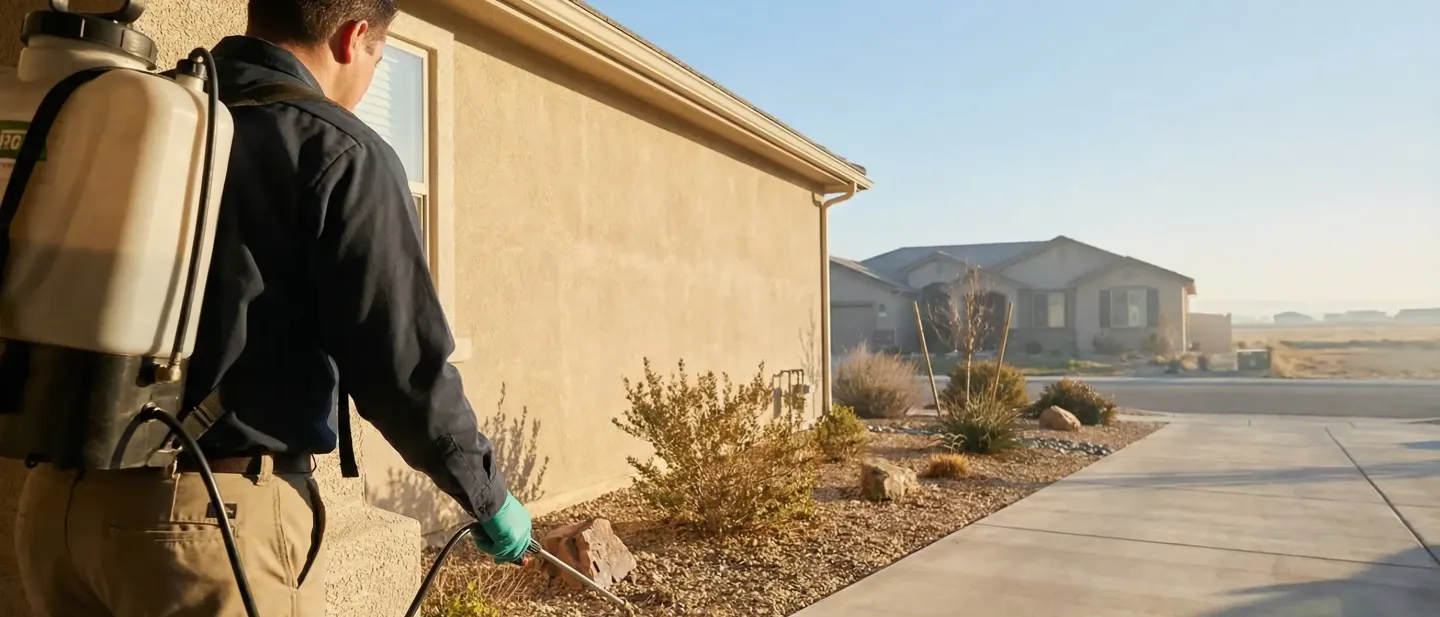
In Stockton, CA, people search for pest control services about 1,470 times a month on Google; a top-of-page click costs $10–$38, and demand peaks in October.
Google Keyword Planner · Oct 2025 – Sep 2026
| Search | Monthly searches | Top-of-page CPC |
|---|---|---|
| pest control | 210 | $14–$51 |
| cockroach exterminator | 210 | $11–$38 |
| bed bug treatment | 170 | $1–$16 |
| pest control near me | 140 | $15–$47 |
| bed bug exterminator | 90 | $10–$27 |
| pest control service | 90 | $7–$38 |
| mosquito control | 70 | — |
| termite control | 70 | — |
| exterminator near me | 50 | $11–$48 |
| termite inspection | 50 | — |
US: $37
Google Keyword Planner · Oct 2025 – Sep 2026
Source: Google Keyword Planner (Google Ads), Google Search, English, Stockton, CA, Oct 2025 – Sep 2026. Volumes are Google's monthly averages; CPC is the top-of-page bid range, weighted by search volume. How we collect these figures.
Pest control in Stockton has some of the most favorable demand characteristics of any home services category: year-round pest activity, high termite prevalence from Delta moisture, agricultural surroundings that drive rodent migration, and a homeowner base with genuine, recurring need. Yet most local pest control PPC campaigns significantly underperform against these market fundamentals. The failures cluster around predictable structural problems.
Pest control search intent varies dramatically by pest type — and so does the revenue potential and conversion pathway. A homeowner searching "ants in kitchen Stockton" is a general pest control prospect with a recurring service contract opportunity worth $900-$2,000 per year. A homeowner searching "termite inspection Stockton CA" is a pre-sale or damage-triggered buyer with an inspection and treatment ticket of $1,500-$8,000. A property manager searching "rodent exclusion Stockton commercial" is a B2B lead with a multi-property contract potential of $5,000-$30,000 per year.
Running all three through the same "pest control Stockton" campaign structure bids identically for dramatically different revenue opportunities and uses the same landing page for buyers with completely different decision criteria. The termite buyer needs an inspection scheduling page, inspection pricing, and a warranty explanation. The general pest buyer needs a "starting from $79/month" offer and a service contract comparison. The rodent exclusion buyer needs a commercial service capabilities page and a property manager testimonial. One campaign, one landing page serves none of these buyers optimally.
Stockton's mild winters tempt pest control advertisers to treat the market as seasonal — ramping up in spring and summer, pulling back in fall and winter. This is a structural mistake in a market where termite swarming occurs in March-May and September-October, rodent migration into structures peaks in October-December (harvest disruption plus cooling temperatures), and mosquito season runs from April-October due to Delta standing water. A campaign that goes dark in November misses the peak rodent exclusion window — exactly when homeowners discover mice in their attic and search for immediate help.
National chains — Terminix, Orkin, Rentokil/Western Exterminator — maintain year-round campaign presence in Stockton. Their continuous visibility means that a local operator who pauses campaigns in "off-season" months essentially gifts those leads to national competitors who have the budget discipline to stay present.
Termite searches in Stockton fall into two distinct intent categories that require different campaign handling. The first is real estate-driven: California law requires a wood pest (termite) inspection report for most residential property transactions. Home sellers, buyers, and real estate agents search for termite inspection services primarily during Q1-Q3 (real estate transaction peak). The second is damage-discovery-driven: homeowners who find termite mud tubes, hollow-sounding wood, or swarmers in their living space search with high urgency and high willingness to act immediately. These two audiences need different ad copy, different messaging urgency, and different offer structures.
Stockton's pest control PPC landscape is comparatively less crowded than HVAC or plumbing — BBB lists 1,322 pest control companies within 50 miles versus 4,397 for HVAC — which means properly structured campaigns can achieve cost efficiencies that aren't available in more saturated verticals. The strategic framework builds three purpose-built campaigns that serve the market's three revenue tiers.
Termite inspection and treatment is the highest-ticket segment in Stockton pest control. This campaign operates year-round at consistent spend because real estate transactions and active infestation discoveries are continuous demand sources:
Landing page essentials for termite: inspection pricing or "starting from" estimate, clear scheduling tool, warranty description, and photos of local damage assessments (trust signal). The real estate agent audience also converts well with a dedicated agent program page — preferred vendor relationships with local Stockton agents drive consistent inspection referral volume that reduces CPL below $60 per lead.
General pest campaigns should lead with a recurring service offer ("$79/month — full perimeter pest protection, guaranteed") rather than a one-time treatment price. Annual contract LTV in Stockton's market runs $900-$2,000 per household — a recurring service offer that converts at 15-20% produces substantially better payback than one-time treatment acquisition at the same CPL.
October-December is Stockton's peak rodent incursion window — harvests complete, agricultural fields cleared, rodents migrating toward structures as temperatures drop. This campaign runs at elevated spend from September through January with call-only ad format for the "mice in my attic" high-urgency segment. CPC range: $13–$44/click. CPL target: $40-$65. Average ticket for full exclusion + treatment: $500-$1,500.
Budget framework for a Stockton pest control SMB at $1,500-$3,000/month: 40% termite (year-round), 40% general pest/recurring contract, 20% rodent (seasonal heavy, year-round light). Lower CPCs in this vertical mean budgets generate more lead volume than equivalent spend in HVAC or plumbing — the efficiency advantage of pest control PPC in Stockton is real and meaningful.
Stockton's pest control market is shaped by environmental, demographic, and infrastructure factors that create demand curves unlike any other California urban market. Understanding these dynamics translates directly into campaign advantages — lower CPCs in underserved segments, stronger annual contract retention, and access to commercial accounts that most local operators haven't pursued.
The San Joaquin Valley's agricultural calendar creates predictable pest migration events that Stockton pest control operators can map directly to campaign intensification windows. At harvest — almonds (August-October), tomatoes (August-September), walnuts (October-November), wine grapes (August-October) — combines and equipment clear fields, disrupting established rodent and insect colonies that then migrate toward the nearest residential structures. Stockton's outer neighborhoods (south Stockton, northeast near agricultural boundary, Port-adjacent areas) experience measurable pest incursion spikes during these windows.
The campaign opportunity: Running geo-targeted campaigns with agricultural proximity messaging ("Protect your home during harvest season — rodents and field pests migrate into Stockton neighborhoods every fall") during August-November reaches homeowners who haven't yet seen the problem but are in the highest-risk zone. Preemptive pest prevention messaging converts at lower cost than reactive emergency response messaging — and the homeowners who sign annual contracts during pre-harvest campaigns are among the highest-retention customers in the portfolio.
Subterranean termites — the most damaging and most common termite species in California — require moisture to thrive. The Sacramento-San Joaquin Delta on Stockton's western edge creates persistent humidity gradients in adjacent neighborhoods that support year-round termite colony activity at levels higher than most inland California cities experience. California ranks second nationally for termite damage (behind Florida), and San Joaquin County's Delta-proximate areas are among the higher-risk zones within the state. This isn't a seasonal concern — subterranean termite colonies are active in Stockton soil year-round.
For PPC purposes: termite inspection and treatment campaigns in Stockton can run at consistent monthly spend across all 12 months with predictable lead volume, unlike markets where termite demand is concentrated in a spring swarming window. Annual contract retention for termite protection plans (annual inspection + warranty coverage) runs 75-85% in markets with endemic termite pressure — Stockton qualifies.
Stockton's warehouse and distribution center expansion — Amazon, FedEx, and 3PL operators along the Port and in Lathrop — has created a growing commercial pest control market that local operators rarely pursue through PPC. Food-handling facilities require HACCP-compliant pest management programs with documentation, monitoring, and guaranteed response times. Contract values for commercial accounts range from $500-$5,000 per month depending on facility size and complexity. The keyword set for commercial pest control ("commercial pest control Stockton CA," "warehouse pest management," "food facility pest control San Joaquin County") carries lower CPCs because most pest control PPC spending is consumer-focused. A local operator who builds a commercial pest control campaign now captures the growing warehouse corridor before the segment attracts national operator attention.
The trajectory is clear: Stockton's geographic and environmental factors create structural pest pressure that market forces will continue to amplify, not reduce. Population growth in the suburban ring (Lathrop, Manteca, Mountain House) adds new homes adjacent to agricultural land — prime pest incursion territory — at a rate that outpaces the supply of established pest control accounts.
Pest control PPC in Stockton rewards operators who understand the local pest calendar — termite swarm timing, harvest season rodent migration, Delta moisture's effect on year-round termite activity — and translate that knowledge into campaign structure and seasonal bid adjustments. Generic pest control campaigns from national agencies miss the agricultural pest migration angle, undervalue the termite year-round opportunity, and ignore the commercial warehouse corridor entirely.
MB Adv Agency builds pest control campaigns around your specific service mix. Termite-focused operators need a different campaign than general pest contractors building recurring service contract revenue. Both need different structures than operators pursuing commercial accounts in Stockton's Port and warehouse district. We build the structure that matches your business model — and optimize it against the lead quality data that matters: infestation severity, service type, property type, and close rate by campaign.
Our campaigns include seasonal agricultural pest migration messaging, termite inspection landing pages optimized for real estate agent referrals, rodent exclusion call-only emergency campaigns for the October-December peak, and commercial pest control ad groups for operators targeting Stockton's growing warehouse sector.
Review our Google Ads management approach and pricing tiers, and contact us for a Stockton pest control campaign assessment.

A Stockton termite company's Google Ads strategy should operate across two distinct intent segments simultaneously, with separate campaigns, separate landing pages, and separate bidding for each. The first segment is real estate transaction-driven: California requires wood pest inspection reports for most home sales, making "termite inspection Stockton" and "WDO report Stockton CA" high-volume, year-round search terms with consistent demand that tracks real estate transaction volume. This campaign runs at steady monthly spend, uses form-based lead capture with 24-48 hour scheduling, and should include a dedicated real estate agent referral program page — agents who become preferred vendor relationships route every listing they take through your company. The second segment is active infestation/damage discovery: homeowners who find termite evidence search with high urgency and close at rates exceeding 40% when reached by a contractor who can schedule a same-day or next-day inspection. Call-only ad format, response time messaging ("Same-day termite inspection Stockton — licensed, bonded, guaranteed"), and a scheduling tool that confirms availability in real time are the conversion levers for this intent tier. Budget recommendation for a termite-focused Stockton operator: $1,200-$2,500/month, split 60% real estate inspection terms and 40% active infestation terms. CPL target: $55-$90 for inspections; treatment upsell from inspection conversions generates additional revenue with no additional acquisition cost.
Delta proximity targeting adds meaningful efficiency: neighborhoods in southwest Stockton adjacent to the Delta waterways have measurably higher termite activity and should receive higher bids and specific messaging emphasizing Stockton's documented subterranean termite risk.
Pest control is one of the most efficient verticals for PPC economics in Stockton. The combination of lower CPCs ($10–$38 for pest control terms), strong CVRs (8-13% for high-urgency pest searches), and recurring contract revenue model produces CPL economics that significantly outperform home services with higher average ticket values. General pest control leads — targeting "pest control Stockton CA," "ant control near me," "monthly pest service Stockton" — run at $35-$65 CPL depending on campaign maturity and geographic targeting. Termite inspection leads run at $55-$100 CPL, justified by inspection-to-treatment conversion rates of 30-50% and treatment ticket values of $1,500-$5,000. Rodent exclusion leads in the October-December seasonal peak run at $40-$70 CPL with average project values of $500-$1,500. The recurring contract multiplier is the most important economic factor: a general pest control lead acquired at $50 CPL who converts to a $120/month annual contract ($1,440/year) delivers a 28x first-year ROAS and a 5-year LTV of $7,200 with minimal ongoing acquisition cost. This is why maintaining annual contract acquisition as the primary conversion goal — not one-time treatment — produces dramatically different economics than campaigns optimized purely for service call volume.
How to read this Cost per click and monthly searches are measured with Google Keyword Planner (see above). Cost per lead, conversion rate, budget and leads are estimates compiled from public benchmarks such as WordStream, not measurements.
Sources Industry estimates for pest control PPC + Stockton agricultural surroundings + Delta moisture context + WordStream H&M benchmarks
$590$990/month
1 platform · Google or MetaGoogle + Meta$790$1,290/month
1 platform · Google or MetaGoogle + Meta$1,140$1,940/month
1 platform · Google or MetaGoogle + MetaChatGPT Ads: a separate pilot, $250/month, added to a plan. See the pilot →

Matteo Braghetta founded MB Adv and runs its Google Ads accounts. He takes the first call with every new client, reads the accounts every week and writes the agency’s guides.
The other half of his job is measurement: GA4, Consent Mode and server-side tracking, so the platforms learn from real sales.
MB Adv is a Google Partner agency managing about $4.4M a year in ad spend for clients in the US, the UK and Europe.
Managed on numbers you can check.
Plans for the US