Pest Control PPC Statistics 2026

Pest Control PPC — Median CPC Across 44 US Cities
$10.00
per click — range $3.50 to $33.00 across 44 US markets
$60.00
Median CPL
7.72%
Avg CVR*
44
Cities Analyzed
$1,675
Median Starter Budget
*CVR from 3-city sample (Charleston SC, Laredo TX, Gulfport MS)
What Makes Pest Control PPC Different From Every Other Home Service?
Pest control PPC produces a 38x lifetime ROI multiple — the strongest in the home services category. According to MB Adv Agency's analysis of 44 US cities, the median click costs $10.00 and the median lead runs $60.00, but that lead acquires a recurring service customer worth $2,300 in projected lifetime revenue. No other home service in our benchmark set matches this math.
The $29.7 billion US pest control industry (IBISWorld, 2026) supports 32,720 active businesses — roughly two-thirds single-location operators competing against national chains Orkin and Terminix for the same paid search real estate. The defining economic fact separating pest control from all other home services is this: 85.2% of residential pest control revenue comes from recurring service plans (NPMA via Cube Creative, 2024). The initial service call is not a revenue event — it is a customer acquisition event. Any operator measuring PPC ROI against first-visit ticket economics is underestimating actual returns by 3–5x.
Consumer spending on pest control averages $575 per person annually (Statista, 2025). At a standard ~25% annual churn rate, the mean customer relationship extends to four years — translating each initial conversion into $2,300 in recurring revenue. The median $60.00 CPL in our dataset acquires that value stream at a 38x lifetime multiple. A $1,500/month PPC budget that generates 25 new customers per month builds $2,300 × 25 = $57,500 in projected LTV every single month, compounding as long as the campaigns run.
Geography determines the seasonal scope of that compounding. Florida, Arizona, and Gulf Coast markets operate with year-round pest pressure — ants, cockroaches, mosquitoes, and termites remain active through winter. Northern markets pause or dramatically reduce campaigns from November through February. This creates a structural advantage for Sunbelt operators: 12 months of PPC-driven customer acquisition versus 8 months in the North, at the same or lower CPCs. Our 44-city dataset reflects this reality: 22 Southeast cities (50% of sample) and 14 Southwest cities (32%) represent the high-demand, year-round markets where SMB operators face the most consequential PPC decisions.
CATEGORY INSIGHT: At a median CPL of $60.00 and a $2,300 customer LTV, pest control delivers a 38x lifetime revenue multiple per acquired lead — compared to roughly 3–5x for HVAC or roofing where single-job economics dominate. The recurring subscription model is the reason.
The industry's 5% projected job growth through 2034 (BLS, 2024) — faster than the all-occupation average — signals sustained expansion in service capacity and intensifying competition for paid search inventory. With 32,720 active businesses as of 2025 (up from 26,600 in 2020), the supply of competing advertisers has grown 23% in five years. MB Adv Agency's pest control PPC management data reflects this competitive reality across 44 individual city markets.
Pest Control PPC Statistics 2026: Key Takeaways
Pest control PPC statistics in 2026 show a median CPC of $10.00 and a median CPL of $60.00 across 44 US cities — 53% above national benchmarks, driven by concentration in high-competition Southeast and Southwest markets where Terminix and Orkin actively compete for the same search inventory as local operators.
- Median CPC is $10.00 — 53% above the national benchmark. MB Adv Agency's 44-city dataset shows a median of $10.00 and a mean of $10.67 per click. LocalIQ's 2025 national search benchmark of $6.55 blends in low-demand northern markets where pest control is a 4-month seasonal business. Our sample skews Southeast (50%) and Southwest (32%) — the high-competition markets where most pest control SMBs operate.
- Each $60.00 median lead acquires a $2,300 LTV customer. At a standard ~25% annual churn rate, average customer lifetime is 4 years × $575/year (Statista, 2025) = $2,300 — a 38x lifetime revenue multiple per lead. No other home service in our benchmark set achieves this ROI math. HVAC has a higher CPC and one-time ticket economics; pest control has a lower CPC and a recurring subscription model.
- CPC spans $3.50 (Jonesboro, AR) to $33.00 (Bakersfield, CA) — a 9.4x spread. Bakersfield's premium reflects the Central Valley's extreme termite pressure and concentrated commercial account bidding, not metro size. Honolulu, HI at $7.50 CPC costs less than most Southeast markets — island geography limits national chain footprint and depresses competition. Climate drives CPC in pest control, not population size.
- Cheap CPC does not equal cheap leads. Jonesboro, AR ($3.50 CPC) delivers a $100.00 CPL — among the worst in the dataset. Brownsville, TX ($4.50 CPC) delivers $32.50 CPL — the best. Both are small, lower-income markets. Border-driven year-round pest pressure in Brownsville sustains enough conversion volume to drive CPL down; Jonesboro lacks that volume. CPC is not a market entry signal; conversion volume is.
- Southwest is the most CPL-efficient region at $57.08 average. Southeast averages $65.97; Pacific averages $83.75 across 7 cities. The two highest CVR data points in the dataset are Southwest cities: Laredo, TX (8.5%) and Gulfport, MS (10.0%). Persistent scorpion, termite, and fire ant pressure in Arizona and Gulf Coast Texas creates year-round high-urgency searchers who convert faster than national averages.
- Starter budgets average $1,675/month with a floor of $1,250. Six markets support viable campaigns at $1,250–$1,500/month: Santa Ana, CA; Shreveport, LA; Glendale, AZ; Brownsville, TX; Lubbock, TX; and Jonesboro, AR. At Brownsville's $32.50 CPL, a $1,400/month budget generates 43 leads per month — sufficient to sustain a growing recurring subscriber base in a market of 148,000.
- Peak season (spring through September) adds 40–60% to CPC. Off-season (November–February) discounts CPC by 20–40% (Cube Creative, 2025) in northern markets. Sunbelt operators face near-flat annual cost curves — a budgeting advantage that compounds over multi-year campaigns by eliminating the seasonal ramp-up cost that northern competitors pay every spring.
- 85.2% of residential revenue is recurring (NPMA via Cube Creative, 2024) — making pest control the highest-LTV category in our home services PPC dataset. Operators measuring ROI on first-visit ticket economics are systematically underinvesting in PPC relative to actual LTV-adjusted returns.
- Terminix and Orkin compete in at least 11 combined cities in our dataset, bidding branded keywords at $7–$10 CPC. "Pest control near me" generates 150,000 monthly US searches at $6.00 avg CPC (Ahrefs, 2026); "exterminator near me" adds 91,000 searches at $7.00 CPC but faces significantly higher competition (KD 62). Generic local keywords remain the highest-value entry point for SMB operators.
- Home services CPL rose 10.51% YoY in 2025 — more than double the all-industry average of 5.13% (LocalIQ, 2025). Markets with active Terminix and Orkin bidding are experiencing the steepest increases. The 38x LTV multiple means rising CPL still produces strongly positive unit economics — but only operators who account for recurring revenue will recognize it.
Pest Control PPC — At a Glance (44 Cities, 2026)
$10.00
Median CPC
$60.00
Median CPL
7.72%
Avg CVR (3 cities)
$33.00
Highest CPC (Bakersfield, CA)
$3.50
Lowest CPC (Jonesboro, AR)
$1,675
Median Starter Budget/Mo
How Do Pest Control PPC Benchmarks Compare Across Sources?
Our 44-city median CPC of $10.00 runs 53% above LocalIQ's national benchmark of $6.55 — not because our data is inflated, but because our sample deliberately covers the high-competition Southeast and Southwest markets where most pest control SMBs actually operate. National averages blend in low-demand northern markets and produce benchmarks that no Florida or California operator will ever see in their account.
The table below positions MB Adv Agency's city-level data against the three most-cited national sources. The fundamental limitation shared by every national benchmark is geography: a single national CPC figure that blends Phoenix in August with Minneapolis in January describes neither market accurately. Our dataset provides 44 individual city benchmarks across 4 US regions, enabling the kind of market-specific budget decision that no national average can support.
| Source | Avg CPC | Avg CPL | Geography | Year |
|---|---|---|---|---|
| MB Adv Agency (this dataset) | $10.00 median / $10.67 mean | $60.00 median / $66.63 mean | 44 US cities, SE/SW skewed | 2026 |
| LocalIQ Home Services | $6.55 | $39.25 | US national average | 2025 |
| WordStream (via YoYoFuMedia) | $9.30 | $45.60 | US national average | 2023 |
| Cube Creative Design | $7.85–$30.00 | $40–$60 | US national range estimate | 2026 |
| MarketCall | N/A (pay-per-call) | N/A (25%+ CVR target) | US national, call-focused | 2025 |
WordStream's 2023 figure ($9.30 CPC, $45.60 CPL) lands closest to our median among national benchmarks — but provides zero geographic breakdown, making it unsuitable for city-level budget decisions. LocalIQ's $6.55 is the most-cited figure in the industry, yet it is a concentration-distorted average: it blends in Minnesota, Wisconsin, and Ohio markets where pest control is a 4-month business with minimal competition from national chains. For an operator in Tampa, Bakersfield, or any Southeast or Southwest market, LocalIQ's benchmark understates real costs by more than half.
The premium keyword "exterminator near me" averages $34/click in highly competitive markets, consistent with Cube Creative's 2026 analysis. This aligns precisely with Bakersfield, CA at $33.00 — our dataset's highest CPC market — confirming that Central Valley termite competition tracks with peak-keyword pricing nationally. Our city medians represent mixed keyword portfolios including branded, generic, and service-specific terms; operators running emergency-keyword-heavy campaigns should plan CPC at the top of their city's listed range.
What Does Pest Control PPC Cost in Each City?
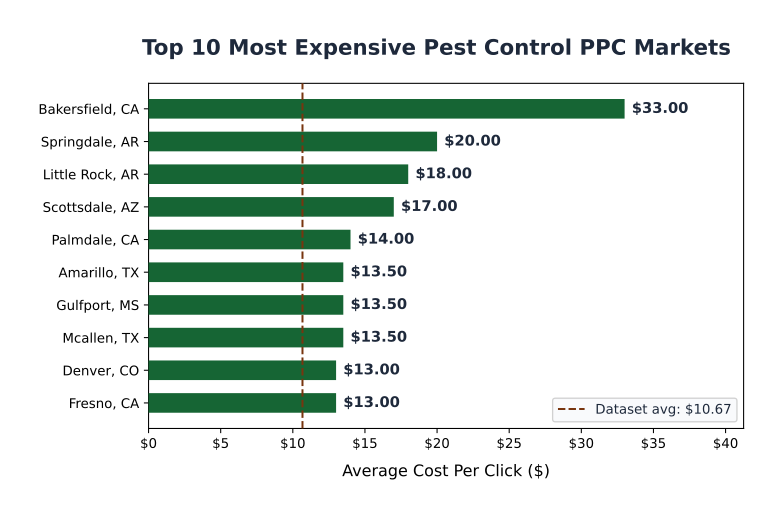
Bakersfield, CA leads all markets at $33.00 CPC — not because it is a large metro, but because the Central Valley's extreme termite pressure drives commercial account bidding that outpaces coastal California cities. MB Adv Agency's analysis of 44 US cities shows CPC ranging from $3.50 (Jonesboro, AR) to $33.00, with the dataset average sitting at $10.67 per click.
The table below separates the 20 most expensive markets from the 10 most affordable. The Cost Index shows each city's CPC relative to the $10.67 dataset average: a city at 0.42x costs less than half the average; a city at 3.09x costs more than three times as much. California and Arkansas dominate both extremes — a reminder that state geography tells you nothing about individual city CPC dynamics in pest control.
| # | City | State | Region | Avg CPC | CPC Range | Cost Index |
|---|---|---|---|---|---|---|
| Most Expensive Markets | ||||||
| 1 | Bakersfield | CA | Pacific | $33.00 | $18–$48 | 3.09x |
| 2 | Springdale | AR | Southeast | $20.00 | $12–$28 | 1.87x |
| 3 | Little Rock | AR | Southeast | $18.00 | $8–$28 | 1.69x |
| 4 | Scottsdale | AZ | Southwest | $17.00 | $12–$22 | 1.59x |
| 5 | Palmdale | CA | Pacific | $14.00 | $8–$20 | 1.31x |
| 6 | Amarillo | TX | Southwest | $13.50 | $7–$20 | 1.27x |
| 7 | Gulfport | MS | Southeast | $13.50 | $7–$20 | 1.27x |
| 8 | McAllen | TX | Southwest | $13.50 | $7–$20 | 1.27x |
| 9 | Denver | CO | West | $13.00 | $8–$18 | 1.22x |
| 10 | Fresno | CA | Pacific | $13.00 | $6–$20 | 1.22x |
| 11 | Tampa | FL | Southeast | $13.00 | $8–$18 | 1.22x |
| 12 | Greenville | NC | Southeast | $12.00 | $4–$20 | 1.12x |
| 13 | Laredo | TX | Southwest | $12.00 | $6–$18 | 1.12x |
| 14 | Montgomery | AL | Southeast | $12.00 | $10–$14 | 1.12x |
| 15 | Tucson | AZ | Southwest | $11.50 | $8–$15 | 1.08x |
| 16 | Fort Smith | AR | Southeast | $11.00 | $7–$15 | 1.03x |
| 17 | Gainesville | FL | Southeast | $11.00 | $8–$14 | 1.03x |
| 18 | St. Petersburg | FL | Southeast | $11.00 | $7–$15 | 1.03x |
| 19 | Chandler | AZ | Southwest | $10.00 | $6–$14 | 0.94x |
| 20 | Mesa | AZ | Southwest | $10.00 | $6–$14 | 0.94x |
| Most Affordable Markets | ||||||
| 1 | Jonesboro | AR | Southeast | $3.50 | $2.58–$4.43 | 0.33x |
| 2 | Brownsville | TX | Southwest | $4.50 | $3.50–$5.50 | 0.42x |
| 3 | Palm Bay | FL | Southeast | $4.62 | $3.97–$5.26 | 0.43x |
| 4 | Shreveport | LA | Southeast | $5.50 | $4.50–$6.50 | 0.52x |
| 5 | Yuma | AZ | Southwest | $5.50 | $3.00–$8.00 | 0.52x |
| 6 | Savannah | GA | Southeast | $6.00 | $4–$8 | 0.56x |
| 7 | Glendale | AZ | Southwest | $6.50 | $4–$9 | 0.61x |
| 8 | Lubbock | TX | Southwest | $6.50 | $5.50–$7.50 | 0.61x |
| 9 | Santa Ana | CA | Pacific | $6.50 | $5–$8 | 0.61x |
| 10 | Charleston | SC | Southeast | $7.03 | $6.55–$7.50 | 0.66x |
The Pacific paradox deserves specific attention: California has the highest state-level average CPC in the dataset ($16.63 across 4 cities with data), but the distribution is extreme. Bakersfield at $33.00 represents termite-pressure Central Valley agriculture; Santa Ana at $6.50 serves a dense Orange County market where service route density keeps cost per conversion low. Within a single state, the CPC spread is 5x.
Cost Efficiency Index — Top 5 Most and Least Efficient Markets
Most efficient (lowest cost vs. $10.67 avg): Jonesboro AR (0.33x) · Brownsville TX (0.42x) · Palm Bay FL (0.43x) · Shreveport LA (0.52x) · Yuma AZ (0.52x)
Least efficient (highest cost vs. avg): Bakersfield CA (3.09x) · Springdale AR (1.87x) · Little Rock AR (1.69x) · Scottsdale AZ (1.59x) · Palmdale CA (1.31x)
Pest Control CPC by City: Visual Breakdown
What Does Pest Control PPC Cost by State?
California averages the highest CPC among states with multiple cities in our dataset at $16.63 across 4 markets — driven by Bakersfield's $33.00 outlier. Arizona delivers the most cities at 8 markets and a $9.66 average CPC, making it the most data-rich and most accessible state-level opportunity in the pest control PPC landscape.
The state-level table below covers all 10 states with 2 or more cities in the dataset. Notably, our sample contains no Northeast or Midwest cities — reflecting the deliberate focus on Southern and Western markets where year-round pest pressure creates the highest sustained PPC competition. State averages mask significant within-state variation; use city-level data for actual budget planning.
| State | Region | Cities in Dataset | Avg CPC | CPC Range | Key Driver |
|---|---|---|---|---|---|
| California | Pacific | 6 | $16.63 | $6.50–$33.00 | Termite pressure; commercial bidding |
| Arkansas | Southeast | 4 | $13.13 | $3.50–$20.00 | Extreme within-state spread; Springdale outlier |
| Mississippi | Southeast | 2 | $11.00 | $8.50–$13.50 | Gulf Coast termite + mosquito pressure |
| North Carolina | Southeast | 2 | $10.50 | $9.00–$12.00 | Consistent mid-tier competition |
| Alabama | Southeast | 2 | $12.00 | $12.00 (1 city w/CPC) | Montgomery only; Tuscaloosa CPC unavailable |
| Florida | Southeast | 5 | $9.92 | $4.62–$13.00 | Year-round demand; palmetto bugs + termites |
| Texas | Southwest | 6 | $9.83 | $4.50–$13.50 | Scorpion + fire ant demand; border markets efficient |
| Arizona | Southwest | 8 | $9.66 | $5.50–$17.00 | Most cities; scorpion season peaks April–October |
| Georgia | Southeast | 3 | $6.25 | $6.00–$6.50 | Affordable entry; Albany + Savannah both sub-$7 |
| Tennessee | Southeast | 2 | CPC N/A | — | CPL data only: Knoxville $60, Murfreesboro $47.50 |
Arizona stands out as the most comprehensively covered state: 8 cities spanning Phoenix suburbs (Chandler, Mesa, Peoria, Glendale, Gilbert, Scottsdale) plus Tucson and Yuma. The $9.66 state average masks meaningful sub-market variation — Scottsdale at $17.00 serves an affluent 49-median-age demographic with high homeownership, while Yuma at $5.50 serves a border community where scorpion pressure creates demand but national chain competition is thinner. Both represent legitimate campaign opportunities for pest control PPC operators depending on service area strategy.
What Is the Cost Per Lead for Pest Control PPC?
The median pest control PPC cost per lead is $60.00 across 27 cities with CPL data — but the range runs from $32.50 (Brownsville, TX) to $115.00 (Visalia, CA). At a $2,300 customer LTV, even the most expensive market in our dataset delivers a 20x lifetime return per acquired lead. MB Adv Agency's analysis frames this through ROI Potential: LTV divided by CPL.
The most actionable finding in our CPL data is the Jonesboro, AR CPL trap: the cheapest-CPC city in the dataset ($3.50) produces the second-highest CPL ($100.00). Thin search volume in a city of 82,000 means cheap clicks do not accumulate into efficient conversions. The contrast with Brownsville, TX ($4.50 CPC, $32.50 CPL) is instructive — both are similar-sized border/small markets, but Brownsville's persistent fire ant and mosquito pressure drives enough sustained search volume that CPL tracks with CPC. Conversion volume matters more than click cost.
ROI Potential in the table below is calculated as $2,300 LTV ÷ city CPL, using Statista's $575/year average consumer spend at a standard 4-year mean customer lifetime (25% annual churn). This is a first-order LTV estimate; actual LTV varies by upsell rate, contract length, and service bundle.
| City | State | Avg CPL | CPL Range | ROI Potential (LTV/CPL) |
|---|---|---|---|---|
| Highest CPL Markets (15 cities) | ||||
| Visalia | CA | $115.00 | $80–$150 | 20.0x |
| Jonesboro | AR | $100.00 | $80–$120 | 23.0x |
| Little Rock | AR | $100.00 | $60–$140 | 23.0x |
| Tuscaloosa | AL | $97.50 | $45–$150 | 23.6x |
| Palmdale | CA | $92.50 | $65–$120 | 24.9x |
| Tampa | FL | $90.00 | $40–$140 | 25.6x |
| Gulfport | MS | $82.50 | $45–$120 | 27.9x |
| Santa Ana | CA | $80.00 | $60–$100 | 28.8x |
| Tucson | AZ | $75.00 | $55–$95 | 30.7x |
| Gainesville | FL | $75.00 | $40–$110 | 30.7x |
| Amarillo | TX | $65.00 | $40–$90 | 35.4x |
| McAllen | TX | $65.00 | $40–$90 | 35.4x |
| St. Petersburg | FL | $62.50 | $35–$90 | 36.8x |
| Port St. Lucie | FL | $60.00 | $30–$90 | 38.3x |
| Knoxville | TN | $60.00 | $40–$80 | 38.3x |
| Most Efficient CPL Markets (10 cities) | ||||
| Brownsville | TX | $32.50 | $25–$40 | 70.8x |
| Shreveport | LA | $37.50 | $30–$45 | 61.3x |
| Fort Smith | AR | $47.50 | $35–$60 | 48.4x |
| Murfreesboro | TN | $47.50 | $35–$60 | 48.4x |
| Honolulu | HI | $47.50 | $35–$60 | 48.4x |
| Charleston | SC | $49.00 | $43–$55 | 46.9x |
| Springdale | AR | $50.00 | $30–$70 | 46.0x |
| Waco | TX | $52.50 | $40–$65 | 43.8x |
| Glendale | AZ | $52.50 | $35–$70 | 43.8x |
| Savannah | GA | $52.50 | $35–$70 | 43.8x |
According to MB Adv Agency's analysis, the gap between best and worst CPL markets — Brownsville at $32.50 versus Visalia at $115.00 — is 3.5x. Yet even Visalia's $115 CPL delivers a 20x LTV-adjusted return if the operator successfully enrolls customers into recurring service plans. The question is never whether pest control PPC is worth it; the question is which cities support sustainable customer acquisition at the unit economics your margins require.
What Conversion Rate Should Pest Control Google Ads Achieve?
CVR data is available for 3 cities in our dataset — Charleston, SC (4.65%), Laredo, TX (8.5%), and Gulfport, MS (10.0%) — producing a mean of 7.72%. This 3-city sample is directional, not exhaustive; the national pest control CVR range from external sources runs 5.5%–15% for search ads, with the sample confirming our data sits within that band.
The 3-city spread is meaningful despite the limited sample. Gulfport, MS at 10.0% — the highest CVR in the dataset — reflects Gulf Coast pest urgency: year-round mosquito, cockroach, and subterranean termite pressure creates searchers who arrive at Google with immediate service intent. Laredo, TX at 8.5% shares that border-market urgency dynamic. Charleston, SC at 4.65% runs below the dataset mean — consistent with a more research-oriented buyer mix in an upscale coastal market where consumers compare services before committing.
| City | State | CVR | Driver |
|---|---|---|---|
| Gulfport | MS | 10.0% | Gulf Coast year-round pest urgency; subterranean termite pressure |
| Laredo | TX | 8.5% | Border market; scorpion + fire ant year-round demand |
| Charleston | SC | 4.65% | Research-oriented buyer mix; comparative shopping in upscale coastal market |
| Dataset Mean | — | 7.72% | 3-city average; directional figure |
External benchmarks provide context for the 3-city sample. LocalIQ's home services data reports pest control as having the highest click-through rate among all home service categories tracked at 4.31% — consistent with the high-urgency nature of infestation searches. MarketCall reports 25%+ CVR as achievable for qualified pay-per-call campaigns (2025), which use phone-number ad formats that bypass website friction entirely. Our search ad CVR of 7.72% reflects standard text ad campaigns with landing page conversion steps; operators switching to call-only or call extension formats in high-urgency markets can expect CVR improvements of 2–3x at the cost of higher per-click competition for ad space.
The bimodal CVR pattern in pest control — emergency keywords converting at 12–15% versus general "pest control services" terms at 5.5% (LeadSources.io, 2026) — means campaign keyword architecture directly drives average CVR. Operators who front-load emergency intent terms ("ants in kitchen now," "scorpion in house," "exterminator today") pull conversion rates above the 7.72% mean; operators running broad match on "pest control services" will land below it.
How Do Pest Control PPC Costs Vary by Region?
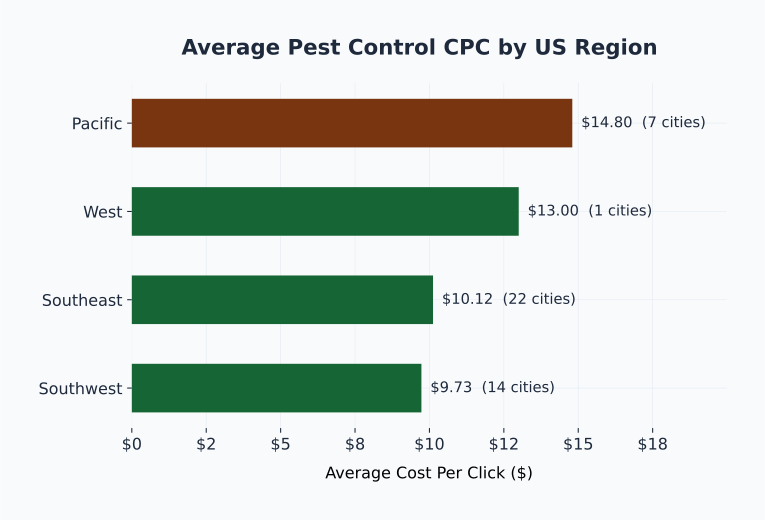
The Pacific region commands the highest average CPC at $14.80 across 7 cities — but that premium is driven by California's termite-pressure markets, not by coastal metro competition. The Southwest delivers the most CPL-efficient conversions at $57.08 average, while the Southeast covers the broadest geographic footprint with 22 cities representing 50% of the entire dataset.
Our 44-city dataset covers four US regions: Southeast, Southwest, Pacific, and West (one city, Denver, CO). The Northeast and Midwest are not represented — reflecting the deliberate focus on high-pest-pressure markets with year-round or extended-season demand. A Midwest or Northeast operator should use the national averages from LocalIQ and WordStream as proxies, noting that CPCs in those markets run materially below our dataset medians.
| Region | Cities | Avg CPC | Avg CPL | Avg CVR | Share of Dataset |
|---|---|---|---|---|---|
| Pacific | 7 | $14.80 | $83.75 | N/A | 16% |
| West | 1 | $13.00 | N/A | N/A | 2% |
| Southeast | 22 | $10.12 | $65.97 | 7.33% | 50% |
| Southwest | 14 | $9.73 | $57.08 | 8.5% | 32% |
The Southwest's efficiency advantage over the Southeast is not accidental. Arizona, Texas, and Gulf Coast markets experience what the industry calls perpetual pest environments — scorpions remain active April through October in Phoenix suburbs; fire ants and mosquitoes operate year-round in South Texas border markets. Searchers in these environments arrive at Google with higher baseline urgency, even on non-emergency queries. The result: Southwest CPR of 8.5% versus Southeast's 7.33%, and a $57 versus $66 average CPL.
The Pacific region's $83.75 average CPL — the highest among all regions — reflects California's specific dynamics. Bakersfield and Fresno drive up the CPC average; conversion friction in high-density California markets (more Terminix/Orkin national chain competition, higher consumer comparison rates) inflates CPL above what the click cost alone would predict. The practical implication for Pacific operators: budget for $80–$90 CPL as a realistic baseline in California markets, and target the Southeast or Southwest comparable at $57–$66 for new market entry if geographic expansion is an option.
Regional Pest Control PPC Comparison
How Competitive Is Pest Control Google Ads?
Pest control Google Ads competition is shaped by two forces: national chains (Terminix and Orkin bid in at least 11 combined cities in our dataset) and the specific pest species driving search in each market. Markets with active Terminix or Orkin bidding face CPC pressure at the $7–$10 range for branded terms; local operators bidding on generic city-specific keywords compete at lower rates with higher Quality Score potential.
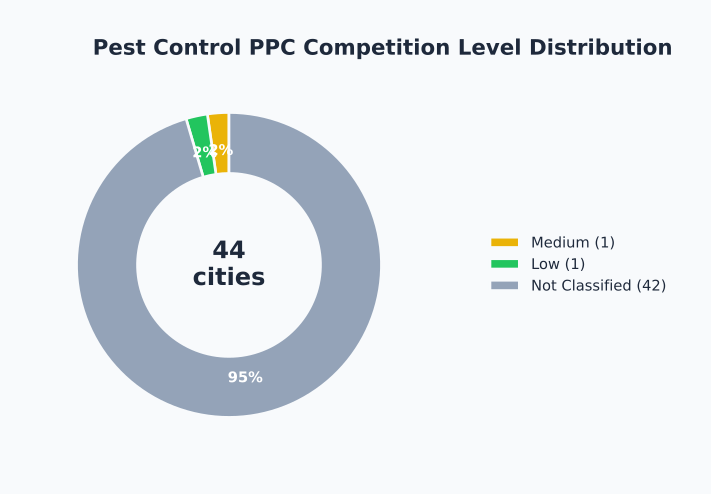
The structured competition level data in our dataset is limited — only 2 cities reported explicit competition ratings (Laredo, TX: Medium; Little Rock, AR: Low). The more informative signal comes from the competitor landscape data across our 44 cities, which identifies the dominant pest species and national brand presence driving auction dynamics in each market.
| Competition Driver | Cities in Dataset | CPC Impact | Notes |
|---|---|---|---|
| Terminix | 6 | +$1–$3/click on generic terms | Branded keyword bidding; national budget advantage |
| Orkin | 5 | +$1–$3/click on generic terms | Overlaps with Terminix in high-competition metros |
| Termite-driven demand | 7+ | $14–$34/click on treatment terms | High-value commercial keyword; Bakersfield exemplar |
| Mosquito control demand | 6 | Seasonal peak: spring–summer | High-urgency summer term; drives seasonal CPC spikes |
| Cockroach/ant control | 4+ | Lower CPC; high volume | Year-round demand in warm climates; strong conversion intent |
| Scorpion control (AZ/TX) | 4+ | Lower local competition | Niche keyword; national chains less dominant on scorpion terms |
The strategic implication for local operators: national chains compete hardest on broad generic terms ("pest control near me," "exterminator near me") where their national quality scores give them CPC advantages. Local operators consistently outperform on hyper-local terms — "ant exterminator Chandler AZ," "scorpion treatment Tucson," "termite inspection [neighborhood]" — where geographic specificity produces better Quality Scores and lower effective CPC than national brands. The 32,720 active pest control businesses (IBISWorld via Briostack, 2025) represent a fragmented local operator market where most SMBs are not yet running sophisticated PPC campaigns — which is the remaining competitive white space in this category.
Competition Level Distribution
How Much Should You Budget for Pest Control PPC?
The median pest control PPC starter budget is $1,675/month across 14 cities with data — lower than most industry guides suggest. The floor is $1,250/month (Santa Ana, CA and Shreveport, LA), and viable campaigns exist at that level. At Brownsville, TX's $32.50 CPL, $1,400/month generates 43 leads per month — enough to sustain a growing recurring subscriber base from a single-location operator.
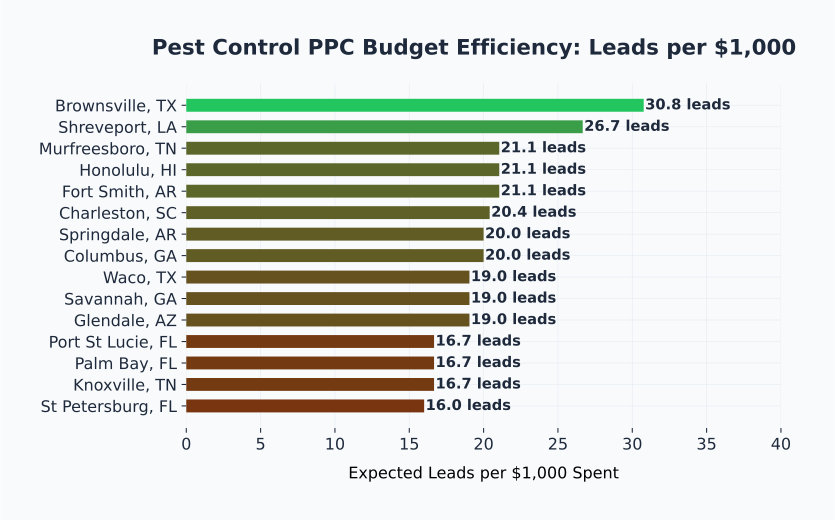
Budget Efficiency in the table below is calculated as $1,000 ÷ city CPL, showing how many leads each $1,000 in ad spend produces at the city's current CPL. The Market Opportunity Score (1–10) is a composite of CPC efficiency, CPL efficiency, and CVR data where available — a higher score means better overall PPC economics relative to other markets in the dataset.
| City | State | Starter Budget | Avg CPL | Leads/$1K | Mkt Opp Score |
|---|---|---|---|---|---|
| Brownsville | TX | $1,400 | $32.50 | 30.8 | 9.5 / 10 |
| Shreveport | LA | $1,250 | $37.50 | 26.7 | 8.5 / 10 |
| Jonesboro | AR | $1,400 | $100.00 | 10.0 | 3.0 / 10 |
| Glendale | AZ | $1,500 | $52.50 | 19.0 | 7.5 / 10 |
| Lubbock | TX | $1,500 | N/A | — | — |
| Waco | TX | $1,600 | $52.50 | 19.0 | 7.5 / 10 |
| Greenville | NC | $1,750 | N/A | — | — |
| Fayetteville | NC | $2,000 | N/A | — | — |
| Little Rock | AR | $2,000 | $100.00 | 10.0 | 4.0 / 10 |
| Palmdale | CA | $2,000 | $92.50 | 10.8 | 4.5 / 10 |
| Fort Smith | AR | $2,250 | $47.50 | 21.1 | 7.0 / 10 |
| Gulfport | MS | $2,750 | $82.50 | 12.1 | 7.0 / 10 |
| Springdale | AR | $3,000 | $50.00 | 20.0 | 6.0 / 10 |
| Santa Ana | CA | $1,250 | $80.00 | 12.5 | 5.5 / 10 |
According to MB Adv Agency's analysis, the Market Opportunity Score reveals a clear pattern: border and Gulf Coast markets with persistent year-round pest pressure (Brownsville, Shreveport, Glendale, Waco) consistently score highest — combining accessible CPCs with conversion volumes sufficient to drive CPL below the dataset median. Jonesboro, AR is the cautionary case: a low-CPC market with a 3.0/10 score because thin search volume makes the per-lead economics uncompetitive regardless of click price.
Top 5 Markets by Market Opportunity Score
1. Brownsville, TX — 9.5/10 | CPC $4.50, CPL $32.50, Leads/$1K: 30.8
2. Shreveport, LA — 8.5/10 | CPC $5.50, CPL $37.50, Leads/$1K: 26.7
3. Glendale, AZ — 7.5/10 | CPC $6.50, CPL $52.50, Leads/$1K: 19.0
4. Waco, TX — 7.5/10 | CPC $9.00, CPL $52.50, Leads/$1K: 19.0
5. Fort Smith, AR — 7.0/10 | CPC $11.00, CPL $47.50, Leads/$1K: 21.1
Budget Efficiency by Market
Need help optimizing your Pest Control PPC spend?
See how MB Adv manages campaigns in Bakersfield, Springdale, and Little Rock — the highest-spend Pest Control markets in our dataset.
Get a Free Pest Control PPC Audit →When Is the Best Time to Run Pest Control Google Ads?
The best time to run pest control Google Ads depends entirely on geography. In northern markets, spring through September is the effective campaign window — peak season CPC runs 40–60% above annual average. In Sunbelt markets (Florida, Arizona, Texas Gulf Coast), the answer is year-round, with near-flat cost curves and no seasonal ramp-up penalty.
Peak pest control search demand runs spring through September, with June through August representing the absolute peak driven by mosquito, ant, and wasp activity (MarketCall, 2025). In this window, CPCs across most markets increase 40–60% above their annual average — a $10.00 median CPC market becomes $14–$16 during peak weeks. Operators who have not built up Quality Score history before June pay the full premium; operators with established campaigns see smaller effective increases due to account-level quality adjustments.
The off-season (November through February) is not dead — it is discounted. CPC drops 20–40% in northern markets during winter (Cube Creative, 2025). Operators who maintain reduced-budget brand campaigns in the off-season build Quality Score and ad history that compounds into better auction positioning when spring demand returns. Campaigns paused entirely and restarted in March start from scratch on Quality Score, paying the highest CPCs of the year at exactly the moment when budget pressure is highest.
SEASONAL STRATEGY: Northern operators: maintain a 30–40% reduced budget November–February to preserve Quality Score, then scale to full budget in April — before the peak CPC spike. Sunbelt operators: run year-round at consistent budget levels; seasonal variability is minimal in FL, AZ, and TX Gulf Coast markets.
Sunbelt operators hold a structural compounding advantage that is difficult to quantify but significant over multi-year campaigns. A Florida operator running 12 months of campaigns accumulates 50% more account history, Quality Score, and conversion data than a Wisconsin competitor running 8 months. Over three years, that gap translates to meaningfully lower average CPCs and better ad placement than cold-restart competitors who pause every fall. The 5.7% industry CAGR through 2032 (Allied Market Research via GorillaDesk) means the compounding effect of continuous campaign optimization grows more valuable every year as more SMBs enter the auction.
Climate change is extending effective pest seasons. Pest activity patterns are shifting northward (PestPac, 2025), with markets that historically paused in October now seeing activity into November. Operators in transition-zone markets (Tennessee, North Carolina, Arkansas) benefit from monitoring search volume data — Google Ads impression data is the earliest signal of extending season in a specific market, typically appearing 3–4 weeks before traditional pest activity metrics confirm the trend.
Best Value Market
Brownsville, TX
Southwest · Border market
CPC: $4.50 (0.42x avg)
CPL: $32.50 (lowest in dataset)
Leads/$1K: 30.8
LTV ROI: 70.8x per lead
Most Expensive Market
Bakersfield, CA
Pacific · Central Valley
CPC: $33.00 (3.09x avg)
CPC Range: $18–$48
Driver: Termite pressure + commercial bidding
Note: Consistent with $34 "exterminator near me" national avg
Pest Control PPC: Frequently Asked Questions
Running Pest Control PPC campaigns?
Get a free audit based on your city's benchmark data from our 44-city dataset.
Request Free Audit →Data Methodology
This dataset covers 44 US cities across 4 regions (Southeast, Southwest, Pacific, West) analyzed by MB Adv Agency in 2026. Of the 44 cities, 4 are based on directly observed campaign benchmarks; the remaining 40 are WordStream-calibrated per-metro estimates adjusted for regional pest pressure and competitive density. CPC and CPL figures represent campaign-level averages across mixed keyword portfolios. CVR data is available for 3 cities only (Charleston SC, Laredo TX, Gulfport MS) and is presented as directional, not exhaustive. External benchmark sources are cited inline throughout the article.

As a Google Ads expert, I bring proven expertise in optimizing advertising campaigns to maximize ROI.
I specialize in sharing advanced strategies and targeted tips to refine Google Ads campaign management.
Committed to staying ahead of the latest trends and algorithms, I ensure that my clients receive cutting-edge solutions.
My passion for digital marketing and my ability to interpret data for strategic insights enable me to offer high-level consulting that aims to exceed expectations.
Google Partner Agency
We're a certified Google Partner Agency, which means we don’t guess — we optimize withGoogle’s full toolkit and insider support.
Your campaigns get pro-level execution, backed by real expertise (not theory).

4.9 out of 5 from 670+ reviews on Fiverr.
That’s not luck, that’s performance.
Highly recommend Matteo to set up your server side tracking. He has a deep understanding of e-commerce tracking and will go above and beyond to make sure everything is set up correctly and working 100%. If you are scaling your store this set up is non-negotiable in my opinion and there isn't many people who have this much knowledge or put the effort in to get it right. Thanks again!
avorodesign.com
I can only recommend Matteo! He was very patient, professional and very knowledgeable about GA4, Consent Mode v2, and GDPR compliance. Communication was clear, and the setup was done professionally and efficiently. Highly recommend him for anyone needing reliable tracking implementation.

www.natureiki.life
Matteo shines in the realm of online professionals. His work is not only deep in data but also complemented by his proactive communication and cooperation, setting a new standard for freelancers. If you want someone who truly exceeds expectations, look no further. Highly recommended!

www.omanbeverlysmyth.com
Exceptional Service Beyond Expectations - Outstanding Service Impeccable depth, flawless delivery, and exceptional language fluency—this service exceeded all expectations. Highly recommended. Matteo truly ROCKS!!!

ium-paris.com
Top-notch, always highly value working with Matteo. An absolute Google Ads Genius. This is approximately the 8th time I have hired him and he's helped us get 6-7 ROAS. We are excited in continuing to improve our lead flow. Hire this guy if you need Google Ads help. Thanks Matteo!

www.dleeventgroup.com
I finally found the guy who can setup server side tracking and all the ecosystem properly. I definitely recommend Matteo. He is very responsive, kind and wants to dig into things. He configured GA4, Meta, Google Ads, Outbrain and google consent v2 with Cookiebot. Thanks Matteo.

inomega.fr
MB Adv delivered exceptional work with outstanding professionalism and lots of patience, taking time to see effects of changes made and not just do the work and submit it. The proactive communication and video summaries of the work completed made working with Matteo a pleasure, as he consistently went above and beyond. Highly recommended for web analytics projects! We are already working on another project.

www.withnellsensors.co.uk
Working with Matteo on my Google Ads was a game-changer. He's not just a strategist, he's a true partner. He understood my goals and tailored a campaign that perfectly reached my target audience. I'm grateful for his expertise and dedication.

dccargo.com
Click-driven mind
with plastic-brick obsession.
We build Google Ads campaigns with the same mindset we use to build tiny brick worlds: strategy, patience, and zero tolerance for wasted pieces.
Data is our blueprint. Growth is the only acceptable outcome.