On-Page vs Off-Page SEO: Key Differences (2026)

On-Page vs Off-Page SEO 2026
On-page · Off-page · Technical
On-page SEO is everything you optimize on the page you control — content, title tag, header tags, internal links, URL, images. Off-page SEO is the authority you earn off your site — chiefly backlinks and mentions. Technical SEO is the third pillar: crawl, render, index.
Google rewrites 61.6% of titles (Zyppy) · the meta description is a CTR tool, not a ranking factor (Portent ~70% rewritten) · multiple H1s are valid (Mueller)
On-Page vs Off-Page SEO: the Key Differences at a Glance
The difference between on-page and off-page SEO comes down to one line: on-page SEO is everything you optimize on the page you control — the content, the title tag, the header tags, internal links, the URL, and images — while off-page SEO is the authority you earn off your site, chiefly backlinks and mentions. Technical SEO is the third pillar, and it governs how well search engines crawl, render, and index the site. On-page and off-page are complements, not rivals: one makes the page relevant and clear, the other builds the authority that helps it rank.
The cleanest way to hold the three apart is by who owns each lever. On-page work is yours to do today, on your own pages, without waiting on anyone. Off-page authority is earned over time and lives on other people’s sites. Technical work is shared with whoever controls the codebase. Table 1 maps the three pillars side by side, then this guide routes the two neighbouring disciplines out to their own pages and spends the rest of its depth on the on-page essentials this pillar owns — header tags, title tags, and meta descriptions.
| Pillar | What it is | Example factors | Who controls it | Covered in depth by |
|---|---|---|---|---|
| On-page SEO | Optimization on the page you own | Content & search intent, title tag, header tags, internal links, URL, image alt text, meta description (CTR) | You — directly | This pillar |
| Off-page SEO | Authority earned off-site | Backlinks, referring domains, brand mentions, digital PR, reviews | Earned — partly outside your control | what link building in SEO is |
| Technical SEO | How engines crawl, render, and index the site | Crawlability, indexation, Core Web Vitals/speed, HTTPS, mobile, canonical, structured data | You + a developer | what technical SEO is |
Source: the standard three-pillar taxonomy (Ahrefs / Moz / Search Engine Land convention), documented on-page factor lists at Moz and Ahrefs. This is an industry model, not a single Google announcement. Not mbadv data.
New to the framework entirely? Start with what SEO is, then come back here for the split. MB Adv Agency frames it the same way for every business it works with: on-page is the half you fully control, so it is usually where a site should start, and paid search is the separate lever we run alongside strong organic on-page work. Off-page depth lives in what link building in SEO is, and technical depth in what technical SEO is — this page keeps its focus on the elements you edit directly on the page.
On-Page, Off-Page, and Technical SEO: the Three-Pillar Model
Technical SEO is the third pillar, not a subset of on-page. The three-pillar model splits search optimization into what you put on the page (on-page), the authority you earn elsewhere (off-page), and how well engines can crawl and index the whole site (technical). Naming technical separately matters because it tells you which lever you are pulling: rewriting a title is on-page, earning a link is off-page, and fixing crawl or speed is technical. Table 2 lines up on-page against off-page on the dimensions that decide where to spend first.
Two facts fall out of that table. First, on-page is the half you fully control, so it compounds across every page and costs nothing but the work — which is why most sites should start there. Second, off-page is where the heavier ranking correlate sits: links are one of the highest-correlating factors, but they are earned, not edited. The honest sequence is to get the on-page essentials right on every page, then invest in the authority that the strong on-page work deserves. Off-page tactics belong in what link building in SEO is; this pillar owns the on-page half.
| Dimension | On-page SEO | Off-page SEO |
|---|---|---|
| Location | Your own page and site | Other sites (links, mentions) plus your brand |
| Primary levers | Content, title tag, header tags, internal links, URL, images | Backlinks, referring domains, brand signals, reputation |
| Control | Direct — you own it | Indirect — earned, not fully controllable |
| Ranking role | Relevance & clarity (headers a minor/indirect signal) | Authority & trust (links a top correlate) |
| Where to start | Usually first — fastest to fix | Builds over time — see link building |
Sources: Ahrefs / Moz / Search Engine Land three-pillar convention; header ranking role per John Mueller (Search Engine Roundtable). Ranking weight is qualitative — Google publishes no on-page weighting number. Not mbadv data.
The practical read: on-page and off-page do different jobs, and neither one wins in isolation. Great on-page with zero authority struggles to rank; strong authority pointed at a page with a mismatched title and a weak outline wastes the links. The rest of this guide works through the on-page elements you edit directly — starting with the header tags that carry the most demand in this cluster.
What People Search: On-Page vs Off-Page Demand
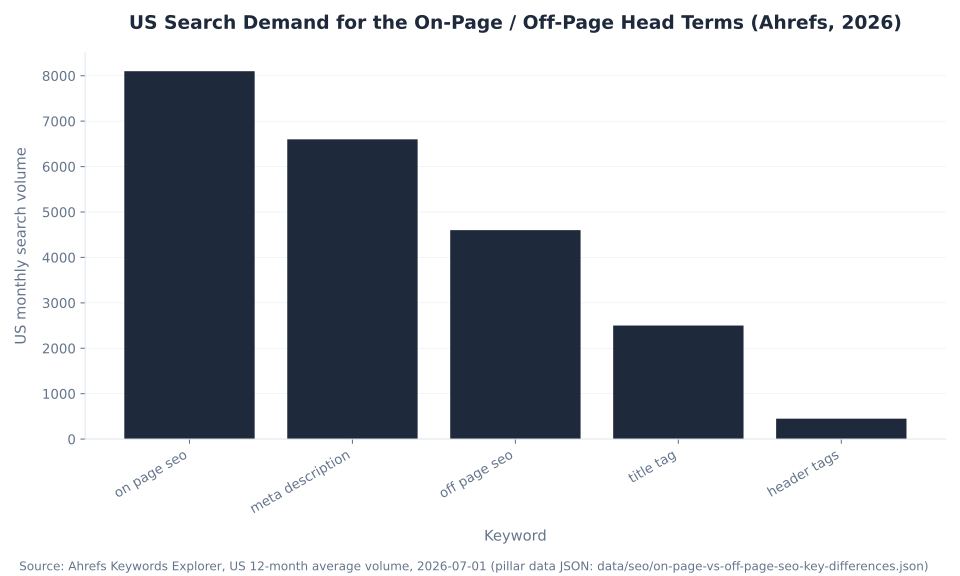
Demand for this topic splits across the on-page elements themselves. “On page seo” runs 8,100 US searches a month at KD 74, and “off page seo” 4,600 at KD 44 (Ahrefs Keywords Explorer, US, 2026-07-01) — the framework head terms. But the highest-volume single element is “meta description” at 6,600 a month, which is exactly why answering “it is not a ranking factor” cleanly is high-leverage. Table 3 lists the head terms this pillar targets.
| Keyword | US monthly volume | KD | Note |
|---|---|---|---|
| on page seo | 8,100 | 74 | The framework head term this pillar owns |
| meta description | 6,600 | 71 | Highest-volume single on-page element — answered “not a ranking factor” |
| off page seo | 4,600 | 44 | The other half of the framework (depth routed to link building) |
| title tag | 2,500 | 63 | The <title> is still primary; rewritten 61.6% |
| header tags | 450 | 38 | Feeds the header-tags section that absorbs the 2,311-impression “what is h1 h2 h3” page |
Source: Ahrefs Keywords Explorer, US 12-month average volume, 2026-07-01, from the pillar data JSON (data/seo/on-page-vs-off-page-seo-key-differences.json). Not mbadv data.
The concentration matters for how this page is built. “Header tags” carries only 450 searches a month on its own, but the header-tags section below absorbs a page that holds 2,311 Google Search Console impressions across 91 keywords at position 28.8 — its top query is “what is h1 h2 h3.” That is the single highest-value redirect in this cluster, so the header-tags section answers “what are H1, H2, and H3 tags” in its first line. To watch how these terms convert clicks by position after you rank, use how to track SEO performance with Google Search Console.
Header Tags (H1, H2, H3) in SEO: Structure, Hierarchy, and Impact
H1, H2, and H3 tags are HTML heading elements that structure a page: the H1 states the page’s main topic, H2 tags label the major sections, and H3 tags mark sub-points within a section. They organize the page for two audiences at once — readers and screen readers who navigate by the outline, and search engines that use the outline to understand what each section is about. Table 4 sets out the hierarchy and each tag’s role.
Their biggest jobs are structure, accessibility, and context, not raw ranking power. A logical, sequential heading outline is how a screen-reader user moves through a page (W3C/WCAG), and it is how an engine maps the page’s topics. As a ranking signal, headers are minor and indirect: John Mueller has described headings as helping Google understand a page rather than acting as a heavy direct factor. Google publishes no header-tag weighting figure, so the honest description of their ranking role is qualitative — write them for humans first.
| Tag | Role | Best practice | Accessibility / SEO note |
|---|---|---|---|
| H1 | The page’s main title / topic | One clear, descriptive H1 (multiple H1s are valid per Mueller; one is cleaner) | Top of the outline for screen readers; a minor/indirect ranking signal |
| H2 | Major section headings | Descriptive wording that reflects the section’s intent | Primary navigation landmarks for assistive technology |
| H3 | Sub-points within an H2 | Nest logically; do not skip levels | Deepens the semantic outline of the page |
| H4–H6 | Finer sub-structure (rare) | Use only if the content truly nests that deep; keep the sequence intact (no H2→H4 jump) | — |
Sources: header ranking role and the “multiple H1s are valid” guidance per John Mueller (Search Engine Roundtable); heading-structure accessibility per W3C Web Accessibility Initiative. Not mbadv data.
The most stubborn header myth is “one H1 only.” One clear H1 is a sensible best practice for clarity, but multiple H1s are valid — Mueller has stated directly that a page can have more than one H1 and it is fine, and HTML5 sectioning allows it. What matters is a logical, descriptive outline: one H1 that names the topic, H2s that reflect each section’s intent, and H3s nested underneath without skipping a level. MB Adv Agency’s guidance is simple — keep one primary H1 when you can, do not panic at two, and never skip from an H2 to an H4. Once the outline expresses the topic and its intent, connect the headings to the keywords behind them via what keywords in SEO are, and make sure the content under each heading satisfies its intent per what SEO content is.
Title Tags and Meta Descriptions: On-Page Best Practices
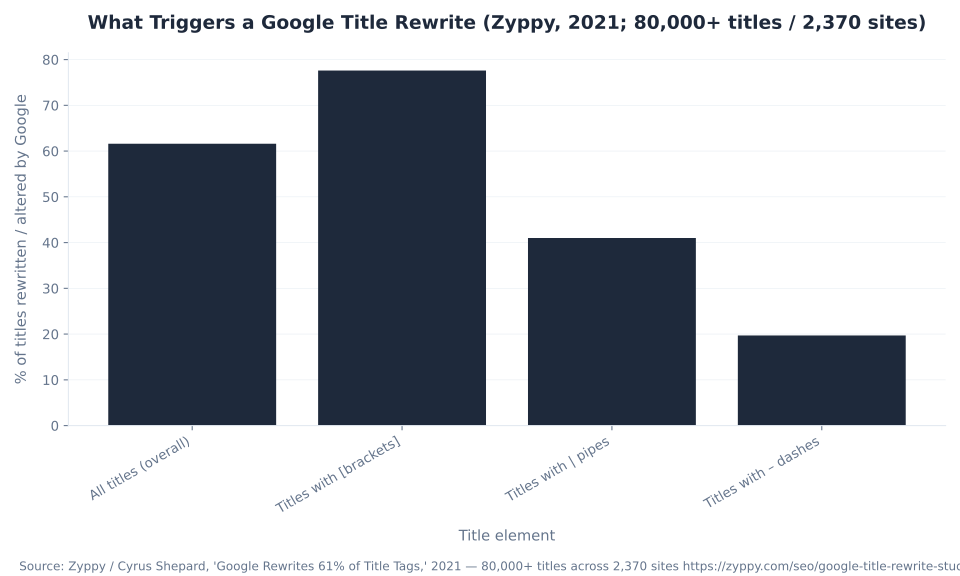
The title tag is still the most important on-page tag Google reads — even though Google rewrites the title it shows most of the time. Two facts sit together and both are true. Google’s August 2021 “title link” update lets it generate the results title from your <title>, on-page headings, or anchor text, and Zyppy’s study of 80,000+ titles across 2,370 sites found Google rewrites 61.6% of titles at least partially. Yet the <title> remains the primary source Google uses, more than 80% of the time. Table 5 turns Zyppy’s findings into concrete levers.
The resolution is not “titles do not matter.” It is to write a clear, accurate, right-sized <title> and accept that Google decides the final display. Zyppy quantified the triggers: the 51–60 character band was rewritten least, overly long titles were the number-one trigger, titles with [brackets] were rewritten 77.6%, and separators split sharply — Google removed or replaced pipes (|) 41.0% of the time against dashes (–) 19.7%, making a dash roughly twice as rewrite-resistant. Front-load the keyword, keep it near 50–60 characters, prefer a dash, and skip brackets, and you keep control of the input.
| Element | Data / best practice | Why it matters |
|---|---|---|
| Overall rewrite rate | 61.6% of titles rewritten at least partially | Rewriting is normal — write for clarity, not for a locked string |
| Length | 51–60 characters rewritten least; overly long titles the #1 trigger | Stay near 50–60 characters and front-load the term |
Brackets [ ] | 77.6% rewritten | Avoid square brackets; parentheses are safer |
Pipes | vs dashes – | Pipes removed/replaced 41.0% vs dashes 19.7% | Prefer a dash separator over a pipe |
| Primary source | The <title> is used >80% of the time | You control the input Google starts from |
Source: Zyppy / Cyrus Shepard, “Google Rewrites 61% of Title Tags” (2021; 80,000+ titles across 2,370 sites); Google’s August 2021 “title link” update. Not mbadv data.
The meta description sits right beside the title in the same snippet, and it earns the most citations because the common belief about it is wrong: the meta description is not a ranking factor. Its only job is the text under the title link, which affects the click, not the position — the next section works through what it does, how often Google rewrites it, and why click-through rate is governed by position. Structured data can also shape how your title and snippet appear in richer results; see enhancements and rich results in Google Search Console and Google’s title-link documentation.
Meta Descriptions and the Click: What They Do (and Don’t)
The meta description is a click-through tool, not a ranking factor — and Google rewrites it even more often than the title. It has no effect on rankings; its sole job is the snippet under the title link, which influences click-through rate, not position. And Google rewrites it the majority of the time: Portent found roughly 71% on mobile and 68% on desktop. So the stance is the opposite of “stuff keywords to rank” — write a compelling, accurate, unique description of about 150 characters that earns the click when it is shown. Table 6 states the guidelines plainly.
| Question | Answer | Source |
|---|---|---|
| Is it a ranking factor? | No — CTR only | Google Search Central |
| How often is it rewritten? | ~70% (Portent: ~71% mobile / ~68% desktop) | Portent |
| How long should it be? | ~150 characters (tool convention; Google truncates by pixels/device, with no fixed limit) | Moz / Google |
| What do you optimize for? | A compelling, accurate, unique snippet that earns the click when shown | Google Search Central |
Sources: Google Search Central (control your snippets; the meta description is not a ranking factor); Portent (rewrite rate). Never present the meta description as a ranking lever. Not mbadv data.
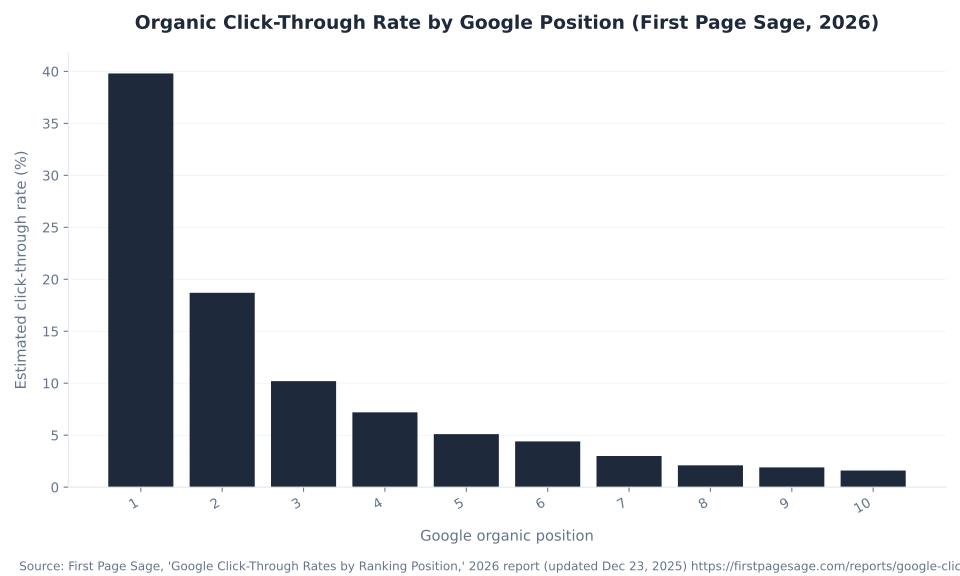
If click-through rate is the prize the description competes for, it helps to know how much of CTR is actually decided by the snippet versus by position. The answer: position dominates. First Page Sage’s 2026 meta-analysis puts position 1 at about 39.8% and the top three positions at about 68.7% of clicks combined. Table 7 shows the full curve.
| Google organic position | Estimated CTR |
|---|---|
| 1 | 39.8% |
| 2 | 18.7% |
| 3 | 10.2% |
| 4 | 7.2% |
| 5 | 5.1% |
| 6 | 4.4% |
| 7 | 3.0% |
| 8 | 2.1% |
| 9 | 1.9% |
| 10 | 1.6% |
| Top three combined | ~68.7% of clicks |
Source: First Page Sage, “Google Click-Through Rates by Ranking Position” (2026 report, updated Dec 23, 2025). A single-source meta-analysis — do not mix with another CTR study. Not mbadv data.
Read the two tables together and the honest conclusion is clear: a great meta description wins the click at a given position, but the position itself is earned by content, relevance, and links — not by the description text. Write the snippet to convert the impression you have, and use on-page and off-page work to climb the positions that carry the clicks. The metric to watch is CTR by position, which lives in the Search Console performance report; the workflow for monitoring it is in how to track SEO performance with Google Search Console.
The On-Page SEO Checklist: the Elements You Control
Once the framework is clear, on-page SEO becomes a short, ordered list of elements you optimize on every page — and every one of them is entirely in your control. Table 8 is that checklist: the title tag, the H1 and heading outline, content that matches intent, descriptive internal links, a readable URL, image alt text, and a click-worthy meta description. It is the highest-leverage work most sites under-do, precisely because it is the part you can fix today without waiting on a link or a developer.
| Element | What “good” looks like | Depth pillar |
|---|---|---|
| Title tag | Query-matching, ~51–60 characters, term front-loaded | This pillar |
| H1 / heading outline | One clear H1; logical H2/H3 hierarchy, no skipped levels | This pillar (header-tags section) |
| Content & intent match | Satisfies the search intent behind the query | what SEO content is |
| Internal links | Descriptive anchor text to relevant pages | This pillar / link building |
| URL | Short, readable, keyword-relevant | This pillar |
| Image alt text | Descriptive alt for accessibility + image search | what SEO content is |
| Meta description | Compelling, ~150 characters, written for CTR (not ranking) | This pillar |
Source: the documented on-page factor list (Moz / Ahrefs on-page guides) plus the title, header, and meta specifics above. Not mbadv data.
The checklist also shows where this pillar hands off. Title tags, the heading outline, URLs, internal links, and the meta description are covered here in depth. Content and intent depth belongs to what SEO content is and the keyword and intent research behind it to what keywords in SEO are. Work the list top to bottom on your most important pages first; it compounds, because the same seven elements apply to every page you publish.
Where Off-Page and Technical SEO Take Over
On-page work has limits, and knowing where it ends keeps you from over-investing in the wrong lever. Once the page is relevant and clear, two disciplines take over. Off-page SEO is the authority you earn elsewhere — backlinks, referring domains, brand mentions, digital PR, and reviews. Links are one of the highest-correlating ranking factors, but they are earned, not edited, which is why they are a separate discipline with its own playbook in what link building in SEO is.
Technical SEO is the third pillar: how well engines crawl, render, and index the site. It covers crawlability and indexation, Core Web Vitals and speed, HTTPS, mobile-friendliness, canonical signals, and structured data. Structured data does not boost rankings directly — it drives rich-result eligibility — and Core Web Vitals are a lightweight page-experience system, largely a tie-breaker between similar-quality pages. The depth for all of it lives in what technical SEO is, with the field measurement in Google’s Core Web Vitals guidance and the markup rules in Google’s structured-data documentation.
The division of labour is the whole point of the model. On-page makes the page worth ranking; off-page builds the authority that ranks it; technical makes sure engines can reach and understand it. For a B2B or SaaS site weighing where paid search fits alongside this organic work, MB Adv Agency runs the paid side — see our B2B PPC and SaaS PPC services.
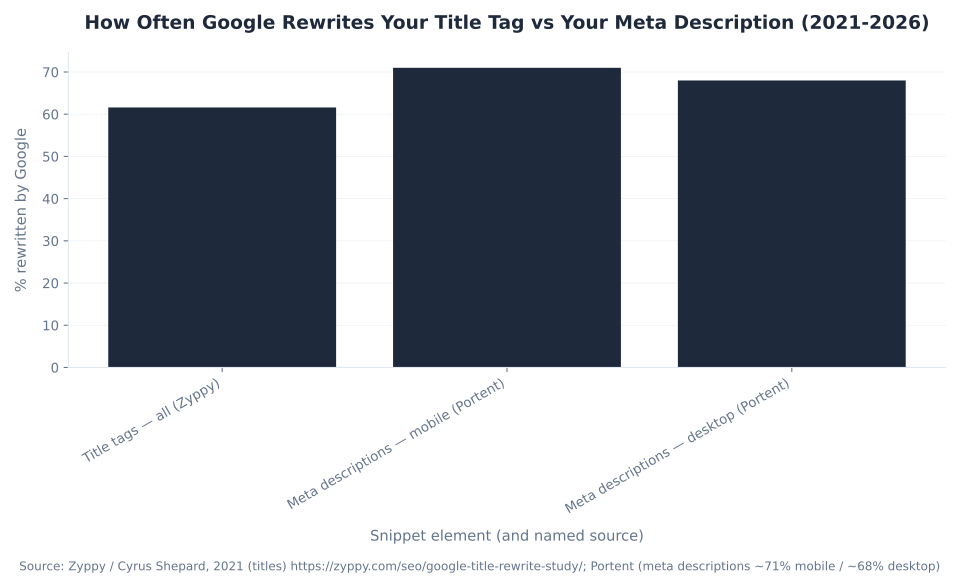
Does Google Rewrite Your Title and Meta Description?
Yes — Google rewrites the majority of both. Titles are rewritten 61.6% of the time at least partially (Zyppy, 80,000+ titles), and meta descriptions even more often, at roughly 71% on mobile and 68% on desktop (Portent). Seeing those two numbers side by side leads some people to the wrong conclusion — that neither tag is worth writing well. The opposite is true, and understanding why is the difference between writing for a ranking algorithm and writing for a human who is about to click.
You control the input; Google decides the display. The <title> is still the primary source Google starts from more than 80% of the time, and how you write it — length near 51–60 characters, no brackets, a dash instead of a pipe, the query matched — directly shapes whether Google keeps it. The meta description never ranks you, but when Google does show it, a compelling, accurate, unique ~150-character snippet earns the click. So write both for humans: a clear, query-matching title and a click-worthy description. The chart accompanying this section reads each rewrite rate against its own named study, so treat the two as directional rewrite rates from different methods, not one dataset.
The one line to remember: rewriting is normal, and it is not a verdict on your input. It is Google adapting the display to the query. Give it a clean, accurate title and snippet and it keeps them more often — and when it adjusts them, it does so to match intent, which is the same goal you are writing toward.
Is On-Page or Off-Page SEO More Important — and Which Comes First?
Neither one wins in isolation, because they do different jobs. On-page SEO makes a page relevant and clear, and you fully control it. Off-page SEO builds the authority — chiefly links — that helps a relevant page actually rank. A page with excellent on-page work and zero authority struggles to break through; authority pointed at a page with a mismatched title and a weak outline wastes the links. The question is not which matters more, but which to sequence first.
For most sites the answer is on-page first, for a practical reason: it is the work you can do today, on your own pages, without waiting on anyone. Off-page authority takes time and depends on other sites; technical fixes often need a developer. On-page is immediate and it compounds — a query-matching title, a clear H1 and outline, intent-satisfying content, sensible internal links, a readable URL, descriptive alt text, and a click-worthy meta description apply to every page you own. Get those right across the site, then earn the authority that the improved pages deserve through link building, and align each page’s target queries using what keywords in SEO are.
The framing MB Adv Agency uses with the businesses it works with: on-page is the free, controllable foundation, off-page is the earned amplifier, and paid search is the third channel we run to complement both. You do not choose between on-page and off-page — you build the on-page foundation first, because it is the half you own outright.
The On-Page Priority Order: What to Fix First
When you optimize a page’s on-page SEO, the order that works is the order below — it maps to how much each element shapes relevance and the click. MB Adv Agency runs the paid campaigns that complement this organic work, and the sequence it recommends to the businesses it works with is deliberately simple, because the compounding value is in doing all of it on every important page rather than perfecting one element on one page.
First, write a query-matching <title> of about 51–60 characters with the term front-loaded, no brackets, and a dash rather than a pipe — the input Google keeps more than 80% of the time. Second, set one clear H1 that names the topic and a logical H2/H3 outline with no skipped levels. Third, make the content genuinely satisfy the search intent behind the query. Fourth, add descriptive internal links to relevant pages and descriptive image alt text. Fifth, write a compelling, accurate, unique meta description of about 150 characters for the click — never as a ranking lever. Sixth, verify the heading hierarchy is sequential and accessible before you publish.
That six-step order is the on-page half of the job in full. When you are ready to layer paid search on top of strong organic pages, a Google Ads PPC audit is the fastest read on the paid side, and our full PPC services cover end-to-end paid media. For an ecommerce catalogue, the on-page discipline pairs with ecommerce PPC and fashion / ecommerce PPC.
On-Page Is Yours — the Paid Half Is Ours
The paid search that complements strong on-page work is where our team earns its keep
MB Adv Agency does not sell SEO services — you own the on-page work. We run the Google Ads and PPC that complement your organic search. Talk to us about the paid side.
Talk to our team →The Title-Link Trend: Writing for a Display You Don’t Fully Control
The clearest on-page trend of the last few years is that Google took more control of the snippet. The August 2021 “title link” update meant Google generates the displayed title from your <title>, on-page headings, or anchor text whenever something else matches the query better — and Zyppy’s data shows that happens 61.6% of the time. Meta descriptions were already rewritten at roughly 70%. The direction of travel is consistent: you write the input, Google decides the display.
That trend does not demote the title tag — it sharpens how you write it. Because the <title> is still the primary source more than 80% of the time, the levers Zyppy identified are the ones that keep your title intact: stay in the 51–60 character band, front-load the term, avoid brackets, and use a dash instead of a pipe. For the meta description, accept that its job is the click, not the rank, and write it to convert the impression when Google shows it. The right way to see whether your titles and snippets are earning clicks is the click-through-rate data by position in how to track SEO performance with Google Search Console — if a page ranks well but under-earns clicks, the title and snippet are the first things to test.
Common On-Page SEO Misconceptions
Three on-page beliefs are wrong often enough that correcting them is the highest-value part of this guide — each one is declarative and named-sourced.
1. The meta description is not a ranking factor — it only affects CTR, and Google rewrites it about 70% of the time. The most common on-page myth is that a keyword-optimized meta description helps you rank. It does not: Google has said for years it has no effect on rankings. Its sole role is the snippet under the title link, which influences the click, not the position, and Google rewrites it the majority of the time (Portent: ~71% mobile / ~68% desktop). Write it for the click — compelling, accurate, unique, about 150 characters — never as a ranking lever.
2. You do not need exactly one H1 — one H1 is best practice, but multiple H1s are valid. A stubborn myth holds that more than one H1 “breaks SEO.” John Mueller has said directly that a page can have multiple H1s and it is fine — Google handles it, and HTML5 sectioning allows it. The best practice of one clear H1 is about clarity and accessibility, not a penalty for two. What matters is a logical, descriptive heading outline.
3. A rewritten title does not mean your <title> is pointless. Because Google rewrites 61.6% of titles (Zyppy), some conclude the <title> no longer matters. The opposite is true: it is still the primary source more than 80% of the time, and how you write it — length near 51–60, avoiding brackets and pipes, matching the query — directly shapes whether Google keeps it. The businesses MB Adv Agency works with that also run paid search — from B2B to ecommerce — get the same advice: control the input, and let Google handle the display.
On-Page vs Off-Page SEO: FAQs
On-Page Solid, Paid Side Lagging?
Strong organic pages deserve a paid channel that pulls its weight
Once your on-page work is dialed in, paid search is the complement that captures the demand it cannot. Our team finds where the paid budget is leaking and brings it back in line.
Google Ads PPC audit →All PPC servicesMethodology & Sources
Every number in this guide is Google-documented, drawn from a named study with a date and URL, or taken from the pillar’s Ahrefs data. The title-rewrite figures — 61.6% overall, 77.6% for brackets, 41.0% for pipes against 19.7% for dashes, and the 51–60 character band — come from Zyppy / Cyrus Shepard’s study of 80,000+ titles across 2,370 sites (2021), read alongside Google’s August 2021 “title link” update.
The meta-description rewrite rate (~71% mobile / ~68% desktop) is from Portent, and the “not a ranking factor” position is Google’s own snippet documentation. The click-through-rate curve (position 1 ~39.8%, top three ~68.7%) is a single-source set from First Page Sage’s 2026 report and is never mixed with another study. The header-tag guidance — one H1 best practice, multiple H1s valid, a minor/indirect signal — is from John Mueller (Search Engine Roundtable), with heading accessibility from the W3C. Search demand is Ahrefs Keywords Explorer (US, 2026-07-01).
MB Adv Agency has no SEO service page and no SEO client benchmark dataset, so the point of view here stays qualitative: on-page is the half you own and should build first, off-page is the authority you earn, and the paid search we run is the complement to strong organic work. No mbadv client metric appears anywhere in this guide, and no WordStream or LocaliQ figure is used — those are paid-search cost data, irrelevant to on-page SEO. Last updated 2026-07-01. To discuss the paid side of search, talk to our team.
Search Engine Optimization (SEO) is a critical aspect of digital marketing. It enables businesses to enhance their online presence, attract organic traffic, and ultimately convert visitors into customers. Among the various strategies SEO encompasses, two primary categories emerge: On-Page and Off-Page SEO. Understanding the differences between these two approaches is crucial for developing a well-rounded SEO strategy.
On-Page vs. Off-Page SEO: Key Differences
On-Page SEO refers to the various strategies and techniques that can be applied directly to the website to improve its ranking in search engines. This includes optimizing content, meta tags, images, and site architecture. Conversely, Off-Page SEO involves actions taken outside the website to enhance its authority and trustworthiness in the eyes of search engines. This typically includes building backlinks, social media engagement, and influencer outreach.

The fundamental difference between the two lies in where the optimization occurs. While on-page focuses on factors you can control directly within your own site, off-page depends largely on external factors. Both approaches are interconnected and critical for a successful SEO campaign. Understanding the nuances of each can help you devise a more comprehensive strategy that leverages the strengths of both methodologies.
Definitions and examples
To better grasp the concepts of On-Page and Off-Page SEO, let’s delve into their definitions and provide some examples.
- On-Page SEO: This refers to practices applied on your own website to improve its visibility. Key elements include:
- Content Quality: Content must be relevant, informative, and helpful to the user. For example, a blog post answering specific industry-related questions can attract more visitors. Additionally, using engaging visuals and infographics can enhance the reader's experience and encourage social sharing.
- Meta Tags: Titles and descriptions that accurately represent the content help search engines index your pages correctly. An engaging title tag can improve click-through rates. Furthermore, using schema markup can provide search engines with more context about your content, potentially leading to rich snippets in search results.
- URL Structure: Clean and descriptive URLs not only enhance user experience but also give search engines hints about the content of the page. For instance, using keywords in the URL can make it more relevant. A well-structured URL can also improve the chances of being shared on social media platforms.
- Off-Page SEO: These are tactics conducted outside your website to improve its authority. Typical strategies include:
- Backlink Building: Obtaining links from reputable sites signals to search engines that your content is credible. Guest blogging on relevant industry websites is a common method. Engaging in partnerships with other businesses for link exchanges can also be beneficial.
- Social Media Engagement: Sharing content across social media platforms can generate traffic and enhance brand visibility. A viral post can lead to increased backlinks and credibility. Moreover, active participation in discussions and communities can establish your brand as an authority in your niche.
- Influencer Marketing: Collaborating with influencers can bring valuable traffic to your site. An endorsement from a respected figure can enhance your site's reputation significantly. Influencers can also help you tap into their audience, providing a shortcut to a larger customer base.
Benefits of each approach
Both On-Page and Off-Page SEO have unique advantages that can significantly contribute to your overall SEO success.
Benefits of On-Page SEO
- Control and Customization: You have complete control over your website’s on-page elements. This allows for easy modifications to meet best practices or respond to algorithm updates. Regularly auditing your on-page elements can help you stay ahead of changes in search engine algorithms.
- Improved User Experience: Optimizing elements such as navigation, loading times, and mobile responsiveness leads to a better user experience, which in turn can reduce bounce rates. A streamlined user journey can also encourage visitors to explore more pages on your site, increasing overall engagement.
- Targeted Keywords: On-Page SEO allows you to strategically place keywords throughout your content. This makes it easier for search engines to understand what your page is about. Additionally, utilizing long-tail keywords can attract more specific traffic, often resulting in higher conversion rates.
Benefits of Off-Page SEO
- Enhanced Authority: Gaining backlinks from authoritative sites boosts your own site's credibility, which search engines take into account when ranking pages. This not only improves your rankings but can also lead to more organic traffic as users trust your site more.
- Broader Reach: Off-Page strategies often expose your content to a wider audience, driving traffic not only from search engines but also from social platforms. Engaging with online communities and forums can also help you reach niche audiences who are interested in your content.
- Long-term Visibility: Well-established backlinks and a solid online reputation can lead to sustained traffic and improved rankings over time. This cumulative effect means that the efforts you put into Off-Page SEO can yield benefits long after the initial work is done.
How to combine strategies effectively
While On-Page and Off-Page SEO have distinct differences, combining both strategies is essential for maximizing your website’s visibility and overall performance in search engine results.

Creating a Cohesive Strategy
To effectively meld On-Page and Off-Page SEO strategies, consider the following steps:
- Start with Solid On-Page SEO: Ensure your website is properly optimized with quality content, fast loading speeds, and user-friendly navigation before focusing on Off-Page strategies.
- Leverage Content for Backlinks: Create high-quality, shareable content that naturally attracts backlinks. Infographics, research reports, and in-depth guides often serve as valuable resources.
- Engage on Social Media: Promote your on-page content through social channels. Building a strong social media presence can encourage shares and discussions, leading to more traffic and potential backlinks.
- Analyze Performance: Regularly monitor your website’s performance using analytic tools. Look for areas where the on-page and off-page efforts overlap and refine your strategies based on these insights.
In addition to these foundational steps, it’s crucial to stay updated with the latest SEO trends and algorithm changes. Search engines are continuously evolving, and what worked last year may not yield the same results today. Subscribing to SEO blogs, attending webinars, and participating in online forums can provide valuable insights into emerging strategies and best practices. Furthermore, consider the importance of mobile optimization as a part of your On-Page strategy; with an increasing number of users accessing the web via mobile devices, ensuring a seamless mobile experience can significantly impact your rankings and user engagement.
Moreover, fostering relationships with other content creators and industry influencers can enhance your Off-Page SEO efforts. Collaborating on guest posts, participating in podcasts, or co-hosting webinars can not only increase your visibility but also establish your authority within your niche. These partnerships often lead to valuable backlinks and can drive targeted traffic to your site, further amplifying the effectiveness of your combined SEO strategies. By integrating these approaches, you can create a robust online presence that resonates with both search engines and your audience.

As a Google Ads expert, I bring proven expertise in optimizing advertising campaigns to maximize ROI.
I specialize in sharing advanced strategies and targeted tips to refine Google Ads campaign management.
Committed to staying ahead of the latest trends and algorithms, I ensure that my clients receive cutting-edge solutions.
My passion for digital marketing and my ability to interpret data for strategic insights enable me to offer high-level consulting that aims to exceed expectations.
Google Partner Agency
We're a certified Google Partner Agency, which means we don’t guess — we optimize withGoogle’s full toolkit and insider support.
Your campaigns get pro-level execution, backed by real expertise (not theory).

4.9 out of 5 from 670+ reviews on Fiverr.
That’s not luck, that’s performance.
Highly recommend Matteo to set up your server side tracking. He has a deep understanding of e-commerce tracking and will go above and beyond to make sure everything is set up correctly and working 100%. If you are scaling your store this set up is non-negotiable in my opinion and there isn't many people who have this much knowledge or put the effort in to get it right. Thanks again!
avorodesign.com
I can only recommend Matteo! He was very patient, professional and very knowledgeable about GA4, Consent Mode v2, and GDPR compliance. Communication was clear, and the setup was done professionally and efficiently. Highly recommend him for anyone needing reliable tracking implementation.

www.natureiki.life
Matteo shines in the realm of online professionals. His work is not only deep in data but also complemented by his proactive communication and cooperation, setting a new standard for freelancers. If you want someone who truly exceeds expectations, look no further. Highly recommended!

www.omanbeverlysmyth.com
Exceptional Service Beyond Expectations - Outstanding Service Impeccable depth, flawless delivery, and exceptional language fluency—this service exceeded all expectations. Highly recommended. Matteo truly ROCKS!!!
ium-paris.com
Top-notch, always highly value working with Matteo. An absolute Google Ads Genius. This is approximately the 8th time I have hired him and he's helped us get 6-7 ROAS. We are excited in continuing to improve our lead flow. Hire this guy if you need Google Ads help. Thanks Matteo!
www.dleeventgroup.com
I finally found the guy who can setup server side tracking and all the ecosystem properly. I definitely recommend Matteo. He is very responsive, kind and wants to dig into things. He configured GA4, Meta, Google Ads, Outbrain and google consent v2 with Cookiebot. Thanks Matteo.
inomega.fr
MB Adv delivered exceptional work with outstanding professionalism and lots of patience, taking time to see effects of changes made and not just do the work and submit it. The proactive communication and video summaries of the work completed made working with Matteo a pleasure, as he consistently went above and beyond. Highly recommended for web analytics projects! We are already working on another project.

www.withnellsensors.co.uk
Working with Matteo on my Google Ads was a game-changer. He's not just a strategist, he's a true partner. He understood my goals and tailored a campaign that perfectly reached my target audience. I'm grateful for his expertise and dedication.
dccargo.com
Click-driven mind
with plastic-brick obsession.
We build Google Ads campaigns with the same mindset we use to build tiny brick worlds: strategy, patience, and zero tolerance for wasted pieces.
Data is our blueprint. Growth is the only acceptable outcome.