
What Are Keywords in SEO? Intent & Long-Tail

What Are Keywords in SEO · 2026
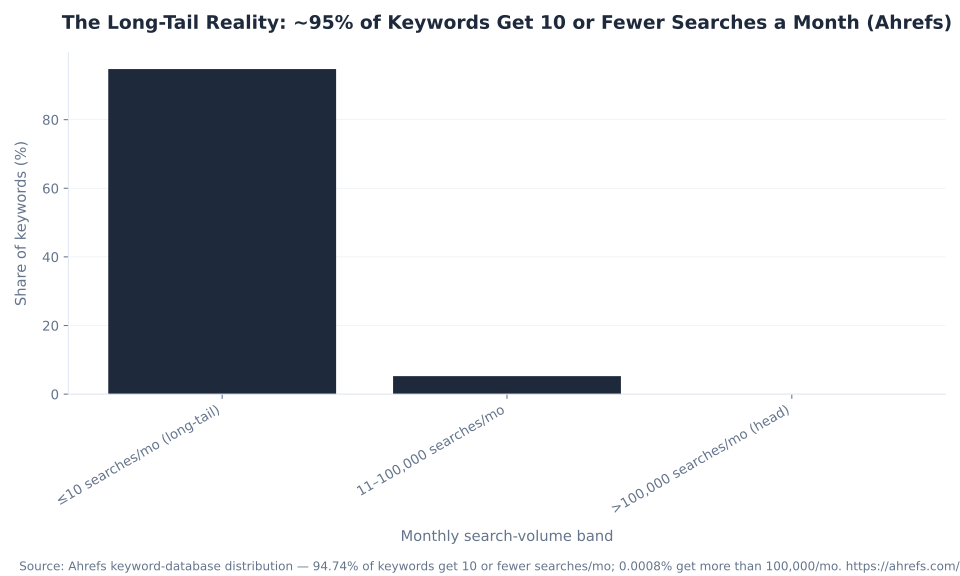
94.74%
of keywords get 10 or fewer searches a month (Ahrefs). A keyword is the query your page aims to be the best answer for — and in 2026 Google matches the meaning behind it, not the exact string.
Google reads meaning via BERT (into Search Oct 2019) & MUM (May 2021) · most demand lives in the long tail · third-party volume & Keyword Difficulty are modeled estimates, not Google figures
What Are Keywords in SEO?
A keyword in SEO is the word or phrase a person types into a search engine — and, from your side of the screen, the query you want a page to be the best answer for. That is the whole literal definition: a keyword is the search query you want a page to rank for. Good SEO is choosing queries that match real demand and your ability to win, matching each query to the searcher’s intent, and then writing the genuinely best answer. It is not sprinkling an exact-match phrase across a page at some target density.
The single most damaging leftover from 2010s SEO is the idea that ranking is about placing an exact phrase often enough. Since Google rolled BERT into Search on October 25, 2019 and announced MUM in May 2021, Google interprets queries with natural-language models, entities, and embeddings. It understands that “how do I get my site to show up on Google” and “why isn’t my page ranking” are close in meaning even though they share almost no words. So you optimize a page for a topic and an intent, cover it comprehensively, and let Google map the many phrasings to your content.
| Concept | What it means | Why it matters |
|---|---|---|
| Keyword / query | The word or phrase a person types into search — and, from your side, the query you want a page to be the best answer for | You optimize a page for a topic and an intent, not for a string to repeat |
| Short-tail (head) term | A short, high-volume, high-competition query, often 1–2 words (e.g. “keyword research”) | Broad intent and hard to win; a handful of terms, enormous competition |
| Long-tail keyword | A longer, lower-volume, higher-intent query, often 3+ words or a full question (e.g. “how to do keyword research for a new blog”) | Most keywords are long-tail; easier to win and usually higher-converting |
| Search intent | What the searcher is trying to do — informational, navigational, commercial, or transactional | Match your page type and format to the intent behind the keyword |
| Keyword stuffing | Repeating an exact phrase to hit a “density” target | Obsolete and harmful; Google reads meaning with NLP and embeddings, not repetition |
Sources: Google, BERT into Search (Oct 25, 2019); Semrush, search intent; Ahrefs, long-tail keywords. Not mbadv data.
If you are new to the discipline entirely, start with what SEO is, then move to writing SEO content for intent. This page is the keyword layer that sits between them: how to choose the right queries, read their metrics honestly, and match each to the page that serves it. MB Adv Agency frames the whole exercise the same way for every business — keyword research is where organic search and paid search meet, and the intent map you build for content is the same input a well-run paid campaign uses.
How Google Reads a Query: Meaning, Not Strings
The practical consequence of BERT and MUM is that a keyword is a meaning to satisfy, not a token to match. BERT (Bidirectional Encoder Representations from Transformers) went into Search on October 25, 2019, affecting about 10% of US English queries at launch and now applied to nearly all English queries. MUM (Multitask Unified Model), announced at Google I/O in May 2021, is multimodal and multilingual and was described as about 1,000 times more powerful than BERT. Together they are why keyword-string matching and mechanical density targets are obsolete.
This changes what a keyword strategy is for. You are no longer trying to guess the exact phrasing a searcher will use; you are identifying the topic and the intent, and covering that topic so completely that Google can confidently match your page to the hundreds of ways the same question gets asked. Over-repeating an exact phrase does not just fail to help — it reads as low-quality, keyword-stuffed content and works against you. For the full picture of how Google crawls, indexes, and matches meaning to queries, see how search engines work.
There is a useful way to picture the shift. Older search behaved like a card catalog: it looked for pages that contained the exact words you typed, so writers gamed the system by repeating those words. Modern search behaves more like a well-read librarian: it understands that “a cheap flight to the coast” and “affordable airfare to a beach town” describe the same need, and it recognizes the real-world entities involved — places, products, people, brands — and how they relate. That is why a page that thoroughly and accurately covers a topic can rank for queries whose exact wording never appears on it. Entity clarity and comprehensive coverage do the work that keyword repetition used to pretend to do.
The rest of this guide follows from that one idea. Because Google reads meaning, the job is choosing the right queries (search demand and the long tail), classifying what the searcher wants (intent), reading tool metrics honestly (volume, Keyword Difficulty, CPC), correcting a myth that still tells writers to chase “LSI keywords,” and running a repeatable research workflow that maps each keyword to one page and builds topical authority through interlinked clusters.
What People Search: This Cluster’s Demand
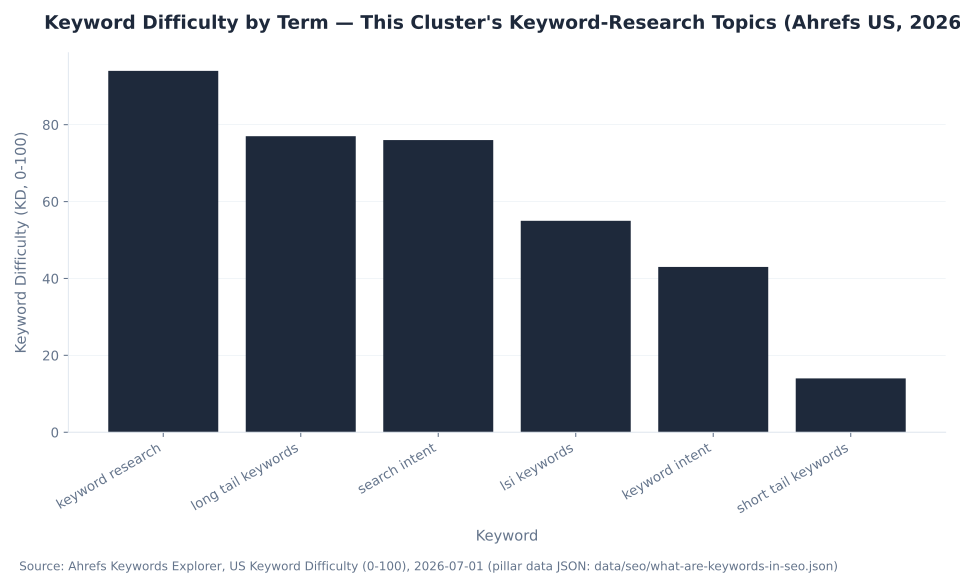
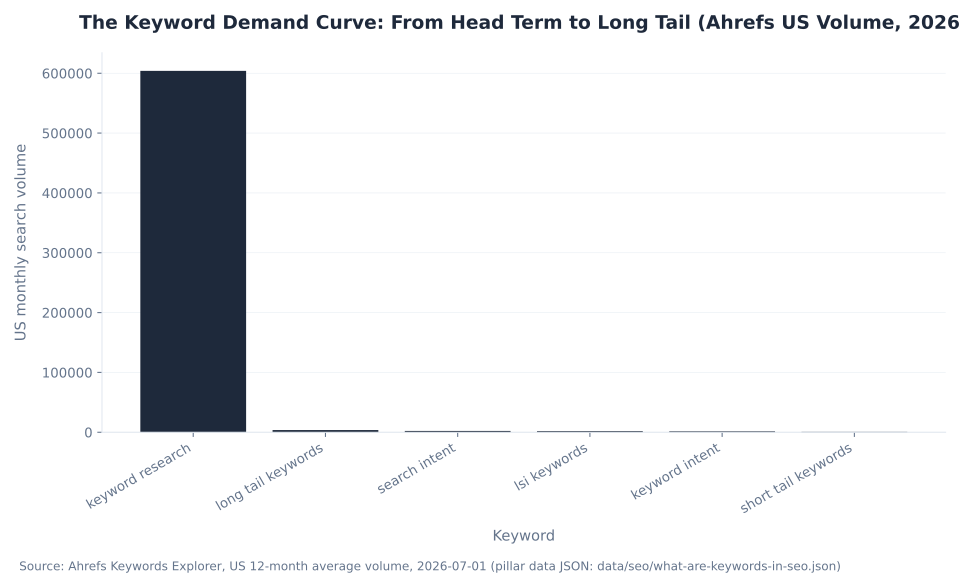
The demand for this topic is dominated by one head term and a set of concept queries. “Keyword research” runs 604,000 US searches a month at Keyword Difficulty 94 (Ahrefs Keywords Explorer, US, 2026-07-01) — the umbrella this page sits under. Around it sit the concept terms this guide answers directly: “long tail keywords” (3,700/mo), “search intent” (2,200/mo), “lsi keywords” (1,900/mo), “keyword intent” (1,500/mo), and “short tail keywords” (700/mo).
| Keyword | US monthly volume | KD | CPC | Role in this pillar |
|---|---|---|---|---|
| keyword research | 604,000 | 94 | $2.00 | The cluster’s true head term — the topical umbrella |
| long tail keywords | 3,700 | 77 | $1.20 | The 2,520-impression toehold this page defends |
| search intent | 2,200 | 76 | $0.90 | Served by the four-intent section |
| lsi keywords | 1,900 | 55 | $2.00 | Answered with the correction, not the myth |
| keyword intent | 1,500 | 43 | $2.50 | Absorbed by the intent section |
| short tail keywords | 700 | 14 | $2.50 | The head / short-tail counterpart |
Source: Ahrefs Keywords Explorer, US 12-month average volume, 2026-07-01 (pillar data JSON), plus the pillar GSC export (90-day window 2026-04-02–2026-07-01, prefix /seo/). Third-party volume and KD are modeled estimates, not Google figures. Not mbadv data.
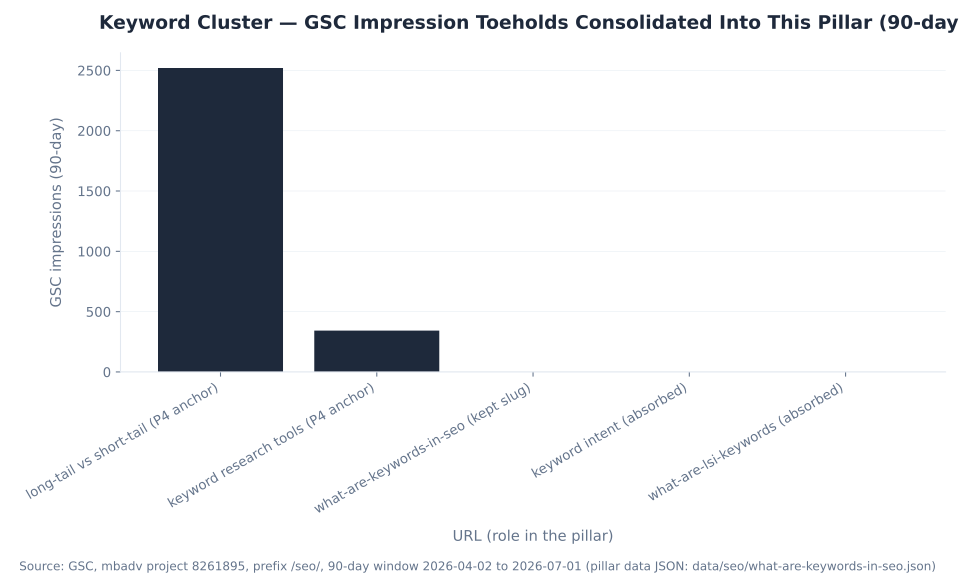
In Search Console, the cluster carries 2,863 impressions and 0 clicks across five URLs in the 90-day window, concentrated in two toeholds: the long-tail-vs-short-tail page (2,520 impressions, average position 40.2) and the keyword-research-tools page (343 impressions, position 37.7). That is why this pillar keeps its slug and consolidates the cluster into named H2 anchors rather than scattering it across thin pages — it preserves those impression toeholds while it builds topical authority. To measure which keywords actually earn clicks and impressions for your own site, use Search Console.
Search Intent: The Four Types of Keyword Intent
Search intent — also called keyword intent — is what the searcher is actually trying to do, and it is the most important thing to get right about a keyword. Two people can type queries with similar volume and difficulty and want completely different things: one wants to learn, the other wants to buy. Semrush’s framework names four types, and the winning move is to align your page type and format to the intent behind the term, not just to the term itself.
| Intent type | What the searcher wants | Example queries | Best-fit page type |
|---|---|---|---|
| Informational | Learn or understand something | “what are keywords in seo”, “how does google rank pages”, “keyword difficulty meaning” | Guide, glossary, or blog post |
| Navigational | Reach a specific site, brand, tool, or page | “ahrefs keywords explorer”, “google keyword planner login”, brand names | Homepage, branded landing page, or login page |
| Commercial (investigation) | Compare options before buying | “best keyword research tool”, “ahrefs vs semrush”, “moz keyword explorer review” | Comparison, “best-of,” or review page |
| Transactional | Take an action or buy now | “buy seo software”, “semrush free trial”, “keyword research service pricing” | Product, pricing, or sign-up page |
Source: Semrush, “What Is Search Intent?”. Example queries are qualitative; per-type share figures (such as “70% of searches are informational”) have no living primary source and are not charted here. Not mbadv data.
Intent decides everything downstream. A commercial-investigation query like “best keyword research tool” needs a comparison page, not a definition; a transactional query needs a product or pricing page, not a blog post. Matching format to intent is also what turns a definition page like this one into SEO content that actually ranks — you serve the reader the thing they came for. When you classify keywords in the research workflow further down, tagging each one by intent is the step that keeps you from building the wrong page for the right keyword.
Long-Tail vs Short-Tail Keywords
Short-tail (head) keywords are short, high-volume, high-competition, and broad in intent — “keyword research” is a head term. Long-tail keywords are longer, lower-volume, lower-competition, clearer in intent, and usually higher-converting — “how to do keyword research for a new blog” is long-tail. The names come from the shape of the demand curve: a few high-volume terms at the head, then a long, thin tail of low-volume terms that, taken together, is where almost all demand lives.
| Attribute | Short-tail (head) | Long-tail |
|---|---|---|
| Length | 1–2 words | 3+ words, often a full question |
| Example | “keyword research” | “how to do keyword research for a new blog” |
| Search volume | High | Low (often 10 or fewer per month) |
| Competition / KD | Usually high | Usually lower |
| Intent clarity | Broad, ambiguous | Specific, clear |
| Conversion propensity | Lower | Higher (clearer intent) |
| Share of all keywords (Ahrefs) | The head is a rounding error — 0.0008% of keywords get more than 100,000/mo | About 94.74% of keywords get 10 or fewer searches a month |
Source: Ahrefs, long-tail keywords and Ahrefs, 107 SEO statistics for 2026 (94.74% of keywords get 10 or fewer searches/mo; 0.0008% get more than 100,000). A share of keywords, not of searches. Not mbadv data.
Here is the honest, sourced version of the long-tail story, because most SEO advice gets it wrong. You will see the claim that “long-tail keywords make up 70% of all searches.” There is no living primary source for that figure. The number that is sourced, and makes the point more powerfully, comes from Ahrefs’ study of its keyword database: about 94.74% of keywords get 10 or fewer searches a month, and only 0.0008% get more than 100,000. That is a distribution of keywords, not of search volume — about 2.3 billion keywords get fewer than 10 searches a month, while just under 18,000 US keywords exceed 100,000. The primary chart on this page plots that distribution. The takeaway is structural: a strategy built only on a handful of head terms leaves almost the entire map of demand untouched, and the winnable, high-intent opportunities live in the tail. For where those keywords go once you have chosen them, see on-page vs off-page SEO.
The practical value of the long tail is compounding coverage. A single long-tail page rarely produces dramatic traffic on its own, but a library of them — each answering one specific question with clear intent — adds up to a broad, durable footprint that head-term competition cannot easily displace. Long-tail queries also convert better because the intent is unambiguous: someone searching “how to do keyword research for a new blog” is further along and easier to serve than someone searching the bare head term “keyword research.” And because the tail is where the vast majority of keywords live, it is also where a smaller or newer site can realistically win while it builds the authority to compete for the head. Treat the head term as the pillar topic and the long tail as the cluster of specific pages that support it.
Keyword Research Tools Compared
The tools split into two camps. Google Keyword Planner uses Google’s own advertiser data, but without an active Google Ads spend it shows broad ranges rather than exact volumes, and its “Competition” column is an ad-auction metric for advertisers, not a measure of organic ranking difficulty. The third-party trio — Ahrefs, Semrush, and Moz — report modeled search volume plus each tool’s own proprietary Keyword Difficulty on a 0–100 scale.
| Tool | Volume data | Difficulty / competition metric | Notable |
|---|---|---|---|
| Google Keyword Planner | Ranges (e.g. “1K–10K”) without active Ads spend; exact numbers only with active spend | “Competition” (Low / Medium / High) — an ad-auction metric, not organic difficulty | Free with a Google Ads account; data is Google’s own, built for advertisers |
| Ahrefs Keywords Explorer | Modeled monthly volume, clickstream-corrected | Keyword Difficulty (KD 0–100), proprietary | Large keyword database; parent-topic and SERP data |
| Semrush Keyword Magic | Modeled volume | Keyword Difficulty %, proprietary | Intent labels and keyword clustering |
| Moz Keyword Explorer | Modeled volume | Keyword Difficulty plus Priority, proprietary | Organic-CTR estimate |
Sources: Google Ads Help, Keyword Planner; Ahrefs keyword-research guide; Moz Keyword Explorer. Third-party volume and KD are modeled estimates that differ tool-to-tool. Not mbadv data.
The discipline that keeps a keyword plan honest is simple: use one tool’s numbers consistently for relative comparison (this term versus that term), and never present a third-party volume or Keyword Difficulty as a hard Google fact. The secondary chart on this page shows the Keyword Difficulty this cluster’s own terms carry in Ahrefs — the head term “keyword research” scores 94, while the niche meta-term “short tail keywords” scores 14, because KD reflects how hard a term is to rank for, not the length of the keywords it describes. Semrush and Moz would score the same terms differently. Turning that research into paid results is where our PPC campaign management picks up.
Keyword Metrics Defined: Volume, Difficulty, CPC
Four numbers travel with every keyword, and each measures something specific. Search volume is estimated monthly demand. Keyword Difficulty (KD) is a proprietary 0–100 estimate of how hard the term is to rank for. CPC is the average paid cost-per-click — a commercial-value proxy borrowed from advertising, not an SEO ranking input. And SERP features, including AI Overview presence, describe what the results page looks like and therefore how many clicks a ranking actually earns.
| Metric | What it measures | Who reports it | Caveat |
|---|---|---|---|
| Search volume | Estimated monthly searches for a keyword | Ahrefs / Semrush / Moz (modeled); Google Keyword Planner (ranges) | Third-party volumes are modeled estimates, not Google’s true counts; Keyword Planner shows ranges without active Ads spend |
| Keyword Difficulty (KD, 0–100) | Estimated difficulty of ranking on page one | Ahrefs / Semrush / Moz (each proprietary) | Not a Google metric; each tool computes it differently, so scores do not match across tools |
| CPC | Average paid cost-per-click for the term | Ahrefs / Semrush / Google Ads | A paid-search signal and commercial-value proxy, not an SEO ranking input |
| SERP features / AI Overview presence | What appears on the results page for the query | Ahrefs / Semrush | Shapes real organic CTR — an AI Overview cuts clicks even for a page that ranks |
| Illustrative (this cluster) | “keyword research”: volume 604,000, KD 94, CPC $2.00 | Ahrefs Keywords Explorer, US, 2026-07-01 | A modeled estimate; the head term is high-volume and high-difficulty at once |
Source: Ahrefs keyword-research guide; volume, KD, and CPC for this cluster from the pillar data JSON (Ahrefs Keywords Explorer, US, 2026-07-01). Third-party figures are modeled estimates, not Google counts. Not mbadv data.
Reading these numbers well means treating them as directional. Only Keyword Planner uses Google’s own data, and even it shows ranges without active spend; everything else is modeled, and each tool’s KD is its own model, so the same keyword can read 40 in one tool and 60 in another. Sanity-check against the live SERP — who actually ranks, and is there an AI Overview eating clicks? CPC is the fastest read on a keyword’s commercial value, which is exactly why the same terms feed paid campaigns; for the paid metrics that sit alongside these, see Google Ads metrics and KPIs.
The Keyword Demand Curve: Head to Long Tail
The clearest way to see the head-to-tail idea is to line up real volumes. The head term “keyword research” runs 604,000 US searches a month; the concept terms around it run in the thousands; and beyond them stretches a tail of terms running in the tens, ones, and zeros. The context chart on this page plots this drop-off — from 604,000 down to 700 — which is the long-tail-versus-short-tail story in a single image.
| Term | US monthly volume | KD | Segment |
|---|---|---|---|
| keyword research | 604,000 | 94 | Head |
| long tail keywords | 3,700 | 77 | Torso |
| search intent | 2,200 | 76 | Torso |
| lsi keywords | 1,900 | 55 | Torso |
| keyword intent | 1,500 | 43 | Long-tail-ish |
| short tail keywords | 700 | 14 | Long-tail |
Source: Ahrefs Keywords Explorer, US 12-month average volume, 2026-07-01 (pillar data JSON). Third-party volumes are modeled estimates, not Google’s true counts. Not mbadv data.
The demand curve is why volume alone is a poor way to prioritize. The head term dwarfs everything, but it is also the hardest to win (KD 94) and the broadest in intent; most keyword demand sits in a long tail of low-volume, high-clarity terms where a focused page can actually rank. Read the curve as a map: cover the head topically through a strong pillar, and win the tail through specific pages that answer specific questions. For the paid-media hub that uses the same demand data, see our PPC services.
“LSI Keywords”: The Correction
A large amount of published SEO advice still tells writers to “add LSI keywords.” Google’s John Mueller settled this on the record in 2019: “There’s no such thing as LSI keywords.” LSI (Latent Semantic Indexing) is a 1980s information-retrieval technique built for small, fixed document collections; it has nothing to do with how a web-scale, transformer-driven search engine works today. Repeating the myth marks content as dated.
| Claim | Reality |
|---|---|
| “Google uses LSI keywords to rank pages” | False. John Mueller of Google said in 2019: “There’s no such thing as LSI keywords.” LSI (Latent Semantic Indexing) is 1980s technology for small, fixed document sets — not modern web-scale search |
| “You must sprinkle LSI keywords or hit a keyword density” | Reframe. There is no density target. Include genuinely related and semantically relevant terms and entities that a comprehensive answer naturally covers |
| “So how does Google understand a query?” | NLP, entities, and embeddings. BERT (into Search Oct 2019, about 10% of US English queries at launch, now near-universal for English) and MUM (announced May 2021, multimodal and multilingual, about 1,000× more powerful than BERT). Google reads meaning, not keyword strings |
Sources: Search Engine Roundtable (Mueller, 2019); Google, BERT into Search (Oct 25, 2019). Google does not use LSI. Not mbadv data.
The kernel of truth people are reaching for is real and useful: comprehensive content naturally includes related and semantically relevant terms and entities, and covering a topic fully — not hitting a keyword quota — is what helps. So the correct move is to reframe. Do not hunt “LSI keywords”; write the genuinely complete answer and let Google’s language understanding do the semantic matching. This is one of the highest-value corrections on the page, because so much competing content gets it wrong — and it is exactly the direction AI is taking SEO, toward entities and meaning rather than strings.
How to Do Keyword Research (Step by Step)
Keyword research is a repeatable workflow, not a one-time list. You start from the topics your audience cares about, expand them into a raw list, attach honest metrics, classify each keyword by intent, prioritize for winnability rather than raw volume, and map each keyword or cluster to a single page. The last step matters most: the pillar-and-cluster model — one broad pillar plus interlinked cluster pages mapped to related keywords — is what builds topical authority.
| Step | What you do | Output |
|---|---|---|
| 1. Seed topics | List the core topics and services your audience searches for | Seed list |
| 2. Expand | Use a tool (Keyword Planner / Ahrefs / Semrush) plus autocomplete and People Also Ask to expand the seeds | Raw keyword list |
| 3. Add metrics | Pull volume, Keyword Difficulty, intent, and SERP features / AI Overview presence | Scored list |
| 4. Classify intent | Tag each keyword informational / navigational / commercial / transactional | Intent-mapped list |
| 5. Prioritize | Balance relevance × intent × winnability × business value; favor winnable long-tail over vanity head terms | Shortlist |
| 6. Map to pages | Assign each keyword or cluster to one page; build topic clusters (a pillar plus interlinked cluster pages) | Keyword-to-URL map |
Sources: Ahrefs keyword-research guide; HubSpot, topic clusters (the pillar-and-cluster model, 2017). Not mbadv data.
The prioritization step is where most of the value is created, because it is where you resist the pull of vanity head terms. A winnable long-tail keyword with clear intent — even at 10 searches a month — often drives more qualified traffic per unit of effort than a head term you cannot realistically rank for. This same intent map is a shared asset: it feeds B2B content and B2B paid search alike, which is why our B2B PPC team and verticals such as SaaS and software PPC build from the same keyword and intent research an SEO team does.
Keywords in SEO vs Keywords in Google Ads
The same word has two jobs. In SEO, a keyword is a topic you earn a ranking for over time, with no per-click cost and no control over match — Google matches the meaning of a query to your content. In Google Ads, a keyword is a term you bid on and control with match types (broad, phrase, exact), paying per click for immediate placement. Keyword research feeds both, which is the honest agency angle on this whole topic.
| Aspect | SEO keywords | Google Ads keywords |
|---|---|---|
| What they are | Topics and queries you optimize content to rank for organically | Terms you bid on to trigger ads |
| Match control | None — Google matches meaning to your content | Match types (broad / phrase / exact) control triggering |
| Cost | No per-click cost (organic) | Pay-per-click (CPC) |
| “Difficulty” signal | Keyword Difficulty (a third-party estimate) | Auction competition plus CPC |
| Speed | Slow and compounding | Immediate, for as long as you pay |
Source: cross-glossary — Google Ads keywords and match types; Google Ads Help (auction and match types). Not mbadv data.
The recommendations chart on this page shows why the anchors on this page matter: it plots the Search Console impression toeholds this pillar consolidates — long-tail-vs-short-tail (2,520 impressions) and keyword-research-tools (343) — that the named H2 sections above receive and defend. The strategic point is broader than one page: the intent map and demand data you build for content are the same inputs a well-run paid-search campaign uses, and the fastest read on a keyword’s commercial value is often its CPC. The businesses that get the most out of both treat keyword research as one exercise feeding two channels — routing the highest-intent, highest-value terms to paid through work like lead-generation PPC (strong in verticals such as financial-services PPC) while compounding topical authority organically.
Keyword Research Feeds Two Channels
Route the highest-intent, highest-value keywords to paid search
MB Adv Agency runs the paid campaigns — Google Ads and PPC — that complement your organic keyword work, so your best-converting queries earn traffic immediately while your content compounds. Talk to our team about the paid side of search.
Talk to our team →How AI and Entities Are Changing Keywords
The direction of travel is away from keyword strings and toward topics, entities, and meaning. Google Search Central describes a system that matches the meaning of a query, and AI Overviews and AI Mode extend that further — they read a question, synthesize an answer, and cite sources. Visibility increasingly depends on entity clarity, comprehensive coverage, and being the genuinely best answer, not on hitting an exact phrase.
That does not retire keyword research; it sharpens it. You still need to know what people search, how much demand exists, and what they intend — but you use that map to build entity-rich, comprehensively-covered topics rather than thin exact-match pages. Answer Engine Optimization (being the extracted answer in snippets, voice, and AI boxes) and Generative Engine Optimization (being cited inside AI answers) are extensions of the same discipline: cover the topic completely, structure it clearly, and earn the citation. Keeping up with how Google’s systems reward this is a moving target — see understanding Google algorithm updates for the broader context.
Keyword Mistakes to Avoid (the Corrections)
Four beliefs cause most keyword mistakes, and each one has a named correction. Getting these right is what separates a page like this from the thin content it consolidates — and they are the passages most likely to be cited by an AI answer engine, so they are worth stating plainly and declaratively.
“LSI keywords help your rankings.” No. Google does not use LSI (Mueller, 2019); the useful version is to include genuinely related terms and entities by covering the topic fully. “A higher-volume keyword is always better.” No. High-volume head terms are usually high-competition and broad-intent; a winnable long-tail term with clear intent often drives more qualified traffic per unit of effort, and the tail is where about 94.74% of keywords live (Ahrefs). Prioritize relevance, intent, winnability, and business value over raw volume.
“Long-tail keywords are 70% of all searches.” No. There is no living primary source for that figure; the defensible finding is a distribution of keywords, not searches — about 94.74% of keywords get 10 or fewer searches a month. “You should hit a target keyword density.” No. There is no density target and no safe percentage; Google matches meaning, and over-repeating an exact phrase reads as keyword-stuffed content. MB Adv Agency’s honest angle is narrow and clear: we do not sell SEO services, we run the paid campaigns that complement your organic keyword work — and the same discipline that keeps a keyword plan honest (name your source, prioritize intent over volume) is the discipline that keeps a paid budget honest. For where keywords sit on the page itself, see on-page vs off-page SEO.
Keywords in SEO: Frequently Asked Questions
Turning Keywords Into Leads?
Put your highest-intent keywords to work in paid search
Your keyword and intent research is the same input a well-run paid campaign uses. Our team audits where the budget goes and builds campaigns around the terms that convert.
Google Ads PPC audit →All PPC servicesMethodology & Sources
Every number in this guide is either an Ahrefs or Search Console figure from the pillar data JSON (US, 2026-07-01) or a named external authority: Ahrefs’ long-tail study, Semrush’s intent framework, Google’s BERT and MUM announcements, John Mueller via Search Engine Roundtable, and each tool’s own documentation. No figure appears without a named source.
Two accuracy rules are enforced throughout. First, the long-tail figure is a share of keywords, not of searches: this guide states “about 94.74% of keywords get 10 or fewer searches a month” (Ahrefs) and refutes the sourceless “long-tail = 70% of all searches” claim rather than repeating it. Second, “LSI keywords” are not a Google signal (Mueller, 2019); the concept is reframed as related and semantic terms, with meaning handled by BERT and MUM. Third-party volume and Keyword Difficulty are presented as modeled estimates, not Google figures, and no WordStream or LocaliQ paid-search figure is used, because it does not describe SEO keyword demand.
MB Adv Agency has no SEO service page and no SEO client dataset, so the point of view here stays qualitative: our team, the campaigns we run, and the businesses we help that also invest in organic search. No mbadv client metric appears anywhere in this guide. MB Adv Agency runs the paid side — Google Ads and PPC — that complements organic keyword work. Last updated 2026-07-01. To discuss the paid search that complements your keyword strategy, talk to our team.
Search Engine Optimization, commonly referred to as SEO, is a vital component of digital marketing that aims to enhance the visibility of a website in search engine results. One of the most fundamental elements of SEO is the use of keywords. In this article, we will explore what keywords are, provide definitions and examples, analyze how they impact search rankings, and offer tips for effective keyword selection.
What Are Keywords in SEO?
Keywords are words or phrases that users type into search engines when looking for information, products, or services. They serve as the bridge between what people are searching for and the content you offer. By optimizing your content with targeted keywords, you increase the chances of appearing in relevant search results.
In essence, keywords function as the main themes of your content. They help search engines determine the subject matter of your webpage, enabling the algorithm to display your site to users who are searching for related terms. Keywords can range from single words to longer phrases known as long-tail keywords, which are typically more specific and less competitive.
Definition and Examples
To better understand keywords, it's crucial to define the terms used in SEO. The simplest way to categorize keywords is into three types: short-tail, mid-tail, and long-tail keywords. Short-tail keywords are typically one or two words, such as "shoes" or "travel." These keywords tend to have high search volumes but can also be highly competitive.
In contrast, long-tail keywords consist of three or more words, such as "best running shoes for women" or "budget-friendly travel destinations in Europe." These keywords may attract fewer searches, but they often target a more specific audience, resulting in higher conversion rates.
For example, a website that sells running shoes could optimize for short-tail keywords like "shoes" but could also benefit from targeting long-tail keywords like "best running shoes for flat feet." By incorporating both types of keywords into their content strategy, the website can reach a broader audience while also catering to specific consumer needs. Additionally, utilizing mid-tail keywords, which fall between short-tail and long-tail in terms of length and specificity, can provide a balanced approach, allowing businesses to capture traffic that is both relevant and moderately competitive.
How keywords impact search rankings
Understanding how keywords affect search rankings is essential for any SEO strategy. Search engines use complex algorithms to determine which pages to display in response to a user's query. Keywords play a critical role in this process by indicating the relevance of your content to that search query.
When you strategically incorporate keywords into your webpages—be it in titles, headers, meta descriptions, or throughout the content itself—you signal to search engines that your site is relevant to those terms. The better the match between the search query and your keywords, the higher your chances of ranking well in search results.
However, it's important to note that keyword placement should feel natural and not forced. Overusing keywords, a practice known as keyword stuffing, can lead to penalties from search engines, ultimately harming your rankings. The key is to use keywords thoughtfully and in a way that enhances the user experience. Moreover, keeping abreast of keyword trends and user intent is vital; as search behaviors evolve, so too should your keyword strategy. Tools like Google Trends and keyword research platforms can provide insights into emerging keywords and shifts in user interest, allowing you to adapt your content accordingly.
Tips for effective keyword selection.
Choosing the right keywords is essential for driving relevant traffic to your website. Below are some tips to help you select effective keywords that align with your business goals:

- Research Your Audience: Understanding your target audience's needs and preferences is fundamental. Utilize tools such as Google Keyword Planner or SEMrush to see what terms they search for.
- Analyze Competitors: Look at websites similar to yours. Investigating the keywords they're ranking for can provide insights into potential opportunities for your own strategy.
- Focus on Long-Tail Keywords: While they may have lower search volumes, long-tail keywords generally face less competition and can lead to higher conversion rates.
- Consider Search Intent: Different keywords can indicate different intentions behind a search. Determine whether users are looking for information, a product, or a service, and tailor your keywords accordingly.
- Regularly Update Your Keywords: The digital landscape is ever-evolving. Regularly revisiting your keyword strategy to incorporate new trends or changes in consumer behavior is essential.
By applying these tips, you can refine your keyword selection process, making your content more accessible to potential visitors. Additionally, consider leveraging social media platforms to gauge what topics are currently trending among your audience. Engaging with users through polls or discussions can yield valuable insights into their interests and concerns, which can be translated into effective keywords. Furthermore, utilizing analytics tools to track the performance of your selected keywords can help you identify which ones are driving traffic and conversions, allowing you to optimize your strategy over time.
Moreover, don't underestimate the power of local SEO in your keyword strategy. If your business serves a specific geographic area, incorporating location-based keywords can significantly enhance your visibility in local search results. This approach not only helps in attracting nearby customers but also fosters a sense of community around your brand. As you refine your keyword selection, keep an eye on emerging trends and technologies that could influence search behavior, such as voice search and AI-driven queries, to stay ahead of the competition.
Conclusion
Keywords are a fundamental element of any SEO strategy. They serve as the cornerstone for connecting content with users actively searching for information. By understanding the types of keywords, their impact on search rankings, and employing effective selection strategies, businesses can enhance their online presence and drive more relevant traffic to their websites.

Ultimately, effective keyword use not only helps improve search visibility but also enriches the user experience, leading to greater satisfaction and potentially higher conversion rates. It’s a crucial part of digital marketing that requires ongoing attention and adaptation to stay ahead in the competitive online landscape.

As a Google Ads expert, I bring proven expertise in optimizing advertising campaigns to maximize ROI.
I specialize in sharing advanced strategies and targeted tips to refine Google Ads campaign management.
Committed to staying ahead of the latest trends and algorithms, I ensure that my clients receive cutting-edge solutions.
My passion for digital marketing and my ability to interpret data for strategic insights enable me to offer high-level consulting that aims to exceed expectations.
Google Partner Agency
We're a certified Google Partner Agency, which means we don’t guess — we optimize withGoogle’s full toolkit and insider support.
Your campaigns get pro-level execution, backed by real expertise (not theory).

4.9 out of 5 from 670+ reviews on Fiverr.
That’s not luck, that’s performance.
Highly recommend Matteo to set up your server side tracking. He has a deep understanding of e-commerce tracking and will go above and beyond to make sure everything is set up correctly and working 100%. If you are scaling your store this set up is non-negotiable in my opinion and there isn't many people who have this much knowledge or put the effort in to get it right. Thanks again!
avorodesign.com
I can only recommend Matteo! He was very patient, professional and very knowledgeable about GA4, Consent Mode v2, and GDPR compliance. Communication was clear, and the setup was done professionally and efficiently. Highly recommend him for anyone needing reliable tracking implementation.

www.natureiki.life
Matteo shines in the realm of online professionals. His work is not only deep in data but also complemented by his proactive communication and cooperation, setting a new standard for freelancers. If you want someone who truly exceeds expectations, look no further. Highly recommended!

www.omanbeverlysmyth.com
Exceptional Service Beyond Expectations - Outstanding Service Impeccable depth, flawless delivery, and exceptional language fluency—this service exceeded all expectations. Highly recommended. Matteo truly ROCKS!!!

ium-paris.com
Top-notch, always highly value working with Matteo. An absolute Google Ads Genius. This is approximately the 8th time I have hired him and he's helped us get 6-7 ROAS. We are excited in continuing to improve our lead flow. Hire this guy if you need Google Ads help. Thanks Matteo!

www.dleeventgroup.com
I finally found the guy who can setup server side tracking and all the ecosystem properly. I definitely recommend Matteo. He is very responsive, kind and wants to dig into things. He configured GA4, Meta, Google Ads, Outbrain and google consent v2 with Cookiebot. Thanks Matteo.

inomega.fr
MB Adv delivered exceptional work with outstanding professionalism and lots of patience, taking time to see effects of changes made and not just do the work and submit it. The proactive communication and video summaries of the work completed made working with Matteo a pleasure, as he consistently went above and beyond. Highly recommended for web analytics projects! We are already working on another project.

www.withnellsensors.co.uk
Working with Matteo on my Google Ads was a game-changer. He's not just a strategist, he's a true partner. He understood my goals and tailored a campaign that perfectly reached my target audience. I'm grateful for his expertise and dedication.

dccargo.com
Click-driven mind
with plastic-brick obsession.
We build Google Ads campaigns with the same mindset we use to build tiny brick worlds: strategy, patience, and zero tolerance for wasted pieces.
Data is our blueprint. Growth is the only acceptable outcome.

Read other
Insights






Book a call!
Ready to stop guessing and start winning? Fill out the form — we’ll take it from here.