Google Search Console Performance Report & Search Analytics
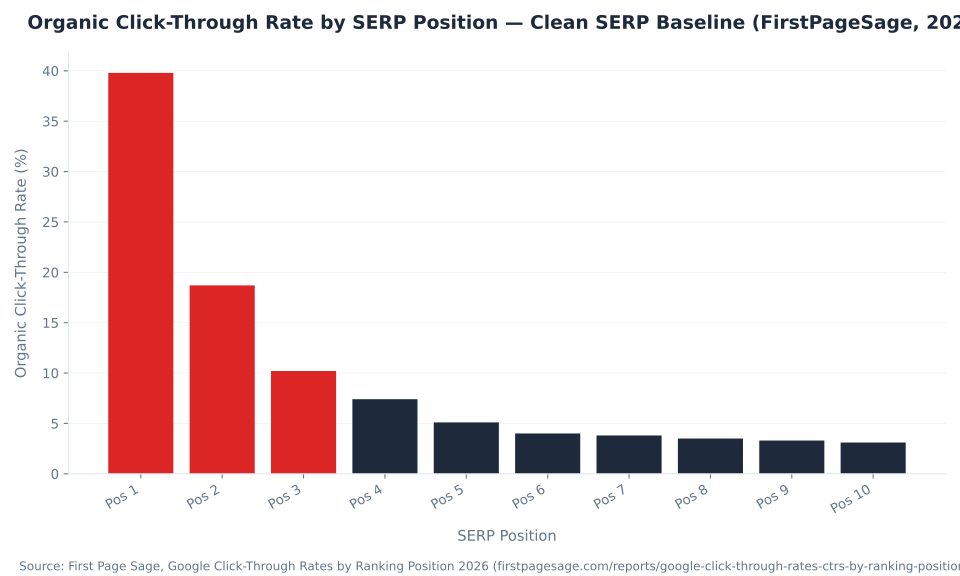
Position 1 organic CTR — clean SERPs (FirstPageSage, 2026)
39.8%
Position 2 captures 18.7% — the largest single gap on any SERP.
On AI Overview queries, position 1 CTR drops to 1.6% (Ahrefs, Feb 2026).
46.77%
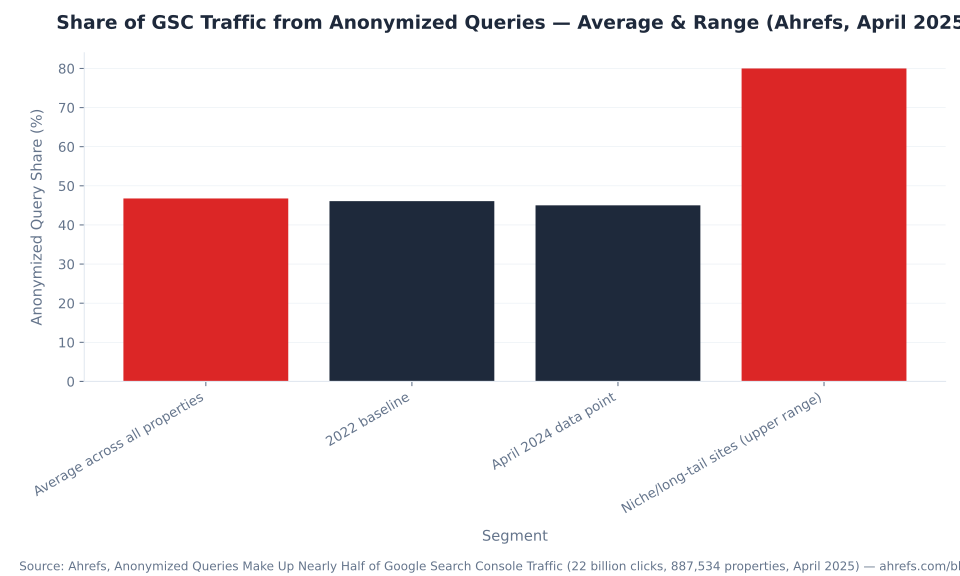
Queries anonymized in GSC (Ahrefs, 22B clicks, Apr 2025)
50,000
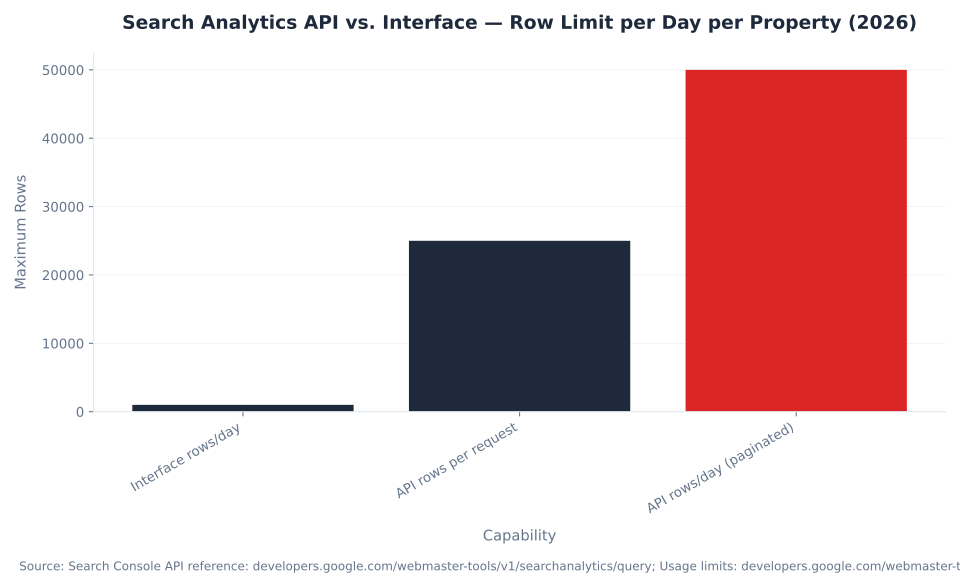
Max rows/day via Search Analytics API (vs. 1,000 in the interface)
16 mo.
Performance data retention — rolling window, no retroactive archive
What Is the GSC Performance Report?
Google Search Console's Performance report is the diagnostic core of the platform — and its four metrics are the most systematically misread numbers in organic search. Clicks, Impressions, CTR, and Average Position appear side by side, but they are not a flat list. They are a diagnostic chain, and reading any one of them correctly requires understanding its relationship to the others.
The chain runs in one direction. Impressions measure coverage: how often Google served one of your URLs in results. Clicks measure response: how many users acted on those appearances. CTR captures the ratio — Clicks divided by Impressions — which is a snippet quality signal, not a traffic signal. Average Position locates where those impressions appeared, which sets the realistic ceiling for any CTR benchmark comparison. A page averaging position 8 with a 2.1% CTR is not underperforming — that is within range for its position. A page averaging position 1 with a 2.1% CTR is a serious problem.
The practical diagnostic flow runs the same direction. Low impressions on a page you expect to rank point to an upstream problem: indexing, crawlability, or content relevance — see Index Coverage & Indexing in GSC before adjusting any content. High impressions with low clicks point to the snippet. Acceptable CTR with inadequate volume closes the case at Average Position: positions 6–10 collectively earn 1–4% CTR regardless of title quality, and no amount of meta-description optimization overcomes a page-2 position.
The 2025–2026 period introduced three compounding factors that require explicit context before interpreting any Performance data from this window. On September 11, 2025, Google deprecated the &num=100 URL parameter, eliminating bot-driven impressions for deep-result positions that had suppressed Average Position figures for years. AI Overviews — present on a growing share of informational queries — compressed organic CTR at every position: Ahrefs' February 2026 analysis of 300,000 keywords found position 1 CTR falling from 7.3% (December 2023 baseline) to 1.6% (December 2025) on AI Overview-triggered queries. And a GSC logging bug inflated impressions platform-wide from May 13, 2025 through April 27, 2026 — clicks were not affected, but CTR and Average Position derived from those inflated impression counts are unreliable for that window.
For a full orientation to GSC's report inventory and property verification, see What is Google Search Console. For the SEO measurement context — how Performance data relates to Google Analytics 4 session counts, rank tracker position data, and backlink signals — the Performance report is the one data source that cannot be replicated outside Google's own infrastructure.
Key Takeaways
- GSC's Performance report tracks four metrics — Clicks, Impressions, CTR, and Average Position — that form a diagnostic chain, not a flat list. Read them in sequence to locate where the problem is, not just that a problem exists.
- Average Position is an impression-weighted arithmetic mean across all users, geographies, device types, and personalization signals. It reads better than rank tracker output by design — both numbers are correct; they measure different things.
- On clean SERPs, position 1 earns 39.8% of clicks and position 2 earns 18.7% — a 21-percentage-point gap that is the largest single positional drop on the page (FirstPageSage, 2026). The top three positions together capture 68.7% of all clicks.
- Ahrefs' April 2025 analysis of 22 billion clicks across 887,534 GSC properties found anonymized queries account for 46.77% of all GSC traffic. The Queries table always shows a partial view — the chart totals always exceed the table row sums.
- The Search Analytics API returns up to 50,000 rows per day per property per search type (versus 1,000 in the interface) and includes hourly data for the last 10 days via the
HOURdimension. - GSC retains 16 months of Performance data on a rolling basis. Data older than 16 months is permanently deleted; there is no retroactive recovery once it ages out.
- GSC impressions from May 13, 2025 through April 27, 2026 are permanently inflated due to a platform-wide logging bug. Clicks from that window are reliable; impression-derived metrics (CTR, Average Position) are not benchmarks for that period.
68.7%
of all organic clicks go to positions 1–3 on clean SERPs (FirstPageSage, 2026)
46.77%
of GSC traffic comes from anonymized queries invisible in the Queries table (Ahrefs, Apr 2025)
50,000
rows/day available via Search Analytics API vs. 1,000-row interface cap
58%
CTR reduction for position-1 pages on AI Overview-present queries (Ahrefs, Feb 2026)
The Four Performance Metrics: Definitions, Counting Rules, and Diagnostic Use
GSC defines each metric precisely, and the counting rules contain edge cases that explain most of the data discrepancies that trip up practitioners. The table below draws directly from Google's authoritative documentation at support.google.com/webmasters/answer/7042828.
| Metric | Google's definition | Counting rule | Critical edge case + diagnostic use |
|---|---|---|---|
| Clicks | How often someone clicked a link from Google to your site | Each click routing the user to your site; if a user clicks, presses Back, and clicks again, both clicks count. Duplicate URL clicks count against the canonical URL, not the clicked URL. | Edge case: Clicks in Discover or Google News are counted in those separate reports, not here. Use: Absolute traffic volume; baseline for session reconciliation against GA4 (note: GSC counts clicks, GA4 counts sessions — one user, multiple clicks = one session). |
| Impressions | How often someone saw a link to your site on Google | Web search: recorded when the user views the SERP page — even if the result is not scrolled into view. Image search (infinite scroll) and Discover: result must scroll into view to count. Compound elements (Knowledge Panels): count as 1 impression by property, N impressions by page. | Edge case: If the user never loads page 2 of results, your page-2 results receive zero impressions — "0 impressions" does not mean a page did not rank. Use: Coverage signal. Low impressions → indexing or query-coverage problem, not necessarily a ranking failure. |
| CTR | Clicks ÷ Impressions × 100 | Per-row: that row's clicks ÷ that row's impressions. Chart-level total: all clicks ÷ all impressions including anonymized queries. Table row sums never equal chart totals because anonymized queries are excluded from table rows but counted in chart totals. | Edge case: CTR increase driven by impression loss (fewer but more targeted queries showing your result) is not a win — traffic volume fell. Use: Snippet quality signal. Benchmark against position (see Table 4); always read alongside absolute Clicks. |
| Average Position | Average position of the topmost result from your site for a given query or grouping | Arithmetic mean of the position of your topmost result across all qualifying impressions: SUM(position) ÷ SUM(impressions). Aggregated across all users, geographies, devices, and personalization signals in the date range. A query at position 2 in 1,000 impressions + position 14 in 1 impression = Average Position 2.01. | Edge case: Results on page 2 that received no impressions are excluded from the average — they do not pull it down. Use: Ranking health at portfolio scale. Discrepancies vs. rank trackers are expected (see the Average Position section below). Cross-reference with Impressions to distinguish shallow-but-broad from deep-but-narrow positioning. |
One implication of these counting rules is consistently missed: the CTR you calculate from the Queries table is never the true property-level CTR. Anonymized queries (those not issued by enough users to clear Google's privacy threshold) appear in the chart totals but are absent from the table rows. For a typical site, Ahrefs' April 2025 analysis found this gap accounts for 46.77% of all traffic — meaning table-level CTR calculations always overstate the ratio against the full impression pool. The chart header is the correct denominator for property-level CTR.
Organic CTR by SERP Position: The 2026 Benchmark Data
The most actionable use of the Performance report is comparing your CTR at each position against external benchmarks. If your position-1 pages are delivering 8% CTR and the clean-SERP baseline for position 1 is 39.8%, the gap is the diagnostic — not the position itself.
| SERP Position | Organic CTR — clean SERP (FirstPageSage 2026) | Context |
|---|---|---|
| Featured Snippet (pos. 0) | ~43% | Highest average CTR for informational queries; zero-click risk is a separate question from the click that does occur |
| Position 1 | 39.8% | Clean-SERP baseline. AWR Q4 2025: position 1 desktop CTR fell 3.20 pp vs. Q3 2025 — continued compression. On AI Overview queries: 1.6% (Ahrefs, Feb 2026) |
| Position 2 | 18.7% | The largest single gap on the page — 21.1 pp below position 1. Positions 1–3 together: 68.7% of all clicks |
| Position 3 | 10.2% | Still double-digit; within the first-fold zone on most desktop viewports |
| Position 4 | 7.4% | Rapid decay continues; positions 4–10 together typically capture 25–30% of remaining clicks |
| Position 5 | 5.1% | Top 5 positions capture 67% of all clicks (FirstPageSage) |
| Position 6 | 4.0% | Positions 6–10: 1–4% each; steep decay. AWR Q4 2025: positions 2–6 desktop CTRs increased a combined 11.58 pp quarter-over-quarter — a redistribution from a compressing position 1, not a gain |
| Position 7 | 3.8% | |
| Position 8 | 3.5% | |
| Position 9 | 3.3% | |
| Position 10 | 3.1% | |
| Page 2+ (positions 11+) | <1% | After the &num=100 deprecation (Sept 11 2025), results below position 20 are nearly invisible to trackers; real-user click share near zero |
The clean-SERP figures above are the diagnostic baseline. In practice, CTR at any position varies by query type, device, SERP features present, and whether an AI Overview is triggered. The 39.8% position-1 figure applies to informational queries on uncluttered SERPs — branded navigational queries regularly exceed 60%, while queries with shopping modules, local packs, or AI Overviews can compress organic CTR well below these medians.
The AI Overview gap is not symmetric. Ahrefs' February 2026 analysis found pages cited within an AI Overview see a 35% click boost relative to uncited pages on the same AI Overview query — the citation partially offsets the overall CTR suppression. If your GSC data shows impressions rising without proportional clicks, filtering by Search Appearance is the correct diagnostic step, not a title revision.
MB Adv Agency has found that clients with average positions between 4 and 6 show the highest CTR improvement potential relative to effort — small, precise revisions to titles and meta descriptions at those positions move the CTR needle more than any other single intervention. Pages at positions 1–3 with below-benchmark CTR require SERP feature diagnosis first; a low CTR at position 1 almost always indicates AI Overview competition or a mismatched query intent, not a weak title. For the paid-search equivalent — CTR, CPC, and impression-share interactions in Google Ads — see Google Ads Metrics & KPIs.
The Page Experience report — which tracks how Core Web Vitals performance correlates with organic position — sits alongside the Performance report in GSC. See Core Web Vitals & Page Experience for how CWV affects the position data you read in this report.
Search Types and Separate Performance Reports
The default Performance report view shows Web search data. GSC tracks five additional search surfaces — each with its own impression-counting rules and, for Discover and Google News, separate report sections entirely.
| Search type / Report | What it covers | Metrics available | Impression counting rule |
|---|---|---|---|
| Web (Search results) | Standard organic results across Google Search | Clicks, Impressions, CTR, Avg. Position | User views the SERP page — scroll not required for web results (unlike image) |
| Image | Image Search results (image.google.com and image carousels) | Clicks, Impressions, CTR, Avg. Position | Result must scroll into view on the infinite-scroll image results page |
| Video | Video search results (video tab and carousels) | Clicks, Impressions, CTR, Avg. Position | Same page-view rule as web results |
| News | Google News tab (news.google.com + Search News tab) | Clicks, Impressions, CTR, Avg. Position | AMP or valid news sitemap required for most coverage |
| Discover | Google Discover feed (mobile homepage) | Clicks, Impressions, CTR (no Average Position) | Scroll-into-view required; no ranked position concept exists in Discover |
| Google News (separate report) | google.com/news and the Google News app | Clicks, Impressions, CTR (no Average Position) | Separate from the News search type above; requires Google News eligibility; separate report section in GSC |
All click, impression, and position data is stored and reported separately per search type. A URL that appears in both web results and image results has independent data for each — switching the search type filter in the Performance report is not a view preference, it loads a different dataset. The Discover and Google News reports cannot be combined with the Web results report in the interface; export to CSV or Sheets is required to merge them. For product-feed and shopping context where Google Merchant Center image data intersects with Search, see Google Merchant Center.
Organic Click-Through Rate by SERP Position — Clean SERP Baseline (FirstPageSage, 2026)
Performance Report Dimensions
The Performance report segments data across five dimensions. Each dimension changes the aggregation scope — not just the visual grouping — so adding a filter changes which data pool the metrics are calculated against.
| Dimension | Grouping scope | Data aggregated by | Primary use case |
|---|---|---|---|
| Query | Search query string | Property (all pages) | Find traffic-driving queries; identify the anonymized-query gap (table row sum always < chart total) |
| Page | URL that received the click or impression | Page (individual URL) | Diagnose page-level CTR underperformance; identify which pages drive traffic |
| Country | Country where the search originated | Property | Identify geographic concentration; isolate international ranking issues; verify hreflang is routing correctly |
| Device | Desktop / Mobile / Tablet | Property | Diagnose mobile vs. desktop position gaps; AWR Q4 2025 confirms desktop and mobile CTR curves diverge meaningfully |
| Search Appearance | SERP feature type (rich result type, AMP, Featured Snippet, etc.) | Page | Measure incremental CTR from structured data; see Enhancements & Rich Results in GSC. Note: FAQ rich results deprecated May 7, 2026; Search Console API FAQ search appearance support deprecates August 2026 |
Combining dimensions (e.g., Page + Query or Page + Device) narrows the data pool to the intersection, which is where real diagnostic value lives. A page averaging position 3 overall that averages position 11 on mobile is a mobile experience or mobile-intent problem — visible only when the Device dimension is applied against the Page dimension. For Google Tag Manager users building custom GSC data layers, the dimension structure here maps directly to the Search Analytics API dimension parameters.
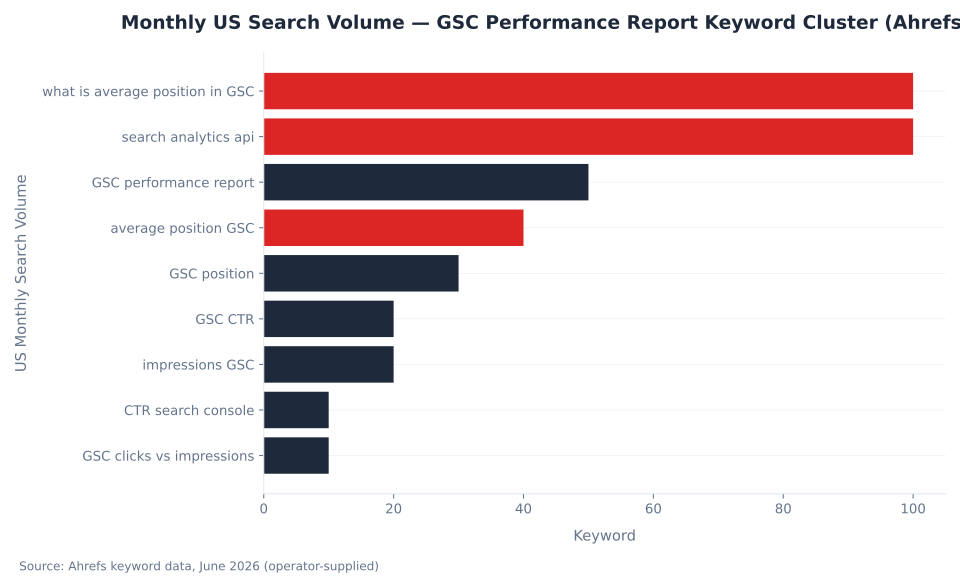
Monthly US Search Volume — GSC Performance Report Keyword Cluster (Ahrefs, June 2026)
Filters, Regex, and Comparison Mode
The Performance report's filter layer transforms it from a snapshot into a diagnostic instrument. Regex filtering (launched April 2021), the branded query filter (March 2026), and comparison mode each serve distinct analytical purposes — and each has edge cases that affect how results should be read.
| Filter / Mode | Available? | Key behavior and notes |
|---|---|---|
| Filter by dimension | Yes | Query, Page, Country, Device, Search Appearance filters are stackable; multiple filters active simultaneously; each filter narrows the data pool, not just the table view |
| Regex filter (query and page) | Yes — April 2021 | RE2 syntax; case-insensitive by default — prepend (?-i) for case-sensitive matching. Combine patterns with |. Examples: how.*(track|measure) for intent-grouped query analysis; /blog/.*2024 for URL path date-filtering |
| Comparison mode (two date ranges) | Yes (Web search only) | One comparison active at a time; adds a "Difference" column to all table views; weekly or monthly granularity recommended for period-over-period comparisons to suppress day-of-week noise. Available from December 2025 |
| Branded vs. non-branded filter | Yes — Nov 2025, all eligible sites March 2026 | AI-assisted classification; covers typos and brand-related product queries; works across all search types (web, image, video, news). Isolates organic demand from brand equity vs. discovered demand — the critical split for any reporting that distinguishes content performance from brand halo |
| Date range | Up to 16 months (rolling) | 24-hour view (hourly granularity) added December 12, 2024; weekly and monthly aggregation views added December 10, 2025. The 16-month window is a hard limit — data older than 16 months is permanently deleted |
| Export | Yes (CSV / Google Sheets) | Discover and Google News reports cannot be combined in-interface but export to Sheets allows manual merge; active filters apply to the export |
The regex filter is the most underused capability in the Performance report. A regex like ^(what|how|why|when|can) isolates informational-intent queries across the entire property — immediately exposing which pages answer questions (and whether those pages are capturing the traffic their intent warrants). Applying (?-i)brand_name in case-sensitive mode filters branded queries with precision that the AI-assisted branded filter cannot match for complex brand strings. For step-by-step guidance on building these filters, see GSC API & Automation where the regex syntax is documented alongside API-equivalent filter parameters.
Share of GSC Traffic from Anonymized Queries — Average & Range (Ahrefs, April 2025)
The Search Analytics API: Beyond the 1,000-Row Cap
The Search Analytics API and the Performance report interface share the same underlying dataset — but the API removes the 1,000-row ceiling, adds hourly granularity, and returns anonymized queries as a filterable zero-length string. For any site with thousands of pages or queries, the interface is a directional sample; the API is the complete picture.
| Parameter / Capability | Interface limit | API capability | Notes |
|---|---|---|---|
| Rows returned | 1,000 per view | 25,000 per request; 50,000/day/property/search type | Paginate via startRow; set rowLimit explicitly — API default is also 1,000 unless overridden |
| Dimensions | 5 (Query, Page, Country, Device, Search Appearance) | Same 5 + HOUR | HOUR dimension available with dataState: HOURLY_ALL; added April 2025 |
| Hourly data window | ~1 day (24-hour view) | Last 10 days | first_incomplete_hour field indicates in-progress hours; use for post-publish monitoring and algorithm-update response tracking |
| Historical window | 16 months | 16 months | Same underlying data; API uses startDate / endDate in YYYY-MM-DD format |
| Anonymized queries | Omitted from table rows | Returned as zero-length string "" |
Counted in totals but query string withheld; downstream systems can filter and count anonymized traffic even without the query text |
| Data freshness | 2–6 hour delay (typical) | Same | Check last_update field in API response; historical incidents have pushed delays to 50–70 hours |
| Search type filter | 6 types (separate) | Same 6 types | type parameter accepts: web, image, video, news, discover, googleNews. No combined-type query available — each search type requires a separate API call |
The Search Analytics API is free, subject to standard API quotas. The 50,000-row daily limit is per property per search type — a site pulling web + image + video data has up to 150,000 rows available per day. For any automated SEO reporting stack — whether Looker Studio pulling directly via the connector, a BigQuery pipeline via Looker Studio's BigQuery export, or a custom Python script — the API is not a developer-only tool. It is the minimum viable data source for complete reporting at meaningful scale. For full API integration patterns, BigQuery setup, and the hourly data workflow, see GSC API & Automation.
The 1,000-row cap is not a display limit — it is a data truncation. The API returns rows sorted by clicks in descending order. Every row beyond position 1,000 in the interface is simply absent — not hidden. For a site with 5,000 ranking pages, the interface shows the top 20% of the click distribution. The API shows the complete distribution, which is where long-tail content audits, cannibalization checks, and tail-query discovery actually happen.
MB Adv Agency has found that the Search Analytics API, when piped into a BigQuery dataset with rolling daily snapshots, produces the most complete picture of organic performance available — more reliable than rank tracker data for portfolio-level trend analysis because it reflects real user impression distribution rather than single-point crawls. For conversion-side data that complements GSC's click data, see Conversion Tracking & Attribution in Google Ads.
Diagnosing Performance Report Anomalies
Most Performance report anomalies have a pattern. The table below maps the most common symptoms to their likely causes and the first dimension to check — before drawing conclusions from the top-line numbers alone.
| Observed anomaly | First dimension to check | Likely cause | Rule out first |
|---|---|---|---|
| Impressions dropped sharply; position stable | Search type + Date | Seasonal demand drop; query reformulation; SERP feature change reducing blue-link impressions; AI Overview expansion; &num=100 deprecation effect (crosses September 2025) | Check Google Trends for query demand; verify whether a SERP feature now absorbs the impression |
| Impressions rose; clicks flat or falling | Search Appearance + Query | AI Overview or Featured Snippet now satisfies the query without a click (zero-click); impression inflation from the May 2025–April 2026 bug if the window crosses those dates | Filter by Search Appearance — did a specific feature type drive the impression gain? Confirm date range does not overlap the logging bug window |
| CTR dropped; position unchanged | Query + Device | Competitor title/meta improvements; mobile vs. desktop CTR divergence; new SERP feature competing for attention at the same position | Filter by Device — compare mobile and desktop CTR separately; a mobile CTR drop at stable position is a mobile-experience signal, not a content signal |
| Average Position improved; clicks fell | Search type + Date | Impression volume dropped — fewer queries triggered your result. Position improvement is real but the query pool shrank. Also: &num=100 deprecation eliminated deep-position bot impressions, making Average Position appear to improve with no ranking change | Cross-reference absolute Impressions against Average Position — if both the position improved and impressions fell sharply at the same date, the deprecation effect is the cause |
| Table total clicks < chart total clicks | Query (row sum vs. chart header) | Anonymized queries excluded from table rows but counted in chart totals — this is expected; gap averages 46.77% per Ahrefs April 2025 analysis of 22 billion clicks | Not a bug — no action needed. For sites with primarily niche or long-tail queries, the gap reaches 80%+ |
| GSC Average Position better than rank tracker | N/A — cross-tool comparison | GSC is impression-weighted across all users, devices, and geographies; rank tracker is a single-point crawl from a fixed location and date | Both numbers are correct — they measure different things. See the Average Position section below for the full explanation |
| New page shows 0 impressions after 14 days | N/A — check Index Coverage | Page not indexed, crawled but not indexed, or indexed but not ranking for any queries with sufficient demand to register impressions | Check Index Coverage and Sitemaps & URL Inspection before assuming a ranking problem |
One pattern that cuts across all of these scenarios: when multiple anomalies appear simultaneously (position stable, impressions flat, clicks falling, CTR falling), the cause is almost always a SERP feature change — not a content problem. AI Overviews, Featured Snippets, and Knowledge Panels all absorb clicks from results that are still technically ranking. The Search Appearance dimension isolates which feature is involved. For security and manual action signals that affect ranking independently of content quality, see Links, Manual Actions & Security in GSC.
Data Freshness, the 16-Month Window, and the 2025–2026 Logging Bug
GSC Performance data arrives with a 2–6 hour delay under normal conditions and is retained for exactly 16 months on a rolling basis. Both constraints have operational implications that matter for any reporting architecture built on GSC as a primary data source.
| Capability | Interface | API |
|---|---|---|
| Rows per view / request | 1,000 | 25,000 |
| Total rows/day/property/search type | 1,000 | 50,000 |
| Hourly data window | ~1 day | 10 days |
| Historical data window | 16 months | 16 months |
The 16-month hard limit means year-over-year comparison — which requires at least 24 months — is impossible from the GSC interface alone unless data was previously exported. Any site that did not run regular API exports or Looker Studio BigQuery connections before June 2025 has permanently lost the data needed to compare June 2026 against June 2025. The correct architecture for long-term GSC reporting: daily API pulls into an external store from the first day a property is verified.
The May 2025–April 2026 logging bug — what it affects and what it does not. A GSC logging error inflated impressions platform-wide from May 13, 2025 through April 27, 2026. Key facts per Search Engine Land's original report: clicks were not affected; impressions were over-reported; CTR (which is derived from impressions) was artificially suppressed; Average Position (computed per impression) was skewed. Historical data was not retroactively corrected — those impression figures are permanently inflated in GSC. Any site that saw an impressions drop in late April or early May 2026 saw the fix take effect, not a ranking loss. Benchmark any impression-derived metric from that window with explicit caveats. For current data anomaly status, check Google's data anomalies documentation.
Search Analytics API vs. Interface — Row Limit per Day per Property (2026)
GSC Showing Position Drops, CTR Gaps, or Impression Anomalies?
The Performance report surfaces the signals — reading them correctly requires knowing what each metric actually measures. MB Adv can audit your GSC data, separate real ranking issues from reporting artifacts, and build the reporting stack your organic program needs.
Talk to us about your GSC data →Methodology
All data in this article is current as of June 2026. GSC metric definitions, counting rules, impression counting behavior, API parameters, row limits, and feature launch dates are sourced from official Google documentation: support.google.com/webmasters and developers.google.com/search. CTR-by-position benchmarks are sourced from First Page Sage, "Google Click-Through Rates by Ranking Position in 2026" (firstpagesage.com), and Advanced Web Ranking, Q4 2025 CTR Changes Report (advancedwebranking.com). AI Overview CTR impact data is sourced from Ahrefs, "AI Overviews Reduce Clicks by 58%" (February 2026, 300,000 keywords, aggregated GSC data). The 46.77% anonymized-query figure is sourced from Ahrefs, "Anonymized Queries Make Up Nearly Half of GSC Traffic" (April 2025, 22 billion clicks, 887,534 properties). The &num=100 deprecation date (September 11, 2025) is sourced from Intero Digital and Ice Nine Online. The GSC impressions logging bug (May 13, 2025 – April 27, 2026) is sourced from Search Engine Land. Reviewed by MB Adv Agency, June 2026.

As a Google Ads expert, I bring proven expertise in optimizing advertising campaigns to maximize ROI.
I specialize in sharing advanced strategies and targeted tips to refine Google Ads campaign management.
Committed to staying ahead of the latest trends and algorithms, I ensure that my clients receive cutting-edge solutions.
My passion for digital marketing and my ability to interpret data for strategic insights enable me to offer high-level consulting that aims to exceed expectations.
Google Partner Agency
We're a certified Google Partner Agency, which means we don’t guess — we optimize withGoogle’s full toolkit and insider support.
Your campaigns get pro-level execution, backed by real expertise (not theory).

4.9 out of 5 from 670+ reviews on Fiverr.
That’s not luck, that’s performance.
Highly recommend Matteo to set up your server side tracking. He has a deep understanding of e-commerce tracking and will go above and beyond to make sure everything is set up correctly and working 100%. If you are scaling your store this set up is non-negotiable in my opinion and there isn't many people who have this much knowledge or put the effort in to get it right. Thanks again!

avorodesign.com
I can only recommend Matteo! He was very patient, professional and very knowledgeable about GA4, Consent Mode v2, and GDPR compliance. Communication was clear, and the setup was done professionally and efficiently. Highly recommend him for anyone needing reliable tracking implementation.

www.natureiki.life
Matteo shines in the realm of online professionals. His work is not only deep in data but also complemented by his proactive communication and cooperation, setting a new standard for freelancers. If you want someone who truly exceeds expectations, look no further. Highly recommended!

www.omanbeverlysmyth.com
Exceptional Service Beyond Expectations - Outstanding Service Impeccable depth, flawless delivery, and exceptional language fluency—this service exceeded all expectations. Highly recommended. Matteo truly ROCKS!!!

ium-paris.com
Top-notch, always highly value working with Matteo. An absolute Google Ads Genius. This is approximately the 8th time I have hired him and he's helped us get 6-7 ROAS. We are excited in continuing to improve our lead flow. Hire this guy if you need Google Ads help. Thanks Matteo!

www.dleeventgroup.com
I finally found the guy who can setup server side tracking and all the ecosystem properly. I definitely recommend Matteo. He is very responsive, kind and wants to dig into things. He configured GA4, Meta, Google Ads, Outbrain and google consent v2 with Cookiebot. Thanks Matteo.

inomega.fr
MB Adv delivered exceptional work with outstanding professionalism and lots of patience, taking time to see effects of changes made and not just do the work and submit it. The proactive communication and video summaries of the work completed made working with Matteo a pleasure, as he consistently went above and beyond. Highly recommended for web analytics projects! We are already working on another project.

www.withnellsensors.co.uk
Working with Matteo on my Google Ads was a game-changer. He's not just a strategist, he's a true partner. He understood my goals and tailored a campaign that perfectly reached my target audience. I'm grateful for his expertise and dedication.

dccargo.com
Click-driven mind
with plastic-brick obsession.
We build Google Ads campaigns with the same mindset we use to build tiny brick worlds: strategy, patience, and zero tolerance for wasted pieces.
Data is our blueprint. Growth is the only acceptable outcome.