What Is Local SEO? Google's 3 Local Ranking Factors

Local SEO 2026 — Google’s 3 Local Ranking Factors
3
Google documents exactly three local ranking factors — Relevance, Distance (proximity), and Prominence — and publishes no numeric weights for them. Local SEO is the work of optimizing your free Google Business Profile, citations, and reviews to rank in the Local Pack and Maps.
Google Business Profile: $0 (free, no premium tier) · “local seo” 46,000 US searches/mo (Ahrefs, 2026) · three factors: relevance, distance, prominence (support.google.com/business/answer/7091)
What Is Local SEO?
Local SEO is the practice of optimizing your online presence — most importantly your free Google Business Profile, your local citations and NAP (Name, Address, Phone), your reviews, and location-relevant on-page content — to rank in Google’s geographically-targeted results, the Local Pack and Google Maps, so nearby customers find you when they search for what you do. When someone types “plumber near me,” “dentist Austin,” or “HVAC repair Flagstaff,” Google shows a distinct set of local results — a map with a short list of businesses — above the classic organic links. Ranking in that block is the entire goal of local SEO.
Local SEO is for any business that lives or dies on nearby customers: a plumbing company, a dental practice, an HVAC business, a law firm, a restaurant, an auto shop — anything with a physical location or a defined service area. The plain difference from traditional organic SEO is the surface and the object being ranked. Traditional SEO ranks web pages in the blue links through content, links, and technical health. Local SEO ranks a different object entirely: your Google Business Profile (formerly Google My Business), the free listing that is the primary thing Google ranks in the Local Pack and on Maps. That single fact reframes the work — the highest-leverage local-SEO task is optimizing a free profile, not writing another blog post.
The one-line thesis this guide returns to: your Google Business Profile is the local engine, and it is free ($0, no premium tier). Google ranks the Local Pack on three documented factors — relevance, distance, and prominence — and every practical move in local SEO comes back to strengthening the two you control (relevance and prominence) on a profile you cannot pay to rank organically. If local SEO is new to you, start with the broader discipline in what SEO is, then read what a Google Business Profile is. MB Adv Agency has no local-SEO service — we run the paid search (Google Ads, Local Services Ads) that complements a strong organic local presence — so the playbook below is the honest, free version.
The Local Pack / Map Pack: Where Local SEO Shows Up
The Local Pack (also called the Map Pack) is the block of business listings with a map that appears above the classic organic links on a local search. It usually shows three businesses, each with a name, star rating, review count, category, and quick actions such as call, directions, and website. Google Maps is the same data on its own dedicated surface. Ranking into this three-slot block — not the blue links beneath it — is what local SEO is built to do, because the Local Pack captures the attention and the clicks on local-intent queries.
The Local Pack differs from traditional organic results in three concrete ways. First, the ranked object is your Google Business Profile, not a page on your website. Second, the ranking inputs are relevance, distance, and prominence rather than content, links, and technical signals alone. Third, the actions are local: a searcher calls, requests directions, or taps through to your site, and Google measures those interactions in the free Business Profile Performance report. For the deep version of how the profile drives the pack, see how a Google Business Profile impacts local rankings.
The quick takeaways, before the tactics: (1) Local SEO ranks your free Google Business Profile in the Local Pack and Maps, not a web page. (2) Google names three factors — relevance, distance, prominence — and publishes no weights. (3) The profile is free, and it is the single biggest lever. (4) Citations (consistent NAP) and reviews build the prominence you can influence over time. (5) You cannot buy your way into the organic pack, and you cannot out-optimize physical distance for a searcher across town — so you concentrate effort on relevance and prominence. The rest of this guide takes each lever in turn. Source: Google, how local results are ranked.
Local Search Demand: What People Actually Type
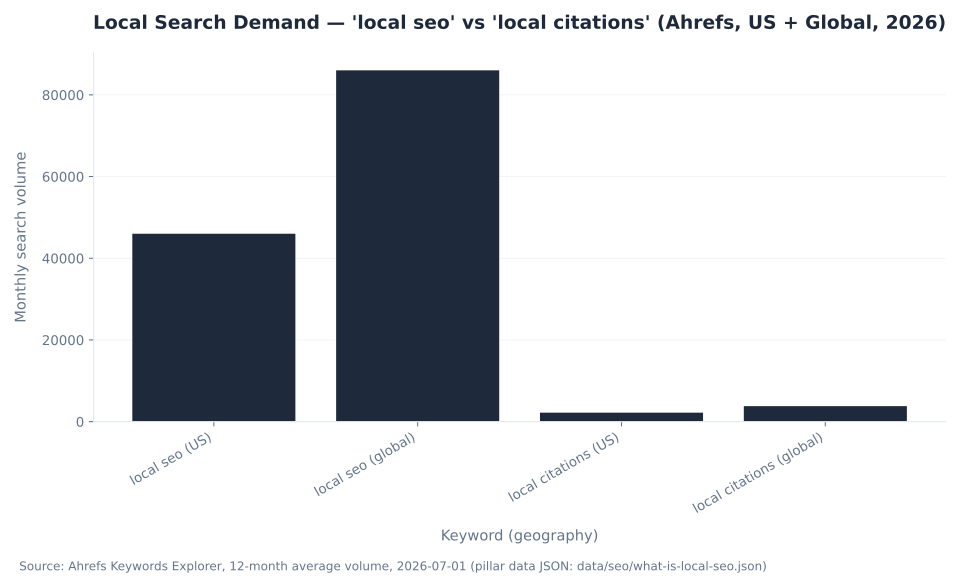
Two local terms carry verified search demand in this space, and they frame the whole strategy. “local seo” runs 46,000 US searches per month (86,000 global) at a brutal Keyword Difficulty of 86 — it is the head term this guide targets and one of the hardest local terms to rank for organically. “local citations” runs 2,200 US searches per month at KD 34 — a fraction of the volume but far more winnable, which is exactly why a smart local program builds depth on the winnable sub-topics rather than only chasing the head term.
| Keyword | US volume/mo | Global volume/mo | KD (0–100) | Advertiser CPC | Note |
|---|---|---|---|---|---|
| local seo | 46,000 | 86,000 | 86 | $6.00 | ★ Head term; the Local Pack appears on this SERP; the definition above answers it plainly |
| local citations | 2,200 | 3,800 | 34 | $5.00 | ★ Winnable (KD 34 vs 86); the citations & NAP section targets it |
Sources: Ahrefs Keywords Explorer (US 12-month average volume, Keyword Difficulty, and advertiser CPC), 2026-07-01. “local seo” and “local citations” are the only two in-scope local terms with verified Ahrefs volumes — no volume is fabricated for “local pack,” “map pack,” or “near me.” KD and CPC are Ahrefs third-party estimates, not Google figures. Not mbadv client data.
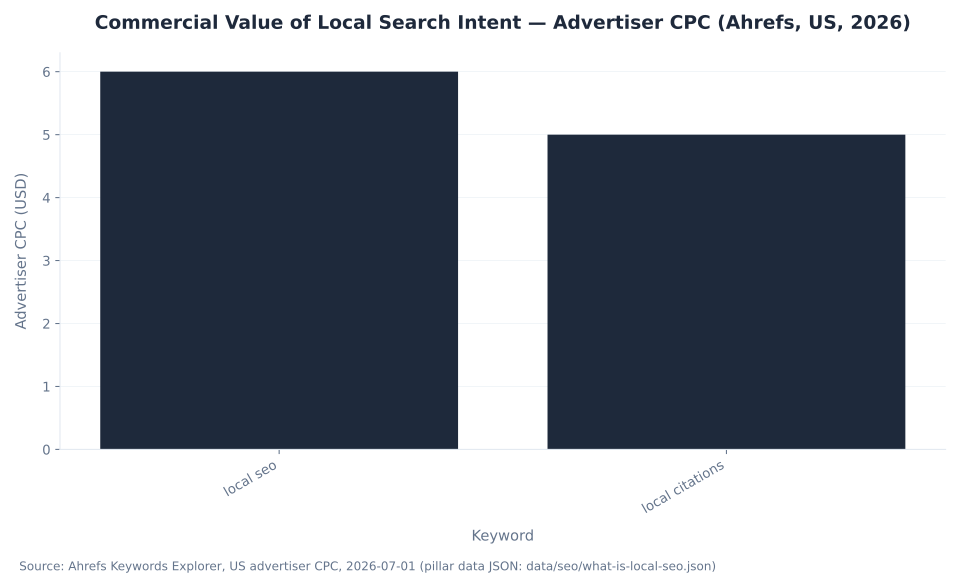
The advertiser CPC column is worth a note, because it explains the honest agency framing later in this guide: local terms carry real commercial value (about $5–$6 per click), which is why a paid layer exists at all — yet the organic local foundation (Google Business Profile, citations, reviews) is free. The recommendation that follows from the demand data is not “win the head term tomorrow” but “build the free foundation and the winnable sub-topics first, then decide whether to layer paid search on top.” For the raw search-demand methodology, see Ahrefs’ local SEO guidance.
Google’s Three Local Ranking Factors: Relevance, Distance & Prominence
Most “what is local SEO” pages hand-wave the ranking logic. They do not need to, because Google documents it plainly: local results are ranked on a combination of relevance, distance, and prominence. That is the whole framework, and internalizing it is the single most useful thing a local business can do. Table 2 defines all three straight from Google’s own documentation.
| Factor | What Google says it means | What you can influence |
|---|---|---|
| Relevance | How well your Business Profile matches what someone is searching for | Complete, accurate categories, services, description, and attributes so Google can match you to the query |
| Distance (proximity) | How far your business is from the location term in the search, or from the searcher | Accurate address and service-area info; you cannot change physical distance or fake a location — Google verifies it |
| Prominence | How well-known a business is — from links, articles, and directories, plus review count and score, and your web presence and organic ranking | Earn links, citations, and mentions, build genuine reviews, and rank organically — the factor you build over time |
Source: Google, “Improve your local ranking on Google” (relevance, distance, prominence; prominence includes review count and score). ★ Google publishes no numeric weights for these factors — anyone quoting a hard percentage “from Google” is fabricating. Not mbadv client data.
The framework reframes the work. You cannot buy your way into the organic Local Pack; you cannot out-optimize physical distance for a searcher across town; and prominence is the one factor you build steadily over time. This is also where the most expensive misconception in local SEO gets refuted: “proximity is everything — if I am not the closest business, I cannot rank” is false. Distance is one of three factors, not the only one. Relevance and prominence decide the order among the many businesses within a reasonable radius of a searcher. A closer competitor with a thin, poorly-categorized, low-review profile routinely loses to a slightly farther business with a complete, well-reviewed, well-cited one. Proximity sets the pool of eligible businesses; relevance and prominence set the order within it. You optimize the two you control.
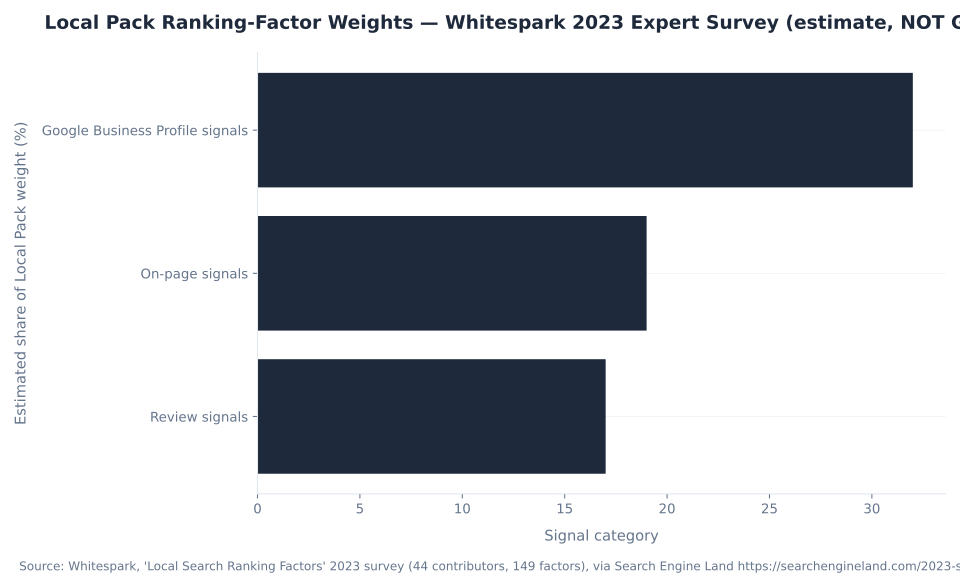
So where do the famous local-ranking percentages come from? Not Google. They come from expert surveys — most notably Whitespark’s Local Search Ranking Factors, a poll of local-SEO practitioners, not a readout of Google’s code. Table 3 shows the 2023 edition’s Local Pack estimate, and it must be read with the label attached.
| Signal category | Estimated share of Local Pack weight | Note |
|---|---|---|
| Google Business Profile signals | ≈32% | Categories, keywords in the profile, proximity of address — the largest single category |
| On-page signals | ≈19% | NAP on the site, keywords in content, domain authority |
| Review signals | ≈17% | Review quantity, velocity, diversity, and keywords in reviews (feeds prominence) |
| (Other categories) | not shown here | Whitespark’s full breakdown includes more categories — see the source; not charted, to avoid fabrication |
Source: Whitespark, Local Search Ranking Factors 2023 survey (44 contributors, 149 factors), via Search Engine Land. ★ An aggregated expert-opinion estimate, NOT Google’s published algorithm; Google publishes no numeric weights. Partial: only three of the survey’s categories are shown — do not infer the rest. Do not blend with the 2026 edition. Not mbadv client data.
Two disciplines keep this section trustworthy. First, the weights are a map, not the territory: present them as a named expert-survey estimate with its year and source, never as Google’s figures. Second, never blend editions. Whitespark’s 2026 report emphasizes proximity even more heavily — it weights proximity at about 55% — but that is a different survey, methodology, and year, so it is kept out of the 2023 table above and treated separately as context. MB Adv Agency treats this as a hard source-discipline rule, the local analog of never mixing two datasets in one chart. For the framing that named the pos-9.7 query on this topic (“relevance and proximity in SEO”), see Moz’s local ranking factors.
Optimizing Your Google Business Profile (the Free Local Engine)
If local SEO has one highest-leverage task, this is it: optimize your Google Business Profile. The profile is free ($0, no premium tier), and it is the primary object Google ranks in local results — so a complete, accurate, well-categorized, well-reviewed profile is the closest thing to a lever there is. Table 4 is the optimization checklist, ordered roughly by ranking impact.
| Element | Action | Local-SEO impact |
|---|---|---|
| Primary category | Choose the single most accurate category for what you do | The strongest relevance signal in the pack — get this right first |
| Secondary categories | Add every additional category that genuinely applies | Expands the queries you are eligible for without diluting the primary |
| NAP + hours + service area | Keep Name, Address, Phone, hours, and service area accurate and consistent | Feeds relevance and distance; inconsistency fragments trust |
| Description, services & products | Complete the business description and list services and products | More relevance surface for Google to match queries against |
| Photos | Add real, current photos of the business, team, and work | Signals an active business; drives engagement in the pack |
| Google Posts | Publish fresh updates, offers, and events | Freshness and activity; keeps the profile current |
| Reviews | Earn genuine reviews and respond to them | Feeds prominence and is the biggest trust cue a searcher sees |
| Attributes & Q&A | Set attributes and seed and monitor Q&A | Extra relevance detail and searcher-facing information |
Sources: Google Business Profile Help (categories, completeness, reviews as ranking inputs); the profile is free. Cross-reference the deeper GBP glossary for each element. Not mbadv client data.
The category choice deserves emphasis: your primary category is a top relevance signal, and it is the most common thing local businesses get wrong — either too broad or simply inaccurate. Fix it first. For the deep version, see optimizing your business categories. After categories, completeness compounds: NAP, hours, services, photos, Posts, and attributes each add relevance surface and activity signals, and none of them cost anything. For how the whole profile translates into pack placement, see how a Google Business Profile impacts local rankings, and if you have not claimed a profile yet, start with what a Google Business Profile is.
The honest agency framing sits here too. There is no premium tier of the profile to buy — the features that drive ranking and conversions are all free. Paid advertising (Google Ads, Local Services Ads) does not buy a “better profile”; it buys additional placement on top of the free organic foundation. MB Adv Agency’s role is that paid layer, not the profile itself, which the local businesses we work with own and manage. Build the free profile fully first; the paid decision comes later, once you want lead volume beyond what organic delivers.
Local Keyword Research: “Service + City” and “Near Me”
Local keyword research is a specialized form of keyword research built around geographic modifiers. Instead of chasing a national head term, you map the “service + city” and “near me” patterns that nearby customers actually type. These queries carry lower absolute search volume than national terms but far higher local intent, and they are the queries where the Local Pack appears. Table 5 lays out the patterns with examples.
| Pattern | Example | Intent |
|---|---|---|
| service + city | “emergency plumber Austin” | High local intent; the core local pattern |
| service + “near me” | “dentist near me” | Google localizes to the searcher automatically |
| service + neighborhood / ZIP | “roofer 78704” | Hyper-local intent within a metro |
| “best/top” + service + city | “best HVAC company Flagstaff” | Comparison intent; reviews and prominence matter most |
| service + city + modifier | “24 hour HVAC repair Flagstaff” | Urgency and specificity; strong conversion intent |
Sources: Ahrefs local keyword-research guidance and Semrush search-intent framing; verified local volumes (“local seo” 46,000/mo, “local citations” 2,200/mo) from Ahrefs, 2026-07-01. No volume is fabricated for the “near me” or city-modified variants. Not mbadv client data.
How this differs from national keyword research is the point. National research optimizes for one high-volume term against the whole web; local research maps a set of lower-volume, higher-intent, geo-qualified queries against the businesses in one service area — and the SERP for those queries carries a Local Pack, not just blue links. Because the ranked object is your Google Business Profile, the “keywords” work is really about matching your categories, services, and description to the service-plus-city language your customers use. Local keyword research builds on the same fundamentals as general keyword research in SEO — search intent, volume, and difficulty — applied through a geographic lens.
Practical sequencing: list your services, cross them with the cities and neighborhoods in your service area, add the “near me,” “best,” and urgency modifiers, and use Ahrefs or Semrush to size the ones with real demand. Then reflect that language on the profile (categories and services) and in location-relevant on-page content. You are not stuffing keywords; you are making sure Google can match the free profile to the geo-qualified queries that convert.
Local Citations & NAP Consistency
A citation is any online mention of your business’s NAP — Name, Address, Phone — on a directory, data aggregator, or other site: Google Business Profile, Apple Maps, Yelp, Bing Places, industry directories, and your own website. NAP consistency means the identical name, address format, and phone number everywhere, so Google can trust that all these mentions describe one real business. Consistency is the point, not the raw count. Table 6 is the citations and NAP checklist, ordered from the most authoritative sources down to the audit that ties it together.
| Citation source / step | Why it matters |
|---|---|
| Google Business Profile | The anchor listing — the primary object Google ranks in local results |
| Primary data aggregators | Feed your NAP to many downstream directories; fix errors at the source |
| Apple Maps / Bing Places | Major map and search surfaces beyond Google |
| Yelp + top industry/local directories | Authoritative, category-relevant citations — quality over quantity |
| Your own website | NAP in the footer plus LocalBusiness structured data — first-party confirmation |
| NAP consistency audit | Identical name, address format, and phone everywhere — the point of the exercise, not the count |
Sources: CallRail on NAP consistency (a citation is a NAP mention; consistency = identical formatting) and Whitespark (citation quality and relevance over volume). No fabricated citation-count or “listings audited” numbers — none are published or verified. Not mbadv client data.
Here is the second load-bearing refutation of this guide: “more citations always help — list my business on as many directories as possible” is false, and often harmful. What matters is NAP consistency and citation quality and relevance, not raw volume. A smaller set of accurate citations on authoritative, category-relevant directories and the major data aggregators beats a large pile of low-quality listings — and inconsistent NAP across many directories actively hurts by fragmenting the trust signal Google uses to confirm you are one real business. Blasting your NAP onto hundreds of thin directories is a numbers game that does not move rankings and can set you back.
The practical order of work: clean up and align the core data aggregators first, then Google Business Profile, Apple Maps, and Bing Places, then the top industry and local directories, then your own site’s footer and LocalBusiness schema. Audit for identical formatting everywhere — the same suite number style, the same phone format — and fix conflicts at the aggregator level so corrections flow downstream. A fast, mobile-friendly, schema-marked site supports this work; see technical SEO for the LocalBusiness structured-data side.
Online Reviews: a Prominence Signal (and a Conversion Engine)
Reviews do two jobs at once. They feed the prominence factor — Google explicitly lists review count and score among the inputs to local ranking — and they are simultaneously the single biggest trust cue a searcher sees in the Local Pack. But the nuance matters: reviews influence prominence; they are not a simple “more stars equals higher rank” dial. Velocity, recency, responses, and relevance all matter, and reviews are one prominence signal among several (links, citations, mentions, organic rank). Table 7 is the review-management playbook.
| Step | What to do | Why it matters for prominence |
|---|---|---|
| Ask | Request reviews from real customers after service (no gating or incentivizing, per policy) | Genuine volume and velocity feed prominence |
| Respond | Reply to positive and negative reviews | Signals an active, real business and builds trust |
| Recency / velocity | Aim for a steady flow, not a one-time burst | Fresh reviews weigh more than a stale total |
| Relevance | Natural mentions of service and location in genuine reviews | Reinforces relevance and prominence |
| Monitor | Track rating and count over time | Catch drops early; measure the payoff of free work |
Sources: Google (review count and score feed prominence); named local authorities Sterling Sky (Joy Hawkins) and Moz on reviews and local ranking. No fabricated review-count or conversion-lift numbers. Not mbadv client data.
The reason reviews connect to everything else is compounding: the same free Business Profile work — earning genuine reviews, responding to them, keeping categories and information accurate — is what builds prominence and what a paid Local Services Ads campaign later ranks on. There is no premium local-SEO tier to buy; the highest-leverage local work costs nothing, and it is the foundation the paid layer stands on. A strong review profile improves organic pack placement first, and if you later run Local Services Ads it improves that ranking too, which lowers your effective cost per lead.
Follow policy strictly: ask every real customer after a completed job, never gate or incentivize reviews, and respond to both praise and complaints in a professional voice. For the full treatment of why reviews matter and how to manage them at scale, see why customer reviews matter for local SEO. The named local authorities are consistent that response rate and steady velocity outperform a one-time push for a large total.
Local SEO vs Traditional (Organic) SEO
Local SEO and traditional organic SEO are different games with different surfaces, objects, factors, and measurement. Most local businesses need both, but the local foundation — Google Business Profile, citations, reviews — comes first because it is where nearby, high-intent demand is captured. Table 8 puts the two side by side.
| Dimension | Local SEO | Traditional (organic) SEO |
|---|---|---|
| Primary SERP surface | Local Pack + Google Maps | Classic organic links and AI surfaces |
| Ranked object | Google Business Profile + your site | Web pages on your site |
| Top ranking factors | Relevance, distance, prominence; GBP, citations, reviews | Content, links, technical health, E-E-A-T |
| Who it is for | Physical-location or service-area businesses | Any site targeting search demand |
| Measurement | GBP Performance: calls, directions, clicks + local-pack rank | Organic clicks, impressions, position (Search Console) |
Sources: Google local ranking documentation (local factors) and standard on-page/off-page/technical SEO taxonomy (Ahrefs, Moz). Not mbadv client data.
The measurement difference is the one businesses miss. Traditional SEO is measured in Search Console: clicks, impressions, and average position for your pages. Local SEO adds the free Business Profile Performance report on top — calls, direction requests, website clicks, and searches that surfaced your profile — plus your rank within the Local Pack for your core queries. To track the organic side, see tracking SEO performance with Google Search Console. Prominence is partly built on links, so link building in SEO — local link building through chambers, local press, and sponsorships — feeds the same signal.
When do you need each? If you are a plumber, dentist, or HVAC company serving one metro, local SEO is the priority and often most of the return. If you also publish content that ranks nationally — guides, comparisons, resources — traditional SEO carries that. The two reinforce each other: a strong site supports the profile’s prominence, and the profile captures the local-intent demand a national page cannot. Start with the broader discipline in what SEO is and layer the local playbook on top.
Difficulty & Commercial Value: Which Local Terms to Target
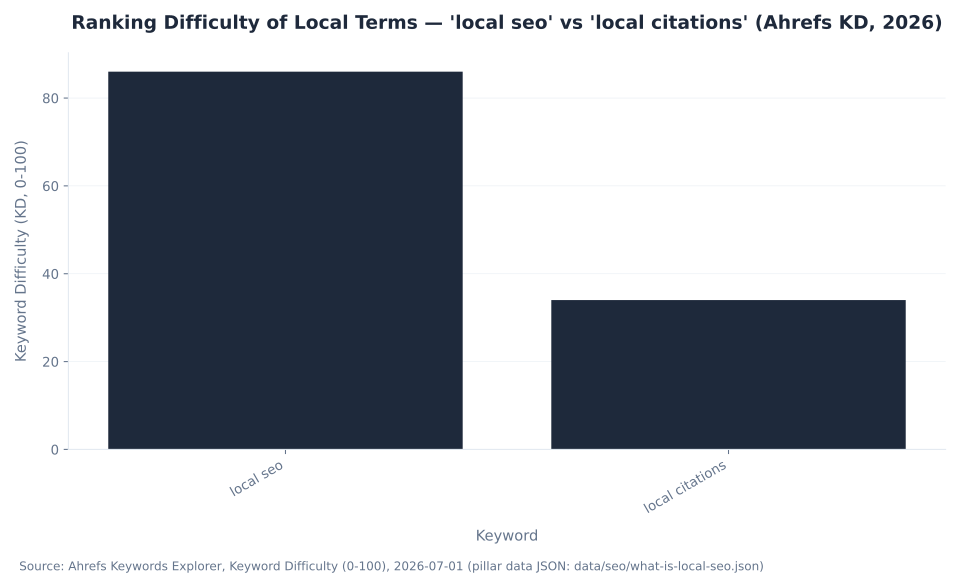
The strategy for a competitive local space falls out of two numbers: ranking difficulty and commercial value. “local seo” sits at Keyword Difficulty 86 — one of the hardest terms in the field — while “local citations” sits at KD 34, genuinely winnable. Both carry strong advertiser CPC (about $5–$6 per click), which confirms real commercial local intent. Table 9 sets the difficulty and value side by side.
| Keyword | KD (0–100) | Advertiser CPC (USD) | Strategic read |
|---|---|---|---|
| local seo | 86 | $6.00 | Near-maximum difficulty; the head term — concentrate authority, do not chase it alone |
| local citations | 34 | $5.00 | Genuinely winnable; build depth on the winnable local sub-topics |
Source: Ahrefs Keywords Explorer (Keyword Difficulty and US advertiser CPC), 2026-07-01. KD and CPC are Ahrefs estimates, not Google figures. CPC is what advertisers pay per paid click — it is not an organic-SEO cost. Not mbadv client data.
The honest read on the two numbers: the head term is a long game won through overall topical authority and a dominant local presence, while the winnable sub-topics (citations, NAP, the “service + city” queries) are where a focused local business earns visibility faster. And the CPC tells you why the paid layer exists: local search converts, so once the free foundation is in place, paid Google Ads and Local Services Ads can accelerate lead volume on top of it. Turning local visibility into measurable leads is exactly what our lead-generation PPC work does — the paid complement to a free local foundation.
For end-to-end paid media alongside your organic local presence, see our PPC services. For trade-specific local search, see our HVAC PPC and plumbing PPC work. The sequencing MB Adv Agency recommends never changes: free foundation first, paid acceleration second, and the paid budget always sized against your trade’s real lead economics.
How to Start With Local SEO: the Free Playbook
The starting playbook is short, ordered, and mostly free. Build the foundation Google actually ranks before you spend a dollar on ads, because the free work is the highest-leverage local marketing there is and it is what a paid campaign later stands on.
The seven steps, in order: (1) create and verify a free Google Business Profile. (2) Choose the single most accurate primary category and complete NAP, hours, services, and description. (3) Do local keyword research — map the “service + city” and “near me” queries in your service area. (4) Build consistent citations across the core aggregators and the top industry and local directories, with identical NAP everywhere. (5) Earn and respond to genuine reviews, steadily. (6) Add location-relevant on-page content and LocalBusiness structured data to your site. (7) Track Google Business Profile Performance and your Local Pack rank, and adjust.
Every step above costs $0. The only spending decision is whether to layer paid advertising on top once the foundation is in place — and that decision is sized against your trade’s lead economics, not a generic benchmark. For a worked local example, see our guide to HVAC PPC in Flagstaff, AZ; running local campaigns in a metro, see local PPC campaign management in Austin, TX. For a professional-services vertical, our dental PPC work pairs the free profile with paid demand. MB Adv Agency runs that paid side; the free local foundation is yours to own.
The Local Foundation Is Free — the Paid Layer Isn’t
Google Ads and Local Services Ads are where a specialist earns its keep
MB Adv Agency runs the paid campaigns that complement your organic local presence — Google Ads and Local Services Ads — so nearby demand turns into measurable leads. Talk to our team about the paid side of local search.
Talk to our team →Where Local SEO Is Heading in 2026
Local search keeps changing at the surface while the fundamentals hold. AI surfaces increasingly summarize and answer queries, and “near me” intent is folded into conversational search — but the Local Pack, Google Maps, and the three documented factors (relevance, distance, prominence) remain how nearby businesses get found. The constant across every shift is the same: a complete, well-reviewed, consistently-cited free Google Business Profile is what wins, because it is the object Google ranks in local results.
On the ranking-weight debate, the honest 2026 read is that practitioner surveys are placing more emphasis on proximity: Whitespark’s 2026 edition weights proximity at about 55%. Two cautions apply. First, that is a named expert-survey estimate, not Google’s algorithm, and Google still publishes no weights. Second, it is a different survey and year than the 2023 estimate, so the two are never blended in one chart or claim. The practical implication is unchanged from the framework: proximity sets the pool, and you win the order on the relevance and prominence you build — categories, completeness, citations, and reviews. For the profile-to-ranking mechanics, see how a Google Business Profile impacts local rankings.
The broader AI-search shift touches local too — more answers are summarized before a click — and the response is the same durable one: entity clarity, consistent NAP, genuine reviews, and a strong site make you the business AI surfaces and the Local Pack both surface. For how AI is reshaping organic search overall, see how AI is changing SEO. None of it changes the starting move: own the free profile, build prominence over time, and layer paid search only when the lead math works.
Why the Highest-Leverage Local SEO Work Is Free
Because “SEO” sounds like something you buy, it is worth stating the opposite plainly: the highest-leverage local-SEO work costs nothing. The free Google Business Profile is not a lesser version of some paid product — it is the whole product Google ranks in the Local Pack, and its most powerful levers are all free.
The primary category is the single strongest relevance signal, and it costs nothing to set correctly. Reviews feed prominence — one of Google’s three documented factors — and they are free to earn; a strong review profile also improves any later Local Services Ads ranking and lowers effective cost per lead, so the free work directly reduces the paid cost. Consistent citations and NAP build the trust signal that confirms you are one real business, and cleaning them up costs time, not money. Photos, Google Posts, accurate hours, attributes, services, and the free Performance report are all included at no cost. For the review and category deep-dives, see why customer reviews matter for local SEO and optimizing your business categories.
Paid advertising does not buy a better profile — it buys additional placement (a Local Search Ad on Maps, or the Local Services Ads unit at the top of Search) on top of the organic foundation. The practical answer for most local businesses: build the free profile fully first, because it is the highest-leverage local-marketing work you can do and it costs nothing, then decide whether to accelerate with paid Google Ads or Local Services Ads. MB Adv Agency’s honest angle is narrow and clear: the local businesses we work with own the free profile themselves, and we run the paid campaigns that complement it.
Frequently Asked Questions About Local SEO
Free Foundation Set — Ready to Accelerate?
Layer paid search on top of a strong local presence
Once your Google Business Profile, citations, and reviews are in place, paid Google Ads and Local Services Ads turn nearby demand into measurable leads. Our team runs the paid side and keeps your cost per lead honest.
Google Ads PPC audit →All PPC servicesMethodology & Sources
Every ranking definition in this guide is from Google’s own documentation; every ranking weight is a named expert-survey estimate, explicitly labeled “not Google’s algorithm,” presented with its year and source. Google publishes no numeric weights for relevance, distance, or prominence, so any hard percentage “from Google” is fabricated. The three factors are sourced to Google’s “Improve your local ranking on Google” and Google’s local-results documentation.
The Local Pack weight estimates come from Whitespark’s Local Search Ranking Factors survey, via Search Engine Land: the 2023 edition (44 contributors, 149 factors) estimates Google Business Profile signals at about 32%, on-page at about 19%, and reviews at about 17% — an aggregated expert opinion, not Google’s code, and only three of its categories are shown here. The 2026 edition’s proximity estimate (about 55%) is treated separately and never blended with the 2023 numbers. NAP and citation guidance is sourced to CallRail; the reviews and local-ranking framing to Sterling Sky (Joy Hawkins) and Moz; search demand to Ahrefs Keywords Explorer (US, 2026-07-01: “local seo” 46,000/mo at KD 86; “local citations” 2,200/mo at KD 34).
Anti-fabrication is strict. No WordStream or LocaliQ figures appear anywhere, because those publishers report paid-search CPC and CPL, which are irrelevant to organic local SEO. MB Adv Agency has no SEO or local-SEO service page and no local-SEO client benchmark dataset, so the point of view here stays qualitative: our team, the local businesses we work with, and the paid campaigns we run that complement a free profile. No mbadv client metric appears in this guide. Last updated 2026-07-01. To discuss the paid side of local search, talk to our team.
In the ever-refining world of digital marketing, one aspect that has gained tremendous importance is Local SEO. As more businesses recognize the significance of online visibility, particularly for those with physical locations, understanding Local SEO becomes critical. This article explores the definition and purpose of Local SEO, its importance for small businesses, and the key elements that shape effective Local SEO strategies.
Definition and Purpose
Local SEO, or Local Search Engine Optimization, refers to the process of optimizing a website and its content to rank higher in local search results. It involves various strategies and practices designed to enhance visibility for users who are searching for services or products in their local area. The main objective of Local SEO is to attract traffic from local searches on search engines like Google, thus connecting businesses with potential customers nearby.
The purpose of Local SEO extends beyond just increasing website traffic. It aims to create a strong online presence that can drive foot traffic to physical store locations. By optimizing for local searches, businesses can improve their chances of appearing at the top of search results, particularly when users search for terms that include location-specific keywords. This is especially important for small businesses that rely heavily on local clientele, as a well-executed Local SEO strategy can significantly impact their bottom line by increasing sales and brand recognition within the community.
Moreover, Local SEO helps businesses to build relationships with their customers. By appearing in local search results, businesses can engage with their community through targeted promotions, events, and local content that resonates with their audience. This not only fosters customer loyalty but also encourages word-of-mouth referrals, which are invaluable for local businesses. In an age where consumers are increasingly seeking personalized experiences, Local SEO allows businesses to cater to their audience's specific needs and preferences, making them more competitive in their local markets.
How It Works
At its core, Local SEO leverages various online signals to improve the ranking of a business. This includes optimizing webpage content, creating localized listings, and building quality backlinks from relevant local sites. Search engines prioritize businesses that are not only relevant but also geographically close to the user performing the search. By utilizing tools like Google My Business, businesses can provide essential information such as their address, phone number, and operating hours, which enhances their visibility in local search results.
Local SEO also uses various online directories, social media platforms, and review sites to establish a business’s legitimacy and relevance. This multi-channel approach helps in enhancing online visibility, leading to greater chances of conversion from search to foot traffic. Furthermore, encouraging satisfied customers to leave positive reviews can significantly boost a business's local search ranking, as reviews are a critical factor in how search engines determine the credibility of a business. Engaging with customers through social media not only helps in building a community but also allows businesses to share local updates, promotions, and events, thereby reinforcing their connection to the local area and enhancing their overall SEO strategy.
Importance for Small Businesses
The significance of Local SEO is especially pronounced for small businesses. Unlike large corporations with vast marketing budgets, small businesses often struggle to compete in a global marketplace. Local SEO levels the playing field by allowing these businesses to target customers in their immediate vicinity effectively.

By focusing on local search optimization, small businesses can attract customers who are more likely to convert into paying clients. For example, a local bakery can thrive by appearing prominently in search results when a user nearby searches for “fresh bread near me” or “best bakery in [City Name].” This proximity marketing allows small businesses to build a loyal customer base within their communities. Moreover, engaging with local customers fosters a sense of community, as these businesses often become integral parts of their neighborhoods, participating in local events and supporting other local initiatives.
In addition to attracting new customers, Local SEO helps small businesses enhance their online reputation. By encouraging satisfied customers to leave positive reviews on platforms like Google and Yelp, businesses can significantly improve their visibility and credibility. A bakery with glowing reviews not only stands out in search results but also builds trust among potential customers who rely on the experiences of others when making purchasing decisions.
Cost-Effective Marketing Solution
When compared to traditional advertising methods such as print, radio, or television, Local SEO represents a cost-effective marketing strategy. Many of the tactics involved, such as optimizing Google My Business and leveraging local keywords, can be executed at a lower cost than traditional methods.
Additionally, the return on investment (ROI) for Local SEO can be significantly higher if implemented correctly. Since Local SEO targets specific regions and demographics, businesses can achieve better performance metrics and higher conversion rates. For instance, a small plumbing service that optimizes for local search terms can see a direct increase in calls and inquiries from nearby residents, translating to more jobs and revenue. This targeted approach not only maximizes marketing budgets but also ensures that businesses are reaching the right audience at the right time, making every marketing dollar count.
Furthermore, the ongoing nature of Local SEO allows small businesses to adapt and evolve their strategies based on changing consumer behavior and market trends. By regularly updating their online presence and engaging with local customers through social media and community events, these businesses can maintain a competitive edge. This adaptability is crucial in today’s fast-paced digital landscape, where consumer preferences can shift rapidly, and staying relevant is key to long-term success.
Key Elements of Local SEO Strategies
To develop an effective Local SEO strategy, it's important to understand and implement the various key elements that contribute to local search rankings. Below are some of the most vital components:

- Google My Business Optimization
Creating and optimizing a Google My Business (GMB) listing is crucial for establishing a business's online presence. A well-optimized GMB profile should include accurate business information, such as address, phone number, and operating hours. Regular updates, including posts and photos, can also engage local customers effectively. Additionally, leveraging features like the Q&A section and booking buttons can enhance user interaction, making it easier for potential customers to connect with your business directly. Regularly monitoring insights from GMB can also provide valuable data on how customers find and interact with your listing, allowing for continuous improvement.
- Localized Content Creation
Producing content that is relevant to your local area is essential. This could involve writing blog posts about local events, creating guides to local attractions, or showcasing community engagement. Incorporating local keywords naturally into the website helps attract search engine algorithms and potential customers. Furthermore, collaborating with local influencers or community organizations can amplify your reach and credibility. By sharing stories or experiences that resonate with the local audience, businesses can foster a deeper connection and encourage loyalty among customers.
- Citations and Local Listings
Citations are mentions of your business across various online platforms. Consistency is key; ensure that your business name, address, and phone number (NAP) are consistent across all directories, such as Yelp, Yellow Pages, and other relevant platforms. This consistency helps to build credibility in local directories. Moreover, it can be beneficial to seek out niche-specific directories that cater to your industry, as these can provide targeted exposure and enhance your local search visibility.
- Online Reviews and Reputation Management
Customer reviews play a pivotal role in local SEO. Positive reviews not only influence potential customers' decisions but also signal search engines of your business's trustworthiness. Encouraging satisfied customers to leave reviews on different platforms and responding promptly to feedback can strengthen brand reputation. Additionally, implementing a system for addressing negative reviews can demonstrate your commitment to customer satisfaction, showing potential clients that you value their opinions and are willing to make improvements.
- Mobile Optimization
With most local searches being conducted on mobile devices, ensuring your website is mobile-friendly is critical. A responsive website that loads quickly and provides a seamless user experience can significantly affect search rankings and user engagement. Furthermore, integrating features like click-to-call buttons and location-based services can enhance the mobile experience, making it easier for users to reach out or visit your business. As mobile technology continues to advance, staying ahead of the curve with mobile optimization will be essential for maintaining a competitive edge.
In summary, Local SEO is essential for businesses looking to attract local customers and ascend in search rankings. Through effective strategies and a keen understanding of the local market, small businesses can leverage Local SEO to boost their visibility and foster growth.
As the digital landscape continues to evolve, the role of Local SEO is only set to increase. By investing time and resources into Local SEO practices, businesses can ensure they remain competitive in their local markets while building lasting relationships with community customers. The integration of social media platforms into your Local SEO strategy can also enhance visibility, as sharing local content and engaging with the community online can drive traffic back to your website and improve overall search rankings. As businesses adapt to these changes, the importance of a comprehensive, multi-faceted approach to Local SEO will become even more apparent.

As a Google Ads expert, I bring proven expertise in optimizing advertising campaigns to maximize ROI.
I specialize in sharing advanced strategies and targeted tips to refine Google Ads campaign management.
Committed to staying ahead of the latest trends and algorithms, I ensure that my clients receive cutting-edge solutions.
My passion for digital marketing and my ability to interpret data for strategic insights enable me to offer high-level consulting that aims to exceed expectations.
Google Partner Agency
We're a certified Google Partner Agency, which means we don’t guess — we optimize withGoogle’s full toolkit and insider support.
Your campaigns get pro-level execution, backed by real expertise (not theory).

4.9 out of 5 from 670+ reviews on Fiverr.
That’s not luck, that’s performance.
Highly recommend Matteo to set up your server side tracking. He has a deep understanding of e-commerce tracking and will go above and beyond to make sure everything is set up correctly and working 100%. If you are scaling your store this set up is non-negotiable in my opinion and there isn't many people who have this much knowledge or put the effort in to get it right. Thanks again!
avorodesign.com
I can only recommend Matteo! He was very patient, professional and very knowledgeable about GA4, Consent Mode v2, and GDPR compliance. Communication was clear, and the setup was done professionally and efficiently. Highly recommend him for anyone needing reliable tracking implementation.

www.natureiki.life
Matteo shines in the realm of online professionals. His work is not only deep in data but also complemented by his proactive communication and cooperation, setting a new standard for freelancers. If you want someone who truly exceeds expectations, look no further. Highly recommended!

www.omanbeverlysmyth.com
Exceptional Service Beyond Expectations - Outstanding Service Impeccable depth, flawless delivery, and exceptional language fluency—this service exceeded all expectations. Highly recommended. Matteo truly ROCKS!!!

ium-paris.com
Top-notch, always highly value working with Matteo. An absolute Google Ads Genius. This is approximately the 8th time I have hired him and he's helped us get 6-7 ROAS. We are excited in continuing to improve our lead flow. Hire this guy if you need Google Ads help. Thanks Matteo!

www.dleeventgroup.com
I finally found the guy who can setup server side tracking and all the ecosystem properly. I definitely recommend Matteo. He is very responsive, kind and wants to dig into things. He configured GA4, Meta, Google Ads, Outbrain and google consent v2 with Cookiebot. Thanks Matteo.

inomega.fr
MB Adv delivered exceptional work with outstanding professionalism and lots of patience, taking time to see effects of changes made and not just do the work and submit it. The proactive communication and video summaries of the work completed made working with Matteo a pleasure, as he consistently went above and beyond. Highly recommended for web analytics projects! We are already working on another project.

www.withnellsensors.co.uk
Working with Matteo on my Google Ads was a game-changer. He's not just a strategist, he's a true partner. He understood my goals and tailored a campaign that perfectly reached my target audience. I'm grateful for his expertise and dedication.
dccargo.com
Click-driven mind
with plastic-brick obsession.
We build Google Ads campaigns with the same mindset we use to build tiny brick worlds: strategy, patience, and zero tolerance for wasted pieces.
Data is our blueprint. Growth is the only acceptable outcome.