What Is Technical SEO? Core Web Vitals & Schema (2026)

Technical SEO in 2026 — the three Core Web Vitals
LCP ≤2.5s · INP ≤200ms · CLS ≤0.1
Technical SEO is the pillar that makes a site fast, secure, mobile-usable, crawlable, indexable, and machine-readable. The three Core Web Vitals are measured at the 75th percentile of real-user field data — and INP replaced FID on March 12, 2024.
Ranking uses CrUX field data, not the Lighthouse lab score · canonical is a hint, not a directive · structured data drives rich-result eligibility, not a ranking boost (web.dev & developers.google.com, 2026)
What Is Technical SEO?
Technical SEO is the pillar of search optimization that makes a website fast, secure, mobile-usable, crawlable, indexable, and machine-readable, so search engines can access, understand, and confidently rank its content. It sits alongside the other two pillars every practitioner works with: on-page SEO (the content, titles, headings, internal links, and images on the page) and off-page SEO (backlinks, brand signals, and mentions that build authority). This three-pillar split is the standard industry convention documented by Ahrefs, Moz, and Search Engine Land — not a single Google announcement — and technical SEO is the layer that determines whether the other two ever get a fair hearing.
This guide is the umbrella. It defines the term, then walks the six sub-areas most site owners actually touch: page speed optimization, Core Web Vitals and page experience, HTTPS and SSL, mobile SEO, canonical tags, and structured data and schema markup. The deeper crawling and indexing mechanics — crawl budget, robots.txt, XML sitemaps, log-file analysis, and mobile-first indexing internals — are the performance-and-markup layer's companion, and they hand off to the sibling guide how search engines work: crawling, indexing, and ranking. This page covers the performance and markup layer; that one covers the access layer.
| Pillar | What it covers | Representative signals |
|---|---|---|
| On-page SEO | The content and HTML on the page itself | Content quality and relevance, title tags, header tags, internal links, URLs, image optimization |
| Off-page SEO | Signals earned away from your own site | Backlinks and referring domains, brand mentions, digital PR, overall authority |
| Technical SEO (this guide) | The foundation that makes a site accessible and machine-readable | Page speed and Core Web Vitals, HTTPS, mobile-friendliness, canonicalization, structured data, crawlability and indexability |
Source: the standard on-page / off-page / technical taxonomy as documented by Ahrefs, Moz, and Search Engine Land (industry convention, not one Google announcement). Not mbadv client data.
MB Adv Agency frames technical SEO the same way for every business: it rarely wins a ranking on its own, but a slow, insecure, or uncrawlable site quietly caps everything the content and links could achieve. Technical SEO is the tie-breaker layer and the accessibility layer at once. Start with what SEO is for the full three-pillar picture, and remember the honest agency angle throughout this guide — MB Adv Agency runs the paid search that complements your organic SEO, not the SEO itself.
Page Speed Optimization
Page speed is the sub-area most site owners meet first, usually through a PageSpeed Insights report or a "slow page" warning. It matters for two reasons: users abandon slow pages, and speed is a real input to Google's page-experience system. The single most important distinction to get right — and the one most audits get wrong — is lab versus field. PageSpeed Insights shows both a numeric lab score (a Lighthouse diagnostic run in a controlled environment) and field data (real Chrome users, from the Chrome User Experience Report). Google's ranking systems use the field data. The numeric Lighthouse lab score is a diagnostic for debugging, not the ranking input.
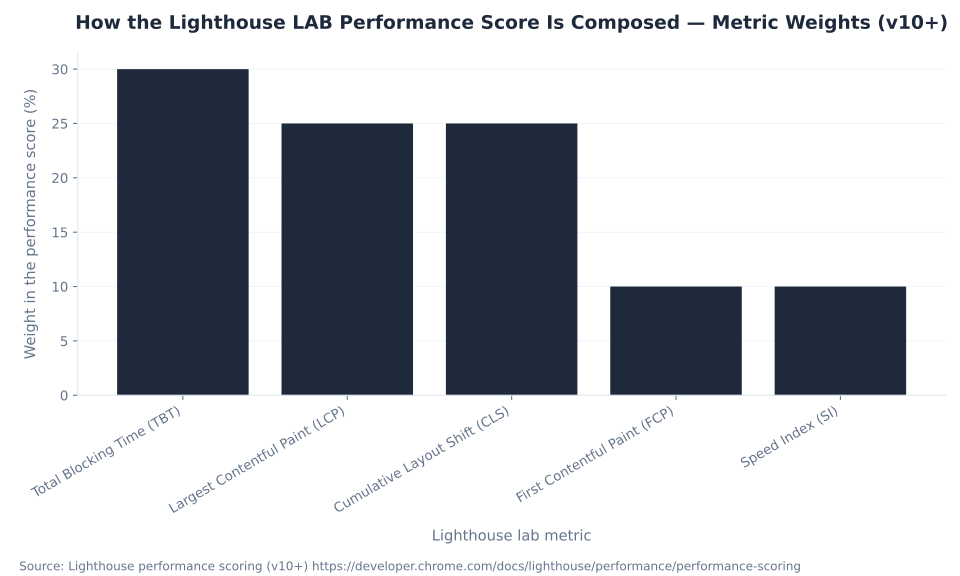
That distinction changes how you work. Chasing a 100 Lighthouse score while your real users experience "poor" Core Web Vitals optimizes the wrong number. The lab score is composed from five weighted metrics, shown in Table 2 — useful for finding what to fix, but never the thing Google ranks on. A 90-plus lab score is good hygiene; it does not itself boost rankings. This is why the Core Web Vitals section below insists on field data at the 75th percentile.
| Lab metric | Weight | What it captures |
|---|---|---|
| Total Blocking Time (TBT) | 30% | Main-thread blocking between first paint and interactivity (the lab proxy for responsiveness) |
| Largest Contentful Paint (LCP) | 25% | When the largest content element renders (loading) |
| Cumulative Layout Shift (CLS) | 25% | How much the layout shifts unexpectedly (visual stability) |
| First Contentful Paint (FCP) | 10% | When the first content renders |
| Speed Index (SI) | 10% | How quickly content is visually populated |
Source: Lighthouse performance scoring (v10+), developer.chrome.com. Weights sum to 100% and have been stable since Lighthouse v10, which moved the retired Time-to-Interactive weight to CLS. This is the LAB diagnostic score — Google's page-experience system ranks on real-user field (CrUX) Core Web Vitals, so a 90-plus lab score does not itself boost rankings. Not mbadv client data.
Two of the biggest speed culprits are third-party scripts and heavy client-side JavaScript — often analytics and marketing tags. Tags loaded through Google Tag Manager are a common LCP and INP drag, and moving that load off the browser with server-side tagging is one of the highest-leverage speed fixes for a script-heavy site. That measurement overlap is where MB Adv Agency does its strongest technical work — our server-side tracking setup moves tag weight off the client so it stops dragging Core Web Vitals down.
Core Web Vitals & the INP Correction
Core Web Vitals are the three field-measured metrics at the heart of page experience, and this is the section that drifts most. The correction to lead with: INP (Interaction to Next Paint) replaced FID (First Input Delay) as a Core Web Vital on March 12, 2024. FID is retired. Any 2026 audit still reporting "FID" is measuring a dead metric. The responsiveness vital is now INP, which measures the latency of all interactions across the page visit, not just the first one. The three current vitals and their "good / needs-improvement / poor" thresholds are in Table 3 — and they are assessed at the 75th percentile of real-user field (CrUX) data, not in the lab.
| Metric | Measures | Good | Needs improvement | Poor | Unit |
|---|---|---|---|---|---|
| LCP (Largest Contentful Paint) | Loading — largest element paint | ≤ 2.5 s | 2.5–4.0 s | > 4.0 s | seconds |
| INP (Interaction to Next Paint) — replaced FID Mar 12, 2024 | Responsiveness — all interactions | ≤ 200 ms | 200–500 ms | > 500 ms | milliseconds |
| CLS (Cumulative Layout Shift) | Visual stability | ≤ 0.1 | 0.1–0.25 | > 0.25 | unitless score |
Sources: web.dev, Web Vitals (thresholds at the 75th percentile of field/CrUX data); web.dev, INP becomes a Core Web Vital on March 12 (INP replaced FID, 2024-03-12). The three thresholds use different units — read each against its own metric, not by comparison. Presented as a table, not a chart, for exactly that reason. Not mbadv client data.
Read the thresholds against their own units: LCP in seconds (2.5), INP in milliseconds (200), and CLS as a unitless layout-shift score (0.1). These are the numbers Google's field-data assessment uses, and they are the ones to monitor in the Core Web Vitals and page experience report inside Search Console. The lab-versus-field discipline from the page speed section applies here directly: monitor field data at the 75th percentile, and use the lab score only to diagnose what to fix. For the broader ranking context, page experience is one tie-breaker inside the wider algorithm system, not a content substitute.
Page Experience: a Lightweight System, Not a Silver Bullet
Core Web Vitals do not act alone. Google evaluates them inside a broader page-experience system — a lightweight set of signals that is largely a tie-breaker between pages of similar quality. Page experience does not override great content: a fast, secure, mobile-friendly page with thin content still loses to a slower page that answers the query better. The components Google checks today are narrower than the 2021 launch definition, because the intrusive-interstitial, safe-browsing, and ad-experience checks were pared out of the page-experience definition in the 2021-to-2022 consolidation. Table 4 shows what remains and where each signal's data comes from.
| Component | What Google checks | Data source | Role |
|---|---|---|---|
| Core Web Vitals (LCP / INP / CLS) | Real-user speed, responsiveness, stability | CrUX field data | Tie-breaker between similar-quality pages |
| HTTPS | Page served securely | The site's certificate | Lightweight signal (since 2014) |
| Mobile-friendliness | Usable and legible on mobile | Smartphone Googlebot | Baseline (mobile-first indexing complete) |
Source: Google, Page experience, developers.google.com. Page experience is a lightweight system that does not override great content; the intrusive-interstitial, safe-browsing, and ad-experience checks were removed from the page-experience definition in the 2021–2022 consolidation. Not mbadv client data.
The practical read is honest and freeing: get the three page-experience components to a solid baseline — passing Core Web Vitals, sitewide HTTPS, a mobile-usable layout — and then stop optimizing them for their own sake and put the effort back into content and relevance. Page experience earns you the tie-breaker; the content itself is what wins the query. MB Adv Agency treats the page-experience baseline as table stakes, not as a growth lever in isolation.
It also helps to know what page experience is not. It is not a single score you can look up, and it is not a penalty. There is no "page experience score" in Search Console the way there is a Lighthouse number; instead, the individual signals feed the ranking systems, and the Core Web Vitals report shows you which URLs pass, need improvement, or fail on field data. Two pages that answer a query equally well can be separated by page experience — but a page that answers the query poorly will not be rescued by fast load times. That ordering — content first, experience as the tie-breaker — is the whole mental model, and it is why the effort you spend here has a natural ceiling.
HTTPS & SSL Certificates
HTTPS is the settled sub-area: it has been a confirmed, if very lightweight, ranking signal since August 6, 2014, and it remains in force as one of the three page-experience components. Serving your whole site over HTTPS with a valid TLS certificate and no mixed content is a baseline expectation in 2026, not an optional upgrade. It will not outrank better content, but its absence is a visible liability: since Chrome 68 in July 2018, Chrome marks every plain-HTTP page "Not secure" in the address bar, which erodes trust before a visitor reads a word. Table 5 lays out the verified timeline.
| Date | Milestone | Effect |
|---|---|---|
| Aug 6, 2014 | Google confirms HTTPS as a "very lightweight" ranking signal | Still in force; a baseline expectation, not a strong lever |
| July 2018 (Chrome 68) | Chrome marks all HTTP pages "Not secure" | Phased in from Chrome 56 (Jan 2017) and Chrome 62 (Oct 2017); a trust and conversion issue |
| 2021 → 2022 | HTTPS folded into the consolidated page-experience system | One of the three page-experience components alongside Core Web Vitals and mobile-friendliness |
Sources: Google, HTTPS as a ranking signal (2014); Chromium, Marking HTTP as non-secure; Google, Page experience. Not mbadv client data.
The action here is binary and cheap: migrate every URL to HTTPS, redirect HTTP to HTTPS with 301s, fix mixed-content warnings (assets loaded over HTTP inside an HTTPS page), and keep the certificate from expiring. Because HTTPS is also one of the canonicalization signals Google weighs, a clean HTTPS setup does double duty — it satisfies a page-experience component and reinforces the canonical you want indexed. Confirm the secure version is the one Google indexes with URL Inspection in Search Console.
Mobile SEO
Mobile SEO is no longer a separate discipline you opt into — it is the default. Mobile-first indexing is complete: the smartphone Googlebot is the default crawler Google uses to index the web ("mobile-first is here," October 2023), and the final Search Console crawler-setting control was removed around July 2024. In practice that means Google sees your mobile page first. If content, structured data, or internal links exist only in your desktop layout and are stripped on mobile, Google effectively does not see them. The rule is simple: serve the same content and the same structured data on mobile as on desktop. Table 6 is the working checklist.
| Check | What to verify | Why it matters |
|---|---|---|
| Content parity | The mobile page has the same primary content as desktop | Google indexes the mobile version; hidden-on-mobile content is effectively invisible |
| Structured-data parity | The same JSON-LD is present on mobile | Missing mobile structured data forfeits rich-result eligibility |
| Responsive design | One responsive layout adapts to viewport, not a separate m-dot site | The simplest way to guarantee parity and avoid duplicate-URL issues |
| Mobile usability | Legible font sizes, tap targets, no horizontal scroll | Contributes to the mobile-friendliness page-experience component |
Source: Google, Mobile-first indexing is here (Oct 2023), developers.google.com; the final Search Console crawler-setting removal was reported around July 5, 2024. Not mbadv client data.
Mobile-friendliness is the third page-experience component, so mobile SEO and Core Web Vitals reinforce each other: a responsive layout that passes the CWV thresholds on a mid-range phone on a slow connection is the real-world target, because that is closer to the field data Google measures than a desktop lab run. Technical, JavaScript-heavy sites — SaaS products are a classic example — feel mobile Core Web Vitals problems first, because the JavaScript that renders their content is exactly what slows LCP and INP on a phone.
Canonical Tags
The most consequential misconception in this whole guide is that a canonical tag forces Google's choice. It does not. rel=canonical is a hint, not a directive. It is one of several signals Google weighs when it picks the canonical URL for a set of duplicate or near-duplicate pages, and Google can select a different URL than the one you annotate. Canonicalization consolidates the ranking signals of duplicate pages onto a single chosen URL; it does not deindex the alternates, and it does not guarantee your pick. Table 7 lists the signals Google actually weighs.
| Signal | Role |
|---|---|
| rel="canonical" annotation | A strong hint — not binding; Google can choose a different URL |
| 301 / 302 redirects | A strong canonicalization signal |
| HTTPS vs HTTP version | Google prefers the HTTPS URL |
| URL in the XML sitemap | A weak signal that a URL is the intended one |
| Internal linking patterns | Which version you link to most is a signal |
| URL formatting | Shorter, cleaner URLs are a minor signal |
Source: Google, Canonicalization, developers.google.com. Purpose: consolidate duplicate signals onto one URL — it does not deindex the alternates or guarantee your annotated choice. Not mbadv client data.
The practical discipline is to make every signal agree. If your rel=canonical points one way but your internal links, sitemap, and redirects point another, you send Google conflicting hints and it can pick the wrong URL. Keep the canonical, the HTTPS version, the internal links, and the sitemap all pointing at the same preferred URL, then confirm Google's actual choice with URL Inspection. Where duplicate-URL problems shade into full crawl and index questions, the index coverage report and the crawling and indexing guide pick up the thread.
Structured Data & Schema Markup
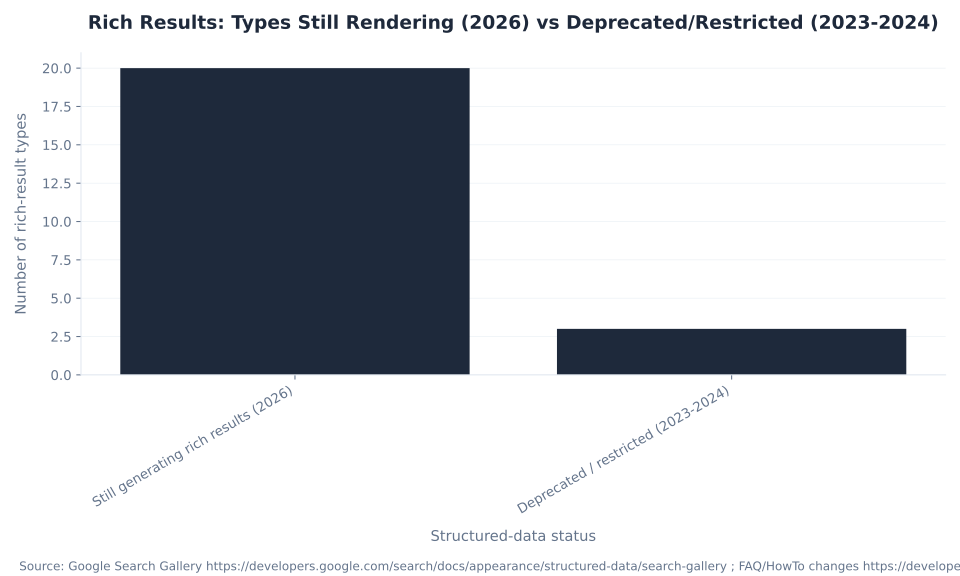
Structured data is machine-readable markup — JSON-LD is Google's recommended format — that describes a page's content so Google can understand it and, for eligible types, show a rich result. The correction to internalize: structured data drives rich-result eligibility, not a direct ranking boost. Adding schema does not raise your position; it makes a page eligible for an enhanced listing when the type still renders. And several once-common rich results no longer render for ordinary sites. Table 8 separates what still generates rich results in 2026 from what was deprecated or restricted in 2023 and 2024.
| Status | Types |
|---|---|
| Still generating rich results (2026) | Article, Breadcrumb, Product / merchant listing, Review snippet, Video, Event, Recipe, Q&A (QAPage — distinct from FAQPage), Local business, Job posting, Organization, Profile page, Course, Dataset, Discussion forum, Software app, and more (20-plus features in the Search Gallery) |
| Deprecated / restricted (2023–2024) | FAQ — restricted Aug 8, 2023 to authoritative government and health sites (not shown for ordinary sites); HowTo — removed in 2023; Sitelinks searchbox — removed globally Nov 21, 2024 |
Sources: Google, Search Gallery; Google, Changes to HowTo and FAQ rich results; Google, Sitelinks search box is going away; Google, Intro to structured data (JSON-LD recommended; eligibility, not ranking). Not mbadv client data.
The takeaway is to mark up content for the types that still render — Article, Product, Review, Video, Recipe, Breadcrumb, Event, Local business — and to stop expecting an FAQ or HowTo rich result on an ordinary site, because those are gone. A structured-data manual action costs you rich-result eligibility but, per Google's structured-data policies, "doesn't affect how the page ranks." Validate your markup in the Rich Results Test and monitor it through the enhancements and rich-results reports in Search Console.
Where the Technical SEO Topics Rank by Search Demand
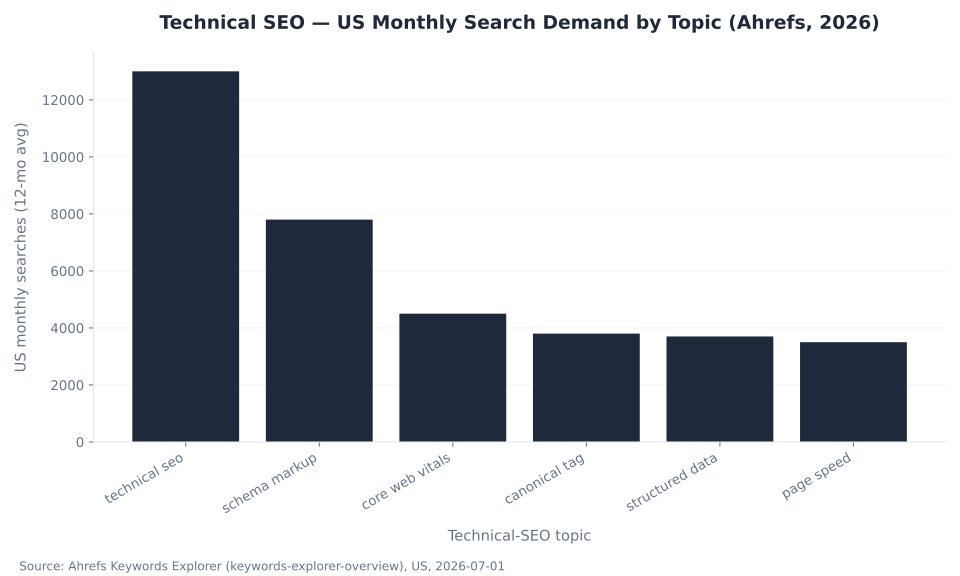
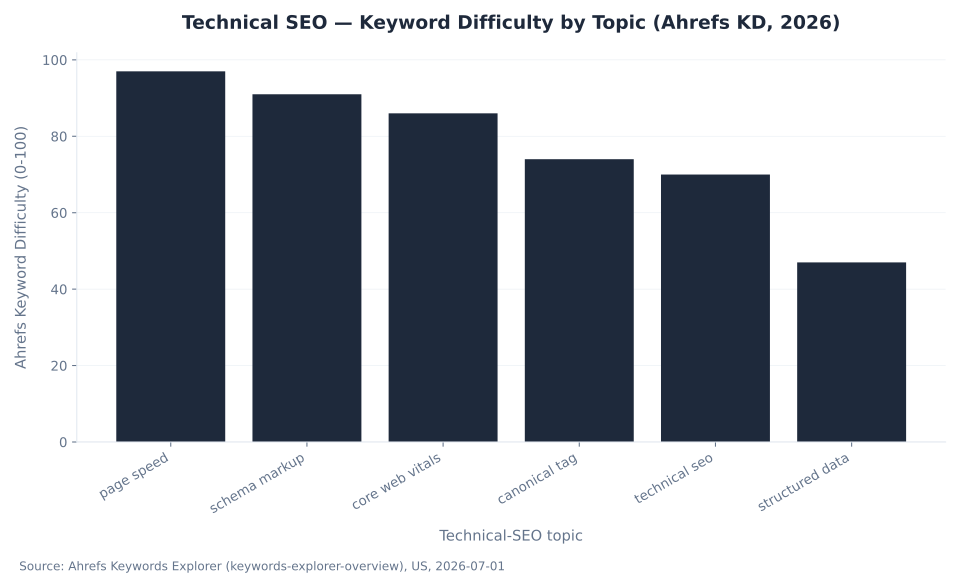
Technical SEO is not one keyword — it is a cluster of sub-topics, each with its own demand and its own competition. "Technical seo" is the head term at 13,000 US searches per month (Ahrefs, US, 2026-07-01), and this guide is built as the umbrella that consolidates the cluster around it. The competition is steep across the set: "page speed" carries a keyword difficulty of 97 and "schema markup" 91, while "structured data" is the most winnable at KD 47. Table 9 shows where the demand sits.
| Term | US volume | Global | KD |
|---|---|---|---|
| technical seo | 13,000 | 29,000 | 70 |
| schema markup | 7,800 | 23,000 | 91 |
| core web vitals | 4,500 | 26,000 | 86 |
| canonical tag | 3,800 | 14,000 | 74 |
| structured data | 3,700 | 13,000 | 47 |
| page speed | 3,500 | 63,000 | 97 |
Source: Ahrefs Keywords Explorer, US 12-month average volume, 2026-07-01 (pillar data JSON). The absorbed page-speed-optimization URL carries the only live Search Console toehold in this cluster — 863 impressions across 40 keywords at position 50.5, top query "web speed optimization" — which now folds into the page speed section above. Not mbadv client data.
The strategy this table implies is topical-authority concentration rather than chasing the head term in isolation: one deep umbrella guide, tightly interlinked with the sub-topic sections and the sibling keyword guide, beats six thin pages competing against each other. Technical SEO makes pages accessible; keyword and content work make them relevant — the two halves of the same job.
A Practical Technical SEO Checklist
Here is the whole guide compressed into one scannable checklist — the six sub-areas, what to verify in each, and the tool that shows it. The final row is the deliberate handoff: crawl and index depth (robots.txt, XML sitemaps, indexability) belongs to the crawling and indexing guide, not this one. Table 10 is the working list a site owner or developer can run top to bottom.
| Area | What to check | Tool |
|---|---|---|
| Page speed / Core Web Vitals | LCP / INP / CLS in field data at the 75th percentile | PageSpeed Insights, CrUX, Search Console Core Web Vitals report |
| Security | Sitewide HTTPS, a valid certificate, no mixed content | Browser padlock, an SSL checker |
| Mobile | Same content and structured data on mobile; a usable layout | Search Console, responsive testing |
| Canonicalization | Correct rel=canonical; no conflicting signals | URL Inspection (Search Console) |
| Structured data | Valid JSON-LD for an eligible rich-result type | Rich Results Test, Schema Markup Validator |
| Crawl / index → see the crawling guide | robots.txt, XML sitemaps, indexability | Search Console — full detail in the crawling and indexing guide |
Source: web.dev and developers.google.com. The crawl / index row hands off to how search engines work. Not mbadv client data.
Run the checklist in order of leverage, not order of interest: security and mobile are near-binary and cheap to get right, Core Web Vitals reward sustained work, and structured data is opportunistic — add it where an eligible rich result exists. To track the results of that work over time, wire the whole thing into Search Console performance tracking.
How to Run a Technical SEO Health Check
A technical SEO health check is a repeatable six-step routine, and it mirrors the structured steps in this guide's HowTo schema. Work it in order, because each step de-risks the next.
Step 1 — Measure Core Web Vitals in field data. Pull LCP, INP, and CLS from PageSpeed Insights, CrUX, or the Search Console Core Web Vitals report at the 75th percentile, and compare against the thresholds in Table 3 (LCP ≤ 2.5 s, INP ≤ 200 ms, CLS ≤ 0.1). Use the Lighthouse lab score only to diagnose what to fix, never as the pass/fail number. Step 2 — Confirm sitewide HTTPS with a valid certificate and no mixed content. Step 3 — Confirm content and structured-data parity on mobile, since the smartphone Googlebot is the indexing crawler. Step 4 — Check rel=canonical is correct and not conflicting with your redirects, sitemap, and internal links. Step 5 — Validate JSON-LD for an eligible rich-result type in the Rich Results Test, and skip FAQ and HowTo markup for rich results, because those are deprecated. Step 6 — Hand crawl and index checks — robots.txt, XML sitemaps, indexability — to the crawling and indexing workflow.
That six-step loop is the entire performance-and-markup layer of technical SEO in one pass. MB Adv Agency runs the same discipline on the measurement side of the campaigns we manage — the tag and tracking setup that feeds your analytics is exactly where slow, script-heavy configurations quietly damage Core Web Vitals, and where a server-side tracking fix pays for itself.
Technical Foundation Set — Now Drive Demand
A fast, crawlable site is the launchpad; paid search is the accelerator
MB Adv Agency runs the paid campaigns — Google Ads and PPC — that complement your organic SEO, and the server-side tracking that keeps script weight off your Core Web Vitals. Talk to our team about the paid side of search.
Talk to our team →Lab vs Field, and the INP Correction: What Changed in 2024–2026
If you are auditing a site from a checklist written before 2024, two corrections dominate everything else. The first is the metric swap: INP replaced FID on March 12, 2024. FID measured only the delay before the browser began processing the first interaction; INP measures the full latency of interactions across the whole visit, which is a far more honest picture of how responsive a page feels. Any tool, report, or consultant still citing FID in 2026 is working from a retired metric, and the correct "good" target is INP ≤ 200 ms in field data.
The second correction is lab versus field, and it is the most common practitioner error in technical SEO. Google's page-experience system ranks on real-user field data (CrUX) at the 75th percentile — not on the numeric Lighthouse or PageSpeed Insights lab score. PageSpeed Insights shows both, side by side, which is exactly why they get conflated. The lab score (composed from the weights in Table 2) is a controlled diagnostic for finding what to fix; the field data is the ranking-relevant assessment. A page can score 95 in the lab and still fail Core Web Vitals in the field if real users on real devices and networks experience slow interactions. Optimize the field numbers; use the lab number as a debugging aid. For how these page-experience signals surface as a tie-breaker inside the broader ranking picture, see Google algorithm updates.
Technical SEO Is a Tie-Breaker, Not a Magic Lever
Because "technical SEO" sounds like a hidden switch that unlocks rankings, it is worth stating the opposite plainly: on its own, technical SEO rarely moves a page up the results. Page experience is a lightweight tie-breaker between pages of similar quality, HTTPS is a very lightweight signal, structured data drives eligibility rather than position, and canonical tags consolidate signals rather than boost them. None of these is a growth lever you pull to leapfrog better content.
What technical SEO actually does is remove ceilings. A page that loads slowly, breaks on mobile, serves over insecure HTTP, sends conflicting canonical signals, or hides its content behind un-rendered JavaScript is capping what its content and links could otherwise earn. Fix the technical layer and you stop leaking the value the other two pillars generate. That is why the honest sequence is: get the checklist to a solid baseline, then invest the marginal hour in content and authority, not in chasing a 100 Lighthouse score. The businesses MB Adv Agency works with that also invest in organic treat technical SEO as maintenance-grade hygiene — necessary, bounded, and not where the growth comes from.
The one place the technical and paid worlds meet directly is tracking. Heavy client-side tags slow Core Web Vitals and muddy measurement at the same time, so the fix — server-side tagging — improves both the field-data numbers Google ranks on and the conversion data your campaigns depend on. That overlap is the honest reason a paid-media agency has a stake in your technical SEO at all.
Technical SEO FAQ
Script-Heavy Site Dragging Your Vitals?
Move the tag load off the browser and the field numbers follow
Third-party tags are a common LCP and INP culprit. Our server-side tracking work moves that weight off the client so Core Web Vitals improve while your measurement gets cleaner.
Server-side tracking →All PPC servicesMethodology & Sources
Every threshold, date, and number in this guide traces to a named primary source. The Core Web Vitals thresholds, the field-versus-lab distinction, and the INP replacement come from web.dev and the web.dev INP announcement. The page-experience system, the HTTPS signal, mobile-first indexing, canonicalization, and structured-data rules come from developers.google.com. The Lighthouse metric weights are attributed to the Lighthouse scoring documentation as a lab-tool convention, never as a Google ranking input.
Search-demand figures are from Ahrefs Keywords Explorer (US, 12-month average, 2026-07-01), and the Search Console toehold data (863 impressions on the absorbed page-speed URL) is from the pillar's own GSC export. Rich-result deprecations are dated to Google's own announcements: FAQ restriction (August 8, 2023), HowTo removal (2023), and the sitelinks searchbox removal (November 21, 2024). No WordStream or LocaliQ figure appears anywhere in this guide — those publish paid-search cost-per-click data, which is irrelevant to technical SEO.
MB Adv Agency has no SEO or technical-SEO service and no SEO client benchmark dataset, so the point of view here stays qualitative: our team, the businesses we work with that also invest in organic, and the paid campaigns we run that complement their SEO. No mbadv client metric appears anywhere in this guide. Last updated 2026-07-01. To discuss the paid search that complements your organic work, talk to our team.
In the ever-evolving landscape of digital marketing and website management, understanding the intricacies of technical SEO is crucial for any website owner aiming to enhance their visibility on search engines. This article delves into the definition and purpose of technical SEO, its significance for website health, and the critical elements that comprise technical SEO.
Definition and purpose
Technical SEO refers to the optimization processes that ensure a website meets the technical requirements of search engines. Unlike traditional SEO, which often revolves around content and backlinks, technical SEO focuses specifically on the elements that facilitate crawling and indexing. It encompasses a variety of practices aimed at enhancing the performance and accessibility of a website.

The primary purpose of technical SEO is to create an efficient and user-friendly experience for site visitors while also enabling search engines like Google to easily navigate and understand the content of the website. When optimized correctly, technical SEO can significantly improve a site's visibility in search results, ultimately leading to increased organic traffic.
Technical SEO involves various disciplines such as website architecture, URL structures, sitemaps, and mobile-friendliness. By addressing these areas, webmasters can ensure their site adheres to best practices that contribute to better search engine ranking and a superior visitor experience. Additionally, a well-optimized website can reduce bounce rates, as users are more likely to stay on a site that loads quickly and is easy to navigate. This not only benefits the user but also signals to search engines that the site is valuable, potentially boosting its rankings further.
Key components of technical SEO
Several key components of technical SEO need to be considered for effective optimization. Understanding and implementing these elements can lead to a more efficient website that performs better in search engine results. Each component plays a crucial role in ensuring that both users and search engines can interact with the site seamlessly.
- Crawlability: Ensuring that search engines can easily crawl and index your website is vital. This can be achieved by optimizing the site's structure, creating an XML sitemap, and using a robots.txt file to guide search engine bots. Proper crawlability ensures that all important pages are discoverable, which is essential for maximizing the site's visibility.
- Mobile Optimization: With the significant rise in mobile users, having a mobile-friendly website is no longer optional. Responsive design and fast loading times are critical components that enhance user experience and improve rankings. In fact, Google has implemented mobile-first indexing, meaning that the mobile version of a site is considered the primary version for ranking purposes.
- Page Speed: Website loading speed significantly impacts user retention and SEO. Tools like Google PageSpeed Insights can help identify areas for improvement. A fast-loading site not only enhances user satisfaction but also reduces the likelihood of users abandoning the site before it fully loads, which can negatively affect conversion rates.
Importance for website health
The importance of technical SEO for website health cannot be overstated. A well-optimized site reduces issues that might arise during interactions with search engines and users, paving the way for a smoother digital experience. In today's competitive online landscape, having a technically sound website is crucial for standing out among countless competitors. Search engines prioritize sites that offer a seamless experience, which means that neglecting technical SEO can lead to lost opportunities for visibility and engagement.

One significant aspect of maintaining website health lies in fixing broken links, which can lead to a poor user experience and harm search rankings. Regularly auditing and updating links helps maintain the integrity and reliability of a site. Additionally, broken links can create a sense of neglect, making users question the credibility of the information presented. Implementing tools that automatically check for broken links can save time and ensure that the website remains trustworthy and user-friendly.
Moreover, page speed directly correlates with bounce rates. A fast-loading website keeps users engaged and content whereas a slow site can lead to frustration and abandonment. Addressing technical SEO issues can substantially reduce bounce rates and improve user engagement metrics. Furthermore, optimizing images, leveraging browser caching, and minimizing HTTP requests are all effective strategies to enhance page speed. As mobile usage continues to rise, ensuring that the site performs well on various devices is also a critical component of maintaining website health.
Technical SEO for user experience
A robust technical SEO strategy not only benefits search engines but also enhances user experience significantly. Visitors are more likely to interact positively with a website that is easy to navigate and loads quickly. Some elements that contribute to a remarkable user experience include:
- Consistent URL structure, ensuring users can easily remember and navigate the site.
- Structured data markup, which helps search engines understand the content better and can enhance listings in search results.
- Secure and accessible websites that build trust with users, particularly in e-commerce and sensitive data handling.
In addition to these elements, mobile optimization is increasingly vital in today's digital environment. With a significant portion of web traffic originating from mobile devices, ensuring that a website is responsive and provides a seamless experience across all screen sizes is essential. This includes optimizing touch targets, ensuring text is readable without zooming, and maintaining fast load times on mobile networks. Another important factor is the implementation of an intuitive navigation system, which allows users to find what they need quickly and efficiently. A well-structured menu and clear call-to-action buttons can significantly enhance user satisfaction and encourage repeat visits.
Key elements of technical SEO
The success of technical SEO hinges on several key elements. By understanding and optimizing these components, website owners can greatly improve both functionality and search engine rankings.
1. SSL Certificates
Having an SSL certificate is now considered a fundamental requirement for websites. SSL (Secure Socket Layer) encrypts data being transferred between the user and the server, ensuring secure transactions and interactions. Websites that utilize HTTPS are prioritized by search engines, making SSL certificates essential for optimizing technical SEO. Furthermore, the presence of an SSL certificate can enhance user trust, as visitors are more likely to engage with a site that visibly protects their information. This trust can lead to increased conversions and lower bounce rates, further signaling to search engines that the site is valuable and relevant.
2. XML Sitemap
An XML sitemap serves as a roadmap for search engines, outlining the structure and pages of a website. Submitting an XML sitemap to search engines like Google can ensure that all important pages are indexed efficiently, improving a site’s crawlability. Additionally, keeping the sitemap updated with new content and changes to existing pages is crucial, as it helps search engines discover and index new information quickly. This proactive approach not only aids in SEO but also ensures that users have access to the latest content, enhancing their overall experience on the site.
3. Mobile Responsiveness
A mobile-responsive website adjusts its design according to the device being used. This flexibility enhances user experience across various platforms and is crucial for achieving high rankings in mobile search results. With the increasing number of users accessing the internet via smartphones and tablets, it is imperative that websites provide seamless navigation and readability on smaller screens. Furthermore, Google employs mobile-first indexing, meaning that the mobile version of a site is considered the primary version for ranking purposes. Therefore, investing in a responsive design is not just a trend but a necessity for modern web development.
4. Error Handling
Regularly checking for and addressing errors like 404 pages is vital. Custom error pages can help redirect users back to useful content, thereby maintaining engagement instead of losing them entirely. Moreover, implementing proper redirects, such as 301 redirects for moved content, ensures that both users and search engines are directed to the correct pages without encountering dead ends. This practice not only improves user experience but also preserves link equity, which is essential for maintaining search rankings.
5. Site Architecture
The architecture of a website impacts both search engine crawling and user navigation. A well-organized structure that includes clear categories and subcategories helps search engines understand the relationship between different pages while improving the user experience. In addition, utilizing breadcrumb navigation can further enhance usability by allowing users to easily backtrack through their browsing history. A logical site architecture also facilitates the implementation of internal linking strategies, which can distribute page authority throughout the site and enhance the visibility of less prominent pages. By creating a cohesive and intuitive navigation system, website owners can significantly boost both user satisfaction and search engine performance.
Conclusion
In conclusion, technical SEO is an essential aspect of website management that has far-reaching implications for online visibility and user experience. With a focus on optimizing the back-end elements of a website, technical SEO not only assists with search engine crawling and indexing but also fosters a healthy environment for users. By understanding and implementing key components, website owners can improve their chances to rank high in search results, ultimately achieving greater online success.

As a Google Ads expert, I bring proven expertise in optimizing advertising campaigns to maximize ROI.
I specialize in sharing advanced strategies and targeted tips to refine Google Ads campaign management.
Committed to staying ahead of the latest trends and algorithms, I ensure that my clients receive cutting-edge solutions.
My passion for digital marketing and my ability to interpret data for strategic insights enable me to offer high-level consulting that aims to exceed expectations.
Google Partner Agency
We're a certified Google Partner Agency, which means we don’t guess — we optimize withGoogle’s full toolkit and insider support.
Your campaigns get pro-level execution, backed by real expertise (not theory).

4.9 out of 5 from 670+ reviews on Fiverr.
That’s not luck, that’s performance.
Highly recommend Matteo to set up your server side tracking. He has a deep understanding of e-commerce tracking and will go above and beyond to make sure everything is set up correctly and working 100%. If you are scaling your store this set up is non-negotiable in my opinion and there isn't many people who have this much knowledge or put the effort in to get it right. Thanks again!

avorodesign.com
I can only recommend Matteo! He was very patient, professional and very knowledgeable about GA4, Consent Mode v2, and GDPR compliance. Communication was clear, and the setup was done professionally and efficiently. Highly recommend him for anyone needing reliable tracking implementation.

www.natureiki.life
Matteo shines in the realm of online professionals. His work is not only deep in data but also complemented by his proactive communication and cooperation, setting a new standard for freelancers. If you want someone who truly exceeds expectations, look no further. Highly recommended!

www.omanbeverlysmyth.com
Exceptional Service Beyond Expectations - Outstanding Service Impeccable depth, flawless delivery, and exceptional language fluency—this service exceeded all expectations. Highly recommended. Matteo truly ROCKS!!!

ium-paris.com
Top-notch, always highly value working with Matteo. An absolute Google Ads Genius. This is approximately the 8th time I have hired him and he's helped us get 6-7 ROAS. We are excited in continuing to improve our lead flow. Hire this guy if you need Google Ads help. Thanks Matteo!

www.dleeventgroup.com
I finally found the guy who can setup server side tracking and all the ecosystem properly. I definitely recommend Matteo. He is very responsive, kind and wants to dig into things. He configured GA4, Meta, Google Ads, Outbrain and google consent v2 with Cookiebot. Thanks Matteo.

inomega.fr
MB Adv delivered exceptional work with outstanding professionalism and lots of patience, taking time to see effects of changes made and not just do the work and submit it. The proactive communication and video summaries of the work completed made working with Matteo a pleasure, as he consistently went above and beyond. Highly recommended for web analytics projects! We are already working on another project.

www.withnellsensors.co.uk
Working with Matteo on my Google Ads was a game-changer. He's not just a strategist, he's a true partner. He understood my goals and tailored a campaign that perfectly reached my target audience. I'm grateful for his expertise and dedication.

dccargo.com
Click-driven mind
with plastic-brick obsession.
We build Google Ads campaigns with the same mindset we use to build tiny brick worlds: strategy, patience, and zero tolerance for wasted pieces.
Data is our blueprint. Growth is the only acceptable outcome.