Google Ads Keyword Match Types: 2026 Guide

55%
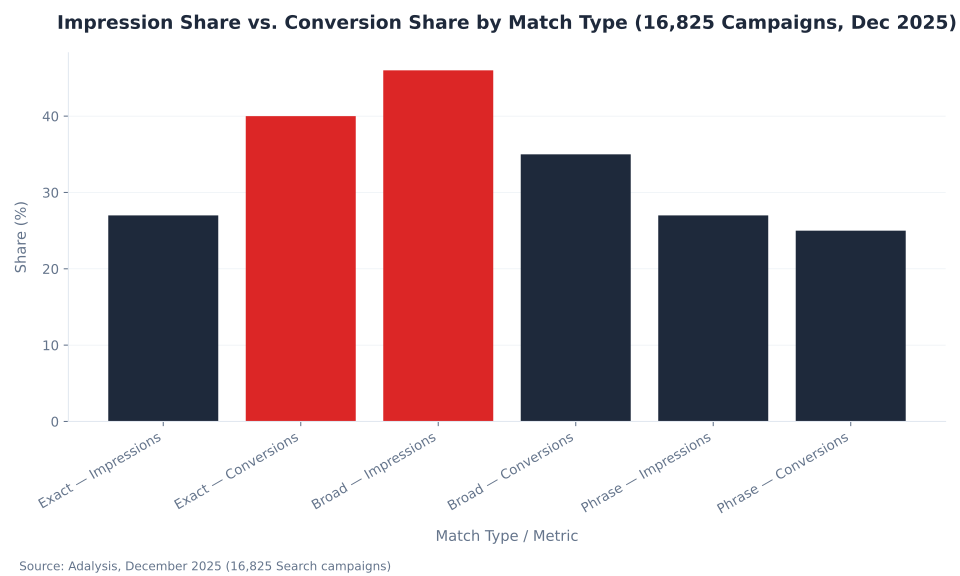
of keywords in analyzed Search campaigns are exact match — yet exact match captures only 27% of available impressions while generating 40% of conversions.
Adalysis · 16,825 Google Ads Search campaigns · December 2025
Google Ads Keyword Match Types: What Changed in 2026
In 2026, Google Ads offers three keyword match types — broad, phrase, and exact. Each one functions as a bidding-strategy coupling decision, not a standalone precision dial. Broad match has been the default for new Search campaigns since July 2024. The question is not which type gives control — it is which bidding-and-match-type combination fits the account's conversion data volume.
Match types govern whether an ad is eligible to show for a given search query. The legacy framing — broad match for reach, exact match for precision — no longer describes how these types work. Since July 2024, Google sets new Search campaigns to broad match by default when a conversion-based Smart Bidding strategy is selected, a change that redefined how advertisers must think about keyword architecture from the moment a campaign is created. Match types are now decision points about automation coupling, not just query expansion breadth.
The three match types differ in how they interpret a user's search query. Broad match expands to related meanings and implied intent — Google's AI interprets the query at auction time and decides whether the keyword is relevant. Phrase match shows for queries containing the keyword meaning in the same general order; since the 2021 migration, it is intent-based and covers paraphrased queries where meaning is equivalent. Exact match covers queries with the same meaning or same intent as the keyword — not the same characters. Close variants including misspellings, plural forms, stems, abbreviations, and same-intent paraphrases are included by default with no opt-out available.
The "broad equals wasteful, exact equals safe" framing that dominated pre-2019 Google Ads strategy is obsolete. The real variables are conversion history depth, Smart Bidding signal maturity, and negative keyword coverage. An account running broad match with 150 conversions per month and Target CPA has the data infrastructure for Smart Bidding to make per-auction bid decisions that filter off-target queries. An account with 20 conversions per month running broad match has no such infrastructure. This pillar covers the match type behavior matrix, negative keyword architecture, Smart Bidding pairing logic, Keyword Planner accuracy, and the four misconceptions that generate the most wasted spend. For the bidding side of this equation, see Google Ads Bidding Strategies. For campaign type architecture decisions, see Google Ads Campaign Types.
Key Takeaways
- ✓ Google Ads has 3 match types since July 2021 — broad, phrase, and exact. Broad match modifier (BMM) is retired and gone.
- ✓ Broad match is Google's default for new Search campaigns since July 2024 — but only when a conversion-based Smart Bidding strategy is active.
- ✓ Exact match includes close variants by default — misspellings, plurals, paraphrases with same intent. There is no opt-out setting.
- ✓ Switching phrase to broad with Target CPA delivers ~+25% more conversions while meeting the cost target (Google internal data, 2024).
- ✓ Negative keywords do NOT match close variants. Each unwanted form needs a separate entry — misspellings auto-covered since June 2024 only.
- ✓ Performance Max negative keyword limit expanded from 100 to 10,000 per campaign in March 2025 — removing the primary PMax exclusion objection.
Match Type Stats at a Glance
3
keyword match types in Google Ads since July 2021
Google Ads Help, 2021
40%
of conversions from exact match keywords (27% of impressions)
Adalysis · 16,825 campaigns · Dec 2025
+25%
more conversions switching phrase to broad with Target CPA
Google Ads Help · answer/10195720 · 2024
10,000
max negative keywords per PMax campaign since March 2025
Google Ads Help · answer/6372658
16,825
Search campaigns in Adalysis match type performance study
Adalysis · December 2025
KD 16
'google ads match types' keyword difficulty — early ownership opportunity
Ahrefs · May 2026
Broad Match + Smart Bidding: Google's 2026 Default Architecture
Broad match is Google's default for new Search campaigns as of July 2024, but only when a conversion-based Smart Bidding strategy is selected. Without Smart Bidding, broad match serves off-topic queries with no per-auction bid calibration. The pairing is the condition — not the match type alone.
Google's explicit framing is that broad match is correct only when paired with one of four Smart Bidding strategies: Target CPA, Target ROAS, Maximize Conversions, or Maximize Conversion Value. Without one of these strategies active, broad match serves queries with no per-query bid calibration to control cost. The AI that interprets query intent at auction time is the same AI that sets the bid — remove the bid automation and the intent filtering loses its cost-control mechanism entirely.
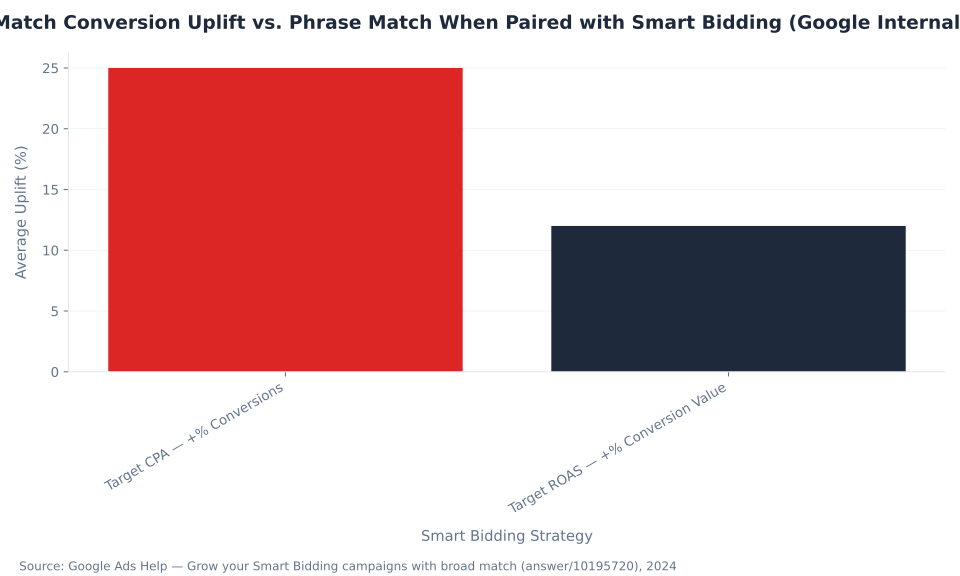
The performance data Google publishes: switching from phrase match to broad match with Target CPA delivers a published average of +25% more conversions while meeting the cost target; switching with Target ROAS delivers a published average of +12% more conversion value while meeting the return target. Both are Google-published averages — they are industry guidance, not guarantees, and Google has not disclosed the methodology or sample composition behind these figures. Additionally, Google's AI improvements to broad match quality delivered a +10% performance improvement, cited in Google's July 2024 announcement. These numbers establish the ceiling of what the pairing is designed to produce; actual results depend on conversion history depth, Smart Bidding signal maturity, and negative keyword architecture.
The campaign-level "broad match keywords" setting forces all keywords in a campaign to broad match and is available only when a conversion-based Smart Bidding strategy is active. This setting is designed for full-funnel campaigns where granular keyword list management is replaced by the combination of audience signals, bidding automation, and negative keyword exclusions. It is not a shortcut — it requires that the account has the conversion history to support full automation.
The conversion threshold question is widely discussed and poorly documented. The industry broadly uses 30 conversions per month as the minimum floor for Smart Bidding signal to be reliable; for Target ROAS specifically, 50 conversions per month is the practitioner benchmark. Neither number is officially published by Google — Google's Smart Bidding documentation uses the phrase "sufficient conversion history" without specifying a threshold. The 30 and 50 conversion benchmarks originate from practitioner consensus, not Google documentation. In accounts below these thresholds, phrase or exact match keeps budget predictable while conversion data accumulates to the level where Smart Bidding can function as designed.
Broad match is not the right architecture for every account state. Brand protection campaigns carry competitor-query overlap risk when broad match interprets branded queries as broadly related to competitor brands. New accounts under 30 conversions per month lack the Smart Bidding signal depth to bid accurately per query. Local service businesses in tight geographies — HVAC in a single suburb, a dental practice in a single zip code — face the additional problem that Smart Bidding does not reliably suppress out-of-area queries in sub-metro geotargeting. For industry-specific keyword architecture in tight geos, see HVAC PPC and the Flagstaff HVAC PPC local guide. For the bidding strategy layer, see Google Ads Bidding Strategies.
Match Type Behavior Matrix (2026)
The three match types differ in query expansion breadth, Smart Bidding coupling requirements, close-variant scope, and account fit. This table is the current state in 2026 — post-BMM retirement, post-close-variant expansion, post-July-2024 default change.
| Match Type | Syntax (UI) | Triggers on | Does NOT trigger on | Close variants? | Recommended bidding | Best for |
|---|---|---|---|---|---|---|
| Broad | No wrapper | Related meaning, implied intent, related searches | Queries AI deems semantically irrelevant | Yes — expands beyond close variants to related meanings | Smart Bidding only (Target CPA / Target ROAS / Max Conversions / Max Conv Value) | Mature accounts (100+ conv/mo); incremental discovery |
| Phrase | "keyword" | Keyword meaning in same general order; intent-equivalent paraphrases | Queries inserting words that change intent; clearly different intent | Yes — intent-based paraphrases and same-meaning variants | Smart Bidding or manual CPC | Established accounts (30–100 conv/mo); new verticals; controlled expansion |
| Exact | [keyword] | Same meaning or same intent as keyword | Queries with additional words that materially change meaning | Yes — misspellings, plurals, stems, abbreviations, function-word changes, word reorder with same meaning, same-intent paraphrases | Any | Brand campaigns; high-value head terms; any campaign where query control matters |
Syntax notation — [brackets] for exact match, "quotes" for phrase match, no wrapper for broad match — matters in Google Ads Editor and the API. In the Google Ads UI, match type is set via a dropdown when creating or editing a keyword; the syntax characters are not required in the UI. The syntax does not change behavior; it is a notation convention. For how match type interacts with Quality Score and Ad Rank, see Google Ads Quality Score and Ad Rank.
Exact Match in 2026: Close Variants You Cannot Opt Out Of
Exact match has not functioned as a character-for-character keyword lock since 2019. Google's current definition is same meaning or same intent — not same words. Close variants are included by default. There is no setting to disable this. A campaign running only exact match keywords still triggers on queries that were not on the original keyword list.
"Exact match gives you exact control." This was accurate before 2019. It has not been accurate since. Google introduced close variants for exact match in stages — initially misspellings and plurals, then same-meaning paraphrases in 2019. The current scope is broad enough that a campaign built entirely on exact match keywords regularly shows for queries that do not contain any keyword term verbatim. The 2026 close variant scope includes seven distinct expansion types.
| Close variant type | What it covers | Example keyword | Example triggering query |
|---|---|---|---|
| Misspellings | Alternate spellings of the keyword | [marketing agencyy] | marketing agency |
| Plural / singular | Singular or plural form | [marketing agency] | marketing agencies |
| Stemmings | Morphological variants | [run ads] | running ads |
| Abbreviations | Shortened forms | [pay per click] | PPC |
| Function-word changes | Add/remove/change in/to/for/but/a/the | [ads for plumbers] | plumber ads |
| Word reordering (same meaning) | Different word order with same meaning | [nike shoes women] | nike shoes for women |
| Same-intent paraphrases | Different words, same intent | [marketing agency] | agency for marketing |
The practical approach: run exact match keywords as your primary control layer, conduct weekly search-term report reviews (weekly is more effective than monthly for catching close-variant expansion early), and add exact-match negative keywords for specific variants you want to exclude. The seven close-variant types cannot be disabled globally — they can only be countered query by query through the negative keyword list. For how search-term data feeds into performance analysis, see Google Ads Metrics and KPIs. In high-CPC verticals where close-variant leakage has material CPA impact, the stakes are higher: see Legal PPC and Personal Injury Law PPC.
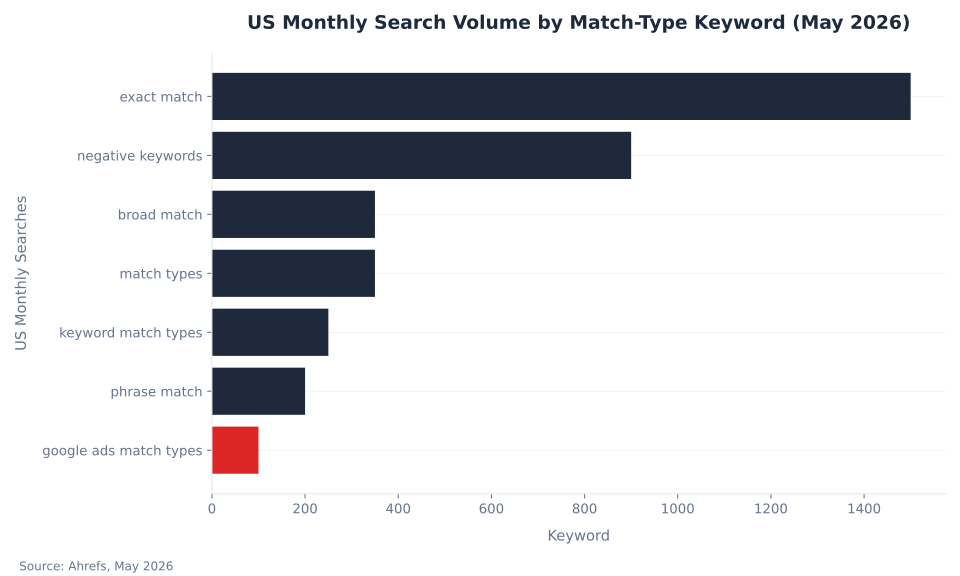
US Monthly Search Volume by Match-Type Keyword (May 2026)
Negative Keywords: The Real Control Lever in 2026
Negative keywords do not match close variants. A negative broad keyword blocks a query only when the search contains all the negative terms — not just some of them. Each unwanted form requires its own entry. Plurals, synonyms, and semantically related terms are not blocked automatically.
The asymmetry between positive and negative keyword matching is the most frequently missed detail in keyword architecture. Positive keywords (broad, phrase, exact) all include some form of variant matching. Negative keywords do not. A negative broad match for "free" does not block "freely" or "complimentary" — each variant is treated as a distinct term. The June 2024 update changed one piece of this: negative keywords now automatically cover common misspellings of the negated term. But the coverage stops there. Synonyms, plurals, and adjacent terms still require individual entries. A negative for "cheap" does not cover "cheapest" or "budget" or "discount" — those must each be added explicitly.
The three negative match types follow the same broad / phrase / exact naming convention as positive match types, but their blocking logic is distinct. Negative broad blocks when a query contains ALL negative terms, in any order — but if a query contains only some of the negative terms, it is not blocked. Negative phrase blocks when all terms appear in the same order, with extra words permitted — different word order is not blocked. Negative exact blocks only when the query exactly matches the terms, in the same order, with no extra words.
A tiered negative keyword structure is the architecture that scales. The three tiers: account-level shared negative list (universal exclusions — irrelevant verticals, competitor brands that should never appear, content categories) applied across all campaigns; campaign-level negatives (theme-specific exclusions that prevent a campaign from serving queries better suited to another campaign); ad-group-level negatives (exact match exclusions preventing ad groups within the same campaign from cannibalizing each other's traffic). Account-level negative keywords are a distinct mechanism from shared negative lists — they apply directly to all campaigns in the account without the shared list infrastructure.
MB Adv Agency has found that accounts running broad match without a tiered negative keyword architecture accumulate off-target spend faster than most teams expect. The search-term report is the only reliable diagnostic — broad match without weekly search-term hygiene is a budget drain, not a reach strategy. For local service verticals where out-of-vertical queries are common, see Plumbing PPC, HVAC PPC, and the Plumbing PPC Missoula MT local guide.
| Negative match type | Blocks when... | Does NOT block | Plurals/synonyms auto? | Misspellings auto? (since June 2024) |
|---|---|---|---|---|
| Negative Broad | Query contains ALL negative terms (any order) | Queries containing only SOME of the negative terms | No | Yes |
| Negative Phrase | All terms appear in same order (extra words OK) | Queries with different word order | No | Yes |
| Negative Exact | Query exactly matches terms, same order, no extra words | Queries with extra words or different word order | No | Yes |
Impression Share vs. Conversion Share by Match Type (16,825 Campaigns, Dec 2025)
Negative Keyword Limits: 2025 State
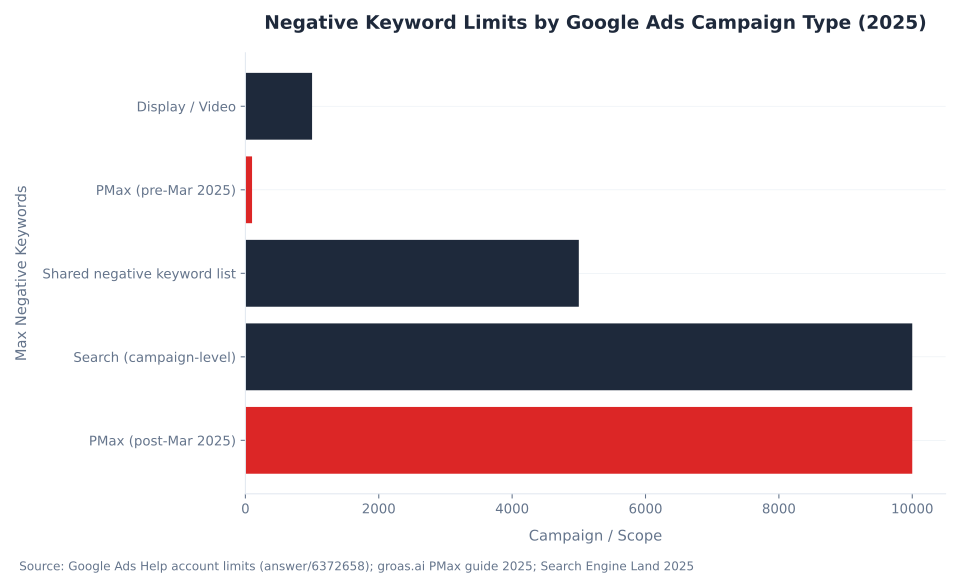
Performance Max campaigns expanded their per-campaign negative keyword limit from 100 to 10,000 in March 2025. Shared negative keyword lists became available for PMax in August 2025. Both changes removed the primary negative-keyword objection to running PMax alongside Search.
Keyword limits define the ceiling of your negative keyword architecture — and the right architecture uses all available tiers. A shared negative keyword list (capped at 5,000 entries) handles universal exclusions that apply across every campaign: irrelevant verticals, competitor brand names you never want to appear for, content categories incompatible with the account. Campaign-level negatives (up to 10,000 per Search campaign) handle theme-specific exclusions. Ad-group-level negatives handle inter-ad-group cannibalization prevention. Knowing the limits for each scope — especially PMax, which changed materially in 2025 — determines how the architecture is built.
| Scope | Limit | Key notes |
|---|---|---|
| Display / Video | 1,000 per campaign | Lower limit than Search or PMax; plan architecture with this constraint |
| PMax (pre-March 2025) | 100 per campaign | Legacy limit; expanded to 10,000 in March 2025 |
| Shared negative keyword list | 5,000 per list | Applied across Search and PMax (from August 7, 2025 for PMax). 5,000 is the official limit. |
| Search (campaign-level) | 10,000 per campaign | Within account aggregate of 1 million campaign targeting items |
| PMax (post-March 2025) | 10,000 per campaign | Expanded from 100; shared negative lists available August 7, 2025 |
A note on the shared list limit: Google Ads liaison Ginny Marvin confirmed that 5,000 per shared negative keyword list remains the official threshold. Some accounts have accepted more than 5,000 entries, but this has not been confirmed as a policy change. Use 5,000 as the planning ceiling for shared lists.
Practical architecture: a shared negative list handles brand exclusions and irrelevant-vertical exclusions uniformly across all campaigns, including PMax from August 2025. Campaign-level negatives handle theme control — preventing one campaign's keywords from pulling in queries that belong in a different campaign. Ad-group-level negatives prevent cannibalization between ad groups within the same campaign. For campaign structure decisions that intersect with this, see Google Ads Campaign Types. For industry applications in roofing and real estate where shared exclusion lists are essential, see Roofing PPC, Real Estate PPC, and the Legal PPC Missoula MT local guide.
MB Adv Agency has found that the March 2025 PMax negative keyword expansion changed how accounts with both Search and PMax campaigns are structured — shared negative lists that previously applied only to Search can now extend coverage to PMax, which closes a significant gap in brand and topic exclusion.
Negative Keyword Limits by Google Ads Campaign Type (2025)
Choosing Match Types: Account Readiness Matrix
Match type selection in 2026 is a function of conversion volume and Smart Bidding signal maturity, not preference. Broad match without sufficient conversion history gives Smart Bidding insufficient data to bid accurately per query. Exact match without search-term hygiene leaks spend on close variants. The matrix below maps account state to the right architecture.
| Account situation | Recommended match type | Rationale | Conv threshold |
|---|---|---|---|
| New account, <30 conv/mo | Phrase or Exact | Smart Bidding has insufficient signal; budget control is the priority | <30 conv/mo (industry threshold — not officially published by Google) |
| Established, 30–100 conv/mo, Smart Bidding active | Phrase + controlled Broad test | Smart Bidding has enough signal on a test broad campaign; do not switch all campaigns at once | 30–100 conv/mo |
| Mature account, 100+ conv/mo, Target CPA/ROAS active | Broad as primary; Exact for brand/high-value | Full Smart Bidding signal; Broad finds incremental queries keyword lists miss | 100+ conv/mo |
| Brand protection | Exact only | Competitor-query overlap risk from Broad or Phrase on brand terms | Any |
| Local service, tight geo | Phrase or Exact + geo targeting | Broad bids on out-of-area queries; Smart Bidding does not reliably suppress out-of-area in sub-metro geotargeting | Any |
Industry practitioner thresholds (30 conv/mo for Smart Bidding; 50 conv/mo for Target ROAS) are widely cited benchmarks. Google's Smart Bidding documentation uses the phrase "sufficient conversion history" without publishing a fixed number. Source: Google Ads Help answer/7065882; groas.com 2025–2026 best practices guide.
For bidding strategy selection that maps to these thresholds, see Google Ads Bidding Strategies. For market-specific implementation in Austin and Chicago, see PPC Consultant Austin TX and the HVAC PPC Flagstaff AZ guide.
Match Type Performance Data: 16,825 Campaigns (December 2025)
Exact match keywords represent 55% of all keywords in the Adalysis dataset — yet they generate only 27% of impressions while capturing 40% of conversions. The gap quantifies the precision premium: highest conversion efficiency per impression, at the cost of missing more than half of available auction opportunities.
The Adalysis study covers 16,825 Google Ads Search campaigns from December 2025. The dataset skews toward performance-focused accounts actively managing match types — accounts that defaulted entirely to broad match following Google's July 2024 default change are likely underrepresented. The figures below reflect the match type distribution and performance in managed, performance-focused accounts rather than the full universe of Google Ads advertisers.
| Match Type | Share of keywords | Share of impressions | Share of conversions | Conv/Impr efficiency ratio |
|---|---|---|---|---|
| Exact | 55% | 27% | 40% | 1.48 (40 ÷ 27) |
| Broad | 25% | 46% | 35% | 0.76 (35 ÷ 46) |
| Phrase | ~20% (remainder) | ~27% (derived) | ~25% (derived) | ~0.93 (derived) |
The +13 percentage-point gap between exact match's 27% impression share and 40% conversion share quantifies the precision premium. Exact match generates the highest conversion efficiency per impression in this dataset — the 1.48 efficiency ratio means each impression point delivers 1.48 conversion points. Broad match inverts this relationship: 46% of impressions from only 25% of keywords (an efficiency ratio of 0.76) illustrates the reach multiplication that Smart Bidding is designed to monetize. Broad match doesn't convert as efficiently per impression, but it surfaces 1.84x more impressions per keyword than exact match. The question is whether the account has the Smart Bidding signal to make those additional impressions cost-efficient. For performance metric frameworks, see Google Ads Metrics and KPIs. For SaaS accounts where keyword efficiency at scale is the central challenge, see SaaS Software PPC.
Broad Match Modifier Is Gone: What Phrase Match Does Now
Broad match modifier was discontinued in July 2021. Any "+keyword" BMM syntax remaining in an account now functions identically to phrase match. There are three match types in Google Ads, not four. Any documentation still describing BMM as a current match type option is describing a behavior deprecated more than four years ago.
| Date | Event | Source |
|---|---|---|
| Feb 4, 2021 | BMM retirement announced; new phrase match behavior begins rolling out for English and major European languages | Google Ads Help (answer/10286719); WordStream |
| Feb 18, 2021 | New phrase match behavior takes effect for English | Google Ads Help (answer/10286719) |
| July 2021 | Updated phrase match applies to all languages; BMM creation disabled for all languages | Google Ads Help (answer/10286719); WordStream |
| July 2021 onward | Legacy "+keyword" BMM keywords continue to serve but behave identically to phrase match | Google Ads Help (answer/10286719) |
What changed between old phrase match and the 2021 update is significant. Old phrase match required exact word order with no interruptions — a query inserting a word between two keyword terms would not trigger the ad. The 2021 phrase match drops this word-order rigidity in favor of intent: it shows for reordered queries if the intent is equivalent. This is something pre-2021 phrase match would not have done. As Google's language models have improved since 2021, the practical boundary between phrase and broad has narrowed further — phrase match today covers substantially more query variation than phrase match did in 2020.
Any "+keyword" BMM notation in an account functions as phrase match. There is no benefit to maintaining BMM syntax — cleaning it up to explicit phrase match syntax improves account readability without changing behavior. The match type column in Google Ads Editor no longer accurately reflects intent when BMM and phrase coexist as the same effective type.
MB Adv Agency has found that accounts still carrying hundreds of "+keyword" BMM entries gain clarity from a cleanup pass — not because behavior changes (it does not), but because the match type column in Google Ads Editor no longer reflects intent accurately when BMM and phrase coexist as the same effective type. For industry contexts where match type clarity is operationally critical, see Financial Services PPC, Fashion PPC, and PPC Consultant Chicago IL.
Broad Match Conversion Uplift vs. Phrase Match When Paired with Smart Bidding (Google Internal Data, 2024)
Match Type Architecture Is Strategy, Not Settings
MB Adv Agency manages keyword architecture across high-spend Search and Performance Max accounts. From negative keyword audits to broad match migration plans, keyword strategy is built around the conversion data available — not the match type default.
Audit My Keyword Architecture →Google Keyword Planner: What the Data Actually Shows
Google Keyword Planner shows broad logarithmic volume ranges for accounts without active ad spend. The competition score does not measure organic ranking difficulty — it measures advertiser auction density. Both misreads are common; both distort keyword selection and budget planning decisions.
| KWP metric | What it actually measures | Common misread |
|---|---|---|
| Average monthly searches | 12-month rolling average of exact-match query volume | Confused with broad-match volume; KWP shows exact-match counts by default |
| Competition score | Advertiser auction density — how many advertisers bid on the term | Misread as organic SEO ranking difficulty (it is not) |
| Top of page bid (low / high range) | Historical bid range for ads appearing at top of page | Treated as a CPC forecast; actual live CPC often diverges materially in competitive verticals |
Accounts without active ad spend see only broad logarithmic volume ranges in Keyword Planner — for example, "1K–10K" or "10K–100K" rather than a specific monthly figure. Active accounts see narrower ranges and, exact monthly figures in certain active accounts. Google has not published a specific spending threshold that unlocks precise data; community reports indicate that even minimal active spend unlocks more granular ranges. Exact monthly figures are not guaranteed even in active accounts — the data depends on query volume levels and available data density for each keyword.
Suited for: initial keyword discovery and grouping; identifying seasonal volume trends across the year; estimating pre-launch budget ranges before a campaign has real data. Keyword Planner excels at the discovery phase — finding keyword themes, understanding relative volume between terms, and building initial keyword lists.
Not suited for: live search term data (60+ days of campaign history in an active account is more reliable once the account is running); competitive keyword gap analysis (Ahrefs and Semrush provide cross-domain keyword data that Keyword Planner cannot); CPC forecasting in competitive verticals (live auction data from the search term report and bid simulator is the only ground truth for actual CPC). For search term analysis beyond Keyword Planner, see Google Ads Audience Targeting and Google Ads Metrics and KPIs. For dental practices where local keyword volume data directly shapes budget planning, see Dental PPC.
Four Misconceptions That Cost Money
The most expensive keyword strategy errors in 2026 share a common root: applying match-type logic that was accurate before 2019 or before July 2021, but has since been superseded by Google's close-variant expansion, the BMM retirement, and the coupling of match types to Smart Bidding automation.
"Exact match gives you exact control."
False, post-2019. Exact match includes close variants by default: misspellings, plurals, stems, abbreviations, function-word changes, word reordering with same meaning, and same-intent paraphrases. There is no opt-out. A campaign running [marketing agency] still triggers on "agency for marketing." The conversion-rate implication in high-CPC verticals is material: an irrelevant close variant at $80 CPC is not a rounding error. The counter: run exact match with weekly search-term audits and exact-match negative keywords on unwanted variants. Source: Google Ads Help answer/9342105.
"Broad match wastes budget."
Outdated framing from the pre-Smart-Bidding era. Broad match paired with Target CPA delivers a published average of +25% more conversions at target; with Target ROAS, a published average of +12% more conversion value (Google internal data, 2024). The condition is Smart Bidding active with sufficient conversion history. Broad match without Smart Bidding still wastes budget — the pairing is the condition, not an optional enhancement. In accounts with conversion history below the 30 conversions per month practitioner threshold, the critique of broad match without Smart Bidding stands.
"Negative keywords automatically cover plurals and synonyms."
False. Negative keywords do not match close variants. A negative broad match for "cheap" does not block "cheapest" or "inexpensive." The June 2024 update covers misspellings only — it is a narrow addition, not a general close-variant expansion for negatives. Synonyms, plurals, and related terms require individual negative entries. Each unwanted form is a separate line item in the negative keyword list. Source: Google Ads Help answer/2453972; Google Ads 2024 Recap answer/15639790.
"Broad match modifier is still a match type."
BMM was discontinued by July 2021. All "+keyword" syntax in Google Ads now behaves identically to phrase match. There are three match types — broad, phrase, exact. Any tutorial or training material describing "+keyword" as a current option is documenting a deprecated behavior that no longer exists as a distinct match type. Cleaning up BMM syntax to explicit phrase match syntax is a readability improvement that does not change campaign behavior. Source: Google Ads Help answer/10286719; WordStream BMM retirement documentation.
MB Adv Agency has found that the most impactful fix in a new client keyword audit is rarely adding keywords — it is fixing match type architecture and expanding the negative keyword list. Broad match with an undeveloped negative keyword strategy is the most common source of wasted spend in accounts MB Adv inherits. For high-CPC verticals where these errors compound fastest, see Personal Injury Law PPC and Dental PPC.
Frequently Asked Questions: Google Ads Keyword Match Types
Every High-Value Lead-Gen Account Starts With Keyword Architecture
In roofing, legal, dental, and financial services PPC — where CPCs run $30–$150+ — match type decisions and negative keyword architecture determine whether the account is profitable or on fire. MB Adv Agency builds the structure that scales.
Talk to a PPC Specialist →Methodology
This pillar draws from Ahrefs keyword data, Google Ads Help documentation, and the Adalysis match type performance study. All numbers are source-attributed.
Data sources: Ahrefs Keywords Explorer (US, May 2026); Google Search Console (March–May 2026); Adalysis match type performance study (December 2025, 16,825 Search campaigns); Google Ads Help documentation current as of May 2026 (answers: 7478529, 9342105, 10195720, 10286719, 2453972, 6372658, 13389795); Search Engine Land; WordStream; Store Growers; groas.ai; groas.com; Ajala Digital. Google internal data on broad match conversion uplift (+25%/+12%) are published averages; Google has not disclosed methodology or sample size for these figures. Last updated: May 31, 2026. Reviewed by MB Adv Agency, May 2026.
Sources & references
- support.google.com/google-ads/answer/10286719
- wordstream.com/blog/ws/2021/02/10/modified-broad-match-...
- searchengineland.com/google-ads-broad-match-default-new...
- support.google.com/google-ads/answer/7478529
- support.google.com/google-ads/answer/13389795
- support.google.com/google-ads/answer/2407784
- storegrowers.com/keyword-match-types
- support.google.com/google-ads/answer/9342105
- wordstream.com/exact-match
- support.google.com/google-ads/answer/10195720
- support.google.com/google-ads/answer/7065882
- groas.com/post/google-ads-best-practices-2025-2026-comp...
- support.google.com/google-ads/answer/2453972
- support.google.com/google-ads/answer/15639790
- support.google.com/google-ads/answer/6372658
- groas.ai/post/performance-max-negative-keywords-2025-co...
- searchengineland.com/google-ads-expands-negative-keywor...
- searchengineland.com/google-ads-doubles-negative-keywor...
- ajaladigital.com/how-to-get-exact-search-volume-data-in...
- support.google.com/google-ads/thread/381084048
- support.google.com/google-ads/answer/7337243
- adalysis.com/blog/the-complete-match-type-performance-s...
- promanageitsolution.com/exact-vs-broad-vs-phrase-what-a...

As a Google Ads expert, I bring proven expertise in optimizing advertising campaigns to maximize ROI.
I specialize in sharing advanced strategies and targeted tips to refine Google Ads campaign management.
Committed to staying ahead of the latest trends and algorithms, I ensure that my clients receive cutting-edge solutions.
My passion for digital marketing and my ability to interpret data for strategic insights enable me to offer high-level consulting that aims to exceed expectations.
Google Partner Agency
We're a certified Google Partner Agency, which means we don’t guess — we optimize withGoogle’s full toolkit and insider support.
Your campaigns get pro-level execution, backed by real expertise (not theory).

4.9 out of 5 from 670+ reviews on Fiverr.
That’s not luck, that’s performance.
Highly recommend Matteo to set up your server side tracking. He has a deep understanding of e-commerce tracking and will go above and beyond to make sure everything is set up correctly and working 100%. If you are scaling your store this set up is non-negotiable in my opinion and there isn't many people who have this much knowledge or put the effort in to get it right. Thanks again!
avorodesign.com
I can only recommend Matteo! He was very patient, professional and very knowledgeable about GA4, Consent Mode v2, and GDPR compliance. Communication was clear, and the setup was done professionally and efficiently. Highly recommend him for anyone needing reliable tracking implementation.

www.natureiki.life
Matteo shines in the realm of online professionals. His work is not only deep in data but also complemented by his proactive communication and cooperation, setting a new standard for freelancers. If you want someone who truly exceeds expectations, look no further. Highly recommended!

www.omanbeverlysmyth.com
Exceptional Service Beyond Expectations - Outstanding Service Impeccable depth, flawless delivery, and exceptional language fluency—this service exceeded all expectations. Highly recommended. Matteo truly ROCKS!!!
ium-paris.com
Top-notch, always highly value working with Matteo. An absolute Google Ads Genius. This is approximately the 8th time I have hired him and he's helped us get 6-7 ROAS. We are excited in continuing to improve our lead flow. Hire this guy if you need Google Ads help. Thanks Matteo!

www.dleeventgroup.com
I finally found the guy who can setup server side tracking and all the ecosystem properly. I definitely recommend Matteo. He is very responsive, kind and wants to dig into things. He configured GA4, Meta, Google Ads, Outbrain and google consent v2 with Cookiebot. Thanks Matteo.

inomega.fr
MB Adv delivered exceptional work with outstanding professionalism and lots of patience, taking time to see effects of changes made and not just do the work and submit it. The proactive communication and video summaries of the work completed made working with Matteo a pleasure, as he consistently went above and beyond. Highly recommended for web analytics projects! We are already working on another project.

www.withnellsensors.co.uk
Working with Matteo on my Google Ads was a game-changer. He's not just a strategist, he's a true partner. He understood my goals and tailored a campaign that perfectly reached my target audience. I'm grateful for his expertise and dedication.

dccargo.com
Click-driven mind
with plastic-brick obsession.
We build Google Ads campaigns with the same mindset we use to build tiny brick worlds: strategy, patience, and zero tolerance for wasted pieces.
Data is our blueprint. Growth is the only acceptable outcome.