How Much Do Apple Ads Cost? 2026 CPT & CPA Guide

Apple Ads Cost 2026
$0.92–$2.25
The 2026 cost-per-tap (CPT) range — a $0.92 global median (AppTweak) up to a $2.25 top-category average (SplitMetrics)
You pay per tap (CPT), never per impression · CPM billing was retired July 19, 2022 · the Advanced tier runs a second-price auction, so your bid is a ceiling · daily budgets are the only type — lifetime budgets are discontinued
How Much Do Apple Ads Cost in 2026?
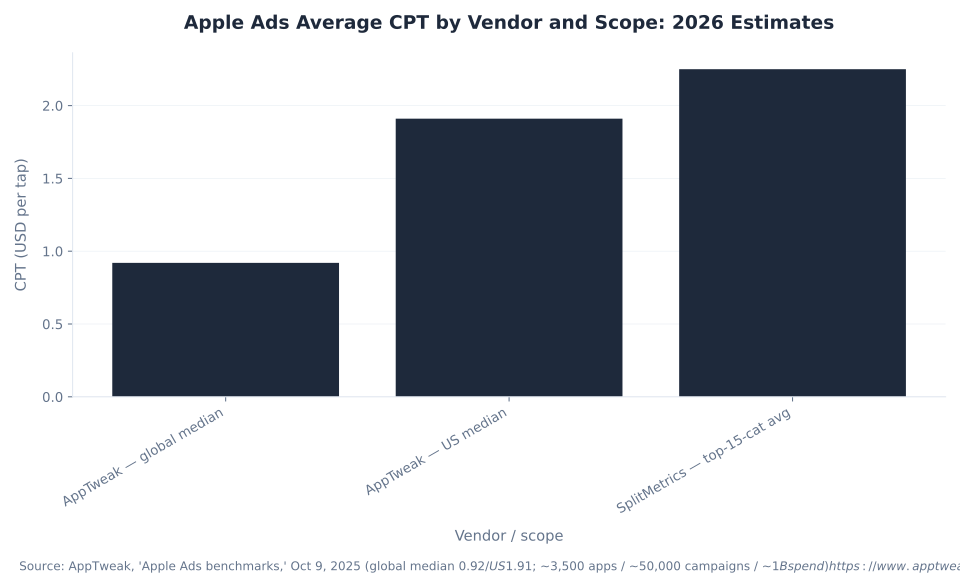
Apple Ads cost is set in an auction, so the honest answer is a per-outcome range, not a rate card: across named Apple-specific vendors the cost-per-tap runs from a global median near $0.92 (AppTweak, October 2025) to a top-category average around $2.25 (SplitMetrics, 2025), with the US median around $1.91. A tap is usually a dollar or two, an install usually a few dollars, and your real number is governed by app category, country, and season — not by a figure you look up.
Apple Ads (formerly Apple Search Ads) on the Advanced tier is bought in a second-price auction, so there is no published price list. A generic web-search CPC benchmark does not apply here: Search-only benchmark reports cover Google and Microsoft web search and contain no Apple Ads figures at all — a different unit (an App Store tap, not a web click), a different auction, and a different price level. Table 1 answers the head-term question with Apple-specific, vendor-attributed ranges, and the sections below explain the auction, the bid controls, and the budget mechanics that move the number.
| Metric (what you're billed on) | 2026 range (vendors disagree — estimates, not a rate card) | Source (Apple-specific) |
|---|---|---|
| Pricing model | Second-price auction (Advanced tier); you pay per tap (CPT) — never per impression — with no subscription / platform fee. (Basic tier bills per install, CPI.) | Apple Ads Help |
| CPT — cost per tap (Advanced) | ~$0.92 global median → ~$2.25 top-category average; ~$1.91 US (AppTweak Oct 2025 global median $0.92 / US $1.91; SplitMetrics 2025 top-15-category avg $2.25) | AppTweak / SplitMetrics |
| CPA — cost per acquisition (Advanced, install) | ~$3.76 top-category average (SplitMetrics 2025); high-cost verticals push it to $9–$20+ (Finance CPA $13.28; Sports CPA $19.74 — SplitMetrics) | SplitMetrics |
| CPI — cost per install (Basic / install benchmark) | ~$1.80 global median → ~$4.06 US (AppTweak Oct 2025 global median CPI $1.80 / US CPI $4.06) | AppTweak |
| TTR (tap-through rate) | ~7.4% (global median) to ~9.7% (top-category average) — high versus web search, reflecting App Store intent | AppTweak / SplitMetrics |
| Conversion rate (CR) | ~56% (global median) to ~66% (top-category average), up to ~73% in top categories — unusually high (App Store search intent) | AppTweak / SplitMetrics |
| Minimum budget | No public minimum-spend figure — Apple does not publish a hard floor for Advanced. Set a daily budget you can fund long enough to gather data. (Basic is capped at $10,000/app/month.) | Apple Ads Help (no published floor) |
Sources: AppTweak, “Apple Ads benchmarks” (published Oct 9, 2025; ~3,500 apps / ~50,000 campaigns / ~$1B spend; global median CPT $0.92 / CPI $1.80 / CR ~56% / TTR 7.4%; US CPT $1.91 / CPI $4.06); SplitMetrics, “Apple Ads Search Results Benchmarks 2025” (top-15-category averages: CPT $2.25 / CPA $3.76 / TTR 9.7% / CR 66.2%); Apple Ads Help (CPT pricing; no published Advanced minimum). Every figure is a third-party Apple-specific vendor estimate, not an official Apple rate card.
MB Adv Agency frames the cost question the same way for every app marketer: locate your expected cost on three axes — category, country, and season — before you quote yourself a number, because the blended ~$2 CPT is almost never your CPT. If you are new to the channel, start with what Apple Ads (formerly Apple Search Ads) are; for the full cost-and-reach comparison against Google App campaigns, Meta, and TikTok, see Apple Ads vs other app advertising platforms.
Why There Is No Single Apple Ads Price
The most common misconception behind the head term is that Apple Ads carry a quotable flat price. They do not. Apple Ads on the Advanced tier are priced in a second-price auction: what you pay is set by your bid against the next-nearest competitor for the same App Store search at the same moment, so the number moves with competition, category, country, and the calendar. There is no subscription and no platform fee — you are billed only when your ad is selected and tapped, per Apple’s pricing documentation.
This is why every credible cost figure is a range rather than a single number. AppTweak’s October 2025 dataset of roughly 3,500 apps and 50,000 campaigns puts the global median CPT at $0.92 and the US median at $1.91; SplitMetrics’ 2025 benchmark across 61 markets puts the top-15-category average at $2.25. Those numbers disagree because they measure different things — a global median across all categories versus an average of the heaviest-spending verticals — not because one is wrong. Read them as the floor and the ceiling of a normal range, then locate your own app inside it.
The cost answer also has a wrong number that circulates widely: a generic paid-search CPC pasted onto Apple Ads. Search-only benchmark reports publish Google and Microsoft web-search costs and contain no Apple Ads data — no CPT, no App Store figures — so a generic web-search CPC has no bearing on the price of an App Store tap. MB Adv Agency keeps Apple cost benchmarks Apple-specific: SplitMetrics, AppTweak, and Admiral Media, every figure tagged to its vendor and period. The keyword structure that pushes a CPT up or down — exact and brand terms against broad and Search Match — is covered in Apple Ads targeting and keywords; when a cross-channel advertiser also runs Google App campaigns, a Google Ads PPC audit finds where the budget leaks.
What App Marketers Search For: The Cost Cluster
“Apple search ads cost” is the real-volume head term in this cluster at 150 US monthly searches (Ahrefs, June 2026, KD 12), with the broader “apple ads cost” and “cost per tap” variants registering low direct volume. The durable demand sits one layer down, in the definitional queries — “cpt advertising,” “what is cost per tap,” “apple ads cpt” — which is why this page answers the head term literally and then defines the billing unit at depth.
| Keyword | US monthly vol. | Global vol. | KD | CPC (USD) | Notes / GSC footprint |
|---|---|---|---|---|---|
| apple search ads cost | 150 | 300 | 12 | $4.00 | The real-volume head term; same-intent variant of the slug |
| cpt advertising ★ | 10 | 20 | 3 | — | ★ The definitional ranker term — the absorbed cost-per-tap page carried 1,118 impressions across 80 keywords; intent transfers to the CPT section below |
| apple ads cost | 0 | 10 | — | — | Same-intent variant covered in the opening cost answer |
| cost per tap | 0 | 0 | — | — | The CPT-definition tail — answered in the cost-per-tap section |
| apple search ads daily budget | — | — | — | — | GSC: 205 impressions across 14 keywords; folds into the daily-budget section |
Sources: Ahrefs keyword data, US, June 2026 (data JSON for this pillar, primary_keywords array; US monthly volume, 12-month average); Google Search Console, mbadv property, 90-day window (Apr 1–Jun 29, 2026) for the absorbed-page footprint.
This pillar consolidates five absorbed cost pages. The largest footprint by far is the cost-per-tap definitional page, which carried 1,118 Search Console impressions across 80 keywords — its intent transfers to the cost-per-tap section below. The budgets page (205 impressions across 14 keywords) folds into the daily-budget section. MB Adv Agency reads the cost question as the entry point for app marketers sizing a first test; the related metrics that turn a cheap tap into an efficient install live in Apple Ads performance metrics and reporting, and the placements and tiers that decide whether you are even in a CPT auction sit in what Apple Ads are.
What Is Cost-Per-Tap (CPT)? Apple Ads' Per-Click Unit
Cost-per-tap (CPT) is the unit you are billed on across Apple Ads Advanced. It is Apple’s equivalent of a cost-per-click: you pay when your ad is selected and tapped on the App Store — in search results, the Search tab, or a product page — and never when it is merely shown. CPT is the single most important cost concept on the platform, and the one app marketers most often confuse with the three other units that appear in benchmark reports.
Place CPT against the units it is mistaken for. A cost-per-click (CPC) is the web-search analog — a click on a web result, in a different auction on a different surface. A cost-per-impression price (CPM) charges per thousand views regardless of taps. A cost-per-install (CPI) charges per download. Apple Ads Advanced bills on CPT alone; CPI is the unit of the separate, automated Apple Ads Basic tier (capped at $10,000 per app per month), and CPI also appears widely as a benchmark unit because it captures the full cost of an acquired user.
The unit app marketers most often expect — CPM — is gone as a price. Apple retired CPM billing on July 19, 2022, when all search campaigns moved to CPT. CPM survives today only as a reported metric on Today-tab and impression placements; you do not bid it and you are not charged on it for search ads. Any guide that tells you to “set a CPM” for App Store search ads is describing a metric, the Basic tier, or pre-2022 mechanics, per Apple’s pricing documentation.
| Term | What it is | Status / where it applies |
|---|---|---|
| CPT — cost per tap | Apple's per-click equivalent: you pay when your ad is selected and tapped, never per impression. The Advanced auction unit | ★ The live billing unit on Apple Ads Advanced (search results / search tab / product pages) |
| CPI — cost per install | You pay per install (download). Automated targeting + bidding, capped at $10,000/app/month | The Basic tier billing model (different product from Advanced). Also a common benchmark unit |
| CPM — cost per 1,000 impressions | Impression-based pricing — the model that ran on App Store ads before 2022 | ★ RETIRED as a billing unit (July 19, 2022). Survives only as a reported metric on Today-tab / impression placements — you do not bid it |
| Max CPT bid | The most you are willing to pay per tap. A ceiling — in the second-price auction you settle around $0.01 above the next-highest bid | You set it (keyword / ad-group level). Apple's suggested bid is a reference, not a forced default |
| CPA cap (formerly "CPA goal") | A bid ceiling aiming to keep installs near/below your cap. NOT an auto-optimizer — actual CPA can exceed it | ★ Renamed from "CPA goal." The CPA-cap-derived bid never exceeds your max CPT bid |
Sources: Apple Ads Help — “How pricing works” (CPT = pay per tap; CPM retired July 19, 2022), “Set and adjust bids” (second-price auction; max CPT is a ceiling, pay ~$0.01 above next bid; suggested bid is a reference), “Set and adjust your CPA cap” (CPA cap is a bid ceiling, not an auto-optimizer; never exceeds max CPT), “Compare Apple Ads solutions” (Basic = CPI, ≤$10k/app/month; Advanced = CPT). The three highest-value corrections: CPM was retired (it is CPT), Basic = CPI not Advanced, and “CPA goal” is now a CPA cap (a ceiling, not an optimizer).
The auction itself is the second concept that decides what you pay. Apple Ads Advanced runs a second-price auction: your max CPT bid is the most you are willing to pay per tap, but you settle at roughly one cent above the next-highest competing bid, so a higher max bid buys position and eligibility rather than a higher price by default. MB Adv Agency sets a max CPT to the keyword’s economic value — what an install from that term is worth — rather than to a published average, because in a second-price auction the ceiling protects you while the auction clears the real price. How that value reads out against tap-through and conversion rate is the job of Apple Ads performance metrics and reporting, and the match-type structure that sets competition per keyword is in Apple Ads targeting and keywords.
Apple Ads Cost by App Category
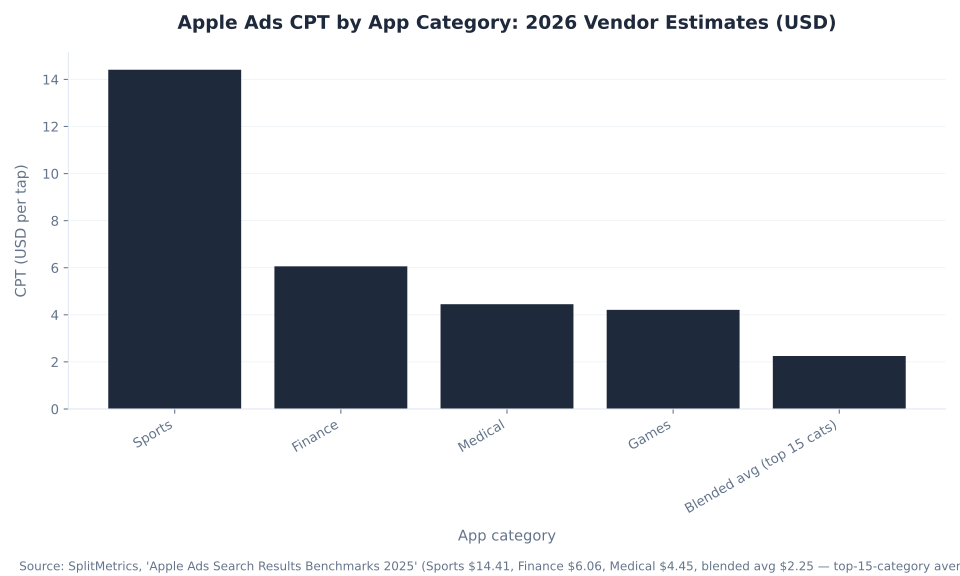
Category moves your cost more than any single bid adjustment. The blended top-15-category CPT average of $2.25 hides a spread of more than six times between the most and least expensive verticals — a finance app and a casual game are not buying the same channel.
SplitMetrics’ 2025 top-category data puts Sports at the top at a $14.41 CPT, Finance at $6.06, and Medical at $4.45, while casual games, music, and utilities sit at or below the blended average. Admiral Media’s February 2026 ranges corroborate the floor: casual games run a $0.40–$0.90 CPT, the cheapest band on the platform. The lesson is structural, not a rate card — locate your category before you budget.
| Category / vertical | CPT (cost per tap) | CPA / CPI (cost per install) | Source |
|---|---|---|---|
| Sports (highest) | $14.41 (US $12.60) | CPA $19.74 (US CPI $26.81) | SplitMetrics 2025 / AppTweak (US) |
| Finance | $6.06 (US ~$3.55; Admiral range $2.00–$5.00) | CPA $13.28 (US CPI $8.44; Admiral $4.00–$12.00) | SplitMetrics / AppTweak / Admiral Media |
| Medical | $4.45 | CPA $8.90 | SplitMetrics 2025 |
| Games (broader category, US) | $4.21 (US median) | CPI $12.28 (US) | AppTweak (US) Oct 2025 |
| Health & Fitness | $1.20–$3.00 (range) | CPI $2.00–$7.00 | Admiral Media Feb 2026 |
| Games — casual (low end) | $0.40–$0.90 | CPI $0.60–$1.60 | Admiral Media Feb 2026 |
| Music / Utilities (most efficient) | Near/below the blended average | Among the lowest CPI (US Music $2.11 / Utilities $2.90) | AppTweak (US) / SplitMetrics |
| ★ Top-15-category blended average | CPT $2.25 | CPA $3.76 — your category is almost never the average | SplitMetrics 2025 |
Sources: SplitMetrics, “Apple Ads Search Results Benchmarks 2025” (top-15-category averages, 61 markets: Sports CPT $14.41 / CPA $19.74; Finance $6.06 / $13.28; Medical $4.45 / $8.90; blended CPT $2.25 / CPA $3.76); AppTweak, “Apple Ads benchmarks” Oct 2025 (US: Games CPT $4.21 / CPI $12.28; Music CPI $2.11; Utilities CPI $2.90); Admiral Media, “Apple Search Ads Benchmarks” Feb 25, 2026 (vertical ranges: casual games CPT $0.40–$0.90 / CPI $0.60–$1.60; Health & Fitness $1.20–$3.00 / $2.00–$7.00; Finance $2.00–$5.00). SplitMetrics top-category averages, AppTweak US medians, and Admiral Media ranges use different methodologies — the durable point is the spread, not the exact dollars.
MB Adv Agency reads a category benchmark as a starting expectation, not a target — the durable point is the ordering (Sports, Finance, and Medical run high; music and utilities run low), because the exact dollar shifts with vendor, market, and period. The keyword and match-type choices that push a category-level CPT up or down are in Apple Ads targeting and keywords.
Apple Ads Cost by Geography
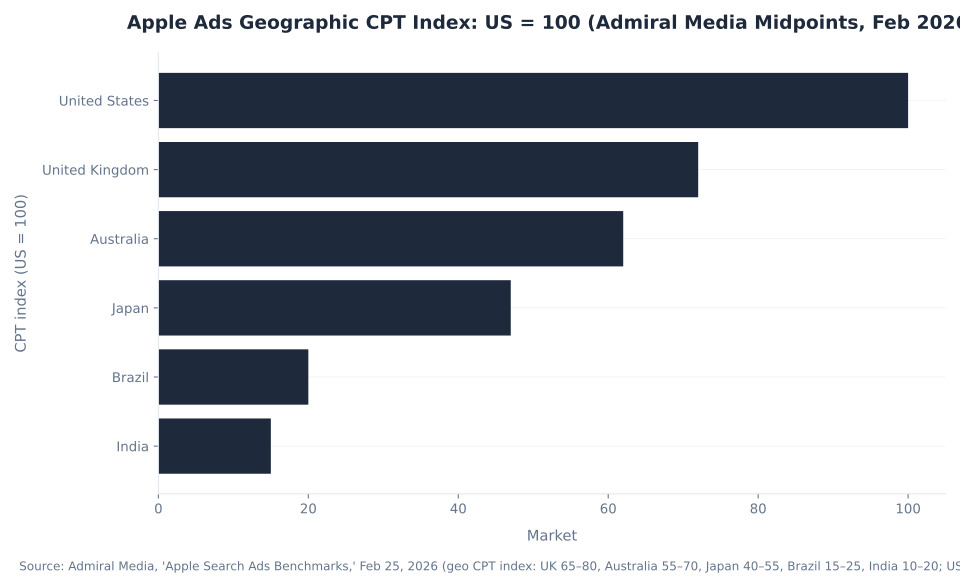
Geography is the second major cost lever. The United States and North America are the most expensive Apple Ads market, and the cheapest markets run a fraction of the US price for the same tap.
Admiral Media’s February 2026 benchmark indexes CPT against the US at 100: the United Kingdom sits around 72, Japan around 47, and India around 15. AppTweak’s October 2025 CPI range spans the same ordering from the other side — roughly $0.73 per install in the Philippines up to $4.06 in the US, a five-fold spread across the full geographic range. A US-only campaign and an India-only campaign are buying very different prices for very different audiences.
| Market | Relative CPT (US = 100) | Notes | Source |
|---|---|---|---|
| United States / North America | 100 (most expensive) | US median CPT ~$1.91, CPI ~$4.06 — the top of the global range | AppTweak / SplitMetrics / Admiral Media |
| United Kingdom | ~65–80 | Western-Europe tier — below the US, above APAC | Admiral Media Feb 2026 |
| Japan | ~40–55 | High-value market but CPT well below the US | Admiral Media Feb 2026 |
| India | ~10–20 (among the cheapest) | High-volume, low-cost market | Admiral Media Feb 2026 |
| ★ Global CPI endpoints | — | ~$0.73 (Philippines) → ~$4.06 (US) — your country can move your cost ~5× | AppTweak Oct 2025 |
Sources: Admiral Media, “Apple Search Ads Benchmarks” Feb 25, 2026 (geo CPT index US=100: UK 65–80, Japan 40–55, India 10–20); AppTweak, “Apple Ads benchmarks” Oct 2025 (geographic CPI range Philippines $0.73 → US $4.06; US median CPT $1.91 / CPI $4.06); SplitMetrics 2025 (North America = highest cost across 61 markets). The index figures are directional vendor estimates — the durable point is the ordering (US/North America most expensive; APAC/emerging markets a fraction), not the exact index.
The durable insight is the ordering, not the exact index: the US and North America most expensive, Western Europe a mid-tier, APAC and emerging markets a fraction. Where geography fits the wider channel decision — whether App Store ads or another app platform fits a given market — sits in Apple Ads vs other app advertising platforms.
Default vs Custom CPT Bids and the CPA Cap
Three controls decide how much of your max CPT you actually spend: the default CPT bid, the custom CPT bid, and the optional CPA cap. None of them is a price guarantee — each is a ceiling you set on top of the second-price auction.
A default CPT bid is the ad-group-level maximum applied to every keyword and Search Match term in the group unless overridden — the baseline ceiling. A custom CPT bid is a keyword-level override of that default: raise it on high-value, high-competition terms and lower it on weaker ones, which is the main manual lever for controlling cost per keyword. The CPA cap (renamed from “CPA goal”) is a separate ceiling that aims to keep installs near or below a target cost — but it is not an auto-optimizer that chases a number, your realized CPA can still exceed it, and the CPA-cap-derived bid never goes above your max CPT bid.
| Control | What it does | How it controls cost |
|---|---|---|
| Max CPT bid | The most you will pay per tap — a hard ceiling you set at keyword or ad-group level | In the second-price auction you settle around $0.01 above the next-highest bid, so a higher max buys position and eligibility, not a higher price by default |
| Default CPT bid | The ad-group-level max CPT applied to all keywords and Search Match in the group unless overridden | The baseline ceiling — set it to the group's typical keyword value |
| Custom CPT bid | A keyword-level override of the default — raise it on high-value / high-competition terms, lower it on weaker ones | The main manual lever for controlling cost per keyword |
| CPA cap (formerly “CPA goal”) | A bid ceiling aiming to keep installs near/below your cap — not an auto-optimizer; actual CPA can exceed it | A brake on top of your max CPT — the CPA-cap-derived bid never exceeds your max CPT bid |
| Second-price auction | The mechanism that clears the price — you pay around one cent above the next-highest bid | Your max CPT and CPA cap are ceilings; the auction sets the realized price beneath them |
Sources: Apple Ads Help — “Set and adjust bids” (default vs custom CPT bids; max CPT is a ceiling; second-price auction pays ~$0.01 above the next bid; suggested bid is a reference) and “Set and adjust your CPA cap” (CPA cap renamed from “CPA goal,” a bid ceiling not an auto-optimizer, never exceeds max CPT).
MB Adv Agency treats the CPA cap as a brake, not a self-driving optimizer — set a sensible max CPT first, then add a CPA cap only if install cost runs hot. Tuning these controls as a campaign scales is the work of optimizing Apple Ads campaigns, and setting bids and budgets that stay efficient day to day is what our team does in PPC campaign management.
Daily vs Campaign Budgets: Lifetime Budgets Are Gone
Apple Ads has one budget type now: the daily budget. Lifetime and campaign-total budgets are discontinued, so any guide that tells you to set a lifetime budget is out of date.
New campaigns have used daily budgets only since June 2022, and the remaining legacy lifetime-budget campaigns were paused in June 2026. The daily budget is set at the campaign level and editable at any time. Monthly spend is capped at the daily figure multiplied by 30.4 — a $100 daily budget spends at most about $3,040 in a month — and spend can run above the daily number on high-opportunity days within that monthly cap. There is no published minimum-spend figure for Advanced; fund a daily budget you can sustain long enough to gather signal, rather than chasing a dollar floor Apple does not publish.
| Item | Detail | Source |
|---|---|---|
| Daily budget | The only budget type now. Set at the campaign level; editable any time. Spend can exceed the daily figure on high-opportunity days within the monthly cap | Apple Ads Help |
| Lifetime / campaign-total budget | ★ DISCONTINUED. No new lifetime budgets since June 2022; the remaining legacy lifetime-budget campaigns were paused June 2026. Do not plan around a lifetime budget | Apple Ads Help / SplitMetrics |
| Monthly spend cap | Daily budget × 30.4. A $100/day budget spends at most about $3,040/month | Apple Ads Help |
| Minimum-spend reality | No public minimum-budget figure for Advanced — Apple publishes no hard floor. Fund a daily budget long enough to gather data. Basic is capped at $10,000/app/month with a $100 starter credit | Apple Ads Help (no published floor) |
Sources: Apple Ads Help, “Manage budgets” (daily budget only; monthly cap = daily × 30.4; lifetime budgets discontinued — new campaigns daily since June 2022, legacy lifetime paused June 2026; no published Advanced minimum); Apple Ads Help, “Compare Apple Ads solutions” (Basic ≤$10k/app/month, $100 starter credit); SplitMetrics (lifetime-budget phase-out context).
Reallocating a daily budget toward the lowest-cost-per-install keywords, categories, and markets once data exists is an ongoing job — see optimizing Apple Ads campaigns for that workflow, and our PPC services for end-to-end management across Google Ads and the App Store.
What Drives Your Apple Ads Cost Up or Down
Six levers decide where your cost lands inside the vendor ranges. Five are external or structural; two — your max CPT and your CPA cap — are the ceilings you control directly.
| Lever | How it moves your CPT / CPA |
|---|---|
| Competition (second-price auction) | More advertisers on a keyword raises the price you pay (you settle ~$0.01 above the next bid). The single biggest external driver |
| App category / vertical | Finance / Sports / Medical run far higher; casual games / music / utilities run low (see Table 4) |
| Geography | US / North America is the most expensive market; APAC and emerging markets a fraction (see Table 5) |
| Match type | Exact / brand keywords command higher CPTs than broad or Search Match (higher intent, more competition) |
| Apple's dynamic pricing | Ad relevance, your bid, competing bids, user experience, and any per-auction reserve price all factor into what you pay |
| Seasonality | Cost peaks around September; the most cost-efficient window is around April (SplitMetrics 2025) |
| Your max CPT / CPA cap | Your ceilings — set them to the keyword's value; the CPA cap is a brake, not an optimizer (see Table 6) |
Sources: Apple Ads Help — “How pricing works” / “Set and adjust bids” (CPT, second-price auction, dynamic-pricing factors, ceilings); SplitMetrics, “Apple Ads Search Results Benchmarks 2025” (seasonality: September peak, April most efficient; category and North-America cost spread). The September-peak / April-trough pattern is the SplitMetrics finding.
MB Adv Agency works the levers in order of leverage: category and country set the baseline, match type and competition move the auction price, season shifts the whole curve, and the bid ceilings cap the downside. The match-type and keyword-structure half of that list is detailed in Apple Ads targeting and keywords.
Cost Per Install by App Category (US)
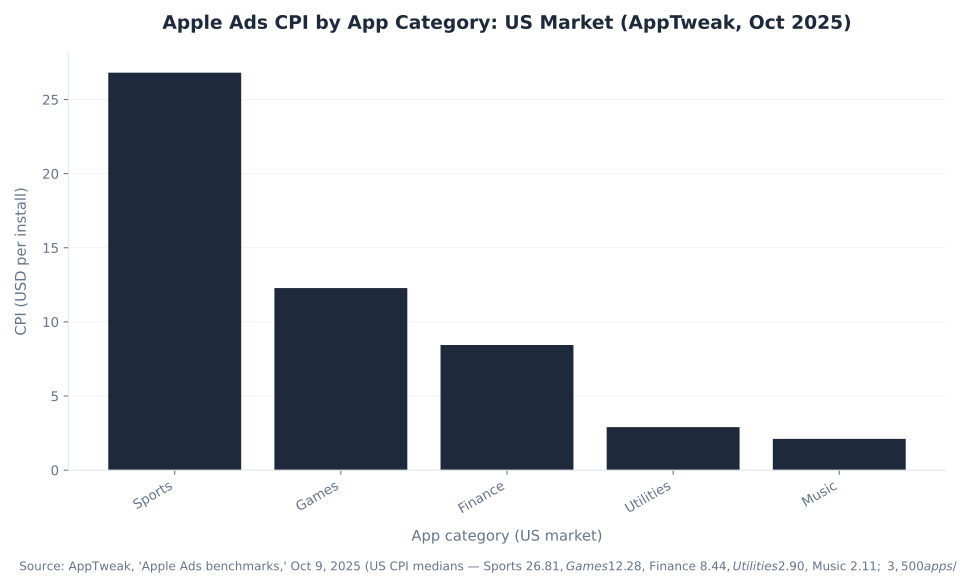
Cost-per-tap tells you what a tap costs; cost-per-install tells you what an acquired user costs — and the gap between them is set by conversion rate. AppTweak’s October 2025 US dataset shows how install cost scales by vertical.
A Sports install costs about $26.81 in the US, a Games install $12.28, and a Finance install $8.44, while Utilities ($2.90) and Music ($2.11) anchor the low end. Sports costs roughly thirteen times more per install than Music. CPI combines the CPT paid in the auction with the observed conversion rate, so a high-competition category with a strong conversion rate still lands high because the bid levels are high. These are US figures; AppTweak’s global median CPI is lower at $1.80.
| Category (US market) | CPI — cost per install (USD) | Read |
|---|---|---|
| Sports | $26.81 | The most expensive install — high CPT, heavy competition |
| Games | $12.28 | High volume, high competition for the broader category |
| Finance | $8.44 | High-value users justify the install cost |
| Utilities | $2.90 | Low end — lighter competition, strong intent matching |
| Music | $2.11 | The cheapest install — ~13× below Sports |
Source: AppTweak, “Apple Ads benchmarks” (Oct 9, 2025) — US CPI medians from ~3,500 apps / ~50,000 campaigns / ~$1B spend. CPI = cost per install, combining the CPT paid in the Advanced auction with the observed conversion rate. These are US-market figures; the global median CPI is $1.80.
A low CPT only matters against a high conversion rate — see Apple Ads performance metrics and reporting for how tap-through rate, conversion rate, and CPA turn a cheap tap into an efficient install.
How to Estimate and Lower Your Apple Ads Cost
To estimate your Apple Ads cost, locate it on three axes before you quote yourself a number: your app category, your country, and the calendar.
Start with category. A casual game planning a US launch reads the low band — a CPT well under a dollar — while a finance or sports app reads the high band, a $6 to $14 CPT. Then adjust for country: a US-only plan sits at the top of the global range, a Western-Europe plan around a third lower, an India or Brazil plan a fraction of the US. Finally, account for season: SplitMetrics finds cost peaks around September and bottoms out around April, so a third-quarter launch budgets for a premium a second-quarter launch avoids.
Lowering the number is a matter of working the controllable levers. Match your max CPT to what an install from each keyword is worth rather than to a published average. Use default CPT bids as the ad-group baseline and custom CPT bids to override your highest-value terms. Add a CPA cap as a brake when install cost runs hot, remembering it never exceeds your max CPT. Read CPT against tap-through and conversion rate — a higher CPT on a high-converting keyword beats a cheap tap that never installs — and reallocate budget toward the lowest-cost-per-install keywords, categories, and markets once you have data.
MB Adv Agency runs this estimate-then-control loop on every plan: size the expected cost from the vendor ranges, set the ceilings to real install value, and let the data redirect spend. Building and maintaining that discipline as you scale is the work of optimizing Apple Ads campaigns and day-to-day PPC campaign management.
Control Your Apple Ads Cost
Set a max CPT and CPA cap that stay profitable as you scale
Apple Ads cost is auctioned, not fixed — the advertisers who keep CPT and CPA in line are the ones who set their ceilings to real install value and let the data redirect spend. Our team runs that day to day.
PPC campaign management →When Apple Ads Cost the Most: Seasonality
Apple Ads cost moves with the calendar. SplitMetrics’ 2025 benchmark data finds CPT and CPA peak around September — driven by back-to-school and pre-holiday competition — and bottom out around April, the lowest-activity window of the year.
The seasonal swing is a planning input, not a fixed surcharge. A campaign that launches into the September peak competes against the year’s heaviest advertiser activity and pays for it in a higher clearing price; the same campaign in April clears against lighter competition. The pattern compounds with category — a games app facing holiday-quarter competition feels the September premium more sharply than a steady-demand utility. Per SplitMetrics’ cost benchmark, the September-peak / April-trough shape is consistent across the top categories.
MB Adv Agency plans launch timing and budget pacing around the curve where the calendar is flexible: front-load testing in the cheaper spring window, then scale into demand with the learnings already paid for. Where timing is fixed by a product release, the lever shifts to the bid ceilings and budget allocation covered in optimizing Apple Ads campaigns.
How to Estimate and Control Your Apple Ads Cost
Controlling Apple Ads cost is a sequence: estimate from the vendor ranges, pick the right tier, set the ceilings to real value, then let the data redirect spend.
- Locate your expected cost on three axes. Use the category, country, and season ranges above — not a flat average — to set a realistic CPT and CPI expectation before you commit a budget.
- Pick the right tier. Apple Ads Advanced is the CPT keyword auction with full control; Apple Ads Basic is the automated, CPI-billed tier capped at $10,000 per app per month. Choose by how much control you need.
- Set a max CPT bid to the keyword's value. Your max CPT is a ceiling — in the second-price auction you usually pay less. Set it to what an install from that term is worth, not to a published average.
- Use default and custom CPT bids deliberately. Set a default CPT bid as the ad-group baseline, then override your highest-value, highest-competition keywords with custom CPT bids.
- Add a CPA cap as a brake. If install cost runs hot, add a CPA cap to keep installs near your target — remembering it is a ceiling, not an optimizer, and never exceeds your max CPT.
- Set a daily budget you can sustain. Lifetime budgets are gone and there is no published minimum; fund a daily budget long enough to gather signal (monthly spend is capped at daily × 30.4).
- Read CPT against TTR and conversion rate, then reallocate. A higher CPT on a high-converting keyword beats a cheap tap that never installs; move budget toward the lowest-cost-per-install keywords, categories, and markets once you have data.
MB Adv Agency runs this loop before scaling any account, because a cost set without locating category, country, and season is a guess. For how the install economics read out once spend is live, see Apple Ads performance metrics and reporting; to weigh the channel against the alternatives, see Apple Ads vs other app advertising platforms. To pressure-test a budget against your real install economics, get in touch.
Apple Ads Cost FAQ
Running App Store and Google App Campaigns?
If your cost-per-install is climbing, the leak is usually structural
Many app advertisers also run Google App campaigns, and a cost problem there is usually a structure problem. Our team finds where the budget leaks — and helps set a max CPT and CPA cap that stay profitable as you scale.
Google Ads PPC audit →Get in touchMethodology
This pillar consolidates five absorbed Apple Ads cost pages (the cost-per-tap definition page, the default-vs-custom-CPT-bids page, the daily-vs-campaign-budgets page, the budget-optimization page, and the head-term cost page). Every cost figure is a named, Apple-specific third-party vendor estimate or an Apple primary-documentation mechanic, verified June 30, 2026: AppTweak’s Apple Ads benchmarks (published October 9, 2025; ~3,500 apps / ~50,000 campaigns / ~$1B spend) for global and US CPT/CPI medians and category figures; SplitMetrics’ Apple Ads Search Results Benchmarks 2025 for top-15-category CPT/CPA averages and seasonality; Admiral Media’s Apple Search Ads Benchmarks (February 25, 2026) for the geographic CPT index and vertical ranges; and Apple Ads Help for the pricing model, the second-price auction, bid controls, the CPA cap, and budget mechanics. Vendors disagree by dataset, methodology, category, region, and period, so every figure is presented as a range tagged to its vendor. No mbadv client metrics appear here — the agency point of view is qualitative, because mbadv keeps Apple cost benchmarks Apple-specific. No generic web-search CPC benchmark is applied to Apple Ads: those Search-only reports contain no Apple Ads data. Search-demand context is Ahrefs, June 2026. Reviewed by MB Adv Agency, June 2026.
Advertising on Apple's platforms, such as the App Store and Apple Search Ads, offers businesses a unique opportunity to engage with a vast audience of Apple users. Understanding the costs associated with these ads is crucial for effective budgeting and strategic planning. This article delves into the various factors that influence Apple ad costs, provides useful budgeting tips, and compares these costs with other advertising platforms.
How Much Do Apple Ads Cost?
The cost of advertising on Apple platforms primarily depends on several factors including the type of ad format, the competition for ad space within specific keywords, and the daily budget set by advertisers. Apple Search Ads operates on a cost-per-tap (CPT) model, where advertisers pay every time a user taps on their ad.
Generally, advertisers can expect to spend anywhere from $0.50 to $3.00 per tap, although costs can exceed this range in highly competitive markets. This variability makes it essential for businesses to evaluate their specific goals and the nature of their competition.
Another critical component in determining the cost is the ad format selected. There are two primary formats offered by Apple: Apple Search Ads Basic, which offers a simplified approach with fixed costs, and Apple Search Ads Advanced, which allows for more customization and campaign management, often resulting in varying costs based on competition and bidding strategies.
Additionally, monitoring performance metrics will help advertisers refine their budgeting strategy and optimize spending over time.
Understanding the audience is also crucial when planning an advertising budget. Apple users are often characterized by their loyalty to the brand and their willingness to engage with ads that resonate with their interests. This means that targeting the right demographics can significantly influence the effectiveness of an ad campaign. Advertisers should take advantage of Apple’s audience targeting features, which allow them to focus on specific user behaviors, interests, and locations, thereby maximizing their ad spend.
Moreover, seasonal trends and promotional events can also impact ad costs. For instance, during holiday seasons or major product launches, competition for ad space may intensify, driving costs higher. Advertisers who anticipate these fluctuations and adjust their strategies accordingly can capitalize on peak times while managing their budgets effectively. By staying informed about industry trends and consumer behavior, businesses can make more strategic decisions about their advertising investments on Apple platforms.
Factors Affecting Ad Costs
Several factors significantly influence the costs associated with Apple advertising. Understanding these factors can help businesses tailor their advertising strategies more effectively.

1. Competition for Keywords
The level of competition for specific keywords is one of the most significant factors affecting ad costs. Highly sought-after keywords can drive up the cost per tap, as multiple advertisers compete for the same queries. For example, if you are in a well-established market with many similar apps, the ad costs will likely be higher than in a niche market with less competition. Additionally, seasonal trends can affect keyword competition; during peak shopping seasons or major events, the demand for certain keywords may spike, further inflating costs. Advertisers must stay informed about these trends to adjust their strategies accordingly.
2. Ad Relevance and Quality Score
Apple evaluates the relevance and quality of your ads when determining cost. Higher quality ads that are more relevant to user searches may achieve lower costs per tap. Advertisers should focus on creating engaging and targeted content to improve their ads' quality score. This includes optimizing app descriptions, keywords, and visuals. Moreover, incorporating user feedback and ratings into your ad strategy can enhance relevance. Positive reviews and high ratings not only improve your app's visibility but also signal to Apple that your app is a trustworthy choice, potentially reducing your ad costs over time.
3. Target Audience and Geo-Location
The target audience you want to reach can drastically affect your ad costs. Advertising in regions where Apple has a strong user base, such as the United States and Europe, may result in higher costs. Conversely, targeting less saturated markets might provide opportunities for lower ad expenses. However, it’s essential to consider the purchasing power and behavior of users in different regions. For instance, while a market may have lower ad costs, the return on investment could be minimal if the audience is less likely to convert. Tailoring your ads to resonate with local cultures and preferences can also enhance effectiveness and justify higher expenditures in competitive markets.
4. Daily Budget and Bidding Strategy
Your daily budget and bidding strategy can also play a crucial role in determining ad costs. Setting a higher budget can allow your ads to be displayed more frequently, but it may not always lead to better results. It’s essential to find a balance that maximizes visibility while maintaining an efficient cost. Additionally, experimenting with different bidding strategies, such as cost-per-acquisition (CPA) versus cost-per-click (CPC), can yield insights into which approach works best for your specific campaign goals. Regularly monitoring and adjusting your budget based on performance metrics will help you optimize your ad spend and improve overall campaign effectiveness.
Tips for Budgeting Effectively
Budgeting for Apple ads requires careful planning and continuous adjustment. Here are some effective tips to help manage your advertising spends:
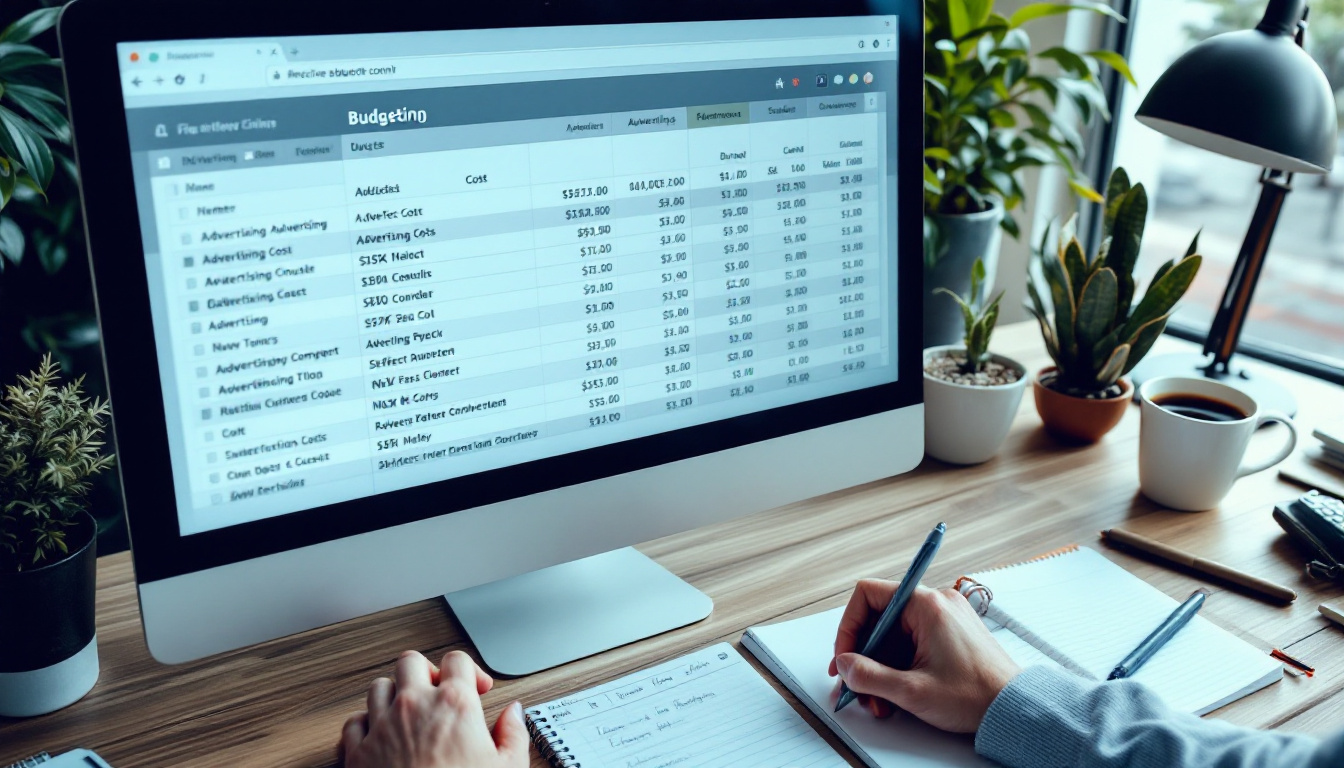
- Define Clear Objectives: Before launching your campaign, establish clear advertising goals. Consider whether you are aiming for app downloads, engagement, or brand awareness. This clarity will guide your budgeting decisions.
- Start with a Test Budget: When launching a new ad, consider starting with a small, test budget. This approach allows you to assess the ad's performance before committing more significant resources.
- Utilize Analytics Tools: Take advantage of Apple’s analytics tools to track your ad performance. These tools can help you understand which ads are performing well and allow you to adjust your budget accordingly.
- Review and Adjust Regularly: Regularly reviewing your ad campaign’s performance metrics is crucial. Make adjustments to your bids, budgets, and strategies based on your ads' performance.
- Consider Seasonal Trends: Be mindful of seasonal trends or specific occasions when potential app downloads might increase. During those times, adjusting your budget may lead to better visibility and engagement.
Additionally, it’s important to research your target audience thoroughly. Understanding the demographics, interests, and behaviors of your potential users can significantly influence your budgeting strategy. By identifying the right audience segments, you can allocate your budget more effectively, ensuring that your ads reach those most likely to convert. Consider creating buyer personas to visualize your ideal customers, which can help in tailoring your ad content and budget allocation.
Another key aspect of effective budgeting is to stay informed about the competitive landscape. Monitoring your competitors’ advertising strategies can provide valuable insights into what works and what doesn’t in your niche. Tools that analyze competitor ad spend and performance can help you identify gaps in the market or opportunities for differentiation. By understanding where your competitors are focusing their resources, you can make informed decisions about where to allocate your budget for maximum impact.
Cost Comparison with Other Platforms
When considering Apple ads, it’s essential to compare their costs with other advertising platforms, such as Google Ads and social media advertising. This will help you understand where your advertising budget can be most effective.
1. Google Ads
Google Ads operates on a cost-per-click (CPC) model, where advertisers pay for each click on their ads. In many cases, Google ads tend to have a lower CPC than Apple ads, primarily due to the broader competition for keywords across a more extensive range of industries. However, Apple ads are often more targeted, focusing on app-specific audiences, which can justify their higher costs. Additionally, Google Ads offers a variety of ad formats, including text, display, and video ads, allowing for greater flexibility in how businesses can present their offerings. This versatility can be beneficial for brands looking to create comprehensive campaigns that reach users at different stages of the buying journey.
2. Social Media Advertising
Social media platforms such as Facebook and Instagram offer various advertising models, often at a lower cost compared to Apple ads. However, these ads may not be as effective in driving app downloads because they lack direct targeting for app searches. Depending on your marketing goals, the return on investment from social media advertising may vary. For instance, while social media can be excellent for brand awareness and engagement, it may not translate to immediate app downloads as effectively as Apple ads. Moreover, the demographic targeting available on these platforms can sometimes lead to a mismatch between the audience and the app's intended users, potentially diluting the effectiveness of the ad spend.
3. ROI and Conversion Tracking
In terms of return on investment (ROI), advertising on Apple platforms can often yield better conversion rates for app downloads as it directly targets users already looking for apps. Therefore, even though the costs may be higher, the potential for higher conversion rates can make Apple advertising a worthwhile investment. Furthermore, Apple provides robust analytics tools that allow advertisers to track user engagement and conversion metrics closely. This data can be invaluable in refining ad strategies and optimizing campaigns for better performance over time. By leveraging these insights, businesses can make informed decisions about their advertising approaches and adjust their spending to maximize returns.
Moreover, the unique ecosystem of Apple users, who are generally perceived to have higher spending power, can also influence the effectiveness of Apple ads. Brands targeting premium audiences may find that the investment in Apple advertising pays off more significantly than on other platforms. The combination of targeted reach, high-quality user engagement, and the potential for increased customer lifetime value can create a compelling case for allocating budget towards Apple ads, especially for businesses focused on app monetization.

As a Google Ads expert, I bring proven expertise in optimizing advertising campaigns to maximize ROI.
I specialize in sharing advanced strategies and targeted tips to refine Google Ads campaign management.
Committed to staying ahead of the latest trends and algorithms, I ensure that my clients receive cutting-edge solutions.
My passion for digital marketing and my ability to interpret data for strategic insights enable me to offer high-level consulting that aims to exceed expectations.
Google Partner Agency
We're a certified Google Partner Agency, which means we don’t guess — we optimize withGoogle’s full toolkit and insider support.
Your campaigns get pro-level execution, backed by real expertise (not theory).

4.9 out of 5 from 670+ reviews on Fiverr.
That’s not luck, that’s performance.
Highly recommend Matteo to set up your server side tracking. He has a deep understanding of e-commerce tracking and will go above and beyond to make sure everything is set up correctly and working 100%. If you are scaling your store this set up is non-negotiable in my opinion and there isn't many people who have this much knowledge or put the effort in to get it right. Thanks again!
avorodesign.com
I can only recommend Matteo! He was very patient, professional and very knowledgeable about GA4, Consent Mode v2, and GDPR compliance. Communication was clear, and the setup was done professionally and efficiently. Highly recommend him for anyone needing reliable tracking implementation.

www.natureiki.life
Matteo shines in the realm of online professionals. His work is not only deep in data but also complemented by his proactive communication and cooperation, setting a new standard for freelancers. If you want someone who truly exceeds expectations, look no further. Highly recommended!

www.omanbeverlysmyth.com
Exceptional Service Beyond Expectations - Outstanding Service Impeccable depth, flawless delivery, and exceptional language fluency—this service exceeded all expectations. Highly recommended. Matteo truly ROCKS!!!

ium-paris.com
Top-notch, always highly value working with Matteo. An absolute Google Ads Genius. This is approximately the 8th time I have hired him and he's helped us get 6-7 ROAS. We are excited in continuing to improve our lead flow. Hire this guy if you need Google Ads help. Thanks Matteo!

www.dleeventgroup.com
I finally found the guy who can setup server side tracking and all the ecosystem properly. I definitely recommend Matteo. He is very responsive, kind and wants to dig into things. He configured GA4, Meta, Google Ads, Outbrain and google consent v2 with Cookiebot. Thanks Matteo.

inomega.fr
MB Adv delivered exceptional work with outstanding professionalism and lots of patience, taking time to see effects of changes made and not just do the work and submit it. The proactive communication and video summaries of the work completed made working with Matteo a pleasure, as he consistently went above and beyond. Highly recommended for web analytics projects! We are already working on another project.

www.withnellsensors.co.uk
Working with Matteo on my Google Ads was a game-changer. He's not just a strategist, he's a true partner. He understood my goals and tailored a campaign that perfectly reached my target audience. I'm grateful for his expertise and dedication.
dccargo.com
Click-driven mind
with plastic-brick obsession.
We build Google Ads campaigns with the same mindset we use to build tiny brick worlds: strategy, patience, and zero tolerance for wasted pieces.
Data is our blueprint. Growth is the only acceptable outcome.