Apple Ads & ASO: Do Ads Boost Organic Rank? (2026)

App Store Discovery — 2026
~65% of downloads
happen directly after an App Store search, and 70% of the App Store’s 850 million-plus weekly visitors use search to find apps (Apple, 2026). That one fact is why Apple Ads (paid) and App Store Optimization (organic) both live on the same surface — and why running them as one keyword loop beats running them in two disconnected tabs.
Source: Apple, “Ads on the App Store”
Apple Ads and ASO: Two Channels, One Keyword Loop
Most app marketers run Apple Ads and App Store Optimization in two disconnected browser tabs — one team owns campaigns and bids, another owns the keyword field, screenshots, and ratings, and the two never talk. That split leaves money on the table: the channels are not rivals and not the same project run twice. They share one keyword funnel and feed each other.
The distinction is clean. Apple Ads (formerly Apple Search Ads) buys you taps and installs through a cost-per-tap auction — new to the platform? Start with what Apple Ads are. App Store Optimization earns you free, durable organic rankings through your listing metadata, creative, and engagement signals. Paid is velocity you switch on; organic is a position you build and keep.
Both matter because of one Apple-published fact: almost 65% of App Store downloads happen directly after a search, and 70% of the store’s 850 million-plus weekly visitors use search to discover apps (Apple, “Ads on the App Store”). Search is where discovery happens, so the paid auction and the organic ranking compete for the same intent on the same screen.
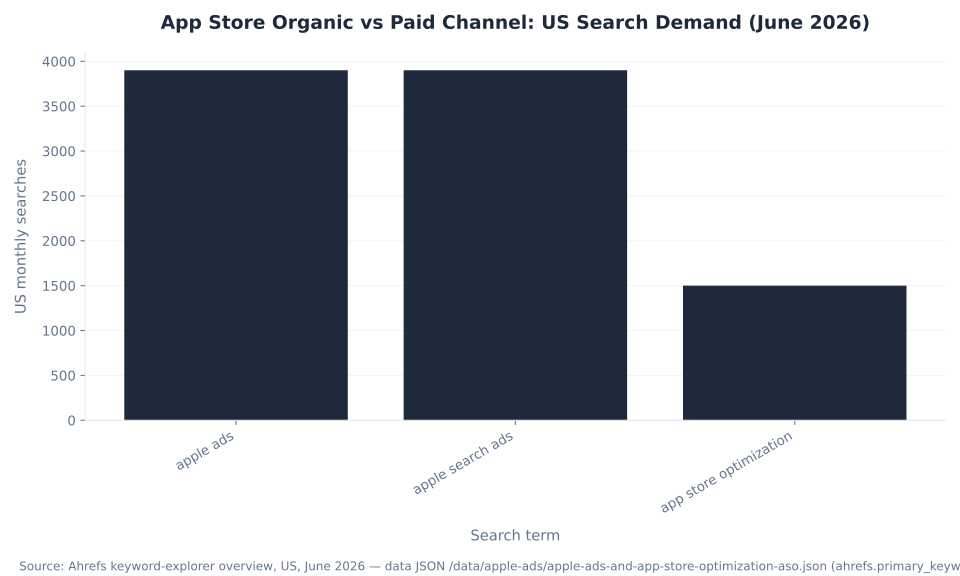
Search demand confirms there is no single “paid or organic” audience — there are two overlapping ones. “Apple ads” and “apple search ads” each draw 3,900 US searches a month, while “app store optimization” pulls 1,500 (Ahrefs, June 2026). The MB Adv Agency view: run them as a single loop — paid discovers and accelerates, organic compounds and defends. The rest of this guide shows how each feeds the other.
App Store Organic vs Paid Channel: US Search Demand (Ahrefs, June 2026)
Key Takeaways
- Apple Ads does not directly boost your organic ranking — Apple has never confirmed a direct link. What is real is indirect: paid installs raise download velocity, a signal the organic algorithm weighs, so ads can lift organic rank on a well-optimized listing (AppTweak; Branch).
- The two channels share one keyword funnel. Apple Ads surfaces per-term tap-through and conversion rates in days; the high-converting terms belong in your ASO title, subtitle, and 100-character keyword field.
- Good ASO pays you back in a lower cost-per-tap. A tightly relevant listing improves ad relevance, and Apple’s second-price auction rewards relevance — so investing in organic reduces what you pay for paid installs.
- Bidding your own #1-ranked brand terms can cannibalize free installs. Run an ON/OFF incrementality test before you scale — one widely-cited estimate puts brand-ad incrementality around 40% (Branch).
- Since July 30, 2025, a single Custom Product Page works on both sides of the funnel — it powers your paid ad variation and, with an assigned keyword, surfaces in organic search (US, English first) (MobileAction; Apple).
The Role of Apple Ads in ASO: Indirect Lift and a Shared Keyword Funnel
Start with the claim everyone overstates: running Apple Ads does not directly boost your organic App Store ranking. There is no confirmed algorithmic link between paying for ads and ranking higher organically, and Apple has never said there is. Any guide that promises “run ads and your organic rank goes up” is selling a mechanism Apple never built.
What is real and well-documented is indirect. Paid installs on a relevant keyword increase your app’s download velocity — the rate of installs over a window — and download velocity is one of the strongest signals the App Store’s organic algorithm weighs. So Apple Ads acts as an accelerant: it drives the velocity organic rankings are built from, which can indirectly lift your position on the keywords you advertised and on adjacent terms (AppTweak; Branch). The framing to keep exact: indirect, not guaranteed, and not a substitute for a good listing. Paid pours fuel on an ASO fire you have already lit — it cannot rank a listing the algorithm and users do not reward.
The second half of the role is the funnel the two channels share. ASO’s hardest question is which keywords actually convert, not just attract impressions — and organic data answers it slowly, over weeks. Apple Ads answers it in days: your Search-results campaigns report, per term, the tap-through rate (do users click?) and the conversion rate (do taps become installs?), and a Search Match discovery ad group mines entirely new terms you were not targeting (the mechanics live in Apple Ads targeting and keywords). Those high-converting terms belong in your ASO metadata — the app title and subtitle carry the most ranking weight, with the 100-character keyword field adding coverage.
| Apple Ads signal | What it tells you | Where it feeds in ASO |
|---|---|---|
| High tap-through-rate terms | Terms users actually click | App title + subtitle (highest-weight metadata) |
| High conversion-rate terms (taps → installs) | Terms that convert, not just attract clicks | The 100-character keyword field |
| Search Match / Discovery ad-group winners | New terms you were not deliberately targeting | Keyword field + new Custom Product Page themes |
| Terms where a specific CPP variation wins | Creative-message ↔ keyword fit | Screenshots + assign that keyword to an organic CPP |
| High-volume but low-CR terms | Mismatch between the term and your listing | Fix screenshots / promotional text (or stop bidding) |
| (reverse) Strong ASO relevance | A tightly relevant listing | Lowers your CPT — Apple’s auction rewards relevance |
Sources: AppTweak, “The ultimate guide to Apple Ads for 2026”; SplitMetrics, “Nine Steps to a Perfect Synergy of ASO & Apple Search Ads.” Metadata weighting is vendor-documented, not an Apple-published ranking formula.
The loop runs the other way too, and most marketers miss it: a tightly relevant listing improves your ad relevance, and Apple’s second-price auction rewards relevance with a lower cost-per-tap — so investing in ASO reduces what you pay for paid installs (AppTweak; SplitMetrics). The MB Adv Agency view: Apple Ads is your live keyword-conversion lab, and ASO is how you compound its findings for free. To read the per-term metrics that feed the loop, see Apple Ads performance metrics and reporting.
Cannibalization: The Honest Caveat, and the Incrementality Test That Resolves It
Here is the uncomfortable truth most “synergy” articles skip: running Apple Ads on a keyword you already rank #1 organically for can cannibalize free installs. You pay for a tap a user would have given you for nothing. This is most acute on your brand terms, where you usually already win the organic result.
The fix is neither “always bid your brand” nor “never bid your brand.” It is to measure incrementality with an ON/OFF test: hold everything else constant, turn the brand campaign off in one market for about a week, and watch what happens to organic installs from that market (Branch; AppTweak). The change you see is the real incremental share for your app — not an industry average.
The vendor findings are sobering, and they are estimates, not constants. One widely-cited estimate puts brand-ad incrementality around 40%, meaning roughly 60% of those paid brand installs were organic installs the app would have won anyway. In a SplitMetrics published game case study, pausing brand campaigns produced only about a 5% lift in organic installs. Treat both as vendor case studies, not settled fact, and let your own ON/OFF test produce your number.
That does not mean never run brand ads. There is a genuine brand-defense case: if you cede your brand slot, a competitor can conquest the top position above your organic result — a sharper risk since the March 2026 inline-search expansion pushed organic listings further down the page. Defend with eyes open: quantify the incremental share before you scale the spend.
Our read: the advertisers who lose money on Apple Ads are usually the ones paying full freight for installs they were already getting free. An incrementality test is the cheapest insurance against it — and running the paid side efficiently is exactly what optimizing Apple Ads campaigns and our PPC campaign management team focus on.
Custom Product Pages Are Now the Literal Bridge Between Paid and Organic
This is the freshest, most under-known fact on the page, and it changes the integration playbook. A Custom Product Page (CPP) is an alternate version of your App Store listing — its own screenshots, previews, promotional text, and a unique URL — built in App Store Connect.
On the paid side, CPPs power your Apple Ads ad variations: the ad selects which CPP supplies the creative and where the tap lands. Apple reports they lift conversion meaningfully — about +2.5 percentage points over a roughly 1.6% default — and AppTweak’s independent median lift across tracked tests is around 6.6% (Apple Developer; AppTweak, benchmark dataset, Oct 2025).
The change that rewrites the playbook: since July 30, 2025, you can assign keywords from your keyword field to a CPP, and when your app ranks for that term, Apple serves the matching CPP instead of your default page in organic search — initially US-only, English (US) localization (MobileAction; AppTweak; Apple). So one well-crafted, keyword-themed CPP now does double duty: it is your paid ad’s landing page and your organic search result for that intent.
Pair that with the per-app cap rising from 35 to 70 CPPs on October 29, 2025, and the practical move is concrete: build CPPs around your highest-converting keyword themes — the ones you discovered in Apple Ads — point the matching paid ad variation at each, and assign the keyword so the same page surfaces organically. The full creative mechanics live in Apple Ads creative and ad policies.
The MB Adv Agency framing: CPP is where “run them together” stops being a strategy slide and becomes a single reusable asset — one page, themed to one intent, working both sides of the funnel. Keep the July 2025 date and the US/English scope exact; this capability has not gone worldwide.

App Store Growth
Want Paid and Organic Working as One Loop?
MB Adv Agency helps advertisers run paid acquisition and organic discovery as a single keyword loop — mining the converting terms in paid, compounding them in your listing, and measuring incrementality before you scale. Talk to our team about an integrated acquisition strategy.
Talk to our team →How to Combine Organic and Paid Strategies in Apple Ads
The honest answer to “paid or organic?” is both, in an order set by where you are. Paid and organic are not a budget either/or — they are a sequence and a loop, and the real question is which one first, and how you wire them so each feeds the other.
Lean paid when you need velocity you cannot earn yet: a brand-new app with no rankings, a launch or feature spike, or a fast read on which keywords convert. Lean organic when durability and acquisition cost matter most — Apple reports almost 65% of downloads happen after a search, organic is the lower-cost compounding base, and a #1 organic position is defensible in a way a paused campaign never is. Run both as the steady state for any live app: paid feeds ASO the converting keywords, ASO relevance lowers your cost-per-tap, and the velocity loop compounds.
| Your situation | Primary lever | Why |
|---|---|---|
| Brand-new app, no organic rankings yet | Paid (Apple Ads) | No organic foothold to lean on; buy install velocity and discover which keywords convert, fast |
| You do not yet know which terms convert | Paid first | Apple Ads’ high-CR search terms are the quickest, cleanest converting-keyword signal — then feed them into ASO |
| Established app already ranking top-5 on core terms | Organic (ASO) | Free installs already flow; bidding here risks cannibalizing them — incrementality-test before you spend |
| Long-term, CAC-sensitive growth | Organic (ASO) | Apple reports ~65% of downloads happen after a search; organic is the lower-cost compounding base |
| Launch spike, new feature, or seasonal push | Paid | Velocity exactly when you need it; you cannot switch organic ranking on for a date |
| Competitor is conquesting your brand term | Paid (brand defense) — but measure | Defends the result, and brand ads are often partly cannibalistic; quantify the incremental share |
| The default for most live apps | Both (the loop) | Paid feeds ASO the converting keywords; stronger ASO lowers your CPT — each compounds the other |
Sources: Apple, “Ads on the App Store” (~65% of downloads after a search); AppTweak; SplitMetrics; Branch. Framework is MB Adv Agency synthesis of the cited mechanics — no mbadv client metrics.
Where a budget decision is genuinely close, the incrementality test on your brand terms tells you whether the spend is adding installs or buying ones you already had. For the auction mechanics that set your cost-per-tap, see how much Apple Ads cost.
The MB Adv Agency view: apps are software businesses, and this paid-plus-organic loop is the same discipline a SaaS and software PPC program runs — the same craft as the rest of your paid media. The question is never “which one,” but “which one first, and how do I wire them so each feeds the other.”
Two 2026 Shifts That Sharpen the Paid/Organic Mix
Two changes this year should inform how you weight paid against organic. Both raise the stakes on getting the loop right.
First, the March 2026 inline-search expansion. Apple added sponsored slots further down the search results, not just the top position — live March 3, 2026 for users on iOS/iPadOS 26.2 and later, with existing campaigns auto-enrolled. The effect on this debate is direct: more sponsored real estate pushes organic listings lower on the screen, which raises the value of both a top organic rank and a brand-defense paid presence.
Second, the algorithm’s center of gravity. AppTweak and SplitMetrics both read the App Store algorithm as putting growing weight on retention and engagement signals, not just raw install counts — a widely held view among ASO practitioners rather than an Apple statement. The implication is sharp: paid velocity buys you a look from the algorithm, but only a genuinely good app with strong listing creative keeps the ranking.
Our take: both shifts argue for the same discipline — use paid to accelerate a listing that already deserves to rank, and measure what the spend adds. Velocity without quality is a rented position; velocity on a strong listing is a down payment on a durable one.
Frequently Asked Questions: Apple Ads & ASO
Next in the Apple Ads series
Apple Ads Targeting & Keywords
The converting keywords that feed your ASO come from your campaigns. The targeting and keywords guide covers broad vs exact match and Search Match — the discovery engine for the new converting terms you funnel into your listing.
Read the targeting guide →Methodology & Sources
This pillar consolidates two absorbed URLs from the mbadv.agency Apple Ads cluster into one synthesis guide on running paid and organic together. The indirect-ranking mechanism (paid installs → download velocity → indirect organic lift) and the shared-keyword-funnel framing are from AppTweak, Branch, and SplitMetrics (“Nine Steps to a Perfect Synergy of ASO & Apple Search Ads”). Cannibalization figures — the ~40% brand-ad incrementality estimate and the ~5% organic lift after pausing brand ads — are vendor case studies from Branch and SplitMetrics, framed as estimates. Custom Product Page facts (organic search since July 30, 2025; US/English scope; the 35→70 cap on October 29, 2025; the ~+2.5pp conversion lift) are from MobileAction, Apple Developer, and AppTweak. Reach and intent figures (~65% of downloads after a search; 850 million-plus weekly visitors) are Apple-published. Search-demand figures are Ahrefs, June 2026. No mbadv client metrics appear in this article. Reviewed by MB Adv Agency, June 2026.

As a Google Ads expert, I bring proven expertise in optimizing advertising campaigns to maximize ROI.
I specialize in sharing advanced strategies and targeted tips to refine Google Ads campaign management.
Committed to staying ahead of the latest trends and algorithms, I ensure that my clients receive cutting-edge solutions.
My passion for digital marketing and my ability to interpret data for strategic insights enable me to offer high-level consulting that aims to exceed expectations.
Google Partner Agency
We're a certified Google Partner Agency, which means we don’t guess — we optimize withGoogle’s full toolkit and insider support.
Your campaigns get pro-level execution, backed by real expertise (not theory).

4.9 out of 5 from 670+ reviews on Fiverr.
That’s not luck, that’s performance.
Highly recommend Matteo to set up your server side tracking. He has a deep understanding of e-commerce tracking and will go above and beyond to make sure everything is set up correctly and working 100%. If you are scaling your store this set up is non-negotiable in my opinion and there isn't many people who have this much knowledge or put the effort in to get it right. Thanks again!
avorodesign.com
I can only recommend Matteo! He was very patient, professional and very knowledgeable about GA4, Consent Mode v2, and GDPR compliance. Communication was clear, and the setup was done professionally and efficiently. Highly recommend him for anyone needing reliable tracking implementation.
www.natureiki.life
Matteo shines in the realm of online professionals. His work is not only deep in data but also complemented by his proactive communication and cooperation, setting a new standard for freelancers. If you want someone who truly exceeds expectations, look no further. Highly recommended!

www.omanbeverlysmyth.com
Exceptional Service Beyond Expectations - Outstanding Service Impeccable depth, flawless delivery, and exceptional language fluency—this service exceeded all expectations. Highly recommended. Matteo truly ROCKS!!!
ium-paris.com
Top-notch, always highly value working with Matteo. An absolute Google Ads Genius. This is approximately the 8th time I have hired him and he's helped us get 6-7 ROAS. We are excited in continuing to improve our lead flow. Hire this guy if you need Google Ads help. Thanks Matteo!
www.dleeventgroup.com
I finally found the guy who can setup server side tracking and all the ecosystem properly. I definitely recommend Matteo. He is very responsive, kind and wants to dig into things. He configured GA4, Meta, Google Ads, Outbrain and google consent v2 with Cookiebot. Thanks Matteo.
inomega.fr
MB Adv delivered exceptional work with outstanding professionalism and lots of patience, taking time to see effects of changes made and not just do the work and submit it. The proactive communication and video summaries of the work completed made working with Matteo a pleasure, as he consistently went above and beyond. Highly recommended for web analytics projects! We are already working on another project.

www.withnellsensors.co.uk
Working with Matteo on my Google Ads was a game-changer. He's not just a strategist, he's a true partner. He understood my goals and tailored a campaign that perfectly reached my target audience. I'm grateful for his expertise and dedication.
dccargo.com
Click-driven mind
with plastic-brick obsession.
We build Google Ads campaigns with the same mindset we use to build tiny brick worlds: strategy, patience, and zero tolerance for wasted pieces.
Data is our blueprint. Growth is the only acceptable outcome.