Optimizing Apple Ads Campaigns: 2026 Playbook
Apple Ads 2026 — Optimization & Automation
5.6×
The gap between the most and least expensive Apple Ads markets — geography is an optimization lever, not background noise
US install ≈ $4.06 vs. Philippines ≈ $0.73 (AppTweak, Oct 2025) · Geo CPT index US 100 / UK 72 / India 15 (Admiral Media, Feb 2026) · September cost peak CPT ≈ $2.00 (SplitMetrics 2025) · Maximize Conversions GA Feb 2026 — an auto-bidder, not autopilot
Diagnosing an Underperforming Apple Ads Campaign: Walk the Funnel Top-Down
Under-performance on Apple Ads is a funnel-stage problem, and the fastest fix is to walk the funnel from the top and stop at the first broken stage. Thin glossary pages say “optimize your keywords.” The truthful answer starts higher: is the campaign even winning the auction? Apple reports Share of Voice (impression share) as a percentage band, and a campaign stuck in the bottom band is not a creative problem — it is a bid or relevance problem, because the max CPT is below where the second-price auction clears, or the App Store metadata is not relevant enough for Apple to surface the app. Only when impressions are healthy do you ask whether searchers are tapping (TTR), then whether taps are converting (CR), and only at the bottom whether the CPA is acceptable.
Each stage has a different cause and a different fix, and the diagnostic table below is ordered top-down so a reader stops at the first broken stage rather than jumping to “add more keywords.” Walking the funnel this way prevents the single most common Apple Ads mistake: pouring budget or rebuilding creative for a campaign whose real problem was a max CPT a few cents below the auction floor, or a metadata-relevance gap Apple was quietly penalizing. The diagnostic starts from the metrics — see Apple Ads performance metrics and reporting for the impression-share band, TTR, conversion rate, and CPA before you change a bid.
| Funnel stage / symptom | Most likely cause | Fix |
|---|---|---|
| Low / no impression share | Max CPT below the auction clearing price, weak App Store metadata relevance, ad still in review, or budget/region mis-set | Raise the max CPT toward or above the suggested bid; review app title, subtitle, and keywords in App Store Connect for relevance; add relevant keywords and remove non-performers; confirm approval, budget, and country |
| Impressions OK, low TTR (tap-through rate) | Ad creative or the keyword-to-app match is off — the searcher does not see why your app fits the query | Test an ad variation off a Custom Product Page whose screenshots and text match the keyword theme; tighten the keyword-to-ad-group theme; review the relevance of broad-match traffic |
| TTR OK, low conversion rate | The product page does not match the search intent — the tap lands somewhere that does not pay off the query | Build Custom Product Pages for your top keyword clusters; align CPP creative and the deep link to the keyword theme; for seasonal or localized traffic, pre-build matching CPPs |
| High CPA with a reasonable CPT | Keyword list too broad — you are buying installs from low-intent or wrong-fit users (a targeting problem, not a price one) | Tighten match types (exact for the highest-intent terms), add negatives aggressively, graduate Search Match winners into controlled exact ad groups, and refine the audience |
| High CPA and high CPT | Bids set above what the term is worth, an expensive geo or category, or a peak-season cost spike | Lower the max CPT or apply a CPA cap as a guardrail; reallocate budget to efficient markets (see the geo index); check where you are in the seasonal calendar before concluding it is broken |
| Performance swings / automation not settling | Maximize Conversions still learning, an unsound target CPA, or recent edits resetting the model | Give it about two weeks of conversion volume before judging; set a target CPA rooted in real install value; stop changing the target mid-learning (it resets); change one variable at a time |
Sources: Apple Ads Help — Tips for Solving Performance Issues (low impression share: raise the bid, add or remove keywords, review metadata relevance), Reporting Options & Definitions (impression share as a percentage band, TTR = taps÷impressions, CR, CPA), and Maximize Conversions; SplitMetrics and Adapty (the optimization checklist and the about-two-week learning window). Funnel ordering and the “stop at the first broken stage” heuristic are a practitioner mental model, not an Apple-published ranking. No figures here are mbadv client data.
When the funnel breaks at the conversion-rate stage it is a creative problem — see Apple Ads creative and ad policies. This pillar has two halves under one roof: the hands-on diagnostic above and Apple’s automation roadmap, the system steadily absorbing those same tasks.
The Optimization Levers: What Each Does, and When to Pull It
The Apple Ads optimization loop has one move the other platforms do not: graduate winners out of Search Match discovery into exact match. Apple gives you exactly two match types — broad (the default) and exact — plus Search Match, an automated setting that serves your ad to relevant searches with no keywords at all. The discipline that compounds is a pipeline, not a longer list: run Search Match and broad inside a dedicated Discovery ad group whose only job is to mine new converting terms, then promote the winners into tightly-themed exact-match Brand, Competitor, and Category ad groups where you control the bid.
The week-to-week toolkit below earns the optimization head term. Pair it with the diagnostic above: the diagnostic tells you where the funnel breaks, this table tells you which lever fixes it. The full keyword structure lives in Apple Ads targeting and keywords, and the cost-per-tap and CPA-cap ranges in how much Apple Ads cost.
| Lever | What it does | When to use it |
|---|---|---|
| Max CPT bid | Sets the ceiling in the second-price auction (you pay about $0.01 above the next bid, never more than your max) | When impression share is low on a relevant keyword (raise toward or above the suggested bid); lower it on terms that win impressions but convert poorly. At 90-100% impression share, stop raising and spend the budget on new keywords instead |
| CPA cap (Limits Impressions) | A per-keyword bid ceiling Apple derives to keep installs near or below a cost — not an auto-optimizer; actual CPA can exceed it and it never exceeds your max CPT | When CPA is drifting and you want a guardrail on a manual ad group. Do not mistake it for the Maximize Conversions target CPA (a different mechanic) |
| Keyword graduation (Discovery → exact) | Promotes a winning term mined by Search Match or broad in a Discovery ad group into a controlled exact-match Brand, Competitor, or Category ad group | Continuously — the core optimization loop. Add each graduated term as a negative back in Discovery so the two groups do not bid against each other |
| Negative keywords | Block irrelevant or already-covered queries (exact by default; broad negatives need all words present); up to 5,000 per ad group | When CPA is high with a reasonable CPT (a targeting/relevance problem, not a price one); to prevent Discovery from overlapping your exact groups |
| Ad variations / Custom Product Pages | Test creative by pointing an ad variation at a CPP whose screenshots and text match the keyword theme (one active custom ad per ad group plus the always-on default) | When TTR or conversion rate is weak (a creative-to-intent match problem); build CPPs for your top keyword clusters and for seasonal or localized pushes |
| Audience refinement | Narrows by customer type (All / New / Returning / Users of My Other Apps), demographics, device, and location | Sparingly — applying age or gender excludes users with Personalized Ads off (a large share of traffic), so it can sharply cut reach; an audience needs more than 5,000 customers to serve |
Sources: Apple Ads Help — Set and Adjust Bids, Set and Adjust your CPA Cap, Structure Campaigns, Understand Search Match, Use Negative Keywords, Set Audience Refinements, and Create Ad Variations. The Discovery-to-exact “graduation pipeline” and the top-down ordering are a practitioner mental model, not an Apple-published ranking. No figures here are mbadv client data.
MB Adv Agency has found that a maturing account’s CPA usually drifts up for one reason: a keyword list that only ever grows, with no graduation and no negatives, so you pay broad-match prices for traffic you should buy on tightly-controlled exact terms.
What Advertisers Search When a Campaign Stalls
Exact-match demand for the optimization head terms is moderate and high-intent: “apple search ads optimization” registers 150 US monthly searches at a $17.00 CPC — the highest cost-per-click in the apple-ads cluster — and “apple search ads automation” registers 150 US monthly searches at an $8.00 CPC (Ahrefs, June 2026). Global volume (350 plus 250) points to meaningful international readership, consistent with the geography angle later in this pillar. These are practitioners willing to act, so depth and precision convert here, not search volume at scale.
| Keyword | US Monthly Vol. | Global Vol. | KD | CPC (USD) | Intent / note |
|---|---|---|---|---|---|
| apple search ads optimization | 150 | 350 | 3 | $17.00 | Head term; hands-on lever-pulling intent. The highest CPC in the apple-ads cluster — strong transactional intent |
| apple search ads automation | 150 | 250 | — | $8.00 | Maximize Conversions and Search Match questions; the absorbed ranker’s top term (pos 11) |
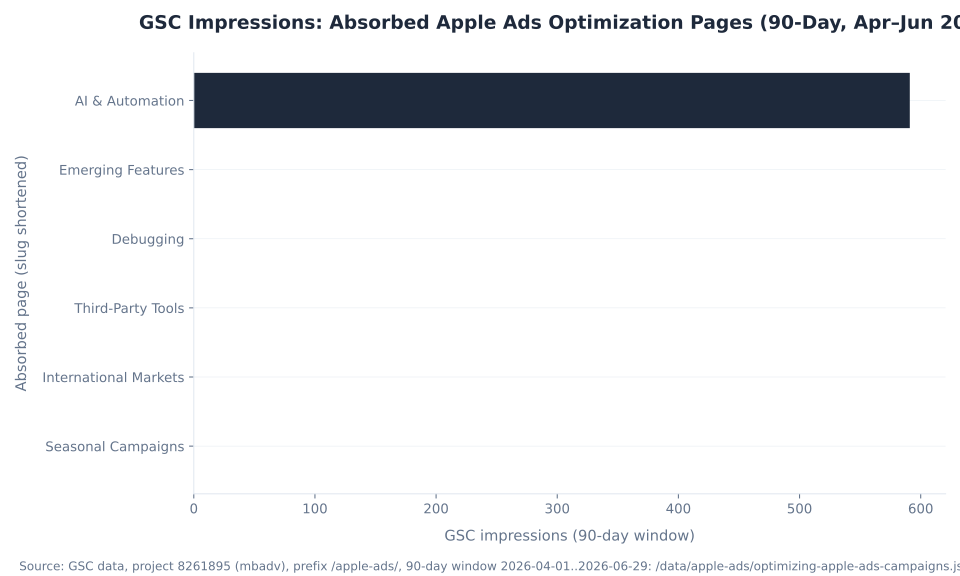
| 6 consolidated source URLs (combined) | — | — | — | — | 591 impressions / 2 clicks across 90 days (GSC), all concentrated in one page — a fresh consolidating pillar is the correct play |
Source: Ahrefs keyword data, June 2026 (US, 12-month average); GSC figures from Google Search Console project 8261895 (mbadv.agency /apple-ads/ prefix), 90-day window April 1 – June 29, 2026. Not mbadv advertising data.
This is a diagnostic, depth-first asset that earns authority from advertisers mid-campaign-crisis. Six absorbed pages 301 into this pillar, and five of the six were zero-click zombies; the chart below shows where the cluster’s search equity actually sat. For readers new to the platform, what are Apple Ads (Apple Search Ads) covers the rebrand, placements, and the CPT auction.
GSC Impressions: Absorbed Apple Ads Optimization Pages (90-Day, Apr–Jun 2026)
The Discovery-to-Exact Pipeline: Graduate Winners, Do Not Just Add Keywords
The accounts that compound are not the ones with the longest keyword lists — they are the ones running a pipeline. Search Match and broad match live in a dedicated Discovery ad group whose only job is to mine new converting terms. When a term proves it converts, you graduate it into a tightly-themed exact-match Brand, Competitor, or Category ad group where the bid is controlled, then add that graduated term as a negative keyword back in Discovery so the two groups do not bid against each other.
Two precision facts keep this clean. Apple Ads has no phrase match — only broad, exact, and the Search Match setting — and “exact match” is not literally exact: it catches plurals, misspellings, word order, and translations, which is why international expansion leans on it. Search Match is an automated setting, not a match type, and isolating it in Discovery turns Apple’s automation into a controlled feeder rather than a budget leak that cannibalizes your own exact groups. The discipline that works: discovery feeds exact, exact gets the budget, and negatives keep the pipeline clean. The full match-type mechanics live in Apple Ads targeting and keywords.
Apple’s AI and Automation: What the System Runs, and What You Still Own
Apple’s automation has crossed from “a CPA cap” into “the automation runs the bidding,” and the honest operator question is what to hand over and what to keep. The stack for Search results is now a suite, not a toggle. Maximize Conversions — generally available since February 25-26, 2026 — bundles Search Match, an auto-bidder, and a target CPA into a locked Automated Ad Group, alongside an optional manual ad group you still control. The Recommendations surface proposes keyword, bid, target-CPA, and budget changes. And the 2026 inline-search expansion added sponsored slots further down in search results that are placed algorithmically — existing campaigns auto-enroll, and advertisers cannot pick or separately bid for the new positions.
The clean framing is a division of labor. Hand the automation the mechanical, high-frequency work it does tirelessly — per-auction bidding, Search Match discovery, and the placement decision you cannot control anyway. Keep ownership of strategy and guardrails: a sound target CPA rooted in your real install economics, a disciplined account structure (the manual ad group, the keyword themes, the negatives), brand-safe creative (the Custom Product Pages that feed ad variations), and the measurement that tells you whether the machine is hitting the goal. Automation removes the busywork; it does not remove the strategist who knows what “good CPA” means for this app.
| Feature | What it automates | What you still own / watch-out |
|---|---|---|
| Search Match (an automated setting, not a match type) | Matches your ad to relevant searches with no keywords, using your App Store metadata, similar apps in your genre, and other search data (Search-results campaigns only) | Isolate it in a dedicated Discovery ad group to mine terms; graduate winners to exact and negative them back. A default-on toggle in manual campaigns; always-on and locked inside Maximize Conversions |
| Maximize Conversions (GA Feb 2026) | Bundles Search Match + an auto-bidder + a target CPA in a locked “Automated Ad Group” (no manual bids), with an optional manual ad group alongside | An auto-bidder, not autopilot: you own the target CPA, the manual ad group, the negatives, and the CPPs. It needs conversion volume; give it about two weeks — changing the target mid-learning resets the model |
| Recommendations | Surfaces suggested keyword, bid, target-CPA, and budget changes based on account data | Suggestions, not auto-applied — review against your structure and economics before accepting; not every recommendation fits your goal |
| Algorithmic inline-search placement (2026 expansion) | Places ads in the new sponsored slots further down in search results (live March 3, 2026, iOS/iPadOS 26.2+); existing campaigns auto-enroll | You cannot pick or separately bid for the new positions — it is algorithmic, and billing (CPT/CPI) is unchanged. Watch blended metrics shift as inventory expands |
| CPA cap (renamed from “CPA goal”) | Derives a per-keyword bid ceiling aiming to keep installs near or below your cost | A ceiling, not an optimizer — actual CPA can exceed it, and it never exceeds your max CPT. Do not describe it as “set a goal and it auto-optimizes” |
Sources: Apple Ads Help — Understand Search Match, Maximize Conversions best practices (GA Feb 25-26, 2026), and Set and Adjust your CPA Cap; Apple Ads News and 9to5Mac (the 2026 inline-search expansion, live March 3, 2026, auto-enroll, advertisers cannot separately bid); SplitMetrics and Adapty (the about-two-week learning window; changing the target CPA resets learning). This is the fastest-aging table in the pillar — product names, status, and dates shift constantly. Maximize Conversions is bidding automation, not a new audience capability, and the CPA cap is a ceiling, not an auto-optimizer. No figures here are mbadv data.
The absorbed page on Apple’s automation is the one ranker this pillar inherits, so the “automation” search intent is the organic foothold to build from. For ongoing optimization across paid channels, MB Adv Agency runs PPC campaign management.
US Search Demand: Apple Ads Optimization Head Terms (Ahrefs, June 2026)
Maximize Conversions Is an Auto-Bidder, Not a Magic Button
The fastest way to waste money on Apple’s automation is to treat it as set-and-forget. Maximize Conversions optimizes toward the target CPA you give it — point it at a number divorced from your install economics, or starve it of conversion volume, and it will spend efficiently toward the wrong goal. It is an auto-bidder, not autopilot, and a bad target or a thin structure makes it fail confidently.
Three disciplines decide whether it succeeds. The CPA cap is a bid ceiling, not the target — actual CPA can exceed it, and the cap never exceeds your max CPT bid, so do not confuse the two. The automation needs conversion volume and a settling-in window — wait about two weeks before drawing conclusions, and never change the target CPA mid-learning, because that resets the model. And you still owe it a sound structure — a clean Discovery-to-exact pipeline, real negatives, and Custom Product Pages — because automation amplifies whatever it inherits.
The MB Adv Agency view is consistent across paid channels: hand the auto-bidder the bidding, but own the inputs — the target, the structure, the creative, and the tracking — because that is the part the automation cannot supply. Apps are software businesses, and SaaS advertisers run the closest playbook to App Store user acquisition; see SaaS and software PPC services, and defer hard CPT and CPA ranges to how much Apple Ads cost.
Third-Party Tools: What Each Does, and What It Is Best For
When the native console is not enough, established platforms extend what it does — campaign automation, creative testing, ASO integration, and the attribution layer Apple Ads does not report natively. The landscape below is descriptive, not an endorsement or a ranking, and no pricing is quoted; every capability is attributed to the named vendor.
| Tool (vendor) | What it does | Best for |
|---|---|---|
| SplitMetrics Acquire (formerly SearchAdsHQ) | Campaign management and automation paired with creative and CPP A/B testing to lift conversion rate from paid traffic; an official Apple Ads Partner | Advertisers who optimize creative and Custom Product Pages alongside bids |
| SearchAds.com (now part of AppTweak) | One of the most established Apple Ads management platforms — rule-based automation plus reporting, now inside AppTweak | Teams wanting a long-standing dedicated ASA management layer |
| AppTweak (Campaign Manager) | Combines campaign automation, ASO integration, creative analytics, and full-funnel reporting (Apple Ads plus MMP data) in one workspace; publishes the benchmark dataset | Operators who run paid plus organic (ASO) together and want benchmarks |
| MobileAction | Task automation, bid optimization, budget allocation, campaign forecasting, and competitor insights across paid plus organic | Teams that want automation plus competitive intelligence |
| Adjust (MMP) | A mobile measurement partner for attribution and analytics — ties Apple Ads to post-install events, LTV, and ROAS (alongside Branch, Singular, AppsFlyer, Kochava) | Anyone optimizing to revenue or LTV (Apple Ads does not report LTV/ROAS natively) |
Sources: AppTweak, “The best Apple Ads tools of 2026” and its Apple Ads automation guide; SplitMetrics Acquire product pages (creative/CPP A/B testing; Apple Ads Partner); MobileAction (bid optimization, budget allocation, forecasting, competitor insights); Adjust, Branch, Singular, AppsFlyer, and Kochava (MMP attribution — the LTV/ROAS layer Apple Ads does not report natively); the Apple Ads Partners directory and Business of Apps. This is a descriptive landscape, not an mbadv endorsement or ranking, and no pricing is quoted.
The one structural gap every operator hits is measurement: Apple Ads does not report LTV or ROAS natively, so a mobile measurement partner is the layer that ties an install to its real value. The deeper treatment of impression share, TTR, conversion rate, and Apple’s Insights engine lives in performance metrics and reporting.
Emerging Features: Tie Every “New” Claim to an Announced, Dated Product
The automation half makes this pillar current rather than evergreen-generic, and it ages fastest, because Apple renames and ships ad products constantly. The honest version of “emerging features” ties every claim to a named, dated 2025-2026 announcement — no speculative feature, no unverified “AI agent.” The table below maps each recent change to what happened and what it means.
| Feature | What is happening (dated) | Status / what it means |
|---|---|---|
| Rebrand to Apple Ads | “Apple Search Ads” became Apple Ads (April 14, 2025) as placements expanded beyond search | Use the current name. “Apple Search Ads” is the stale product name |
| 35 → 70 Custom Product Pages | The CPP cap per app was raised from 35 to 70 (October 29, 2025) | More room to match a CPP to each keyword theme and seasonal push |
| Maximize Conversions | GA February 25-26, 2026 — Search Match + auto-bidder + target CPA in a locked Automated Ad Group | Live; an auto-bidder, not autopilot. You own the target CPA and the structure |
| Insights reporting | A reporting and analysis surface for account performance (March 2026) | Live; read it before changing a bid, not after |
| Algorithmic inline-search expansion | New sponsored slots further down in search results, placed algorithmically (live March 3, 2026) | Live; existing campaigns auto-enroll, billing unchanged, and you cannot separately bid for the new positions |
| Greater creative freedom / Creative Assets | Expanded creative options announced June 8, 2026 (Creative Sets are retired) | Verify availability at publish; do not reference retired Creative Sets |
Sources: Apple Ads News and the Apple Ads Help center (the April 14, 2025 rebrand to Apple Ads; the 35-to-70 Custom Product Page cap, October 29, 2025; Maximize Conversions GA February 25-26, 2026; Insights reporting, March 2026; the June 8, 2026 creative-freedom announcement); Apple Ads News and 9to5Mac (the inline-search expansion, live March 3, 2026). Every product name, status, and date is the fastest-aging content in the pillar — re-confirm at publish. Never ship the stale drift: not “Apple Search Ads” as the product name, not “SKAN 4,” not “CPA goal,” not lifetime budgets, and not Creative Sets. No figures here are mbadv data.
For the vocabulary this assumes — the rebrand, the four placements, the two tiers, and the CPT auction — start at what are Apple Ads (Apple Search Ads).
International Markets: Geography Is a Budget-Allocation Lever
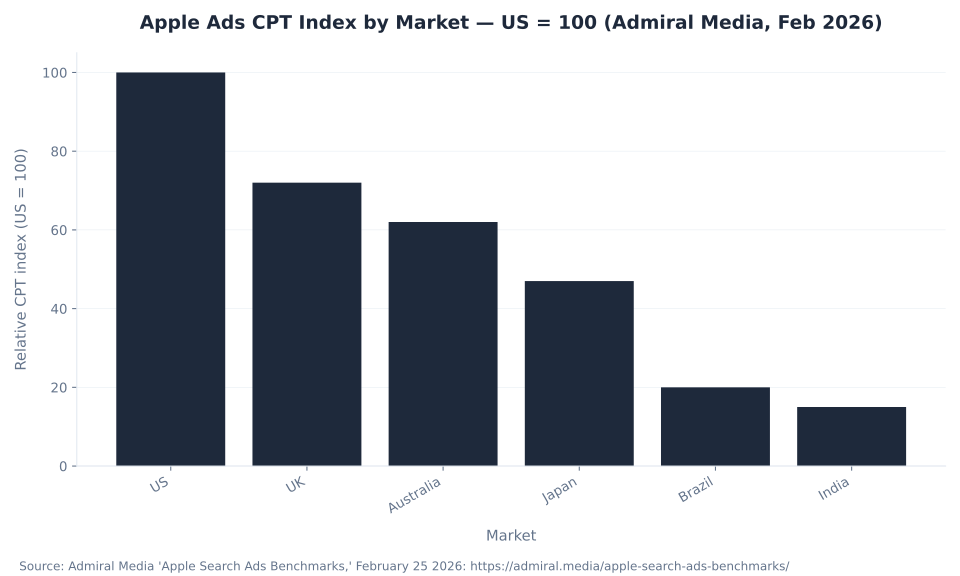
Apple Ads does not cost the same everywhere, so cloning one campaign into every country is how you overspend in some markets and under-serve in others. North America is consistently the most expensive market, and the spread is wide: Admiral Media’s index (February 2026) puts the US at 100, the UK at 72, Australia at 62, Japan at 47, Brazil at 20, and India at 15, while AppTweak’s CPI range runs from roughly $0.73 in the Philippines to $4.06 in the US (October 2025). Treat the index as a budget-allocation map: push volume into efficient markets, and defend the high-intent terms in expensive ones.
Expansion that works is per-country, not global. It uses localized Custom Product Pages in the local language — and because exact match already catches translations, a creative-to-region mismatch is a frequent ad-rejection reason — plus region-aware demographics (minimum targetable age 18 in the US, EU, and LatAm, up to 21 in some markets), and the fact that location can only be refined within Apple’s roughly 30 supported countries, not inside a multi-country campaign. The localized, seasonal creative is covered in Apple Ads creative and ad policies.
| Market | Relative cost (CPT index, US = 100; Admiral Media, Feb 2026) | What to localize / watch |
|---|---|---|
| United States / North America | 100 (the most expensive market; AppTweak US CPI about $4.06, Oct 2025) | Defend high-intent and brand terms; expect peak-season spikes (September). Min targetable age 18 |
| United Kingdom | 72 (midpoint of the 65-80 range) | English creative ports easily, but localize spelling, idiom, and pricing; run a separate campaign for region-level bids |
| Australia | 62 (Admiral Media midpoint) | English-language creative ports with local idiom and pricing; per-country campaign for region-level bidding |
| Japan | 47 (midpoint of the 40-55 range) | A fully localized CPP (language and visuals) is essential — exact match catches translations, so localized keywords and creative matter most here |
| Brazil | 20 (Admiral Media midpoint) | Efficient for volume; localize fully to Portuguese and watch install quality against LTV with an MMP |
| India | 15 (midpoint of the 10-20 range; emerging markets are the most efficient) | Efficient for volume and scale plays; watch install quality versus LTV (cheap installs are not always valuable) |
| Structural rules (all markets) | — | Run per-country campaigns (location can only be refined within Apple’s ~30 supported countries, not inside a multi-country campaign); min targetable age varies (18 in US/EU/LatAm, up to 21); product pages run in 90 countries (not mainland China); Today and Search-tab cover 91 |
Sources: Admiral Media, “Apple Search Ads Benchmarks” (February 25, 2026; geo CPT index US 100, UK 65-80, Japan 40-55, India 10-20; Australia and Brazil are Admiral Media midpoints, confirmed at publish); AppTweak (October 2025; geographic CPI range Philippines about $0.73 to US about $4.06; North America highest-cost); Apple Ads Help — Set Audience Refinements and Ad Placement Options. All cost figures are third-party app-marketing estimates that vary by category and season — not Apple rate cards or mbadv data. Never use WordStream or LocaliQ for an Apple Ads cost; they publish zero Apple data.
Apple Ads CPT Index by Market — US = 100 (Admiral Media, Feb 2026)
Seasonality: When to Push, and When to Harvest Efficiency
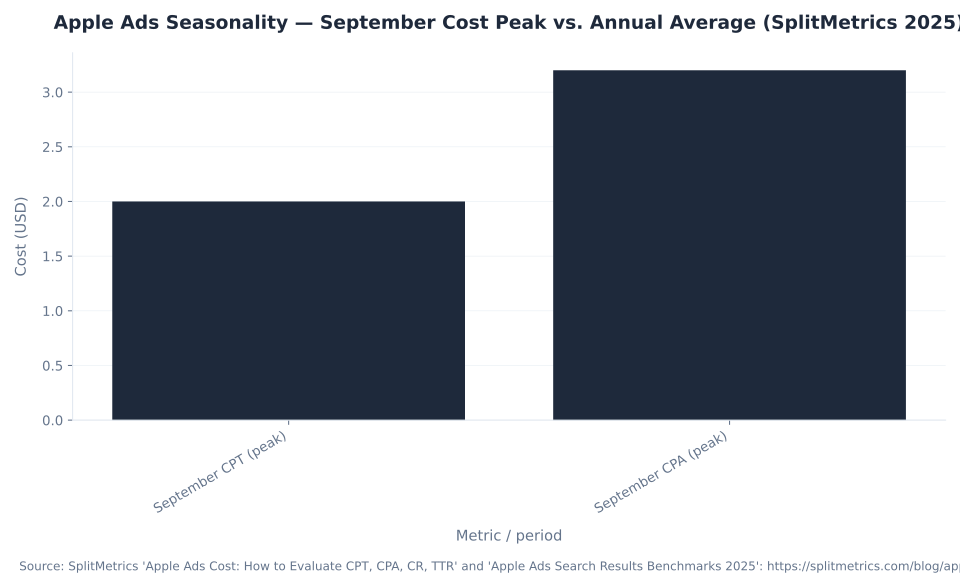
Apple Ads does not perform the same in every month, so seasonality is an optimization lever, not background noise. SplitMetrics’ 2025 dataset shows a combined-cost peak around September — CPT about $2.00 and CPA about $3.20 — driven by the iPhone launch cycle and back-to-school competition, and identifies April as the most cost-efficient acquisition window of the year. Category events sit on top of that rhythm: a Sports CPT surge around the Super Bowl ($14.41 CPT) and a January fitness peak. Annual Search-results averages run CPT $2.25 and CPA $3.76, so the “peak” label reflects combined competitive pressure across categories, not a single per-unit high.
Treat the calendar as a plan, not a surprise. Pre-build seasonal Custom Product Pages before the peak — they are the strongest lever for holding conversion rate when CPT climbs — and do not judge an account’s efficiency without knowing where in the calendar you are standing. MB Adv Agency treats the geo cost index and the seasonal calendar as one budget-allocation problem: push into efficient markets and months, and defend rather than chase when both turn expensive.
| Period / event | What happens (2025 pattern, attributed) | The play |
|---|---|---|
| September (cost peak) | The combined cost peaks (SplitMetrics: CPT about $2.00, CPA about $3.20) — the new iPhone launch plus back-to-school competition | Defend brand and high-intent terms, hold CPA caps, and lean on a peak-ready CPP to protect conversion rate while CPT climbs — do not chase low-intent volume at peak prices |
| April (efficiency window) | SplitMetrics identifies April as the most cost-efficient acquisition window of the year | Scale volume and run Search Match discovery harder while CPTs are soft; build the keyword pipeline you will harvest later |
| Holiday Q4 (Nov-Dec) | A shopping, gifting, and downtime install surge; high intent with rising competition | Pre-build holiday CPPs before the rush; raise budgets ahead of (not during) the spike so Maximize Conversions has runway to learn |
| Category events (e.g. Super Bowl, January fitness) | Vertical-specific spikes — Sports CPT surges around the Super Bowl (SplitMetrics: $14.41 CPT); Health & Fitness peaks in January | Time creative and budget to your category’s calendar, not a generic one; a fitness app’s peak is not a games app’s peak |
| Today-tab / seasonal placements | The Today tab (the App Store front page) is a seasonal awareness surface and requires a Custom Product Page | For brand or awareness pushes around an event, pair Search-results harvesting with a Today-tab CPP — submit early, because Today-tab ads are reviewed before serving |
Sources: SplitMetrics, “Apple Ads Search Results Benchmarks 2025” and “Apple Ads Cost” (September cost peak CPT about $2.00 / CPA about $3.20; April most efficient; annual averages CPT $2.25 / CPA $3.76; Sports CPT $14.41); SplitMetrics’ seasonal-strategy guidance (CPPs essential for peak-season conversion rate; Super Bowl and January category spikes); Apple Ads Help — Ad Placement Options and Today Tab Ads (the Today tab requires a CPP and is reviewed before serving). All figures are SplitMetrics vendor estimates from one year’s dataset, attributed inline — never Apple rate cards or mbadv data. No figures here are mbadv data.
Apple Ads Seasonality — September Cost Peak vs. Annual Average (SplitMetrics 2025)
The Role of AI in Apple Ads: It Automates Execution, Not Strategy
The clean-eyed way to read Apple’s automation is as a division of labor, and the operator’s real question is no longer “how do I optimize?” but “what do I hand to the automation, and what do I still own?” Hand the system the mechanical work it does tirelessly: per-auction bidding inside Maximize Conversions, Search Match discovery in a Discovery ad group, and the algorithmic inline-search placement you cannot control anyway.
Keep ownership of four inputs the automation cannot supply. The target CPA is yours, grounded in what an install is worth. The structure is yours: the manual ad group, the keyword themes, and the negatives that keep Discovery from cannibalizing your exact groups. The creative is yours: the Custom Product Pages that feed ad variations and hold conversion rate when CPT climbs. And the measurement is yours, because Apple Ads does not report LTV or ROAS natively. Point an auto-bidder at a thin signal or an unsound target and it optimizes confidently toward the wrong thing.
MB Adv Agency frames the automation half the same way across every paid channel: hand the machine the busywork, and keep ownership of goals, structure, creative, and measurement. If your Apple Ads campaign stalled on impression share, your CPA is climbing, or you want a clear view of which automation tools are worth handing the wheel before you expand internationally, our team runs PPC campaign management across paid channels — talk to our team about an App Store advertising and PPC strategy.

Diagnose Before You Spend
Most underperforming campaigns are diagnosable in an hour
Our team runs a Google Ads PPC audit that checks the full funnel — from impression share down to conversion tracking and bid strategy — the same top-down discipline this pillar applies to Apple Ads.
Google Ads PPC audit →Inside the 2026 Inline-Search Expansion: Placement You Cannot Bid For
The 2026 inline-search expansion is where Apple’s automation visibly took a decision out of the advertiser’s hands. Live March 3, 2026 on iOS and iPadOS 26.2 and later, it added sponsored slots further down in search results, beyond the long-standing top-of-results placement. Existing campaigns auto-enroll, billing on a CPT or CPI basis is unchanged, and advertisers cannot pick or separately bid for the new positions — placement is algorithmic.
The practical consequence is a measurement one, not a setup one. As inventory expands, blended metrics shift: impression volume rises, and TTR and conversion rate move as lower-position slots mix into the average, so a campaign can look different month over month without any change you made. Read the shift against where the new inventory landed rather than concluding the campaign broke, and check Apple’s Insights reporting before changing a bid. The placement decision is one more piece of mechanical work the automation now owns, which makes the inputs you keep — the target CPA, the structure, the creative, and the measurement — the part that decides whether the expanded inventory pays off. The metric definitions behind that read live in Apple Ads performance metrics and reporting.
The Apple Ads Optimization Playbook: A Weekly Discipline
Optimization is a weekly discipline, and the sequence below mirrors the diagnostic in Table 1. Run it top-down and stop at the first broken stage rather than reaching for the budget slider. The steps stay tool-agnostic enough to survive Apple Ads console changes.
- Confirm serving and check impression share. If the Share-of-Voice band is low, raise the max CPT toward or above the suggested bid and review your app title, subtitle, and keywords in App Store Connect for relevance. Thin delivery is a bid-or-relevance problem, not a creative one.
- Check TTR. If taps are weak, test an ad variation off a Custom Product Page whose screenshots and text match the keyword theme, and tighten the keyword-to-ad-group match. See Apple Ads targeting and keywords.
- Check conversion rate. If taps do not convert, build Custom Product Pages for your top keyword clusters so the page pays off the search intent.
- Diagnose CPA. If CPA is high with a reasonable CPT, tighten match types, add negatives aggressively, and graduate Search Match winners into controlled exact ad groups. If CPA and CPT are both high, lower the bid or apply a CPA cap and reallocate to efficient markets.
- Right-size bids and reallocate. Use the geo cost index and the seasonal calendar as a budget-allocation map — push into efficient markets and months, defend rather than chase when both turn expensive.
- Consider automation. Move proven structure to Maximize Conversions with a sound target CPA, give it about two weeks of conversion volume before judging, and do not change the target mid-learning.
MB Adv Agency has found that the most productive first question on a stalled campaign is not “what is wrong with the creative?” but “which funnel stage broke first?” If your impression share cratered or your CPA is climbing, get in touch for an App Store advertising and PPC strategy.
Apple Ads Optimization & Automation FAQ
Ongoing Apple Ads Optimization
Optimization is a weekly discipline, not a one-time fix
Once the diagnosis is done, our team runs PPC campaign management across bid and CPA-cap tuning, keyword graduation, negatives, and creative tests — so the automation is handed the right work and the strategy stays yours.
PPC campaign management →Get in touchMethodology
This pillar consolidates six absorbed Apple Ads glossary pages (the role of AI and automation, emerging features, debugging performance issues, third-party tools, international markets, and seasonal campaigns). The optimization levers, the automation map, the funnel diagnostic, and the keyword-graduation pipeline are sourced from Apple’s own documentation — Tips for Solving Performance Issues, Understand Search Match, Structure Campaigns, the CPA Cap docs, and Maximize Conversions best practices — verified June 30, 2026. Cost, geography, and seasonality figures are attributed to named vendors: Admiral Media (geo CPT index), AppTweak (CPI range and placement benchmarks), and SplitMetrics (September peak, April efficiency window). All vendor figures are attributed and never presented as mbadv client data; mbadv holds no Apple Ads client benchmark dataset, so the MB Adv Agency point of view stays qualitative. WordStream and LocaliQ are never used for any Apple Ads cost. Search-volume data is from Ahrefs, June 2026; GSC data from a 90-day window, April 1 to June 29, 2026. Reviewed by MB Adv Agency, June 2026.

As a Google Ads expert, I bring proven expertise in optimizing advertising campaigns to maximize ROI.
I specialize in sharing advanced strategies and targeted tips to refine Google Ads campaign management.
Committed to staying ahead of the latest trends and algorithms, I ensure that my clients receive cutting-edge solutions.
My passion for digital marketing and my ability to interpret data for strategic insights enable me to offer high-level consulting that aims to exceed expectations.
Google Partner Agency
We're a certified Google Partner Agency, which means we don’t guess — we optimize withGoogle’s full toolkit and insider support.
Your campaigns get pro-level execution, backed by real expertise (not theory).

4.9 out of 5 from 670+ reviews on Fiverr.
That’s not luck, that’s performance.
Highly recommend Matteo to set up your server side tracking. He has a deep understanding of e-commerce tracking and will go above and beyond to make sure everything is set up correctly and working 100%. If you are scaling your store this set up is non-negotiable in my opinion and there isn't many people who have this much knowledge or put the effort in to get it right. Thanks again!

avorodesign.com
I can only recommend Matteo! He was very patient, professional and very knowledgeable about GA4, Consent Mode v2, and GDPR compliance. Communication was clear, and the setup was done professionally and efficiently. Highly recommend him for anyone needing reliable tracking implementation.

www.natureiki.life
Matteo shines in the realm of online professionals. His work is not only deep in data but also complemented by his proactive communication and cooperation, setting a new standard for freelancers. If you want someone who truly exceeds expectations, look no further. Highly recommended!

www.omanbeverlysmyth.com
Exceptional Service Beyond Expectations - Outstanding Service Impeccable depth, flawless delivery, and exceptional language fluency—this service exceeded all expectations. Highly recommended. Matteo truly ROCKS!!!

ium-paris.com
Top-notch, always highly value working with Matteo. An absolute Google Ads Genius. This is approximately the 8th time I have hired him and he's helped us get 6-7 ROAS. We are excited in continuing to improve our lead flow. Hire this guy if you need Google Ads help. Thanks Matteo!

www.dleeventgroup.com
I finally found the guy who can setup server side tracking and all the ecosystem properly. I definitely recommend Matteo. He is very responsive, kind and wants to dig into things. He configured GA4, Meta, Google Ads, Outbrain and google consent v2 with Cookiebot. Thanks Matteo.

inomega.fr
MB Adv delivered exceptional work with outstanding professionalism and lots of patience, taking time to see effects of changes made and not just do the work and submit it. The proactive communication and video summaries of the work completed made working with Matteo a pleasure, as he consistently went above and beyond. Highly recommended for web analytics projects! We are already working on another project.

www.withnellsensors.co.uk
Working with Matteo on my Google Ads was a game-changer. He's not just a strategist, he's a true partner. He understood my goals and tailored a campaign that perfectly reached my target audience. I'm grateful for his expertise and dedication.

dccargo.com
Click-driven mind
with plastic-brick obsession.
We build Google Ads campaigns with the same mindset we use to build tiny brick worlds: strategy, patience, and zero tolerance for wasted pieces.
Data is our blueprint. Growth is the only acceptable outcome.