Apple Ads Attribution & Privacy: 2026 Guide

Apple Ads Attribution & Privacy 2026
v1–3
Apple Ads registered with SKAdNetwork versions 1, 2 and 3 on April 10, 2025 — not SKAN 4
Two parallel paths: AdServices (first-party, deterministic, iOS 14.3+) & SKAdNetwork / AdAttributionKit (anonymized, cross-network) · ATT does not gate Apple Ads attribution · iAd was shut down Feb 7, 2023 · view-through attribution added Mar 27, 2025
How Apple Ads Attributes an Install: Two Parallel Paths
The hardest fact to get right about Apple Ads is also the most-searched one: how does Apple attribute an install without breaking the privacy rules Apple itself wrote? The answer is that Apple Ads runs two parallel, complementary, privacy-preserving measurement paths at the same time — and almost every thin glossary page conflates them into one pipeline. Path 1 is AdServices + the Apple Ads Attribution API: Apple’s first-party, deterministic, “Apple-attributed” data, granular down to the keyword and creative. Path 2 is SKAdNetwork / AdAttributionKit: Apple’s anonymized, cross-network attribution, reported at the campaign level only.
Table 1 is the reference for the whole pillar. The two paths are not redundant copies of each other — they answer different questions, and they will not reconcile install-for-install. Read them apart. AdServices tells you which keyword and creative earned a conversion; SKAdNetwork lets Apple Ads sit on the same anonymized footing as your Meta and TikTok app campaigns. The reported metrics those installs roll up into — tap-through rate, conversion rate, installs, CPA — live in Apple Ads performance metrics and reporting, not here; this pillar is about the attribution machinery underneath them.
| Dimension | Path 1 — AdServices + Apple Ads Attribution API | Path 2 — SKAdNetwork / AdAttributionKit |
|---|---|---|
| What it is | Apple’s first-party attribution — the on-device AdServices framework returns an attribution token, exchanged through Apple’s Attribution API for “Apple-attributed” data. | Apple’s privacy-preserving, cross-network attribution — anonymized postbacks that let Apple Ads be compared against other ad networks on equal footing. |
| Determinism | Deterministic — a confirmed Apple-ad → install match. | Deterministic but anonymized & aggregated — campaign-level, gated by crowd anonymity. |
| Granularity | Campaign / ad group / keyword / creative — the only path that tells you which keyword converted. | Campaign-level only (through the hierarchical source identifier) — never user- or device-level. |
| Scope | Apple Ads only. | Cross-network (Apple Ads + Meta, TikTok, and others, all on one anonymized standard). |
| ATT dependence | None for attribution. Works regardless of consent; ATT only upgrades the payload Standard → Detailed (Table 2). | None — designed to work without the IDFA / without ATT. |
| iOS minimum | iOS 14.3+ (AdServices). Attribution token TTL = 24 hours. | Apple Ads registered with SKAdNetwork v1–3 on Apr 10, 2025; AdAttributionKit “at a later date.” |
| Use it for | In-Apple-Ads optimization — keyword and creative decisions, bid management. | Cross-network comparison — putting Apple Ads on the same anonymized footing as other channels. |
| Why two? | They answer different questions and will not reconcile install-for-install — that discrepancy is expected, not a bug. AdServices answers “which keyword/creative drove this?”; SKAN/AAK answers “how does this compare across networks, privately?” Neither reports LTV/ROAS natively — that needs an MMP or App Analytics revenue. | |
Sources: Apple Ads Help, “App ad attribution overview” (0094) (two complementary paths); Apple Ads Help, “Measuring ad performance” (0028); Apple Developer, “AdServices”; Apple Developer, “SKAdNetwork”. Verified 2026-06-30.
MB Adv Agency treats a mismatch between “Apple-attributed installs” in the Apple Ads dashboard and the SKAdNetwork installs in an MMP as the normal state of a healthy setup, not a tracking failure. The two systems use different windows, different granularity, and different matching machinery, so they describe the same campaign from two angles. The mistake is expecting one number; the discipline is naming which path you mean every time you quote an install count.
Does Apple Ads Use SKAdNetwork 4? No — It Registered with Versions 1–3
The single most-repeated error on this entire topic is “Apple Ads uses SKAdNetwork 4.” The truth is the opposite of intuitive. Apple Ads registered with SKAdNetwork for the first time on April 10, 2025 — with versions 1.0, 2.0 and 3.0, covering all four App Store placements, with AdAttributionKit integration planned “at a later date.” The latest framework version is SKAN 4.0 (and AdAttributionKit is newer still), so every guide assumes Apple — of all companies — must be on the newest version of its own framework. It is not.
State it declaratively: Apple Ads = SKAdNetwork v1–3 (since April 10, 2025); SKAN 4 is the framework version, not Apple Ads’ registration. And the part almost no page mentions: before April 2025, Apple Ads was not in SKAdNetwork at all. This has a real operational consequence. If you have been modeling Apple Ads SKAN data as “SKAN 4 with fine and coarse values across three postback windows,” you have been wiring up a schema Apple Ads does not expose for its own inventory. Adjust and Kochava both confirm the v1–3 registration date and version set.
This is the citation-magnet correction, and it is why MB Adv Agency leads every Apple Ads attribution review with the framework names rather than the dashboards. Get “v1–3, not SKAN 4” right and the rest of the privacy stack falls into place; get it wrong and the conversion-value schema, the postback expectations, and the cross-network reconciliation all inherit the error. Hardening that postback and conversion-value layer is squarely server-side tracking work.
Why Your Two Attribution Numbers Will Never Reconcile
The most common support ticket on Apple Ads measurement is “my Apple-attributed installs and my SKAdNetwork installs don’t match — which one is real?” Both are real. They measure different things. AdServices reports a deterministic, first-party, keyword-and-creative-level match for Apple Ads only. SKAdNetwork reports an anonymized, aggregated, campaign-level postback that holds for any network. Different machinery, different windows, different granularity — so the counts diverge by construction.
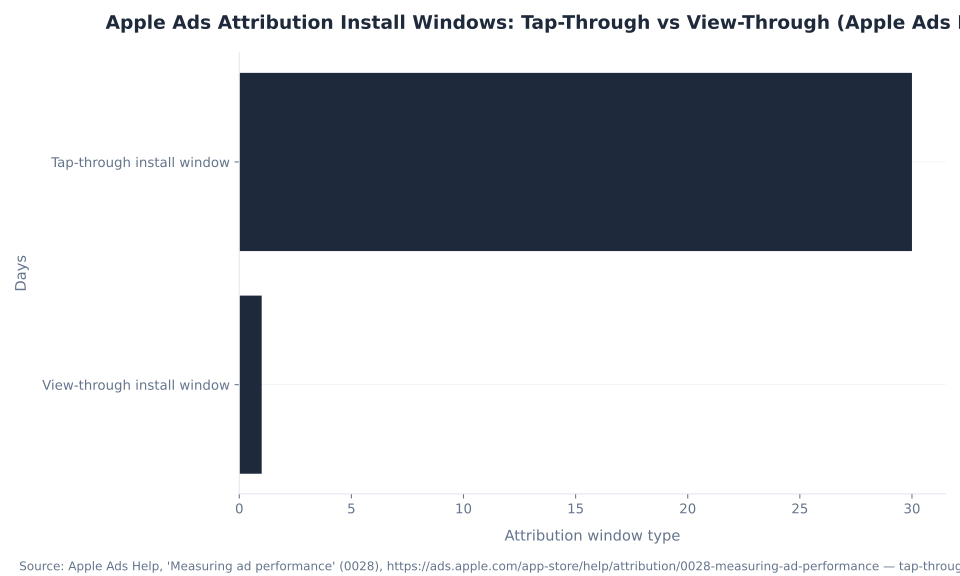
The window difference alone guarantees a gap. On the AdServices side, Apple Ads attributes tap-through installs over a 30-day window and view-through installs over a 1-day window. SKAdNetwork postbacks, when an advertiser has adopted the SKAN 4 framework, arrive across 0–2, 3–7 and 8–35 day windows. Two attribution systems counting on different calendars will report different totals for the same campaign in the same period.
The operational rule MB Adv Agency applies: use AdServices for in-Apple-Ads optimization — keyword, creative and bid decisions that depend on knowing which term converted — and use SKAdNetwork or AdAttributionKit for cross-network comparison, so Apple Ads is judged on the same anonymized basis as every other channel. Stop trying to force one to equal the other. If the gap looks wrong rather than expected, that is exactly what a Google Ads PPC audit untangles for advertisers also running Google App campaigns.
AdAttributionKit: SKAdNetwork’s Successor (and Why There Is No “SKAN 5”)
Apple skipped “SKAN 5” entirely and named the next privacy framework AdAttributionKit (AAK), introduced at WWDC June 2024. AAK is the SKAdNetwork successor: it is built on SKAN fundamentals, keeps the same privacy model (no user or device ID), and adds three things SKAN never had — re-engagement attribution through universal links, first-class view-through support, and a marketplace identifier for alternative app marketplaces. The two coexist as of mid-2026, with full interoperability inside a single app.
The forward-looking detail for Apple Ads specifically: AAK integration is planned “at a later date” per Apple’s own overview page, with no confirmed ship date. So in 2026 an Apple Ads advertiser’s cross-network path is SKAdNetwork (v1–3 registration), with AAK on the roadmap rather than in production. Table 4 decodes the framework comparison and pins where Apple Ads actually sits.
| Dimension | SKAdNetwork (SKAN 4) | AdAttributionKit (AAK) |
|---|---|---|
| Introduced | SKAN 1 (2018) → SKAN 4 (iOS 16.1, 2022) | WWDC June 2024 (Apple skipped “SKAN 5”) |
| Relationship | The original privacy-preserving framework. | The successor, built on SKAN fundamentals with full interoperability — both can coexist. |
| Re-engagement attribution | ✗ Install-only | ✓ Adds re-engagement (bring existing users back through a universal link — the headline advance) |
| View-through attribution | Tap-through focus | ✓ Supports view-through; WWDC 2025 (iOS 18.4) added configurable windows and cooldowns |
| Multiple app stores | ✗ App Store only | ✓ “Marketplace identifier” — supports alternative app marketplaces |
| Privacy model | Anonymized, campaign-level, crowd-anonymity-gated | Same privacy model (no user/device ID) — adds capability, not exposure |
| ★ Where Apple Ads sits | Apple Ads registered with SKAdNetwork v1–3 on April 10, 2025 — NOT SKAN 4, NOT yet AAK. AdAttributionKit integration is planned “at a later date.” As of mid-2026, SKAN 4 and AAK coexist industry-wide; AAK is positioned to eventually replace SKAN, but SKAN is still operational. | |
Sources: Apple Developer, “AdAttributionKit” / WWDC24 session 10060 (successor to SKAdNetwork; re-engagement; full interoperability); Branch, “AdAttributionKit unveiled at WWDC 2024”; Singular, “AdAttributionKit: the new SKAdNetwork?”; Apple Ads Help (0094). Verified 2026-06-30.
The practical takeaway MB Adv Agency gives clients: build for SKAdNetwork today, design the conversion-value schema so it can graduate to AdAttributionKit without a rebuild, and do not let a vendor sell you “SKAN 5” — there is no such thing. Acting on attributed data once it is trustworthy — bids, budgets, creative — is the work in optimizing Apple Ads campaigns.
What Marketers Search For: Attribution & Privacy Demand
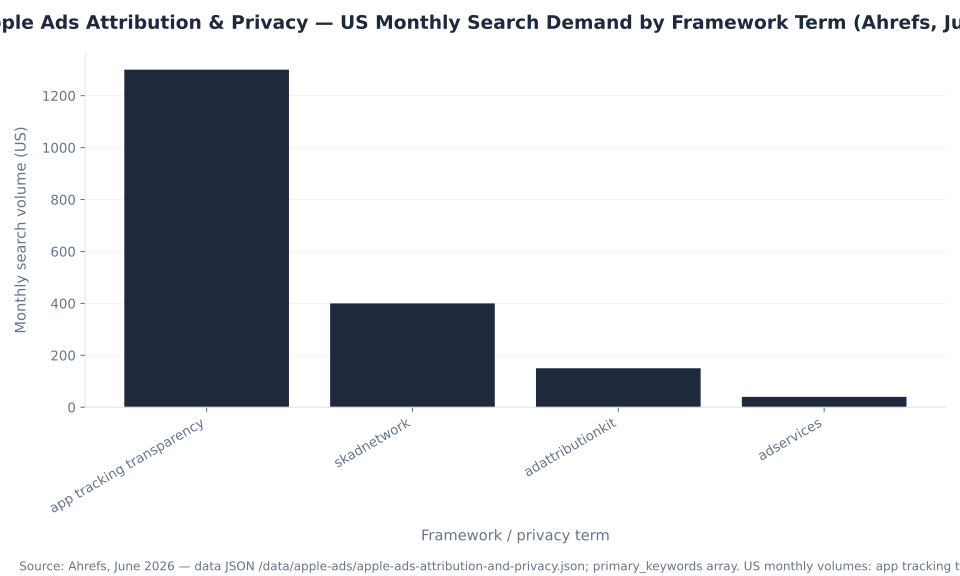
“App tracking transparency” is the cluster’s entry point at 1,300 US monthly searches (Ahrefs, June 2026, KD 23) — privacy concern drives roughly three times the demand of the framework-mechanic query “skadnetwork” at 400. “adattributionkit” at 150 carries the highest CPC in the cluster ($12.00), a signal of commercial developer intent, and “adservices” at 40 is the narrowest Path 1 precision query. Volume here is fragmented by design: the definitional demand splits into long phrases like “how does apple search ads attribution work” and “does apple ads use skadnetwork.”
| Keyword | US monthly vol. | Global vol. | KD | CPC (USD) | Notes |
|---|---|---|---|---|---|
| app tracking transparency ★ | 1,300 | 2,600 | 23 | $0.80 | ★ Cluster head term — privacy-concern / definitional intent |
| skadnetwork | 400 | 2,400 | 10 | $3.00 | Core Path 2 framework query; 6× global multiplier |
| adattributionkit | 150 | 350 | — | $12.00 | SKAN successor; highest CPC in the cluster |
| adservices | 40 | 150 | 4 | $7.00 | Path 1 framework query; precision intent, low volume |
| apple ads attribution | 0 | 10 | — | — | Exact-match too narrow for Ahrefs; earns through entity coverage |
Source: Ahrefs keyword data, June 2026 — data JSON for this pillar (primary_keywords array). US monthly volume is the 12-month average; all three absorbed URLs had 0 clicks and 0 impressions in the 90-day window (2026-04-01 to 2026-06-29) per the data JSON.
The page earns rankings not through high-volume targeting but through correction of high-drift misconceptions — SKAN v1–3 not SKAN 4, iAd is dead, ATT does not gate attribution — because large language models lift those exact corrections verbatim, and that is where the citation authority accumulates. “skadnetwork” earns a disproportionate global footprint (2,400 worldwide, six times its US figure), reflecting strong demand from non-US developer markets. For the product overview that anchors this cluster, see what Apple Ads (formerly Apple Search Ads) is, and for the cost picture, how much Apple Ads cost.
App Tracking Transparency: What It Does and Does NOT Affect
The whole industry’s “ATT killed attribution” reflex is wrong for Apple Ads. When App Tracking Transparency (iOS 14.5, April 2021) made the IDFA opt-in, third-party ad networks lost their device-level matching — Meta, TikTok and others took the hit. Apple Ads did not, because AdServices does not rely on cross-app tracking to know that a tap on an Apple ad led to this install. Apple Ads attributes deterministically whether or not the user grants ATT.
What ATT changes is granularity, not existence. With consent, AdServices returns the Detailed payload, which adds a clickDate/impressionDate engagement timestamp (rounded to the minute). Without consent, it returns the Standard payload. Both still deliver campaign, ad-group, keyword and creative-level Apple-attributed data. Table 5 separates what ATT touches from what it leaves alone.
| Concern | ATT’s actual effect on Apple Ads |
|---|---|
| Does Apple Ads attribution work without the ATT prompt? | ✓ Yes — fully. Apple attributes its own ads deterministically regardless of consent. ATT does NOT gate Apple Ads attribution. |
| What changes with ATT consent? | Only granularity: AdServices returns the Detailed payload (adds the clickDate/impressionDate engagement timestamp) instead of Standard. Same keyword/creative-level attribution either way. |
| What does ATT actually gate? | The IDFA and cross-app / cross-site tracking by third parties — which is why other ad networks (Meta and the like) lost device-level matching, not Apple Ads. |
| Does SKAdNetwork need ATT? | ✗ No. SKAN/AAK were designed to work without the IDFA — anonymized by construction. |
| Audience-refinement interplay | A separate concern: applying age/gender refinements excludes users with Personalized Ads turned off — a delivery limit, not an attribution one. |
| The takeaway | Show the ATT prompt for your other networks’ sake (and weigh the conversion-rate cost) — not because Apple Ads measurement depends on it. It does not. |
Sources: Apple Ads Help, “Measuring ad performance” (0028) (attribution regardless of consent; ATT upgrades Standard → Detailed); Apple Developer, “App Tracking Transparency” (IDFA / cross-app tracking gate, iOS 14.5); Adjust, “How Apple Ads attribution works”. Verified 2026-06-30.
So the decision to show the ATT prompt belongs to your other networks’ needs and your conversion-rate tolerance — not to a false belief that Apple Ads measurement depends on it. MB Adv Agency reframes this for clients constantly: the prompt is a cross-network revenue trade-off, and Apple Ads keeps its keyword-level truth either way. The audience-refinement nuance — age and gender filters excluding Personalized-Ads opt-outs — sits with Apple Ads targeting and keywords, and hardening the consent-aware data layer is server-side tracking territory.
SKAdNetwork Postback Mechanics (the Framework — Read the Scope Note)
To understand Path 2 you have to understand the SKAdNetwork framework — but with a strict scope note attached. This section describes how the SKAN 4 framework works for reader context. Apple Ads’ own registration is with versions 1–3, so these SKAN 4 mechanics apply to SKAN 4 adopters, not to Apple Ads’ own postback schema. Keep that distinction in front of you for the whole section.
SKAdNetwork is Apple’s anonymized, campaign-level attribution: the install postback never identifies a user or device, and the data is gated by crowd-anonymity thresholds that withhold or coarsen results when the audience is too small to stay anonymous. SKAN 4 sends up to three postbacks across expanding conversion windows — 0–2, 3–7 and 8–35 days after install — so an advertiser gets signal across the funnel rather than a single early ping. Table 3 lays out the windows and the fine-versus-coarse conversion-value rules.
| Postback window | Days after install | Conversion value type | What it is for |
|---|---|---|---|
| First postback | 0–2 days | Fine (0–63) or coarse (low/medium/high), depending on crowd anonymity | Onboarding / early high-volume events |
| Second postback | 3–7 days | Coarse only (low/medium/high) | First purchase / trial-start signals |
| Third postback | 8–35 days | Coarse only (low/medium/high) | Long-term signals (revenue bands, renewals) |
| Up to 3 postbacks total | SKAN 4 sends up to three postbacks across the windows above (versus one in SKAN 3) — more signal over the funnel, still aggregated. | ||
| Source identifier | A 4-digit hierarchical source identifier (versus the 2-digit campaign ID in SKAN 3) — more campaign-structure granularity, but still campaign-level, never user-level. | ||
| Crowd anonymity | Tiered. Larger audiences unlock richer data (fine values, more source-ID digits); small audiences receive coarse values or have data withheld — the mechanism that keeps postbacks anonymous. | ||
Sources: Apple Developer, “SKAdNetwork” (postbacks, conversion values, crowd anonymity); Apple Developer, “Receiving postbacks in multiple conversion windows” (0–2 / 3–7 / 8–35); Adjust, “How SKAdNetwork 4 works” (fine 0–63 vs coarse; 4-digit source ID; crowd-anonymity tiers). ★ This describes the SKAN 4 framework for context — Apple Ads registered with v1–3; it does not expose the SKAN 4 schema for its own inventory. Verified 2026-06-30.
The first postback (0–2 days) is the only window that can carry a fine conversion value — a 6-bit integer from 0 to 63 the advertiser configures to encode early in-app behavior — and even then only when crowd-anonymity thresholds are met; otherwise it falls back to a coarse value (low, medium, high). The later windows carry coarse values only. MB Adv Agency designs that conversion-value schema as a server-side tracking problem first and a reporting problem second, because a postback schema you cannot change after launch is a schema you have to get right before launch.

Connecting Apple Ads to Apple Analytics
Apple Ads connects to App Analytics in App Store Connect, the third leg of the measurement stack alongside AdServices and SKAdNetwork. App Analytics is where paid Apple Ads activity ties into overall app growth, because it reports acquisition in three precise download categories — first-time downloads, redownloads and total downloads — plus App Store page-level impressions and conversions.
| Metric | Definition | What it tells you |
|---|---|---|
| First-time downloads | The first-ever instance of a user downloading this app (never downloaded before, on any device) | True new-user acquisition |
| Redownloads | A user who deleted-and-redownloaded, or downloaded the app on a different device (already downloaded before) | Re-acquisition / multi-device behavior |
| Total downloads | First-time downloads + redownloads | Total install volume |
| Plus: impressions & conversions | App Store page-level impressions and conversions, alongside the download categories above | |
| ★ What it does NOT replace | App Analytics gives acquisition context — not keyword-level attribution (that is AdServices / Path 1) and not cross-network parity (that is SKAN/AAK / Path 2). LTV and ROAS are not reported natively. | |
Source: Apple, “App Analytics” in App Store Connect (first-time downloads, redownloads, total downloads; App Store page-level impressions and conversions). Verified 2026-06-30.
The distinction the absorbed integration content always blurred: App Analytics provides acquisition context, not attribution. It does not tell you which keyword converted — that is AdServices, Path 1. It does not put Apple Ads on a cross-network footing — that is SKAdNetwork, Path 2. And it does not compute lifetime value or return on ad spend natively. What it does is let a marketer see how paid ad activity flows through into first-time versus repeat installs and into organic product-page engagement.
MB Adv Agency uses App Analytics as the growth-context layer: AdServices answers “which term,” SKAdNetwork answers “versus other networks,” and App Analytics answers “is paid activity actually growing the new-user base or just churning redownloads.” The in-console reporting definitions those installs feed — tap-through rate, conversion rate, installs — are defined in Apple Ads performance metrics and reporting.
AdServices & the Apple Ads Attribution API (Path 1, in Detail)
Path 1 is the deterministic, first-party half of Apple Ads measurement. The on-device AdServices framework (iOS 14.3+) provides an attribution token through AAAttribution.attributionToken(); the token has a 24-hour TTL, so the app has to POST it to Apple’s Attribution API server inside that window or lose it. In return, the API delivers structured Apple-attributed data at the campaign, ad-group, keyword and creative level — the only path that tells you which keyword drove a conversion.
AdServices is privacy-centric by construction: it “does not explicitly identify a user or device,” and engagement dates are rounded to the minute. Its payload comes in two variants — Standard without ATT consent, Detailed with it — and the only difference between them is the clickDate/impressionDate engagement timestamp, as Table 2 shows. Apple Ads added view-through attribution to this path on March 27, 2025, where it had been tap-through only before. Tap-through installs attribute over a 30-day window; view-through installs over a 1-day window.
| Field / property | Standard payload (no ATT consent) | Detailed payload (ATT consent granted) |
|---|---|---|
| Attribution (yes/no) | ✓ Returned | ✓ Returned |
| Campaign / ad group / keyword / creative IDs | ✓ Full hierarchy | ✓ Full hierarchy |
| Conversion type (Download / Redownload) | ✓ Returned | ✓ Returned |
| clickDate / impressionDate (engagement timestamp) | ✗ Withheld | ✓ Added (dates rounded to the minute) — the only difference |
| Identifies a user / device? | ✗ Never | ✗ Never (even with consent) |
| Mechanism | AAAttribution.attributionToken() returns a token (24-hour TTL) → POST to Apple’s Attribution API server → payload. View-through attribution was added March 27, 2025 (previously tap-through only). | |
| The takeaway | ATT does not decide whether you get Apple Ads attribution — only whether you get the engagement timestamp. Both payloads carry keyword/creative-level Apple-attributed data. | |
Sources: Apple Ads Help, “Measuring ad performance” (0028) (Standard vs Detailed payload); Apple Developer, “attributionToken()” (24-hour token); Adjust, “How Apple Ads attribution works” (Standard = no clickDate; Detailed = clickDate/impressionDate with ATT). Verified 2026-06-30.
MB Adv Agency treats the 24-hour token TTL as a hard deadline, not a guideline: an app that does not capture and forward the token in time simply has no Apple-attributed data for that install, and no dashboard recovers it after the fact. Capturing that token reliably and POSTing it server-side is one of the clearest server-side tracking jobs on the whole platform.
iAd Is Dead: The Legacy Terms to Stop Citing
A surprising number of integration guides and Stack Overflow answers still reference the iAd framework and the old iAd-based “Search Ads Attribution API.” Both are gone. The iAd framework was deprecated after iOS 14.3 and officially shut down on February 7, 2023, and the old Search Ads Attribution API went with it. The current first-party path is AdServices + the Apple Ads Attribution API.
The risk is concrete: an app still shipping iAd attribution code is collecting nothing, and a marketer following an iAd-era tutorial is wiring up a framework that returns no data. The replacement call is AAAttribution.attributionToken() through the AdServices framework. Table 6 is the fast-reference decoder — every row turns a stale term into the 2026 truth, the same posture as treating a renamed-and-removed product as legacy on first reference and then pointing at the live framework.
| If a guide says… | The 2026 truth |
|---|---|
“Use the iAd framework” | iAd is dead — deprecated after iOS 14.3, shut down February 7, 2023. Use AdServices. |
| “Search Ads Attribution API” | The old iAd-based API is retired. The current first-party path is the Apple Ads Attribution API (AdServices, iOS 14.3+). |
| “Apple Ads uses SKAN 4” | Apple Ads registered with SKAdNetwork v1–3 (Apr 10, 2025). SKAN 4 is the framework version; AdAttributionKit “at a later date.” |
| “SKAN 5” | There is no SKAN 5 — Apple skipped it and named the successor AdAttributionKit (WWDC June 2024). |
| “You need ATT for Apple Ads attribution” | No. Deterministic regardless of consent; ATT only upgrades Standard → Detailed. |
| “SKAdNetwork gives user-level data” | No. Anonymized, campaign-level postbacks, crowd-anonymity-gated — never a user or device ID. |
| “Custom Reports” (for attribution analytics) | Reporting was absorbed into “Insights” (March 2026) — but attribution data itself still comes from AdServices + SKAN. |
Sources: Apple Developer, “AdServices” (replaced iAd); Apple Developer, “AdAttributionKit” (successor; no SKAN 5); Apple Ads Help (0094). Verified 2026-06-30.
MB Adv Agency runs this decoder over any inherited measurement setup before changing a single bid, because stale framework wiring is the quietest failure on the platform: it does not error, it just returns empty. Rebuilding that capture on the current AdServices and SKAdNetwork stack is, again, server-side tracking work — and for advertisers running app campaigns across channels, SaaS and software PPC is the closest service fit.
The Durable Measurement Stack: Build It, Don’t Wait on One Framework
Because the two attribution paths answer different questions and neither reports lifetime value or ROAS natively, the marketers who measure Apple Ads well do not pick a winner — they stitch four layers together. AdServices for keyword and creative truth, SKAdNetwork or AdAttributionKit for cross-network parity, a mobile measurement partner (AppsFlyer, Adjust, Singular, Branch, Kochava) to unify both and add post-install revenue over the LTV window, and App Store Connect App Analytics for acquisition context.
| Layer | Tool | What it answers | What it does NOT do |
|---|---|---|---|
| Keyword / creative truth | AdServices + Apple Ads Attribution API | Which keyword and creative drove this Apple-attributed install | Not cross-network; no LTV / ROAS |
| Cross-network parity | SKAdNetwork / AdAttributionKit | How Apple Ads compares to other networks, privately | Not user-level; not keyword-level |
| Post-install LTV / ROAS | MMP — AppsFlyer, Adjust, Singular, Branch, Kochava | Revenue and ROAS over the lifetime-value window | Not reported by Apple natively |
| Acquisition context | App Store Connect App Analytics | First-time downloads, redownloads, total downloads | Not keyword-level; not cross-network |
| The principle | Stop hunting for the one attribution number. Build the stack that answers each question with the right tool — and accept that the four layers will not reconcile install-for-install, because they measure different things on different windows. | ||
Sources: Apple Ads Help (0094) (two paths; neither reports LTV/ROAS natively); AppsFlyer, “SKAdNetwork” glossary and Adjust (MMP unification of AdServices + SKAN); Apple, App Analytics. Verified 2026-06-30.
The conversion-value schema that feeds the SKAdNetwork layer is the part that rewards getting right early. The framework’s fine conversion value is a 6-bit integer (0–63) available only in the first postback window; its coarse value is three buckets (low, medium, high) for the later windows. Designing that encoding to capture the in-app events that actually predict value — and doing it before launch, because the postback schema is hard to change after — is the heart of durable SKAN measurement.
The honest, on-topic place an agency adds value here is the heavy lifting: server-side postback handling, conversion-value schema design and MMP integration. MB Adv Agency builds that layer end to end as server-side tracking, reconciles cross-channel attribution discrepancies through a Google Ads PPC audit, and feeds the result back into the reported metrics defined in Apple Ads performance metrics and reporting.

Durable Apple Ads Measurement
SKAdNetwork postbacks and AdServices token capture are server-side problems before they are reporting problems
Conversion-value schema design, the 24-hour attribution-token POST, and unifying AdServices with SKAN through an MMP — our team builds that measurement layer end to end.
Server-side tracking →What Actually Changed in 2026 — and What Did Not
Apple Ads attribution is the platform’s highest-drift topic, so it is worth stating plainly what moved recently and what stayed put. Three dates carry most of the weight: iAd shut down February 7, 2023; Apple Ads added view-through attribution on March 27, 2025; and Apple Ads registered with SKAdNetwork v1–3 on April 10, 2025 — its first-ever SKAN participation.
On top of those, AdAttributionKit (WWDC June 2024) continues to mature — WWDC 2025 (iOS 18.4) added configurable view-through windows and cooldowns — while staying a roadmap item for Apple Ads rather than a live integration. And on the reporting side, Apple’s Custom Reports were absorbed into the new Insights analytics engine in March 2026; the attribution data itself still comes from AdServices and SKAdNetwork, so Insights changes where you read the numbers, not how Apple computes them.
What did not change is the load-bearing model: two parallel paths, deterministic first-party plus anonymized cross-network, with ATT gating neither. MB Adv Agency treats that stability as the point — the framework names and dates drift, but the architecture is constant, so a setup built on the two-paths model survives the next rename. The cost levers that pair with this measurement work live in how much Apple Ads cost.
How to Set Up Apple Ads Attribution
Durable Apple Ads attribution is a sequence, not a single toggle. The order matters: capture the first-party signal, secure the cross-network path, make a deliberate ATT decision, then unify everything and add growth context.
- Integrate the AdServices framework (iOS 14.3+). Add AdServices so the app can capture the attribution token through
AAAttribution.attributionToken(). This is the on-device source of all Apple-attributed, keyword-level data. - POST the token to Apple’s Attribution API within its 24-hour TTL. Forward the token server-side to Apple’s Attribution API inside the 24-hour window to retrieve campaign, ad-group, keyword and creative data. Miss the window and that install has no Apple-attributed record.
- Confirm SKAdNetwork registration for anonymized cross-network postbacks. Verify SKAdNetwork is in place so Apple Ads can be compared against other networks, and plan for AdAttributionKit as the successor.
- Decide on the ATT prompt deliberately. Apple Ads attribution works without it; ATT only adds the Detailed-payload engagement timestamp. Drive the prompt decision by your other networks’ needs and your conversion-rate tolerance, not by Apple Ads measurement.
- Connect a mobile measurement partner. Wire up AppsFlyer, Adjust, Singular, Branch or Kochava to unify AdServices + SKAN in one place and add the post-install LTV and ROAS that Apple reports for neither path natively.
- Link App Store Connect App Analytics for acquisition context. Connect App Analytics to read first-time downloads, redownloads and total downloads, tying paid activity to overall app growth.
MB Adv Agency runs this sequence on every new Apple Ads account before optimizing a single bid, because attribution wired wrong cannot be optimized toward the right outcome. We build the capture and postback layer through server-side tracking; if your Apple-attributed and SKAN numbers look broken rather than merely different, get in touch for an Apple Ads attribution and tracking review.
Apple Ads Attribution & Privacy FAQ
Two Numbers That Don’t Match?
Not sure whether to read AdServices, SKAdNetwork or your MMP — or whether ATT is quietly costing you measurement?
If your Apple-attributed installs and your MMP’s SKAN numbers don’t reconcile — or your Google App campaign attribution looks off next to them — a focused audit finds the cause.
Google Ads PPC audit →Get in touchMethodology
This pillar consolidates three absorbed Apple Ads glossary pages — how attribution works in Apple Ads, privacy changes and their impact on Apple Ads campaigns, and integrating Apple Ads with Apple Analytics. Every framework name, version and date is sourced to Apple’s own Help and Developer documentation, verified June 30, 2026: App ad attribution overview (0094), Measuring ad performance (0028), AdServices, SKAdNetwork, AdAttributionKit, and App Tracking Transparency. Named mobile measurement partners — AppsFlyer, Adjust, Singular, Kochava, Branch — are cited only for integration and interpretation color, always attributed. Search-volume data is Ahrefs, June 2026. No MB Adv Agency client metrics appear here; the agency point of view is qualitative, because mbadv has no Apple-Ads attribution benchmark dataset. The load-bearing correction throughout: Apple Ads registered with SKAdNetwork versions 1–3 on April 10, 2025, not SKAN 4. Reviewed by MB Adv Agency, June 2026.

As a Google Ads expert, I bring proven expertise in optimizing advertising campaigns to maximize ROI.
I specialize in sharing advanced strategies and targeted tips to refine Google Ads campaign management.
Committed to staying ahead of the latest trends and algorithms, I ensure that my clients receive cutting-edge solutions.
My passion for digital marketing and my ability to interpret data for strategic insights enable me to offer high-level consulting that aims to exceed expectations.
Google Partner Agency
We're a certified Google Partner Agency, which means we don’t guess — we optimize withGoogle’s full toolkit and insider support.
Your campaigns get pro-level execution, backed by real expertise (not theory).

4.9 out of 5 from 670+ reviews on Fiverr.
That’s not luck, that’s performance.
Highly recommend Matteo to set up your server side tracking. He has a deep understanding of e-commerce tracking and will go above and beyond to make sure everything is set up correctly and working 100%. If you are scaling your store this set up is non-negotiable in my opinion and there isn't many people who have this much knowledge or put the effort in to get it right. Thanks again!

avorodesign.com
I can only recommend Matteo! He was very patient, professional and very knowledgeable about GA4, Consent Mode v2, and GDPR compliance. Communication was clear, and the setup was done professionally and efficiently. Highly recommend him for anyone needing reliable tracking implementation.

www.natureiki.life
Matteo shines in the realm of online professionals. His work is not only deep in data but also complemented by his proactive communication and cooperation, setting a new standard for freelancers. If you want someone who truly exceeds expectations, look no further. Highly recommended!

www.omanbeverlysmyth.com
Exceptional Service Beyond Expectations - Outstanding Service Impeccable depth, flawless delivery, and exceptional language fluency—this service exceeded all expectations. Highly recommended. Matteo truly ROCKS!!!

ium-paris.com
Top-notch, always highly value working with Matteo. An absolute Google Ads Genius. This is approximately the 8th time I have hired him and he's helped us get 6-7 ROAS. We are excited in continuing to improve our lead flow. Hire this guy if you need Google Ads help. Thanks Matteo!

www.dleeventgroup.com
I finally found the guy who can setup server side tracking and all the ecosystem properly. I definitely recommend Matteo. He is very responsive, kind and wants to dig into things. He configured GA4, Meta, Google Ads, Outbrain and google consent v2 with Cookiebot. Thanks Matteo.

inomega.fr
MB Adv delivered exceptional work with outstanding professionalism and lots of patience, taking time to see effects of changes made and not just do the work and submit it. The proactive communication and video summaries of the work completed made working with Matteo a pleasure, as he consistently went above and beyond. Highly recommended for web analytics projects! We are already working on another project.

www.withnellsensors.co.uk
Working with Matteo on my Google Ads was a game-changer. He's not just a strategist, he's a true partner. He understood my goals and tailored a campaign that perfectly reached my target audience. I'm grateful for his expertise and dedication.

dccargo.com
Click-driven mind
with plastic-brick obsession.
We build Google Ads campaigns with the same mindset we use to build tiny brick worlds: strategy, patience, and zero tolerance for wasted pieces.
Data is our blueprint. Growth is the only acceptable outcome.