Customer Reviews for Local SEO: Google Guide (2026)

Google Business Profile Reviews & Local SEO (2026)
1 of 3
Reviews are one input to prominence — one of Google’s three local ranking factors (relevance, distance, prominence). They are a real, Google-named signal, not folklore — and every review tool is free.
97% of consumers read reviews (BrightLocal 2026) · reviews ~16–20% of local-pack weight and rising (Whitespark 2026 estimate) · Google removed 240M+ policy-violating reviews in 2024
Why Customer Reviews Matter for Local SEO
This is Google Business Profile (GBP) — the free tool Google renamed from “Google My Business (GMB)” on November 4, 2021. Most articles about reviews still say “GMB,” and most of them overclaim what reviews do. Here is the honest, Google-grounded answer to why customer reviews matter for local SEO, and the compliant playbook to earn, answer, and protect them in 2026.
Google names three local ranking factors and states it plainly: “Local results are mainly based on relevance, distance, and prominence.” Prominence is how well-known a business is, and Google says it is informed partly by the number of reviews and review scores (support.google.com/business/answer/7091). So reviews are a genuine, Google-named ranking input. That is the part the thin pages get right.
The part they get wrong is the weight. Google publishes no percentage. The only named estimate comes from Whitespark’s 2026 Local Search Ranking Factors expert survey (Darren Shaw, published November 6, 2025; about 47 local SEOs), and in it proximity is the single largest local-pack factor at about 55% while reviews sit in a rising ~16–20% band — meaningful and growing, but about a third of proximity, and an expert-survey estimate rather than Google’s algorithm. A business two miles closer with fewer reviews frequently outranks one farther away with more. Reviews compound; they do not override geography.
MB Adv Agency frames reviews the way Google’s own documentation does: a compounding trust-and-prominence asset that works alongside a complete, accurate profile and the correct primary category, not a hack that replaces them. The three factors work together — see how the local and map pack actually rank businesses in how GBP impacts local rankings. The reviews themselves are free to earn, answer, and report, because GBP itself is free — the full breakdown is in how much Google Business Profile costs.
The Search Demand Behind Reviews
The reviews cluster carries real, growing search demand — the evidence that this is a high-intent topic, not a niche one. The three keywords below are US 12-month-average volumes (Ahrefs Keywords Explorer, retrieved 2026-07-01). “How to get google reviews” is the demand headline at 1,200/month; “respond to google reviews” is the most winnable at difficulty 7.
| Keyword | US monthly volume | Difficulty (KD) |
|---|---|---|
| how to get google reviews | 1,200 | 38 |
| google business profile reviews | 300 | 59 |
| respond to google reviews | 200 | 7 (most winnable) |
Source: Ahrefs Keywords Explorer, US, retrieved 2026-07-01 (US 12-month-average monthly search volumes). Volumes are search demand, not rankings. Not mbadv client data.
How Google Sorts and Displays Reviews
Which reviews a prospect sees first is a choice Google makes, and understanding the sort order is part of managing a review profile. The default is “Most relevant,” an algorithmic order that favors depth, photos, likes, and owner replies — which is exactly why responding changes what surfaces (Google; Sterling Sky).
| Sort order | What it does | Why it matters |
|---|---|---|
| Most relevant (default) | Algorithmic order favoring depth, photos, likes, and owner replies | The order most prospects see — owner responses help reviews surface here |
| Newest | Strict reverse-chronological order | Check it to catch a new negative or a suspected-fake early |
| Highest rating | Five-star reviews first, descending | How an interested buyer confirms the upside |
| Lowest rating | One-star reviews first, ascending | A skeptical buyer reads here first — your replies to negatives are on display |
Source: Google, review sorting (Most relevant default; Newest / Highest / Lowest); Sterling Sky practitioner analysis of the “Most relevant” sort favoring owner replies. Not mbadv client data.
Reviews as a Prominence Ranking Signal
Google names three local ranking factors — relevance, distance, and prominence — and says prominence is informed partly by the number of reviews and review scores. The table below maps each review signal to its documented role in local ranking, with every source attributed precisely so the real inputs are separated from the folklore.
| Review signal | Role in local ranking | Source (attributed precisely) |
|---|---|---|
| Number of reviews | A named input to prominence — Google states prominence is informed “partly by the number of reviews and review scores” | Google (answer/7091) |
| Review score / star rating | Also a prominence input (per the same Google statement); doubles as the trust signal shoppers scan in the local pack | Google (answer/7091) |
| “Reviews” as a factor category (weight) | Estimated ~16–20% of local-pack factors and rising — versus proximity ~55% (the single largest) and GBP signals ~32% | Whitespark 2026 (expert survey, ~47 local SEOs — an estimate, not Google’s algorithm) |
| Owner responses to reviews | Favored by the default “Most relevant” review sort (which weighs depth, photos, likes, and owner replies) — changes which reviews surface | Google (answer/16816815) + Sterling Sky (practitioner) |
| Review recency / velocity | A steady, recent flow reads as more credible than a stale burst; practitioner best practice, not a Google-published weight | Sterling Sky / Whitespark (practitioner) |
| Keywords in review text | Often claimed as a lever; Google names review count and score, not keyword-stuffed review text — do not instruct customers what words to use. Treat as unverified | — (not a Google-confirmed factor) |
Sources: Google, “Improve your local ranking on Google” (relevance/distance/prominence; prominence informed partly by number of reviews + review scores); Whitespark 2026 Local Search Ranking Factors (expert survey of ~47 local SEOs; proximity ~55%, GBP signals ~32%, reviews ~16–20% rising — an estimate, not Google’s algorithm); Sterling Sky practitioner analysis. Ranking-weight percentages come from Whitespark only, never from BrightLocal. Not mbadv client data.
How to Get More Google Reviews
Every verified profile has a free, built-in “Ask for reviews” short link in the format g.page/r/XXXX/review (generated from the profile’s short name), plus a downloadable QR code for the same link (support.google.com/business/answer/16816815). The friction that kills review volume is the number of taps between “I’d be happy to” and the review box, and both tools collapse it to one. The plumber texts the link when the job passes inspection; the dental office prints the QR code on the appointment card; the restaurant puts it on the receipt. None of it costs anything.
One rule governs all of it: ask every customer, and let the reviews land where they land. The local businesses MB Adv Agency works with treat a steady stream of genuine reviews — including the occasional three-star answered gracefully — as more credible to both shoppers and Google than a suspiciously perfect wall of five-stars.
| Tactic | How it works | Policy status |
|---|---|---|
| The “Ask for reviews” short link | Google generates a shareable review link — short-URL format g.page/r/XXXX/review. Copy it from the profile (“Ask for reviews” / “Get more reviews”) and paste it into texts, emails, and receipts | ✔ Encouraged (Google-provided, free) |
| The review QR code | Google provides a downloadable QR code for the same link — print it on counter cards, receipts, appointment cards, van magnets, and invoices | ✔ Encouraged (free) |
| Ask at the moment of peak satisfaction | Hand over or send the link right when the job passes inspection, the appointment ends, or the sale closes — one tap from “happy” to the review box | ✔ Encouraged |
| SMS / email follow-up to ALL customers | A short post-service message with the link — sent to every customer, not a pre-screened subset | ✔ Encouraged (must not gate) |
| ✘ Review gating | Screening for satisfaction and routing only happy customers to Google (unhappy ones diverted to a private form) | PROHIBITED (Google policy + illegal under the US FTC rule) |
| ✘ Incentivizing reviews | Offering money, discounts, gifts, or prize entries in exchange for a review | PROHIBITED (reviews removed; account risk) |
| ✘ Buying / fabricating reviews | Purchasing reviews or posting reviews of your own business or competitors | PROHIBITED + illegal (FTC final rule, up to ~$51,744/violation) |
Sources: Google, “Ask your customers for reviews” (review link + QR code); Google review content policy (no incentivized / fake reviews); US FTC final rule on fake reviews (Aug 14, 2024; up to ~$51,744/violation). Not mbadv client data.
Build the ask into the moment of peak satisfaction and it runs itself: the plumber texts the link when the job passes inspection, the dental office prints the QR code on the appointment card, the restaurant sets it on the receipt, and the auto shop hands it over with the keys. None of it costs a cent, because every review tool is free — the same reason the profile itself is free, broken down in how much Google Business Profile costs. What earns the ranking benefit is consistency: a steady flow of genuine reviews from every customer beats an occasional burst, and it never puts the account at risk. In local-service categories where review volume decides the booking, the paid complement runs right alongside the earned trust — see our automotive PPC work for how the two reinforce each other.
How to Respond to Positive and Negative Reviews
Responding to a review is a two-audience act: the reviewer reads it once, and the next hundred prospects read it forever. Google’s default review sort is “Most relevant,” which favors depth, photos, likes, and owner replies (Google; Sterling Sky), so replying is not etiquette — it changes which reviews surface. The higher-stakes reply is to the one-star: acknowledge, apologize for the experience, and move the resolution offline. A defensive, litigious, or dismissive public reply does more damage than the original review.
The example replies below are the “Google review response examples” this section exists to serve. They are illustrative templates — adapt them to your own voice; they are not real MB Adv Agency client reviews or named testimonials.
| Review scenario | Response approach (do) | Example reply (adapt — do not copy verbatim) |
|---|---|---|
| 5-star, detailed | Thank by name; reference the specific detail they mentioned; reinforce the value; keep it short | “Thanks so much, Maria — glad we could get the water heater sorted the same day. We’ll pass the kind words to Dave. Call us any time!” |
| 5-star, no text (rating only) | A brief, warm acknowledgment; do not over-write it; vary the wording across replies | “Thank you for the 5 stars, James — we appreciate you choosing us.” |
| Negative — legitimate complaint | Acknowledge; apologize for the experience; own it; move it offline with a name and direct contact; never argue the facts in public | “I’m sorry your appointment ran late, Priya — that’s not the experience we want. I’d like to make it right; please reach me directly at [name/number].” |
| Negative — factual dispute | Correct gently and factually, once; stay calm and non-defensive; invite an offline resolution; the reply is read by future prospects | “Thanks for the feedback. Our records show the quote included the parts fee we discussed up front — I’d welcome the chance to walk you through it; please call me at [number].” |
| Suspected fake / policy-violating | Do not argue publicly. Post a brief neutral note if useful, then flag → report → appeal (see the report/remove flow) | “We have no record of a visit or job under this name — if we’ve made an error, please contact us. We’ve reported this review for review by Google.” |
| ✘ What NOT to do (any reply) | Do not be defensive, sarcastic, or litigious; do not disclose private details (medical, legal, transaction specifics — a privacy risk); do not offer a discount to remove a review (incentivizing); do not paste the same reply on every review; do not ignore negatives (they read as unresolved) | |
Sources: Google, “Reply to reviews” + review policies; the default “Most relevant” sort favors owner replies (Google; Sterling Sky). Example replies are illustrative templates, never real client reviews or named testimonials. Not mbadv client data.
Two habits separate the businesses that build reputation from the ones that erode it. First, reply to the positives too, not only the negatives — a short, personal thank-you signals an engaged owner, and because the default sort favors owner replies, it helps good reviews surface. Second, never disclose private details in a public reply: a medical, legal, or financial specific is a privacy risk even when the reviewer raised it first, and the reply is a permanent public document the next hundred prospects will read. Treat every reply as marketing copy, and vary the wording so the profile never reads as templated. Review gating and incentivizing sit outside this framework entirely — both are policy violations, covered in the overview of GBP content guidelines.

Best Google Review Examples for a Local Business
The most-searched adjacent query for this cluster is “best Google reviews examples for business.” The honest answer: you cannot script the reviews your customers write, and you must never tell them what to say or seed reviews yourself. What you can do is understand what a strong review looks like — specific, first-person, and grounded in a real job — and earn more of them by making the ask effortless. The examples below are illustrative patterns of what a genuinely useful review contains, not copy to plant.
| Vertical | Illustrative example review (a pattern to earn, not to script) | Why it is strong |
|---|---|---|
| Plumbing / trades | “Called about a burst pipe at 7am and they had someone out by 9. Fixed it, explained the cause, and the price matched the quote. Highly recommend.” | Specific problem, timeline, and outcome; names no forbidden incentive |
| Dental / medical | “First cleaning here after moving to town. The hygienist was gentle, the office ran on time, and they walked me through the plan before starting.” | First-person detail and a real visit; no medical specifics that raise a privacy risk |
| Auto repair | “Brought my car in for a noise no one else could find. They diagnosed it, showed me the worn part, and did not upsell me on anything I did not need.” | Concrete, credible, and trust-building — the kind of detail shoppers scan for |
| Legal / professional | “Clear answers, no jargon, and honest about what my options actually were. Responsive by email the whole way through.” | Communication and honesty are the buying signals in professional services |
Illustrative example reviews — patterns of what a strong, genuine review contains, provided as a model of what to earn. Never script reviews, tell customers what to write, or post reviews yourself (a conflict-of-interest violation, per Google’s content policy). Not real MB Adv Agency client reviews. Not mbadv client data.

Google Review Policy: What Is Allowed and What Is Prohibited
Asking for reviews is encouraged. Two specific tactics are not: review gating (screening for satisfaction and routing only happy customers to Google) and incentivizing (offering money, discounts, or gifts for a review). Both violate Google’s content policy, and gating is now also illegal in the US under the FTC’s 2024 fake-review rule. The compliance reference below is the “is it against Google policy to ask for reviews” answer.
| ✔ Allowed / encouraged | ✘ Prohibited |
|---|---|
| Ask every customer for a review | Review gating — soliciting only satisfied customers / diverting unhappy ones to a private form |
Make it easy — share the g.page/r/…/review link + QR code | Incentivizing — money, discounts, gifts, or prize entries for a review |
| Respond professionally to positive AND negative reviews | Buying reviews or using a review-swap / review-farm service |
| Flag & report policy-violating reviews via the Reviews Management Tool | Posting reviews of your own business (self-reviews) or a competitor’s (fake negatives) — a conflict of interest |
| Keep a steady, genuine review flow over time | Setting up a bulk “review station” / kiosk that filters or mass-generates reviews from one device |
| Report defamatory / off-topic / conflict-of-interest content for removal | Offering to fix a bad review only if the customer deletes it (a form of incentivizing / gating) |
Sources: Google prohibited & restricted content policy; “Ask for reviews” + review policies; US FTC final rule on fake & deceptive reviews (Aug 14, 2024) banning fake reviews AND review suppression / gating; UK CMA / DMCCA fake-review prohibitions (in force 2025). This is a compliance reference, not legal advice. Not mbadv client data.
The reason gating moved from “against policy” to “against the law” is the US FTC final rule on fake and deceptive reviews, announced August 14, 2024. It bans not only fabricated reviews but review suppression — and steering unhappy customers away from Google while funneling happy ones to it is suppression. The UK’s CMA brought parallel prohibitions into force in 2025 under the DMCCA. The compliant instruction is one sentence: ask every customer, make it effortless, and let the reviews land where they land. A wall of suspiciously perfect five-stars reads as less credible to both shoppers and Google than a real distribution that includes the occasional three-star answered well. If you want the paid side that turns earned local trust into booked work, talk to our team.
Review Enforcement and Regulation: Does Google Actually Act?
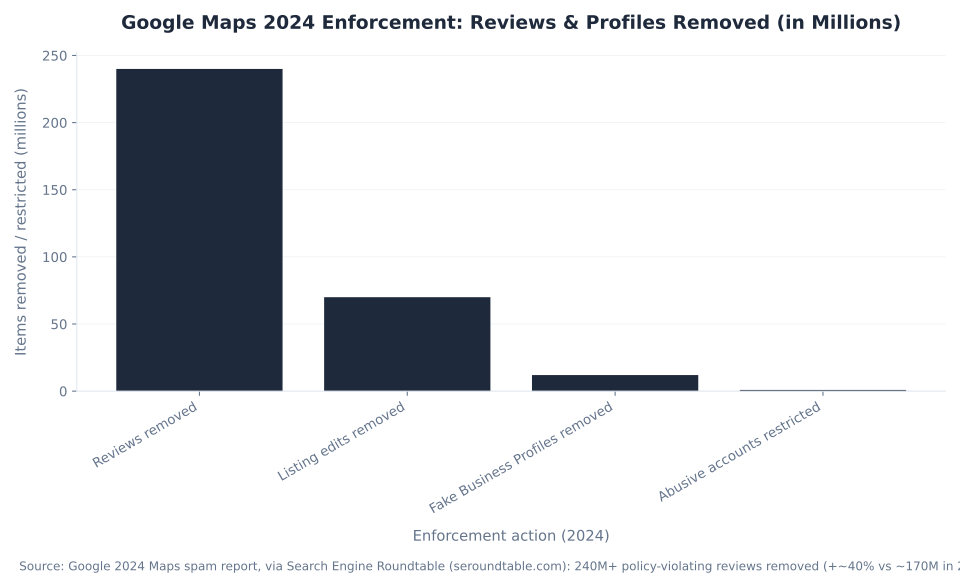
Owners staring at a fake one-star ask a fair question: is flagging worth the effort? The scale of Google’s 2024 Maps enforcement is the answer. Google blocked or removed 240M+ policy-violating reviews in 2024 — up about 40% versus roughly 170M in 2023 — alongside 70M listing edits, 12M fake Business Profiles, and 900K+ restricted accounts (Google 2024 Maps spam report, via Search Engine Roundtable). Regulators added teeth on top: the US FTC rule and the UK CMA/DMCCA both prohibit fake reviews and gating.
| Item | Figure / mechanic | Source |
|---|---|---|
| Policy-violating reviews removed (2024) | 240M+ blocked / removed — up ~40% vs ~170M in 2023 | Google 2024 Maps spam report |
| Fake Business Profiles removed (2024) | 12M fake profiles | Google 2024 Maps spam report |
| Other 2024 enforcement | 70M listing edits blocked / removed; 900K+ abusive accounts restricted | Google 2024 Maps spam report |
| US FTC final rule | Bans fake reviews AND review suppression / gating; penalties up to ~$51,744 per violation (announced Aug 14, 2024) | US FTC (via gtlaw.com / applausehq.com) |
| UK CMA / DMCCA | Fake-review prohibitions in force in 2025; enforcement sweeps mid-2025 | UK CMA (via icpen.org) |
| Report & appeal flow (to remove a review) | Flag → track in the Reviews Management Tool → if not removed, a one-time appeal (attach evidence within a 60-minute window) → Google replies by email in ~5 business days | Google (answer/4596773) |
Sources: Google 2024 Maps spam report (via Search Engine Roundtable) (240M+ reviews removed, +40% vs ~170M in 2023; 12M fake profiles; 70M listing edits; 900K+ accounts); US FTC final rule on fake & deceptive reviews (Aug 14, 2024; ~$51,744/violation — via gtlaw.com, applausehq.com); UK CMA / DMCCA (via icpen.org); Google, “Remove reviews from your Business Profile”. Not mbadv client data.
The scale matters because it changes the calculus on a fake review. When Google removes 240M+ policy-violating reviews in a single year — up about 40% year over year — a clearly fabricated or off-topic review has a real chance of coming down once you flag it and follow the appeal path. That is exactly why the correct response to a suspected-fake is to report it, not to argue with it in public where the next prospect watches you lose your composure. The report and appeal mechanics, including the 60-minute evidence window and the ~5-business-day reply, are detailed in the next section, and the broader policy backdrop that governs what counts as a violation is in the overview of GBP content guidelines.
How to Report and Remove a Fake Google Review
You cannot delete a review you dislike, and you should not try — but you can report a review that violates policy (fake, off-topic, defamatory, or a conflict of interest) and pursue removal through Google’s documented flow. The path has a specific, time-boxed step most owners miss: the one-time appeal accepts supporting evidence only within a 60-minute window once the form opens (support.google.com/business/answer/4596773).
| Step | What you do | Timing / note |
|---|---|---|
| 1. Flag the review | Report the policy-violating review as inappropriate from the profile on Search or Maps | Free; do this instead of arguing in public |
| 2. Track it | Follow the flagged review in the Reviews Management Tool | Shows the status of each report |
| 3. File the one-time appeal | If Google does not remove it, submit the one-time appeal and attach evidence | Evidence window: 60 minutes once the form opens |
| 4. Wait for the decision | Google reviews the appeal and replies by email | ~5 business days |
| 5. If it stays up | Keep a professional public reply on the record and report clear defamation through the appropriate legal channel | The public reply protects the next prospect |
Source: Google, “Remove reviews from your Business Profile” (Reviews Management Tool; one-time appeal; 60-minute evidence window; ~5-business-day email reply). Google removed 240M+ policy-violating reviews in 2024, so clear violations do get acted on. Not mbadv client data.
Two things decide whether a removal request succeeds. You cannot remove a review simply because it is unflattering — only reviews that violate policy (fake, off-topic, defamatory, or a conflict of interest) are eligible — and the 60-minute evidence window is the step most owners miss, so have the documentation ready before you open the appeal. Track every flagged review in the Reviews Management Tool so nothing falls through the cracks, and keep a calm, factual public reply on the record while the appeal is pending, because that reply is what the next prospect reads regardless of how Google rules. For the paid campaigns that keep the phone ringing while your review reputation compounds, talk to our team.

Turn Local Trust Into Booked Jobs
A strong review profile builds the organic trust signal — the paid side converts the demand it creates
GBP and its review tools are free. MB Adv Agency runs the Google Ads and Local Services Ads work that complements a well-reviewed free profile — talk to our team about turning local search demand into qualified calls and forms.
Talk to our team →AI and Review Replies: What Is Real in 2026
Two 2026 developments get conflated into a single overstatement — “Google now writes and posts your review replies automatically.” It does not. Correcting that is worth doing, because the honest position is also the accurate one: AI can draft; a human still reviews and submits.
The generally available AI feature inside Google Business Profile is “Suggest description,” the writer that drafts a business description you edit. AI-suggested review replies are a limited test, not a shipped global feature — running since about March 2026 in the US, Brazil, and India, inconsistently per account, with drafts that are editable and human-submitted. Separately, Google announced a rolling Gemini ↔ Business Profile integration (blog.google, June 10, 2026) that can draft review responses “in your brand voice” — also human-in-the-loop and framed as “coming weeks.” Neither is auto-posting.
The practical takeaway holds regardless of how these features roll out: use AI to reduce the blank-page cost of replying, keep a human in the loop to catch tone and facts, and never let a draft go out unread. The response framework above still governs — AI changes who writes the first draft, not what a good reply says. To see reviews and Google Posts as the two ongoing engagement signals on a profile, see what Google Posts are and how to use them effectively.
One more distinction is worth holding onto as these tools mature. “Suggest description” writes profile copy; the review-reply drafting is a separate capability at a separate stage of rollout, and neither one submits anything on its own. The safe operating rule for a local business is unchanged from the pre-AI playbook: earn genuine reviews from every customer, answer them like a human who was there, and keep a person’s eyes on every reply before it posts. AI lowers the cost of the first draft; it does not change what a trustworthy, on-brand response looks like.
Why Reviews Matter to Buyers, Not Just Rankings
Reviews are not a marginal SEO tweak — they are the storefront most buyers see first. BrightLocal’s Local Consumer Review Survey 2026 (1,002 US adults) documents how consumers actually use reviews. These are consumer-behavior figures, not ranking weights: 97% read reviews for local businesses and 92% care about star ratings, so a thin or unmanaged review profile loses buyers before ranking even matters. 89% expect business owners to respond — the data behind the responding section — and 68% will only use a business with 4+ stars, which is why gaming volume without earning genuine quality backfires (BrightLocal).
This is the business case that ties reviews back to revenue. Reviews drive the calls, direction requests, and website clicks you can track in Performance reports in GBP. For local-service categories where reputation and response speed decide the booking — dentists, auto shops, home services — the review profile and the local-pack position move together. See how the paid side complements a well-reviewed profile in our dental PPC and automotive PPC work, and for a city-level view of local visibility and paid search combined, see dental PPC in Austin, TX.
Google Reviews & Local SEO FAQ
Reviews Earn the Visibility
A lead-gen engine converts it into qualified calls and forms
Reviews are the free organic trust layer; if you want the paid layer that runs alongside it, MB Adv Agency builds and manages it. Start with lead-generation PPC, or see the full PPC services set. Review gating, incentivizing, and fake reviews all fall under Google’s content policies — see the overview of GBP content guidelines.
Lead-generation PPC →PPC services →Methodology & Sources
Every figure in this guide traces to a named source, with the ranking-weight and consumer-behavior sources kept strictly in their lanes. Ranking-weight percentages come from Whitespark’s 2026 Local Search Ranking Factors expert survey (about 47 local SEOs, published November 6, 2025) and are labeled an estimate, not Google’s algorithm. Consumer-behavior figures come from BrightLocal’s Local Consumer Review Survey 2026 (1,002 US adults) and are never presented as ranking weights. Product mechanics and enforcement statistics are Google’s own, and the regulatory items are the US FTC final rule and the UK CMA/DMCCA.
MB Adv Agency is a Google and PPC agency; it does not offer a GBP or local-SEO management service, so this guide carries no client-performance claims — the agency point of view is qualitative throughout, and the example reviews and replies are illustrative templates, never real client reviews. GBP and every review tool covered here are free; the only paid complement is Google Ads and Local Services Ads. The unverified third-party “292M reviews removed in 2025” figure is deliberately excluded — only Google’s own 2024 Maps spam report numbers are used. The FTC penalty ceiling is inflation-adjusted and dated to the Aug 14, 2024 announcement. Have a local presence to build on? Talk to our team. Last updated 2026-07-01.
Local SEO is a critical component of digital marketing strategies for businesses that target specific geographic areas. One of the most influential factors in boosting local search rankings is customer reviews. In this article, we will explore the importance of customer reviews for local SEO and how they can significantly impact your online visibility.
How reviews impact rankings
Customer reviews play a pivotal role in local search engine optimization. Search engines like Google use various ranking signals to determine the relevance and authority of a business in local search results. Customer reviews are one of the key elements considered in these algorithms.
The frequency, recency, and overall quality of reviews directly influence a business's ranking position. Generally, more positive reviews can lead to higher rankings. This is because search engines view customer feedback as a strong indicator of a business's reliability and quality. Businesses that consistently receive high ratings demonstrate they provide exceptional products or services, making them more appealing to potential customers.
Moreover, the diversity of platforms where reviews are posted can also affect rankings. Companies that garner reviews across multiple platforms such as Google My Business, Yelp, and Facebook create a broader online footprint. This variety signals to search engines that the business is trusted and well-regarded in its community, further enhancing its local SEO efforts. Additionally, businesses that engage with their reviewers—whether by thanking them for positive feedback or addressing concerns in negative reviews—can further solidify their reputation. This interaction not only showcases the business's commitment to customer service but also encourages more customers to leave their own reviews, creating a positive feedback loop.
Quality vs. Quantity of Reviews
While having numerous positive reviews can elevate rankings, the quality of those reviews is equally important. Genuine, thoughtful, and detailed feedback tends to carry more weight than a multitude of generic ratings. This is because search engines strive to serve users with valuable information. A well-written review that outlines specific experiences is considered more helpful than one that simply says, "It was good!"
High-quality reviews not only increase credibility in the eyes of search engines but also build trust among potential customers. When users read in-depth reviews, they are more likely to engage with a business, often resulting in higher conversion rates. Furthermore, reviews that highlight unique aspects of a business—such as exceptional customer service, unique product offerings, or a welcoming atmosphere—can set a business apart from its competitors. This differentiation is crucial in crowded markets where consumers have many options to choose from.
The Role of Star Ratings
Star ratings are one of the most visible indicators of a company's reputation. Appearing prominently in search engine results, they can immediately influence a potential customer's decision-making process. Higher star ratings can improve click-through rates, as users are naturally drawn to businesses with favorable reviews.
Additionally, businesses with higher ratings are often highlighted in Google’s “Local Pack,” where a selection of businesses appears prominently on search results. Being part of this exclusive listing can drive significant traffic and enhance visibility, making it essential for businesses to actively manage their online reputation. It's also worth noting that star ratings can influence not only the visibility of a business but also its perceived value. Consumers often associate higher ratings with higher quality, which can justify premium pricing. Therefore, businesses should prioritize not only gathering reviews but also ensuring that they maintain high standards to keep those ratings up. This ongoing effort can lead to a sustainable competitive advantage in the long run.
Benefits of positive customer feedback
The advantages of nurturing positive customer feedback extend beyond just local SEO benefits. Positive reviews can enhance brand reputation, increase customer loyalty, and drive additional conversions. Ultimately, a strong collection of positive reviews can transform a business into a local favorite.

Firstly, positive customer feedback fosters trust among potential customers. In an era of online shopping and digital transactions, consumers often rely on the experiences of others to make purchasing decisions. A consistent stream of positive reviews provides social proof that can assure potential buyers that they are making the right choice.
Moreover, positive reviews can significantly influence customer retention. When customers feel valued and recognized through positive interactions, they are more likely to return, thereby reducing churn rates. Businesses that acknowledge and encourage feedback create an environment of engagement, which fosters loyalty.
Affecting Customer Decisions
Research shows that a majority of consumers read online reviews before engaging with a business. An impressive percentage of these consumers disclose that reading positive reviews increases their likelihood of trying a business. Consequently, businesses that are proactive in obtaining positive customer feedback will have a better chance at attracting new customers.
A balanced and active approach to gathering reviews also demonstrates to potential clients that a company values transparency and customer satisfaction. This notion can be a deciding factor for customers who are choosing between several options. Furthermore, the impact of positive feedback can extend to word-of-mouth marketing, where satisfied customers share their experiences with friends and family, creating a ripple effect that can significantly broaden a business's reach.
Enhancing Brand Image
Promoting a positive image is critical in competitive markets. Positive reviews can enhance brand image and reposition businesses as leaders in their industry. Effective management of customer feedback allows businesses to cultivate a reputation for excellence, which can be leveraged in marketing strategies.
Companies can showcase customer testimonials on their websites and social media platforms, further amplifying positive sentiment. This proactive strategy not only reinforces trust among existing customers but also attracts new clientele who are influenced by testimonials. Additionally, businesses can utilize positive feedback in their advertising campaigns, highlighting real customer experiences to create relatable and compelling narratives that resonate with potential buyers. Such strategies not only enhance brand image but also create a community of advocates who are likely to promote the brand organically.
Examples of leveraging reviews
Businesses have various strategies to leverage customer reviews and enhance their local SEO efforts. Here are a few examples that can help maximize the impact of reviews on online visibility.

Using Reviews in Marketing Campaigns
Integrating reviews into marketing campaigns is a powerful way to leverage customer sentiment. Businesses can create promotional materials featuring positive customer testimonials, star ratings, and user-generated content. These endorsements can manifest in social media ads, email marketing, and even on websites.
Sharing success stories from satisfied customers and highlighting unique experiences can attract attention. Additionally, creating case studies from positive outcomes can display a business's potential value to prospective clients. For instance, a restaurant might showcase a customer's glowing review about a special dining experience, complete with mouth-watering photos of their dishes, enticing others to visit and try the same offerings. This not only builds credibility but also creates a narrative that potential customers can relate to and aspire to experience themselves.
Responding to Customer Feedback
Engaging with customers by responding to their reviews—both positive and negative—demonstrates that a business values customer opinions. Acknowledging positive feedback encourages ongoing engagement and further strengthens customer relationships.
In contrast, responding to negative reviews thoughtfully can showcase a business's commitment to customer service. By addressing complaints and attempting to resolve issues, businesses can often turn a negative experience into a positive one, impressing potential customers browsing the reviews. For example, a hotel might respond to a negative review about cleanliness by explaining the steps they have taken to address the issue, such as increased staff training or enhanced cleaning protocols. This transparency not only reassures the reviewer but also builds trust with future guests who are reading through the reviews.
Encouraging New Reviews
To continually enhance local SEO efforts, businesses should actively encourage customers to leave reviews. This can be achieved through follow-up emails, incentives, or reminders at the point of sale. Simplifying the review process by providing direct links or clear instructions can also reduce barriers for customers wishing to share their experience.
In time, a consistent stream of positive reviews will compound and pay off, further strengthening the business’s local SEO and online reputation. Additionally, businesses can leverage platforms like Google My Business to prompt satisfied customers to leave reviews right after their purchase or service experience, capitalizing on their immediate satisfaction. Offering small incentives, such as discounts on future purchases or entry into a giveaway, can also motivate customers to share their positive experiences, creating a win-win situation for both the business and its clientele.
Customer reviews are not just feedback; they are a vital aspect of local SEO strategies. By understanding how reviews impact rankings, recognizing the benefits of positive feedback, and actively leveraging reviews, businesses can significantly enhance their local visibility and trustworthiness.

As a Google Ads expert, I bring proven expertise in optimizing advertising campaigns to maximize ROI.
I specialize in sharing advanced strategies and targeted tips to refine Google Ads campaign management.
Committed to staying ahead of the latest trends and algorithms, I ensure that my clients receive cutting-edge solutions.
My passion for digital marketing and my ability to interpret data for strategic insights enable me to offer high-level consulting that aims to exceed expectations.
Google Partner Agency
We're a certified Google Partner Agency, which means we don’t guess — we optimize withGoogle’s full toolkit and insider support.
Your campaigns get pro-level execution, backed by real expertise (not theory).

4.9 out of 5 from 670+ reviews on Fiverr.
That’s not luck, that’s performance.
Highly recommend Matteo to set up your server side tracking. He has a deep understanding of e-commerce tracking and will go above and beyond to make sure everything is set up correctly and working 100%. If you are scaling your store this set up is non-negotiable in my opinion and there isn't many people who have this much knowledge or put the effort in to get it right. Thanks again!
avorodesign.com
I can only recommend Matteo! He was very patient, professional and very knowledgeable about GA4, Consent Mode v2, and GDPR compliance. Communication was clear, and the setup was done professionally and efficiently. Highly recommend him for anyone needing reliable tracking implementation.

www.natureiki.life
Matteo shines in the realm of online professionals. His work is not only deep in data but also complemented by his proactive communication and cooperation, setting a new standard for freelancers. If you want someone who truly exceeds expectations, look no further. Highly recommended!

www.omanbeverlysmyth.com
Exceptional Service Beyond Expectations - Outstanding Service Impeccable depth, flawless delivery, and exceptional language fluency—this service exceeded all expectations. Highly recommended. Matteo truly ROCKS!!!

ium-paris.com
Top-notch, always highly value working with Matteo. An absolute Google Ads Genius. This is approximately the 8th time I have hired him and he's helped us get 6-7 ROAS. We are excited in continuing to improve our lead flow. Hire this guy if you need Google Ads help. Thanks Matteo!

www.dleeventgroup.com
I finally found the guy who can setup server side tracking and all the ecosystem properly. I definitely recommend Matteo. He is very responsive, kind and wants to dig into things. He configured GA4, Meta, Google Ads, Outbrain and google consent v2 with Cookiebot. Thanks Matteo.

inomega.fr
MB Adv delivered exceptional work with outstanding professionalism and lots of patience, taking time to see effects of changes made and not just do the work and submit it. The proactive communication and video summaries of the work completed made working with Matteo a pleasure, as he consistently went above and beyond. Highly recommended for web analytics projects! We are already working on another project.

www.withnellsensors.co.uk
Working with Matteo on my Google Ads was a game-changer. He's not just a strategist, he's a true partner. He understood my goals and tailored a campaign that perfectly reached my target audience. I'm grateful for his expertise and dedication.
dccargo.com
Click-driven mind
with plastic-brick obsession.
We build Google Ads campaigns with the same mindset we use to build tiny brick worlds: strategy, patience, and zero tolerance for wasted pieces.
Data is our blueprint. Growth is the only acceptable outcome.