How to use Pmax age and gender exclusions to cut wasted spend and boost google ads performance
Performance Max has always had a strange tension at its core: a campaign type that promises full-funnel reach and cross-network coverage, but gives you almost no control over *who* you’re actually paying to reach.
The recent rollout of age and gender exclusions at the campaign level is the first meaningful crack in that wall. On paper, it’s a small change. In practice, it nudges PMax a little closer to how performance marketers actually think about media buying: not just “more conversions”, but “more of the *right* conversions, from the *right* people, at a sustainable cost”.
This isn’t a revolution, but it is a lever worth understanding before you start pulling it.
PMax’s “conversion at all costs” bias
Anyone who has run PMax at scale knows the pattern: once the model finds a cheap pocket of conversions, it will happily sit there, even if those conversions are strategically useless.
Lead gen accounts see this as a flood of student emails, job seekers, or tire-kickers from demographics that historically never close. Ecommerce sees it as low-value baskets, discount hunters, or age groups that are overrepresented in traffic and underrepresented in revenue.
The system is doing what it’s told: maximize conversions or conversion value within your bid strategy and budget. It is *not* optimizing for “future LTV”, “sales-qualified rate”, or “strategic fit” unless those things are tightly reflected in your conversion setup and value rules – which, in most accounts, they aren’t.
So PMax explores. And it explores where inventory is cheap and plentiful, which often means:
- Younger users with time but not money
- Older users with curiosity but low purchase intent
- Gender segments that don’t match the product’s actual buyer profile
Until now, if you wanted to stop paying for those explorations, your options were indirect: conversion value rules, negative keywords (where available), audience signals, and structural tricks. Age and gender were visible in reporting, but not enforceable.
Now they are.
What age and gender exclusions *actually* change
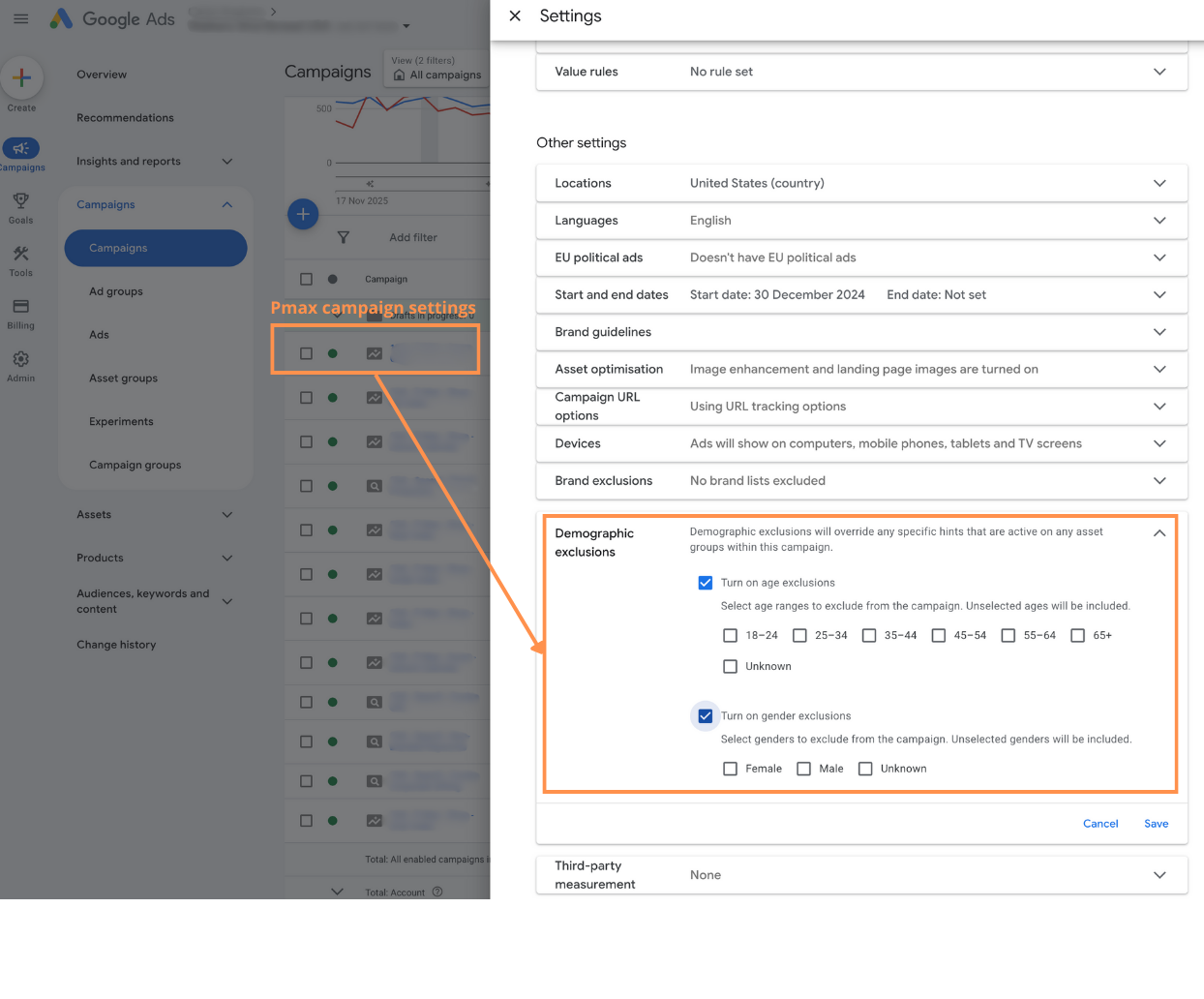
The new controls are simple: at the campaign level, you can block specific age brackets and gender segments from being targeted by a PMax campaign.
That doesn’t turn PMax into a precision targeting machine. It just defines harder boundaries around where the algorithm is allowed to hunt for “cheap” conversions.
Practically, this unlocks a few things:
You can cut structurally low-intent brackets
If your analytics and CRM data tell you that 18–24-year-olds almost never purchase, or that 65+ clicks rarely turn into closed deals, you can now stop paying for that learning loop. Instead of hoping the algorithm “figures it out”, you can enforce it.
You can remove obviously mismatched gender segments
Many brands still have a clear primary buyer. If you’re selling men’s grooming subscriptions and your gender report shows 40% of spend going to female users with weak conversion rates, you don’t need to wait for the model to slowly de-prioritize them. You can just opt out.
You reduce wasted impressions and force better exploration
PMax will still explore, but within a smaller sandbox. If you remove non-buying segments, exploration shifts toward combinations of audiences, placements, and creatives that are more likely to produce meaningful conversions. You’re not making the algorithm smarter; you’re making its mistakes cheaper.
You can improve efficiency without touching assets or bids
This is a structural lever, not a creative or bidding lever. Instead of lowering tROAS, tightening budgets, or endlessly iterating asset groups, you can change *who* is even eligible to see your ads. That often has a cleaner, more predictable impact on CPA/ROAS than yet another headline test.
Where this fits in your broader PMax strategy
The temptation will be to treat these new exclusions as a quick fix: “18–24 looks weak, let’s kill it.” That’s sometimes right, but often too blunt.
In the broader Google Ads ecosystem, PMax is already constrained compared to Search or YouTube. Every exclusion you add narrows the model’s playground. If you go too far, you end up back in a quasi-manual world, but without the transparency and control that classic campaigns give you.
A more considered approach is to treat age and gender exclusions as:
A refinement layer, not a targeting strategy
Your real levers are still conversion setup, value mapping, and campaign structure. Age and gender should follow from that logic, not replace it. If your conversion data is noisy or misaligned, demographic exclusions will just hide symptoms, not fix the disease.
A way to align with downstream business metrics
Most PMax optimization stops at the Google Ads interface. But the real pain often shows up in CRM: cheap leads from demographics that never close, or low-LTV buyers who eat up support resources. If you have that visibility, age and gender exclusions become a way to encode what your sales or retention data already knows.
A tool for segment-specific PMax strategies
In some cases, you don’t want to exclude; you want to separate. For example, you might run one PMax campaign focused on your core demographic and another designed to test an emerging segment, each with different assets, messaging, and ROAS targets. Exclusions then act as guardrails to keep those campaigns from cannibalizing each other’s audiences.
The trade-offs: control versus discovery
The main philosophical trade-off is simple: every time you tell PMax “don’t go there”, you’re accepting that there may be incremental, unexpected value you’ll never see.
Sometimes that’s a good trade. If your budget is tight and your buyer persona is well understood, constraining exploration is rational. But in categories where buyers are more fluid – gifts, multi-user products, shared households – the “wrong” demographic on paper can still be part of the buying journey.
There’s also the question of time horizon. Early in a campaign’s life, you might tolerate broader demographics to let the system learn and to surface non-obvious converters. As the campaign matures and you have clearer data on who actually buys, you can progressively tighten exclusions to improve efficiency.
The key is to treat age and gender not as “optimizations” but as *strategic decisions* about where your business is willing to spend money to learn.
A small update that nudges PMax in the right direction
Demographic exclusions in Performance Max don’t solve the opacity problem. They don’t replace proper conversion tracking, value rules, or the need to reconcile Google’s numbers with your own revenue data.
But they do give performance marketers one more lever to align an aggressively conversion-hunting system with the realities of who actually buys, who actually renews, and who actually matters to the business.
Used thoughtfully, they’re less about cutting waste and more about shaping where the algorithm is allowed to be wrong – and that’s often the difference between “PMax works, but feels messy” and “PMax is a disciplined part of our media mix.”

As a Google Ads expert, I bring proven expertise in optimizing advertising campaigns to maximize ROI.
I specialize in sharing advanced strategies and targeted tips to refine Google Ads campaign management.
Committed to staying ahead of the latest trends and algorithms, I ensure that my clients receive cutting-edge solutions.
My passion for digital marketing and my ability to interpret data for strategic insights enable me to offer high-level consulting that aims to exceed expectations.
Google Partner Agency
We're a certified Google Partner Agency, which means we don’t guess — we optimize withGoogle’s full toolkit and insider support.
Your campaigns get pro-level execution, backed by real expertise (not theory).

4.9 out of 5 from 670+ reviews on Fiverr.
That’s not luck, that’s performance.
Highly recommend Matteo to set up your server side tracking. He has a deep understanding of e-commerce tracking and will go above and beyond to make sure everything is set up correctly and working 100%. If you are scaling your store this set up is non-negotiable in my opinion and there isn't many people who have this much knowledge or put the effort in to get it right. Thanks again!

avorodesign.com
I can only recommend Matteo! He was very patient, professional and very knowledgeable about GA4, Consent Mode v2, and GDPR compliance. Communication was clear, and the setup was done professionally and efficiently. Highly recommend him for anyone needing reliable tracking implementation.

www.natureiki.life
Matteo shines in the realm of online professionals. His work is not only deep in data but also complemented by his proactive communication and cooperation, setting a new standard for freelancers. If you want someone who truly exceeds expectations, look no further. Highly recommended!

www.omanbeverlysmyth.com
Exceptional Service Beyond Expectations - Outstanding Service Impeccable depth, flawless delivery, and exceptional language fluency—this service exceeded all expectations. Highly recommended. Matteo truly ROCKS!!!

ium-paris.com
Top-notch, always highly value working with Matteo. An absolute Google Ads Genius. This is approximately the 8th time I have hired him and he's helped us get 6-7 ROAS. We are excited in continuing to improve our lead flow. Hire this guy if you need Google Ads help. Thanks Matteo!

www.dleeventgroup.com
I finally found the guy who can setup server side tracking and all the ecosystem properly. I definitely recommend Matteo. He is very responsive, kind and wants to dig into things. He configured GA4, Meta, Google Ads, Outbrain and google consent v2 with Cookiebot. Thanks Matteo.

inomega.fr
MB Adv delivered exceptional work with outstanding professionalism and lots of patience, taking time to see effects of changes made and not just do the work and submit it. The proactive communication and video summaries of the work completed made working with Matteo a pleasure, as he consistently went above and beyond. Highly recommended for web analytics projects! We are already working on another project.

www.withnellsensors.co.uk
Working with Matteo on my Google Ads was a game-changer. He's not just a strategist, he's a true partner. He understood my goals and tailored a campaign that perfectly reached my target audience. I'm grateful for his expertise and dedication.

dccargo.com
Click-driven mind
with plastic-brick obsession.
We build Google Ads campaigns with the same mindset we use to build tiny brick worlds: strategy, patience, and zero tolerance for wasted pieces.
Data is our blueprint. Growth is the only acceptable outcome.