Start
$590$990/month
1 platform · Google or MetaGoogle + Meta- Ad spend
- up to $3,000
- New creativesmade by us
- Google + Meta only4 a month
 By Matteo Braghetta, Founder · Google Ads
Fayetteville runs on cars — two per household on average, driven by a young military population that owns vehicles at high rates, maintains them inconsistently through deployment cycles, and returns from overseas needing immediate service. With 72–80% of "mechanic near me" searches coming from mobile devices and national chains from Jiffy Lube to Firestone competing on every general keyword, independent auto repair shops that win Google Ads in this market do so through specificity, not spend.
See how this city's Automotive PPC costs compare nationally in our Automotive PPC Statistics report, featuring data from 40+ US cities.
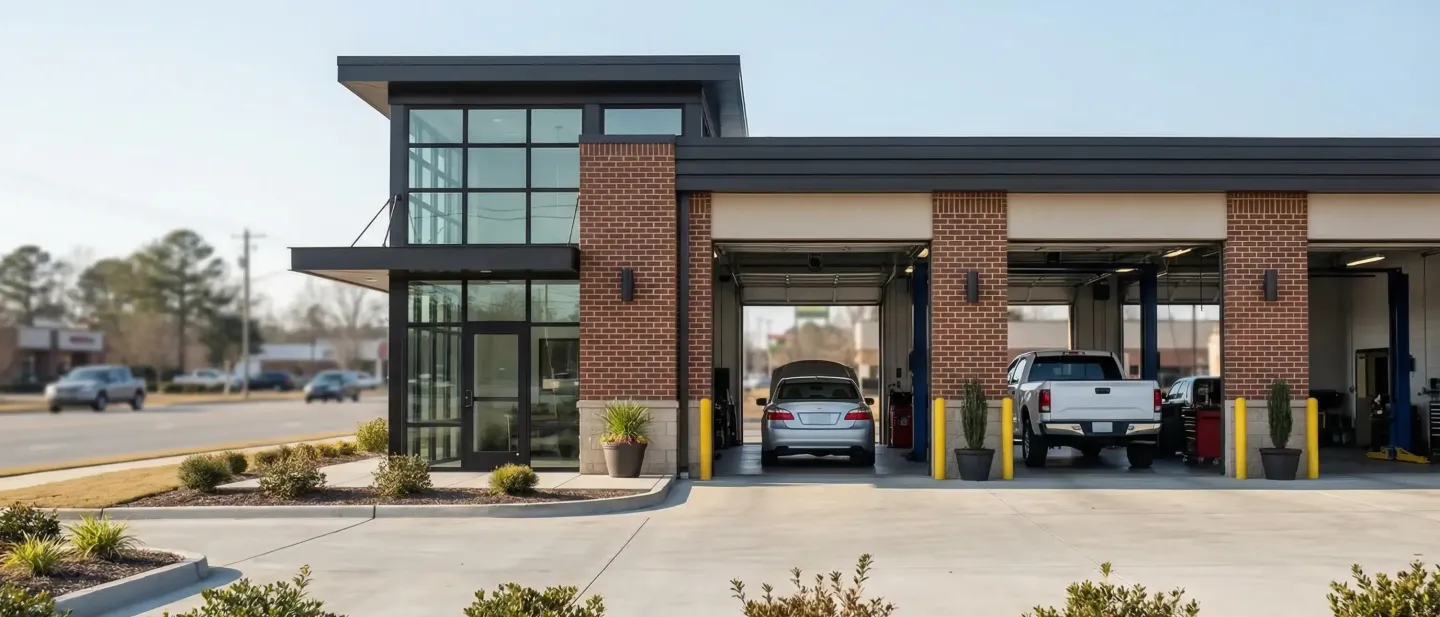
In Fayetteville, NC, people search for automotive services about 4,460 times a month on Google; a top-of-page click costs $1.81–$6.36, and demand peaks in October.
Google Keyword Planner · Oct 2025 – Sep 2026
| Search | Monthly searches | Top-of-page CPC |
|---|---|---|
| mechanic near me | 880 | $1.93–$6.60 |
| tire shop | 590 | $1.62–$3.99 |
| auto repair near me | 480 | $2.03–$6.96 |
| oil change | 390 | $1.97–$5.30 |
| mechanic | 320 | $2.08–$7.03 |
| auto repair | 260 | $2.28–$7.09 |
| car ac repair | 210 | $2.24–$4.44 |
| car repair | 170 | $2–$15 |
| transmission repair | 170 | — |
| wheel alignment | 140 | $1.86–$5.30 |
Source: Google Keyword Planner (Google Ads), Google Search, English, Fayetteville, NC, Oct 2025 – Sep 2026. Volumes are Google's monthly averages; CPC is the top-of-page bid range, weighted by search volume. How we collect these figures.
Auto repair is one of the most competitive Google Ads categories in any market. National chains — Jiffy Lube, Midas, Firestone, Pep Boys, and Goodyear — all operate in Fayetteville with national ad budgets, strong brand recognition, and well-optimized location-specific landing pages. Dealership service departments add another competitive layer on brand-specific repair keywords. Independent shops that compete head-on against national chain advertising on the same broad keywords at the same bids don't win — they bleed budget. The path to competitive automotive PPC in Fayetteville is differentiation, not escalation.
When a Fayetteville driver searches "oil change fayetteville nc" or "auto repair near me," the top paid results belong to national chains. These campaigns run on institutional Quality Scores built across thousands of locations, with historical CTR data that drives Google's Quality Score calculation above what any new independent campaign can match immediately. Independent shops that launch with broad oil change and general repair keywords face CPCs that reflect chain-level competition while producing conversion rates below their actual close ability — because the traffic reaching an independent shop's generic landing page arrived through a keyword category where the national brand already established preference.
The counter-strategy is to own the keyword categories that national chains can't claim authentically. "Post-deployment car inspection Fayetteville" — a category with near-zero competitor bidding — speaks directly to the Fort Liberty soldier returning from an 8-month deployment whose vehicle sat in storage and needs comprehensive assessment before driving. No Jiffy Lube ad says this. No Midas location page addresses this. An independent shop that builds a landing page around post-deployment vehicle inspection, referencing the specific failure modes of vehicles stored during deployment (battery, tire pressure, brake corrosion, fluid degradation), captures a high-intent audience that national brands don't compete for at any price.
Automotive repair generates the highest mobile search share of any service category in Fayetteville. A driver stranded with a dead battery, a tire blowout, or a warning light that just illuminated is searching from their phone, not their laptop. 72–80% of "mechanic near me" and "auto repair near me" searches in Fayetteville come from mobile devices, and the conversion behavior is different from desktop: mobile auto repair searchers convert via phone call, not form fill. They want to speak to a human within 60 seconds of the search. An ad that doesn't have a prominent click-to-call extension active 24/7 loses this conversion opportunity to the competitor whose extension is present and whose phone is answered.
Most independent auto repair shops in Fayetteville run ads without optimized call extensions or after-hours call routing. A shop that installs 24-hour call tracking with an after-hours message and morning callback captures breakdown calls that happen at 7pm, 8pm, or on Sunday — times when national chains with booking systems handle volume but independent shops typically go dark. In a market where active-duty soldiers operate on non-standard schedules (early morning PT, late evening training, weekend operations), the shop reachable outside 9–5 weekday hours wins a disproportionate share of emergency repair calls.
Fort Liberty deployments follow a predictable pattern: large unit rotations that send 500–5,000 soldiers overseas for 6–12 months, then return them to Fayetteville in waves. Vehicles stored during deployment develop specific and predictable problems: battery drain, tire flat-spotting, brake rotor corrosion, fuel degradation, and belt and hose deterioration. A soldier returning from a 9-month deployment knows their car needs work — they just don't always know what specifically. "Post-deployment car inspection Fayetteville" and "vehicle inspection Fort Liberty return" are keyword categories with essentially zero advertiser competition. The search volume is modest but highly targeted, and the conversion rate for a searcher using this exact language is above 15% because the copy-to-intent match is nearly perfect. A $300–$500/month micro-budget dedicated to this keyword group acquires a customer who typically needs $400–$1,200 in deferred maintenance work on the initial visit and returns for ongoing service.
Effective automotive PPC in Fayetteville separates four demand categories into distinct campaign tracks: emergency and mobile repair, high-value repair services, maintenance and customer acquisition, and military-specific market angles. A single consolidated "auto repair" campaign produces the diluted ad relevance and landing page mismatches that cause most independent shops to abandon Google Ads as "too expensive" before they discover that the expense is a targeting problem, not a market problem.
The economic case for automotive PPC in Fayetteville rests on customer lifetime value. An average Fayetteville auto repair customer visits 2.4 times per year at an average order of $350–$600 per visit, generating $840–$1,440/year in direct revenue. At a 3-year retention rate, lifetime customer value reaches $2,520–$4,320. Against a CPL of $25–$55 on a $1,200–$2,000/month campaign, acquiring even 10–15 new customers/month builds a recurring revenue base that compounds. The math most shop owners don't calculate: a single month of PPC that acquires 12 new customers generates $30,240–$51,840 in 3-year LTV. A $1,500/month campaign that produces this outcome costs $18,000/year against $363,000–$622,000 in LTV — a 20–35x return over the customer lifetime. The per-click cost is not the metric that matters. The retained customer value is.
Fayetteville's automotive market has three dynamics that create persistent, predictable demand streams that don't exist in comparable secondary cities: the deployment cycle maintenance wave, the young driver accident and repair rate, and the high vehicle density of a military population that buys cars aggressively on BAH income but services them inconsistently during high-tempo training periods.
Fort Liberty's large unit rotations create visible, predictable waves of deferred vehicle maintenance. When a 3,000-soldier unit returns from a 9-month Afghanistan or Europe deployment, a meaningful percentage of those soldiers need immediate auto service. Vehicles stored in Fort Liberty's government parking lots or at storage facilities develop systematic problems: batteries drain, tire pressure drops, brake rotors surface-corrode, and rubber components degrade. The 2–4 weeks following a large unit's return are peak demand for "quick, comprehensive, trustworthy" auto service in Fayetteville — and most shops service this wave through walk-in traffic rather than capturing it through Google Ads before the customer has already committed to a competitor.
The tactical opportunity is a campaign that activates proactively around deployment return timing. Fort Liberty's large unit deployments are semi-public information — unit redeployment events are covered in local media. A shop that increases its "post-deployment inspection" campaign budget in the 2 weeks surrounding a widely-covered unit return captures the search spike before competitors even notice it. The post-deployment inspection customer is also a trust-building opportunity: the soldier who receives an honest "here's what your car needs, here's what can wait" assessment from a Fayetteville shop is the customer who calls that same shop for every repair for the next 3 years.
Fort Liberty's junior enlisted population — soldiers aged 18–24 — has measurably higher vehicle repair incidence than the general population. Contributing factors include high rates of used-car purchases (budget constraints, impulsive buying, limited mechanical knowledge), irregular maintenance practices during demanding training cycles, accident rates that exceed the civilian 18–24 demographic, and vehicles modified or pushed hard during the high-energy culture of young enlisted service. The average repair order from a junior enlisted customer in Fayetteville runs 15–20% above the civilian average for the same age group, because deferred maintenance compounds — a brake pad replacement that gets ignored for 3 months becomes a rotor replacement.
This demographic responds to transparency and education in automotive advertising more than any other segment. Copy that says "We'll show you exactly what's wrong and exactly what it costs before we touch anything" — and landing pages with transparent pricing tools, "how to read your diagnostic report" guides, and no-pressure estimate CTAs — convert this demographic at above-average rates because it addresses their primary anxiety: being sold unnecessary repairs by an unfamiliar shop in an unfamiliar city. Shops that earn this trust through the first interaction become the default service provider for the soldier's entire Fayetteville posting.
Fayetteville's 2.0 vehicles per household — above the national 1.8 average — reflects the car-centric culture of a military city with limited public transit and a population that commutes to a geographically sprawling base. This vehicle density, combined with a median household income of $58,407 (below the NC average), creates a market that leans toward independent repair shops over dealerships and toward repair over replacement. Independent shops that position on trust, transparency, and value — not just price — capture the segment that drives the most visits per year. The Fayetteville driver who finds a trustworthy independent shop stays for life, because switching costs are high in an unfamiliar city and the base community shares service recommendations through social networks that amplify positive experiences faster than any advertising campaign.
Auto repair PPC in Fayetteville isn't about outspending Jiffy Lube. It's about owning the keyword categories that national chains can't claim: post-deployment inspections, Fort Liberty mechanic searches, and the trust-seeking young soldier looking for the honest shop that won't take advantage of him. None of these categories require large budgets. They require specific copy, dedicated landing pages, and a campaign structure that separates high-urgency mobile searchers from planned maintenance customers from military-specific audiences.
At MB Adv Agency, we build automotive campaigns in four tracks: emergency and mobile, high-value repair, maintenance and acquisition, and military-specific. We write post-deployment inspection copy that no national chain runs. We set up click-to-call extensions optimized for evening and weekend calls. And we use the military-specific trust signals — ASE certification, military discount, deployment experience — that turn a first-visit customer into a 3-year retained revenue relationship.
A $1,200–$2,000/month campaign generates 25–40 repair leads/month in Fayetteville at CPLs of $25–$55 — below the national consumer services average. See our automotive PPC pricing and lead generation approach to understand what a four-track campaign delivers in a military market versus a generic auto repair campaign in the same zip code.
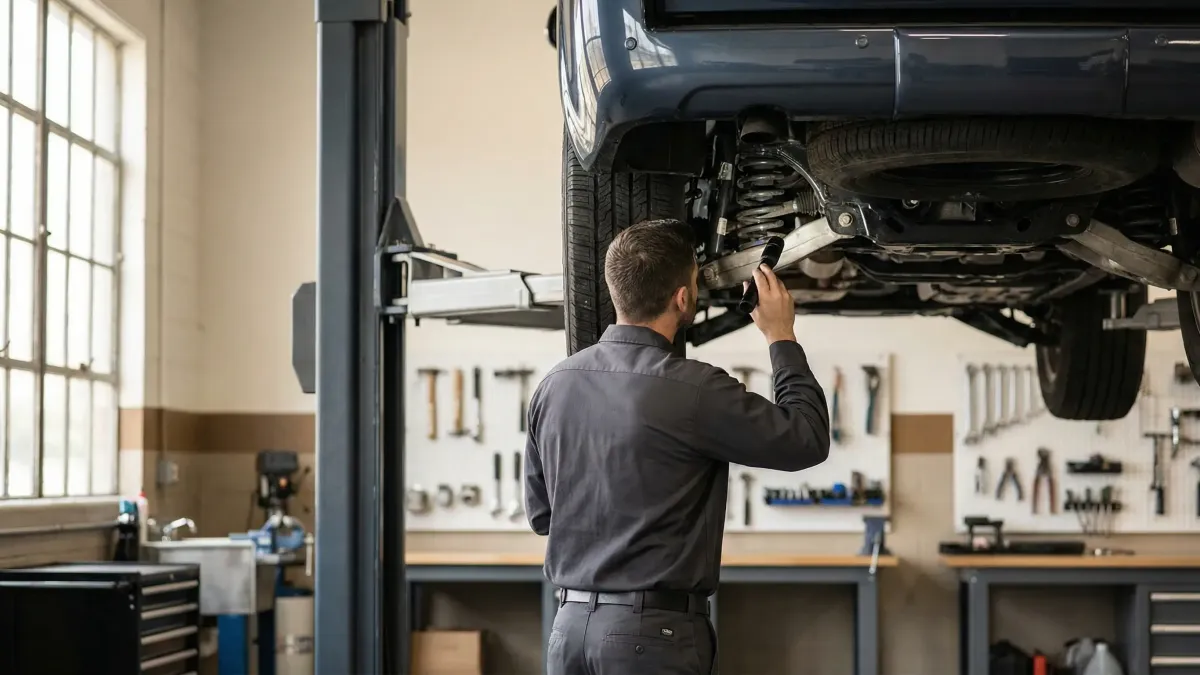
Auto repair Google Ads in Fayetteville, NC runs at a blended CPC of $1.81–$6.36 depending on service type — making it one of the more accessible PPC categories for independent shops. Maintenance keywords ("oil change fayetteville NC," "car inspection fayetteville") run $1.69–$8.66 per click, functioning as customer acquisition keywords rather than high-margin direct revenue generators. High-value repair keywords — "transmission repair fayetteville NC," "brake repair fayetteville" — carry higher order values ($350–$1,500 per job), making the CPL economics compelling. A viable starter budget is $1,200–$2,000/month, generating 25–40 leads at CPLs of $25–$55. The military-specific track — post-deployment inspection, Fort Liberty mechanic keywords — offers near-zero competitive pressure and above-average conversion rates, making it the most efficient new customer acquisition category in this market. Customer lifetime value is the economic anchor: a Fayetteville auto repair customer who visits 2.4 times/year at $350–$600 per visit generates $840–$1,440/year in revenue and $2,520–$4,320 over a 3-year retention period — a 46–78x return on the $55 CPL of acquiring them.
National chain competition is the primary challenge on generic keywords. Jiffy Lube, Midas, and Firestone compete aggressively on oil change and general maintenance terms at Fayetteville CPCs of $1.97–$5.30 for oil changes. Independent shops that compete on these terms with generic copy face a Quality Score disadvantage that manifests as higher effective CPCs for the same ad position. The solution: dominate the categories chains can't claim authentically. Post-deployment inspection, ASE-certified mechanic, military discount shop, Fort Liberty-area mechanic — these keyword categories attract the same motivated customer, with conversion rates that are materially higher because the copy-to-searcher intent match is precise.
The highest-converting automotive keywords for independent shops in Fayetteville, NC cluster around two themes: service-specific repair intent and military-market specificity. High-value repair keywords — "transmission repair fayetteville nc," "brake repair fayetteville nc," "check engine light fayetteville nc" ($0.02–$6.22) — convert at 6–10% with transparency-focused copy. The searcher using these terms has a specific, identified problem and needs confirmation that the shop is trustworthy and capable before calling. Copy and landing pages that lead with ASE certification, warranty terms, and honest estimate language convert this audience at significantly higher rates than generic "best mechanic" positioning. Emergency and mobile keywords — "mechanic near me fayetteville" ($1.93–$6.60), "car won't start fayetteville" — require click-to-call optimization and convert at 8–14% when the call extension is active and the phone is answered; this is the highest-urgency category and converts almost exclusively via phone call rather than form submission.
The most underleveraged conversion category for independent shops in Fayetteville is military-specific targeting. "Post-deployment car inspection Fayetteville" and "auto repair Fort Liberty" have near-zero advertiser competition and above-average conversion rates (10–16%) because the copy-to-intent match is exact — the searcher is a soldier who knows their car needs inspection and is actively looking for a trusted local shop. Three tactical enhancements: add a military discount offer ($10–$20 off labor) in ad extensions — it costs almost nothing per customer but dramatically improves CTR from military searchers; use ad scheduling to cover 6am–9pm rather than standard business hours, since active-duty schedules create auto searches at non-standard times; and add Fayetteville-specific neighborhood references in ad copy (Bragg Boulevard, Raeford Road, All-American Freeway area) to differentiate from chain competitors using generic location targeting.
How to read this Cost per click and monthly searches are measured with Google Keyword Planner (see above). Cost per lead, conversion rate, budget and leads are estimates compiled from public benchmarks such as WordStream, not measurements.
Sources perfoads.com 2026, auto industry CPL consensus — Fayetteville Tier 3 adjusted; high chain competition on maintenance keywords
$590$990/month
1 platform · Google or MetaGoogle + Meta$790$1,290/month
1 platform · Google or MetaGoogle + Meta$1,140$1,940/month
1 platform · Google or MetaGoogle + MetaChatGPT Ads: a separate pilot, $250/month, added to a plan. See the pilot →

Matteo Braghetta founded MB Adv and runs its Google Ads accounts. He takes the first call with every new client, reads the accounts every week and writes the agency’s guides.
The other half of his job is measurement: GA4, Consent Mode and server-side tracking, so the platforms learn from real sales.
MB Adv is a Google Partner agency managing about $4.4M a year in ad spend for clients in the US, the UK and Europe.
Managed on numbers you can check.
Plans for the US