Start
$590$990/month
1 platform · Google or MetaGoogle + Meta- Ad spend
- up to $3,000
- New creativesmade by us
- Google + Meta only4 a month
 By Matteo Braghetta, Founder · Google Ads
Palm Beach County issued 47,000+ building permits in 2023, making West Palm Beach one of Florida's most active construction markets — and one of the most competitive for contractors running Google Ads. The same post-hurricane boom that drives demand also fills search results with aggressive bidders, meaning under-built campaigns bleed budget without producing the high-ticket remodel and impact window jobs your crews can close.
See how this city's Construction PPC costs compare nationally in our Construction PPC Statistics report, featuring data from 40+ US cities.
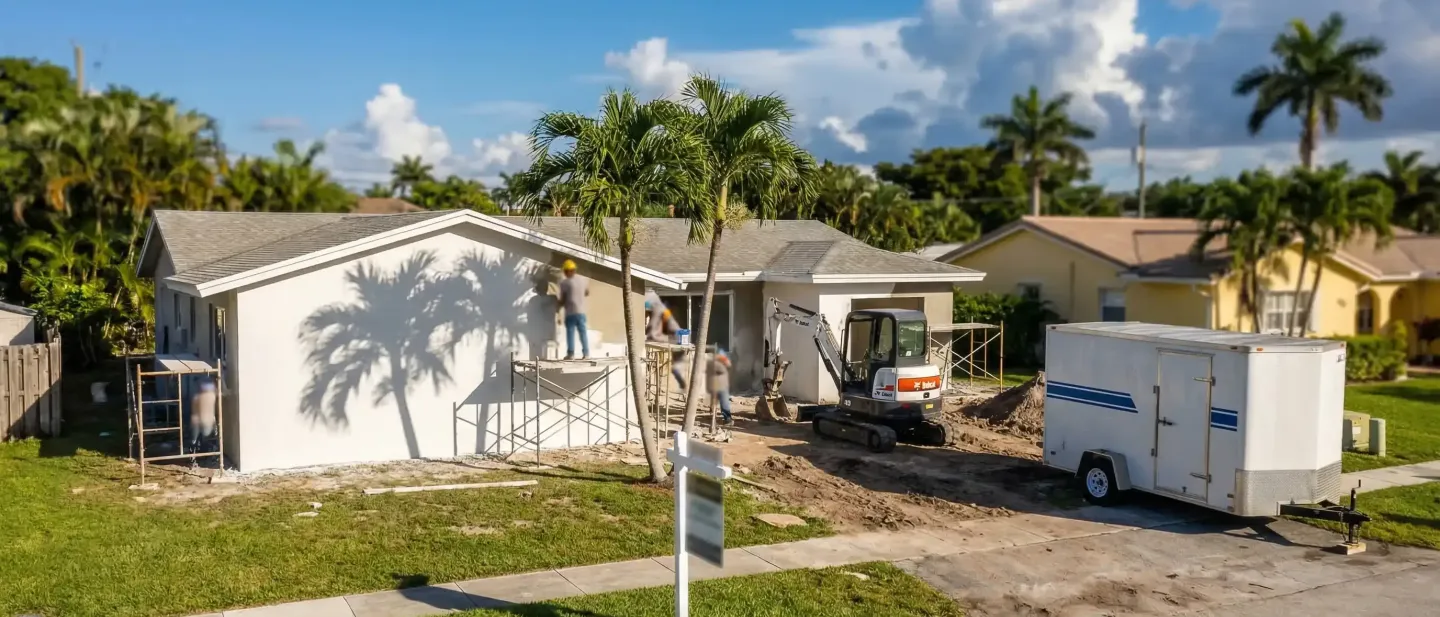
In West Palm Beach, FL, people search for construction services about 1,210 times a month on Google; a top-of-page click costs $8–$39, and demand peaks in October.
Google Keyword Planner · Oct 2025 – Sep 2026
| Search | Monthly searches | Top-of-page CPC |
|---|---|---|
| general contractor | 210 | $6–$47 |
| bathroom remodel | 140 | $14–$46 |
| contractor near me | 140 | $8–$27 |
| bathroom remodeling contractor | 110 | — |
| construction company | 90 | $2–$36 |
| concrete contractor | 90 | — |
| kitchen remodel | 70 | $13–$46 |
| home builder | 50 | $2–$10 |
| construction companies near me | 50 | $10–$57 |
| kitchen remodeling contractor | 50 | — |
US: $32
Google Keyword Planner · Oct 2025 – Sep 2026
Source: Google Keyword Planner (Google Ads), Google Search, English, West Palm Beach, FL, Oct 2025 – Sep 2026. Volumes are Google's monthly averages; CPC is the top-of-page bid range, weighted by search volume. How we collect these figures.
West Palm Beach construction PPC fails for one structural reason most contractors never diagnose: keyword breadth without intent filtering. "Construction company west palm beach" attracts homeowners researching pool permits, commercial developers comparing GC bids, and DIYers pricing materials — all clicking ads meant for a homeowner who needs a $40,000 kitchen remodel. Without tight negative keyword architecture and intent-specific ad groups, a contractor's $3,000/month Google Ads budget delivers clicks from all four of these audiences and converts leads from almost none of them.
The WPB construction PPC market is defined by two distinct competitive tiers. At the top, franchise-backed home improvement brands (HomeAdvisor, Angi, Thumbtack) absorb broad match traffic with massive budgets, bidding on every permutation of "contractor near me" and selling your prospects as leads to your competitors. Below them, local contractors compete on specific service terms — "impact windows west palm beach," "kitchen remodel palm beach county," "outdoor kitchen contractor WPB" — where ad quality and landing page alignment determine who wins the click. Most small WPB contractors try to compete with the aggregators on broad terms and lose. The correct move is to abandon the broad battle and dominate the service-specific tier where job value justifies the CPC and your conversion rate actually reflects purchase intent.
The post-hurricane demand cycle creates a specific PPC hazard: urgency-driven searchers with vague intent. After a named storm, WPB search volume for construction and roofing terms spikes 3–5x. Contractors who haven't pre-configured storm-response campaign infrastructure — dedicated ad groups, emergency landing pages, escalated bid rules — watch their standard campaigns deliver generic messaging to highly urgent prospects who then convert with a competitor who speaks to the storm-specific need. Having a storm-response campaign framework on standby is not optional in the South Florida market — it's table stakes.
Each WPB construction service line has a different conversion profile that requires separate campaign architecture:
The construction market in WPB also faces a geography problem most contractors haven't solved: Palm Beach island jobs command 3–5x the project value of WPB proper, but Palm Beach island search volume is a fraction of county-wide volume. Contractors who structure campaigns to explicitly target Palm Beach island — with location-specific keywords, separate ad groups, and premium bid modifiers — access a highly lucrative, low-competition segment that broad-targeted campaigns consistently miss.
Effective WPB construction PPC requires a multi-campaign architecture that separates service lines, separates intent levels, and maintains always-ready storm-response capability. Here's how the campaign structure breaks down:
Bidding approach: Target CPA bidding for established campaigns (3+ months of conversion data). Manual CPC with bid adjustments for new campaigns or storm response where historical data doesn't apply. Location bid modifiers: +20% for Palm Beach island ZIP (33480), +10% for WPB core (33401–33409), +5% for northern Palm Beach County (Jupiter, Palm Beach Gardens). Mobile bid adjustment: +15% during business hours (homeowners search on desktop), -10% after 9pm.
Call tracking mandatory. 70%+ of construction leads initiate via phone. Without call tracking in place from day one, conversion data is incomplete and bid optimization is flying blind. Every campaign should have call extensions enabled and Google Call Reporting active.
West Palm Beach construction PPC has a demand pattern that Northern-market contractors who've relocated their businesses consistently misread: there is no true off-season, but there are very distinct demand cycles that require budget reallocation rather than budget reduction.
One of WPB's most underexploited PPC opportunities is targeting recently relocated Northern buyers during their remodel window. The migration pattern is consistent: buyers close on WPB homes in October–February, immediately encounter the reality of 1970s-80s construction (outdated kitchens, original bathrooms, single-pane windows), and spend the next 3–6 months contracting the remodel before their first full Florida summer. The search volume for "home remodel west palm beach" and "contractor near me" spikes every October–December as the closing season delivers hundreds of new-to-market homeowners who need contractors immediately.
Contractors who recognize this cycle and increase remodel campaign budgets from October onward — while their competitors are still running summer-peak impact window campaigns — consistently achieve 20–35% lower CPL during this window due to reduced auction competition and highly motivated buyer intent.
Palm Beach County's building code mandates impact-resistant windows and doors for new construction and whole-home renovations — a permanent recurring demand driver that goes beyond storm urgency. The replacement cycle for existing impact windows (installed 15–20 years ago during the post-2004 hurricane season retrofit boom) is accelerating as that original inventory ages. Approximately 40,000 WPB-area homes are entering their first impact window replacement window between 2025–2030 based on permit data from the original installation period. Contractors who position for "impact window replacement" (not just "impact window installation") capture this lifecycle segment at significantly lower CPCs than new-installation terms.
Outdoor living remains a year-round demand category with specific seasonal inflection points. Unlike the Northern markets where pool and patio work is purely warm-weather demand, WPB's year-round outdoor lifestyle means screened enclosures, summer kitchens, and pool renovations generate consistent search volume in every month. The seasonal peak is actually March–April — the "snowbird planning season" when seasonal residents decide on next year's projects before returning North — not summer.
West Palm Beach construction PPC rewards specificity. The contractors winning the highest-value jobs — impact window retrofits, full-home remodels, luxury outdoor living buildouts — are not the ones spending the most on Google Ads. They're the ones whose campaigns are built around WPB's actual demand structure: service-specific campaigns, intent-filtered keywords, storm-ready infrastructure, and Palm Beach island targeting that unlocks the highest-value jobs in the market.
MB Adv Agency builds WPB construction campaigns with the geographic and seasonal precision the market requires. Palm Beach island bid modifiers. Northern buyer remodel cycle timing. Storm response campaigns pre-built and ready to activate. Our Plastic-Brick methodology eliminates the broad-match waste that inflates CPL on construction campaigns — every dollar allocated to the service-specific, location-specific intent signals that produce the jobs worth winning.
We work with WPB construction contractors in the $2,000–$7,000/month ad spend range. Review our pricing tiers and see how structured multi-campaign management produces qualified leads — not the mixed-intent click traffic that most contractor campaigns call "leads." One Palm Beach island remodel pays for a quarter of managed campaign costs. The math works when the targeting is right.
WPB construction PPC competition is service-line dependent — which is exactly why blanket assessments of "highly competitive" or "moderate" miss the actionable insight. The competition picture breaks down like this:
The strategic approach is to abandon the broad tier entirely, dominate the service-specific tier, and invest disproportionately in the premium Palm Beach island segment. Most WPB contractors get this backwards — they bid broadly and miss the high-value narrow opportunities. Seasonal timing matters too: reduce broad keyword budgets during peak storm season (when aggregators spike spend) and redirect toward service-specific terms where your CVR holds up regardless of competitive pressure.
WPB construction Google Ads budgets are best structured by service line, not as a single undifferentiated monthly number. Here's how realistic budget allocation works:
CVR in construction averages 5–10% depending on service and landing page quality — impact window campaigns run higher (8–14%) due to urgency-driven intent; remodel campaigns lower (4–7%) due to longer consideration cycles. At $3,500/month for a dual-service campaign, a well-structured account in WPB should generate 30–40 leads per month by month three, with CPLs declining as bid optimization matures. The key budget discipline: allocate a dedicated reserve (15–20% of monthly budget) for storm response activation — contractors who exhaust their budget before a named storm hits lose the highest-urgency demand window entirely.
How to read this Cost per click and monthly searches are measured with Google Keyword Planner (see above). Cost per lead, conversion rate, budget and leads are estimates compiled from public benchmarks such as WordStream, not measurements.
Sources WordStream 2025 home improvement benchmarks + WPB Phase 3 market research
$590$990/month
1 platform · Google or MetaGoogle + Meta$790$1,290/month
1 platform · Google or MetaGoogle + Meta$1,140$1,940/month
1 platform · Google or MetaGoogle + MetaChatGPT Ads: a separate pilot, $250/month, added to a plan. See the pilot →

Matteo Braghetta founded MB Adv and runs its Google Ads accounts. He takes the first call with every new client, reads the accounts every week and writes the agency’s guides.
The other half of his job is measurement: GA4, Consent Mode and server-side tracking, so the platforms learn from real sales.
MB Adv is a Google Partner agency managing about $4.4M a year in ad spend for clients in the US, the UK and Europe.
Managed on numbers you can check.
Plans for the US