HVAC PPC Corpus Christi, TX
Corpus Christi HVAC businesses face a market unlike any inland Texas city — salt air destroys condensers in 10–13 years instead of 15–20, heat index regularly hits 105°F in July, and 62% of the population speaks Spanish at home. The HVAC contractors who dominate this market aren't running generic PPC — they're running campaigns built around coastal corrosion cycles, emergency intent timing, and a bilingual customer base most competitors are ignoring. <!-- stats-article-link --> <p><em>See how this city's Hvac PPC costs compare nationally in our <a href="/resources/hvac-ppc-statistics">Hvac PPC Statistics</a> report, featuring data from 40+ US cities.</em></p>
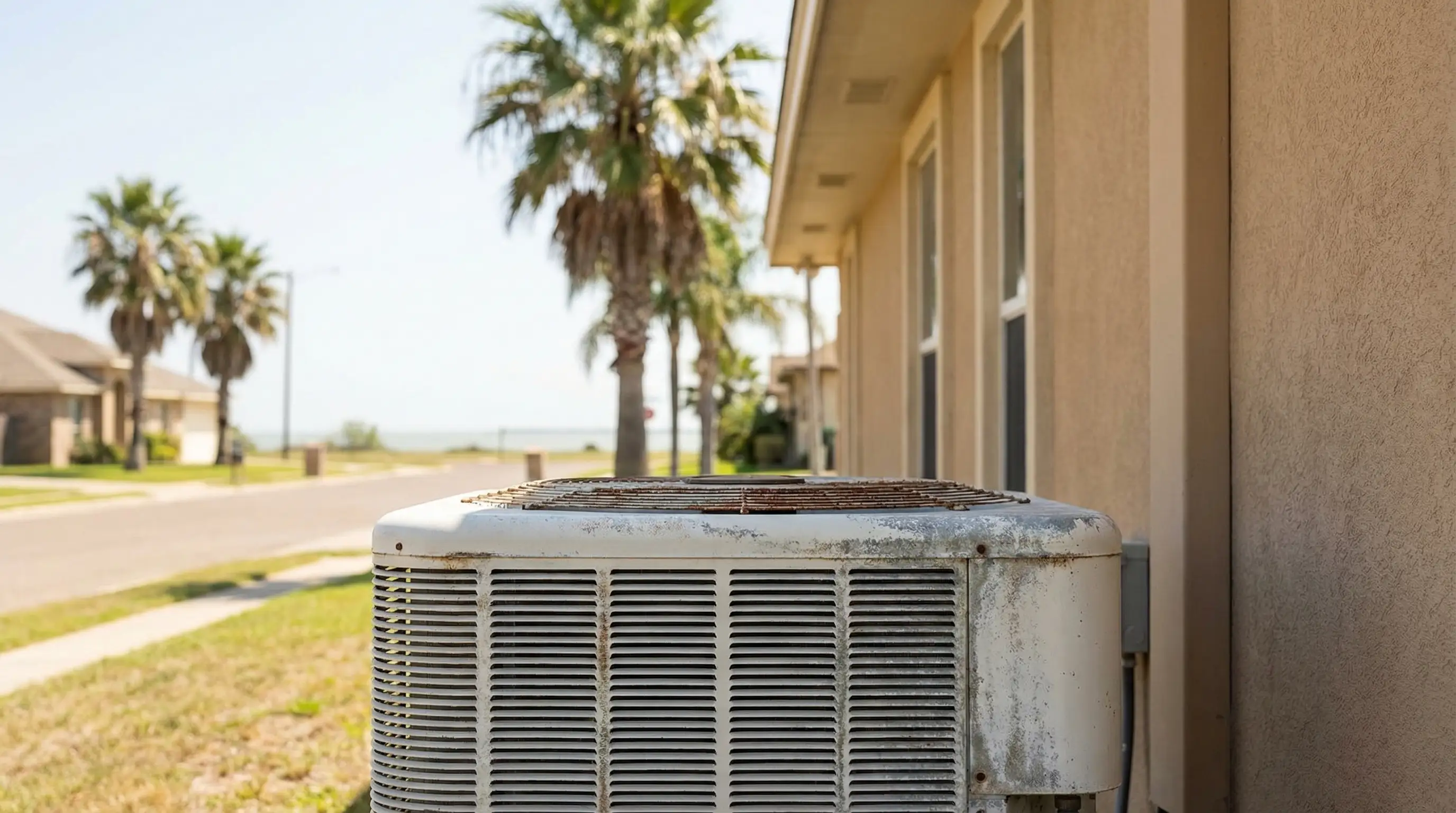
Running Google Ads for HVAC in Corpus Christi without understanding the Gulf Coast environment is like installing an inland-spec condenser two blocks from the bay — it'll work for a while, then corrode faster than anyone planned for. The same dynamic plays out in PPC: campaigns built without local context burn budget against the wrong intent signals, at the wrong times, for the wrong audiences.
The Salt Air Problem No Generic Campaign Catches
The single most important fact about Corpus Christi's HVAC market is one that most PPC agencies never put in an ad: coastal salt air reduces HVAC system lifespan by 30–40% compared to inland Texas. The average condenser in a CC home lasts 10–13 years — not the 15–20 years industry standards assume. That means the entire replacement cycle runs faster here, and replacement-intent searches represent a larger share of the market than in Dallas, Houston, or San Antonio.
Generic HVAC campaigns optimize for emergency repair keywords and ignore the lucrative replacement segment. In Corpus Christi, that's a structural mistake. Homeowners in Flour Bluff, Padre Island, and the Southside neighborhoods closest to the bay are on an accelerated replacement schedule — and they're searching for contractors who understand why their four-year-old unit is already showing corrosion. Campaigns that don't address this miss the highest-average-ticket jobs in the market.
Emergency Intent Timing: The Corpus Christi Heat Window
Emergency AC repair searches in Corpus Christi don't follow a smooth seasonal curve — they spike violently during multi-day heat events when the Gulf humidity amplifies apparent temperature. Corpus Christi averages 10–15 days annually with a heat index above 105°F, and when those clusters hit, emergency search volume surges in a narrow window: 11am to 3pm on consecutive high-heat days is when the phones ring and when competitors who aren't running day-parted campaigns lose impression share they'll never recover.
The average July high in Corpus Christi is 93°F — and with Gulf humidity at 70–85%, the heat index regularly pushes to 100–108°F. An AC unit that's been running 16-hour days for two weeks either starts struggling or fails outright. That failure moment is the moment a family searches on mobile for the fastest contractor they can find. Campaigns without aggressive mobile bid adjustments and a sub-3-hour response time in their ad copy lose to competitors who've built for this exact scenario.
Beyond raw heat, hurricane season introduces a second emergency layer. Corpus Christi sits directly in the central Gulf hurricane corridor — direct landfalls and near-miss tropical storms cause power surges that kill compressors and control boards. Post-storm HVAC failure searches spike within 24–48 hours of storm passage, and contractors with a pre-built storm response ad group activate campaigns that competitors aren't running.
The Bilingual Gap Most Competitors Ignore
Corpus Christi is 62% Hispanic — one of the highest concentrations of any mid-size Texas city. Spanish-language HVAC campaigns are largely absent from this market. A family in the 78405, 78406, or 78415 zip codes — the highest-Hispanic-concentration areas of the city — searching "aire acondicionado Corpus Christi" or "reparación de AC" encounters almost no dedicated competition in paid search. This isn't a marginal opportunity; it's 3 in 5 potential households in the market being served by contractors who haven't bothered to reach them in their primary language.
The mistake compounds when HVAC companies run bilingual ads but route Spanish-speaking callers to English-only intake. The conversion loss at that point is invisible in campaign data but real in closed jobs. A bilingual campaign that connects through to a Spanish-speaking technician or dispatcher is a complete system — and in Corpus Christi's competitive-but-fragmented market, it's a moat most local HVAC companies have left completely undefended.
Finally, military families at Naval Air Station Corpus Christi represent a distinct segment with specific behaviors: they have no established local contractor relationships, they rely heavily on reviews, and they need service contractors who respond within a tight window when a PCS move lands them in a home with a failing HVAC system in July. A campaign that runs ads near NASCC with military-specific messaging ("serving NASCC families") captures a trust signal that generic ads simply don't produce.
A high-performing HVAC PPC strategy in Corpus Christi runs three parallel campaign tracks — emergency response, replacement intent, and bilingual acquisition — and allocates budget dynamically based on weather triggers. A flat monthly budget that doesn't surge during heat events is leaving the most valuable leads on the table.
Campaign Structure: Three Tracks, One Market
The most effective Corpus Christi HVAC campaigns segment by intent, not by keyword match type. Each track targets a distinct decision moment:
- Emergency/Repair Track ($1,800/month): "AC repair Corpus Christi TX," "air conditioning not working Corpus Christi," "emergency AC repair near me," "HVAC repair same day Corpus Christi" — CPC range $18–$35. Heavy mobile bid adjustment (+50%). Day-parting peaks 9am–5pm, with elevated bids 11am–3pm during forecast heat events. Ad copy leads with response time: "AC down in Corpus Christi heat? Here in 3 hours."
- Replacement Intent Track ($1,000/month): "AC replacement Corpus Christi TX," "new HVAC system Corpus Christi," "salt air HVAC replacement," "HVAC unit lifespan Corpus Christi" — CPC range $22–$40. Higher average ticket; longer decision cycle (3–7 days). Landing page should address coastal system lifespan and provide financing options. "Your 12-year-old coastal unit is already at end-of-life — get a quote before it fails."
- Bilingual/Spanish-Language Track ($700/month): "aire acondicionado Corpus Christi," "reparación de AC Corpus Christi TX," "HVAC cerca de mi," "técnico de aire acondicionado" — estimated CPC $8–$18 (minimal competition). Target 78405, 78406, 78415 zip codes. Route to Spanish-speaking staff at intake. This track runs at the most efficient CPL of all three channels.
Google Local Services Ads: The First Position You Can Actually Win
In Houston, LSA slots for HVAC are fiercely contested with 15–25 bidders per area. Corpus Christi's smaller market means LSA competition is proportionally lower, and the pay-per-lead model ($20–$55/lead estimated for CC) delivers ROI that standard search campaigns rarely match on a per-lead basis. LSA should be the first campaign format activated for any new HVAC client in this market — the Google Guaranteed badge drives calls from homeowners who are specifically filtering for credentialed contractors, and those calls convert at a higher rate than standard search traffic.
The combination that works: LSA for emergency calls (the Google Guaranteed badge handles trust), Google Search for replacement and bilingual intent (where LSA doesn't show), and Facebook retargeting for maintenance agreement campaigns and seasonal tune-up promotions targeting the homeowner demographic that LSA emergency calls don't reach.
Keyword Groups with CPC Ranges
- Emergency repair keywords — "AC repair Corpus Christi," "HVAC repair same day," "air conditioning not working" — $18–$35 CPC
- Replacement keywords — "AC replacement Corpus Christi TX," "new HVAC unit," "HVAC installation Corpus Christi" — $22–$40 CPC
- Coastal/corrosion niche — "salt air AC replacement," "coastal HVAC Corpus Christi," "corrosion resistant AC" — $10–$20 CPC (low competition, high-intent)
- Maintenance/seasonal — "AC tune-up Corpus Christi," "HVAC maintenance near me" — $10–$18 CPC
- Spanish-language — "aire acondicionado Corpus Christi," "reparación de AC" — $8–$15 CPC
Negative keywords are non-negotiable: "DIY," "how to fix," "YouTube," "parts," "training," "certification," "jobs," "HVAC school." Without these, emergency-intent campaigns bleed budget on informational queries from people who will never call.
Budget Allocation and Seasonal Surge Protocol
Base monthly allocation for a competitive Corpus Christi HVAC campaign: $3,500/month across Google Search ($1,800), Google LSA ($1,000), and Facebook/bilingual ($700). During multi-day heat events or within 48 hours of a tropical storm, the emergency track budget should scale to $3,000–$5,000 for the surge period — this is when competitors without a dynamic budget protocol lose impression share to whoever shows up. The ROI on surge spending in CC's HVAC market is exceptional because demand vastly exceeds ad inventory during these windows.
Google Partner Agency
We're a certified Google Partner Agency, which means we don’t guess — we optimize withGoogle’s full toolkit and insider support.
Your campaigns get pro-level execution, backed by real expertise (not theory).

The Corpus Christi HVAC market contains three structural demand drivers that don't exist in comparable Texas cities — and understanding them reveals where the real growth opportunity sits, beyond the obvious emergency repair volume.
The Corrosion Replacement Cycle: An Accelerated Demand Engine
Corpus Christi homeowners replace HVAC systems at a rate roughly 30–40% faster than inland Texas homeowners — not because their equipment is lower quality, but because salt air from the Gulf of Mexico chemically attacks aluminum fins, copper coils, and galvanized steel components with no off-season. A unit installed in 2012 in Flour Bluff is statistically likely to be in its final operating season in 2025. The addressable replacement market in Corpus Christi is proportionally larger than the emergency repair market in ways that standard national HVAC PPC playbooks never account for.
Key insight: In coastal Corpus Christi neighborhoods — Flour Bluff, Padre Island, North Beach, Port Aransas-area zip codes — the average active HVAC system is already past the halfway point of its accelerated coastal lifespan. A campaign specifically targeting "HVAC replacement" and "AC not as cold as it used to be" in these zip codes is reaching homeowners who are statistically within 1–3 years of a replacement decision. These leads close at higher tickets ($5,000–$12,000+ for a full system) and generate better LTV than emergency repair calls.
Corrosion-resistant equipment represents an upsell opportunity that no Houston or Dallas HVAC campaign typically runs: coastal-spec units with coated coils, stainless steel fasteners, and enhanced moisture protection command $500–$1,500 premium over standard systems. An HVAC contractor who educates on this in their ad copy and landing page converts homeowners who've already experienced premature system failure — and they're not price-shopping, they're buying the right equipment for their environment.
Stage 3 Water Restrictions: An Indirect Demand Amplifier
As of March 2026, Lake Corpus Christi and Choke Canyon Reservoir sit at 8.5% combined capacity — Stage 3 water restrictions are active. This creates an indirect HVAC demand signal: homeowners running under drought conditions experience more intense sustained heat inside their homes as they reduce swamp cooler and evaporative supplement use. The drought also means CC is operating with higher-than-normal electricity demand for cooling, raising utility bills and driving homeowner interest in energy-efficient HVAC upgrades. A campaign targeting "energy efficient AC Corpus Christi" or "lower electric bill HVAC upgrade" is entering a market where the Stage 3 drought is making utility costs more salient to every homeowner in the city.
Military Families: A High-Value Underserved Segment
Naval Air Station Corpus Christi employs approximately 7,000 military and civilian personnel, and the PCS cycle brings a continuous flow of new arrivals who need to establish HVAC contractor relationships quickly — often before their first summer in a Gulf Coast climate they've never lived in. Military families don't have the local network that civilian Corpus Christi residents use to find contractors; they rely on Google, reviews, and the Google Guaranteed badge. They tend to be homeowners in their 30s–40s, often first-time Gulf Coast residents unfamiliar with the salt air corrosion reality, and they are primed for the educational message: "Here's what the Gulf Coast does to your AC, and here's how we protect it."
The military segment converts at above-average rates for HVAC because urgency is higher (arriving mid-summer to a home with aging equipment), trust signals matter more (Google Guaranteed badge + reviews carry outsized weight), and the referral value inside the NASCC community is exceptional — one satisfied military family recommendation to a unit or squadron generates 3–8 referral calls in the same tight-knit community. HVAC contractors who ignore this segment are leaving structured, predictable demand unaddressed.
The bilingual dimension layers onto the military opportunity as well: NASCC's enlisted community includes a significant proportion of Hispanic servicemembers, and their families — often moving to Corpus Christi from other duty stations — benefit from bilingual service in a market where most HVAC contractors don't provide it.
Running Google Ads in Corpus Christi's HVAC market without Gulf Coast-specific campaign architecture is like quoting a coastal condenser replacement at inland-market pricing — the fundamentals don't transfer, and the gaps show up in wasted spend and missed leads.
MB Adv Agency builds HVAC PPC campaigns from the ground up for coastal Texas markets. That means dynamic budget protocols that surge during heat events, replacement-intent campaigns targeting the accelerated coastal corrosion cycle, and bilingual ad sets that reach Corpus Christi's 62% Hispanic population where competitors aren't competing. It means LSA setup and optimization for the pay-per-lead format that outperforms standard search for emergency HVAC calls in smaller metros. And it means ad copy that says something true and specific about Gulf Coast HVAC — not a template from a Dallas campaign recycled for a different market.
Every HVAC client at MB Adv gets dedicated campaign management, not a shared account dashboard. Our pricing starts at $497/month for campaigns under $3K ad spend — structured for the HVAC SMBs who are ready to compete seriously but haven't previously had a campaign built for Corpus Christi's specific environment. For campaigns at $3K–$10K monthly ad spend, the Aggressive Push tier at $697/month includes full-funnel management across Google Search, LSA, and Facebook.
The contractors who dominate Corpus Christi's HVAC PPC in the next 12 months will be the ones who build their campaigns now — before hurricane season, before the June heat events, before the bilingual ad inventory fills up. The window to enter this market with a real competitive position is still open. Start with a free campaign audit at mbadv.agency.

Frequently Asked Questions
What's a realistic monthly budget to run Google Ads for HVAC in Corpus Christi?
For a Corpus Christi HVAC company that wants to generate consistent emergency repair and replacement leads, a realistic starting budget is $1,800–$2,500/month in ad spend — not including management fees. That range supports an active Google Search campaign for emergency keywords (where CPCs run $18–$35) and a Google Local Services Ads presence (pay-per-lead at $20–$55/lead in the CC market). At $2,000/month, a well-structured campaign targeting emergency and replacement keywords should generate 22–32 leads/month, assuming a 10–14% conversion rate on high-intent summer traffic.
The more important planning consideration is seasonal surge budgeting. A static $2,000/month budget that doesn't flex during multi-day heat events or in the 48–72 hours after a tropical storm will lose impression share to competitors who scale up. The smart approach: maintain a base budget year-round, with a pre-authorized surge budget of $3,000–$5,000 for 1–2 week heat events in June–September and any named storm events. The CPL on surge spend is excellent because demand outpaces ad inventory during those windows.
For HVAC contractors targeting both emergency repair and the higher-ticket replacement segment, a $3,500/month budget split across Google Search, LSA, and a small Facebook retargeting allocation hits the range where replacement-intent campaigns can run alongside the emergency track without cannibalizing each other. Replacement leads close at $5,000–$12,000+ per job — the CPL tolerance is much higher than for $200 service calls. Separating these two audiences in the campaign structure is the operational detail most Corpus Christi HVAC campaigns miss.
How fast can an HVAC Google Ads campaign start generating leads in Corpus Christi?
Emergency HVAC intent in Corpus Christi is immediate and high-frequency — once a Google Search campaign is live and indexed, the first calls typically come within 1–3 days, assuming the campaign is targeted correctly and the landing page loads fast on mobile. Google LSA leads often arrive within 24–48 hours of the account receiving its Google Guaranteed verification, which typically takes 1–5 business days to process after background check and license verification are submitted.
The distinction that matters: leads start fast; profitable optimization takes longer. The first 4–6 weeks are when search term data accumulates and negative keyword lists get refined. An HVAC campaign in month one will have a higher cost-per-lead than the same campaign in month three, because the early data reveals which search terms are converting and which are wasting impressions on informational queries. The goal in month one is volume and data; the goal in month three is efficiency. Budget for both phases differently — and don't measure month-one CPL against a stabilized benchmark.
Timing matters significantly for Corpus Christi's market: campaigns launched in April or May benefit from a 4–6 week data collection and optimization window before the peak June–September demand season. An HVAC company launching in July is paying peak CPCs while simultaneously trying to optimize a raw campaign — the same budget generates fewer leads and produces worse data. The single best time to launch or restructure an HVAC Google Ads campaign in Corpus Christi is the late winter/early spring window, when CPCs are lower and there's time to build a strong Quality Score and keyword exclusion list before the heat arrives.