Start
$590$990/month
1 platform · Google or MetaGoogle + Meta- Ad spend
- up to $3,000
- New creativesmade by us
- Google + Meta only4 a month
 By Matteo Braghetta, Founder · Google Ads
Bakersfield's location at the edge of Kern County's agricultural belt — where farmland borders residential neighborhoods — creates pest pressure that coastal California cities don't experience. Scorpions, black widows, rodents, and agricultural insects migrate from surrounding fields into residential areas year-round, not seasonally. In a market where 78 pest control services compete for Bakersfield homeowners and commercial accounts, and where a single recurring residential account is worth $720–$960/year and a commercial fumigation contract runs $3,000–$12,000, the operators capturing new accounts through Google Ads aren't waiting for referrals.
See how this city's Pest Control PPC costs compare nationally in our Pest Control PPC Statistics report, featuring data from 40+ US cities.
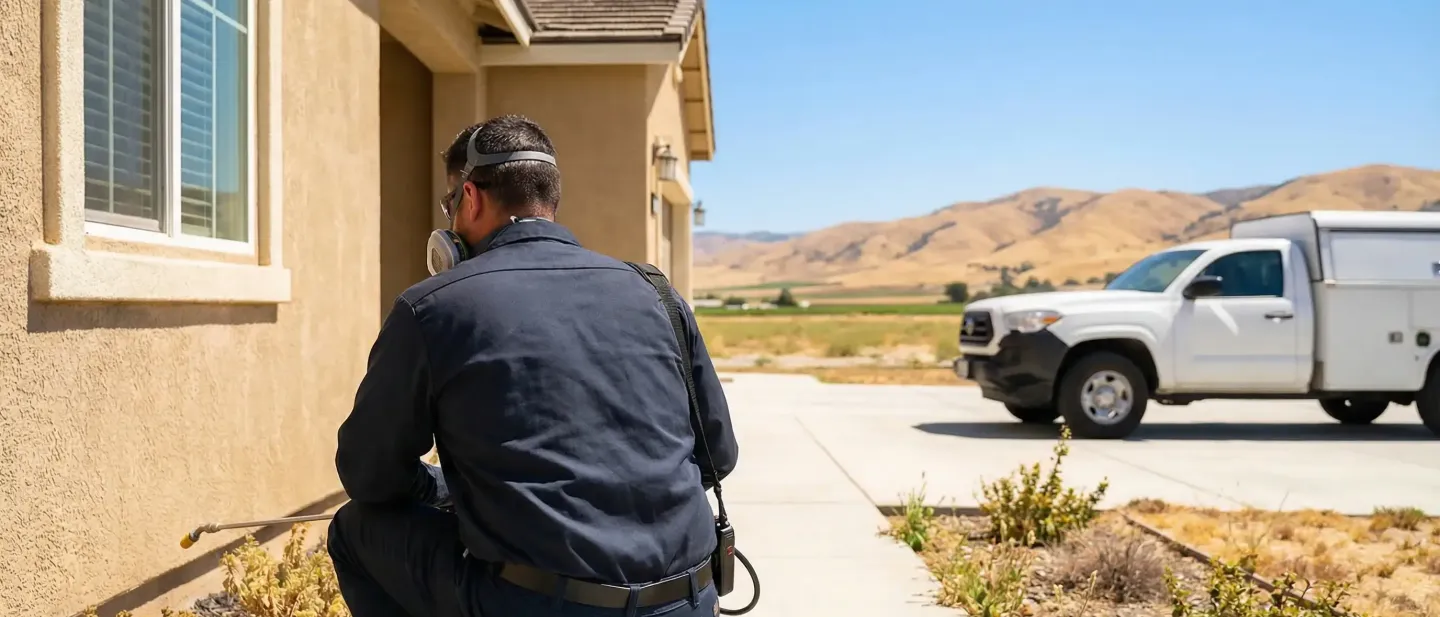
In Bakersfield, CA, people search for pest control services about 1,930 times a month on Google; a top-of-page click costs $10–$45, and demand peaks in May.
Google Keyword Planner · Oct 2025 – Sep 2026
| Search | Monthly searches | Top-of-page CPC |
|---|---|---|
| pest control | 260 | $10–$65 |
| bed bug treatment | 260 | $3–$15 |
| pest control near me | 210 | $14–$68 |
| cockroach exterminator | 210 | — |
| bed bug exterminator | 170 | $8–$27 |
| pest control service | 110 | — |
| termite control | 110 | — |
| termite inspection | 90 | $30–$61 |
| wasp nest removal | 90 | $5–$22 |
| termite treatment | 70 | $16–$41 |
US: $37
Google Keyword Planner · Oct 2025 – Sep 2026
Source: Google Keyword Planner (Google Ads), Google Search, English, Bakersfield, CA, Oct 2025 – Sep 2026. Volumes are Google's monthly averages; CPC is the top-of-page bid range, weighted by search volume. How we collect these figures.
Bakersfield's pest control market has a dynamic that makes PPC both necessary and difficult: the demand is genuine, frequent, and year-round, but the competitive landscape is dominated at the top end by national franchise operators with significantly larger ad budgets. Local operators — Wow Pest Control, Calvary Pest Control, D.O.A. Pest Solutions, Dan's Pest Management — compete on local expertise, personalized service, and response speed, but they're entering a PPC auction where Western Exterminator (Rentokil) and Terminix have years of campaign history, national Quality Score advantages, and ad infrastructure that individual local operators can't replicate on their own.
When a Bakersfield homeowner searches "pest control near me" or "exterminator Bakersfield," they encounter a paid search page that's heavily weighted toward franchise operators. Western Exterminator (Rentokil) and Terminix run professionally managed national campaigns with local geo-targeting — their ads appear at top positions with extensions (call buttons, location details, review stars) that their local competition often doesn't have configured. For a homeowner who doesn't already have a trusted pest control relationship, the franchise ad looks more credible than an unknown local operator's basic text ad. This trust gap — not necessarily the cost gap — is what franchise operators exploit in Bakersfield's paid search environment.
The counter-strategy for local operators is hyper-local differentiation: Bakersfield-specific pest language in ad copy and keyword targeting that national franchise templates miss. "Scorpion control Bakersfield" is a keyword that local homeowners search — scorpion pressure in the Valley is real and well-known among residents — but it's a term that national pest control templates don't always prioritize. Similarly, keywords like "gopher control Kern County," "black widow treatment Bakersfield," and "agricultural pest control Kern County" are locally relevant searches where a Bakersfield-specific operator can compete effectively against franchise generic campaigns that don't speak to local pest realities. D.O.A. Pest Solutions, with 20 years in Bakersfield and a 5.0 Yelp rating, has the local credibility to win on these specific terms — what it needs is the ad infrastructure to capture them.
The subscription model creates a second competitive challenge: churn is more expensive than acquisition for pest control operators, and high-churn acquisition (price-sensitive customers who cancel after one season) undermines the recurring revenue model. PPC campaigns that attract price-shoppers through promotional offers ("$1 first treatment") can generate initial appointment volume while building a customer base that churns out within 90 days. The acquisition cost math only works if the new customer remains on a recurring plan — which means the campaign messaging, keyword selection, and landing page must attract homeowners who want a service relationship, not a one-time discount.
Pest control PPC in Bakersfield needs to account for three distinct seasonal peaks that each require different keyword emphasis and budget allocation. Without intentional seasonal management, campaigns either overspend during low-demand periods or run out of budget at peak demand — both of which reduce the efficiency of a pest control operator's PPC investment. Flat monthly budgets in seasonal service businesses are a predictable source of wasted ad spend. The spring activation window (March–May) is the year's primary new account acquisition opportunity — campaigns that are well-optimized and adequately funded at this window capture accounts that stay on recurring service plans through the year.
Pest control PPC in Bakersfield performs best with a tiered campaign structure that separates recurring-plan acquisition, high-ticket specialty services (termite fumigation, rodent exclusion), and emergency/immediate-need calls into distinct campaigns. The conversion goal is different for each: recurring plan acquisition is a longer-cycle decision (customer is comparing multiple operators and evaluating ongoing cost), specialty services convert from a specific problem the customer has discovered, and emergency calls (scorpion inside the house, active wasp nest) convert in minutes.
For pest control operators whose business model depends on recurring monthly or quarterly service contracts, PPC ad copy must lead with the recurring plan offer, not a one-time treatment discount. An ad reading "Monthly pest protection from $49/month — scorpion, spider & roach coverage" attracts customers who understand the service relationship model. An ad reading "$25 first treatment — call today" attracts price-shoppers who will cancel after the promotional period. The recurring plan message also provides a stronger value proposition: homeowners understand that Bakersfield's pest pressure requires ongoing management, not a single treatment. Leading with recurring plan pricing frames the service correctly from the first impression and pre-qualifies for higher-LTV customer acquisition.
Bakersfield's most underutilized pest control PPC opportunity is the agricultural adjacency segment — the commercial pest control demand generated by the intersection of Kern County farmland and the Bakersfield urban edge. No other comparable California city sits directly adjacent to the country's most productive agricultural county; the pest migration patterns this creates are genuinely different from urban pest control markets, and the commercial demand it generates is largely outside the targeting parameters of national pest control franchise campaigns.
The residential neighborhoods along the northern and eastern edges of Bakersfield — particularly zip codes 93308, 93309, and 93306 — border active agricultural production zones. Rodent populations from adjacent fields (mice, roof rats, gophers) cycle into residential areas during harvest periods (July–October when field crops are disturbed) and again in November–January when cold Valley nights push foraging activity toward warm structures. Rodent exclusion and control demand in Bakersfield's agricultural border neighborhoods is 30–50% higher than the city's suburban interior — a fact that creates a defensible geo-targeting advantage for operators with the field knowledge to serve these areas effectively.
The commercial agricultural segment is separately significant. Kern County agricultural operations — produce storage facilities, packing houses, equipment storage, food processing operations — require pest control services that meet USDA and California Department of Food and Agriculture compliance standards. A single food processing facility compliance contract in Kern County is worth $4,000–$15,000/year and represents the most stable recurring revenue in commercial pest control. National franchise operators do service these accounts, but their generic commercial keyword campaigns don't speak to agricultural compliance language ("food safety pest management," "CDFA compliance pest control Kern County") — an opening for local operators with the certifications and track record to serve agricultural commercial accounts.
The Spanish-language opportunity in Bakersfield pest control mirrors the broader market pattern but has specific pest-culture resonance. Many Bakersfield Hispanic households have agricultural roots and a heightened awareness of specific pests — alacrán (scorpion), rata (rat), cucaracha (cockroach) — and a preference for technicians who can communicate in Spanish. Spanish-language pest control PPC keywords in Bakersfield run at CPCs 20–35% below English equivalents, and the segment is virtually uncontested by national franchise campaigns. For operators with Spanish-speaking technicians, running a parallel Spanish-language campaign is a low-cost, high-qualification customer acquisition channel.
Bakersfield's pest control market rewards operators who understand local pest biology, agricultural adjacency, and the subscription acquisition model — and who run Google Ads campaigns built around those specifics rather than national franchise templates. A campaign that targets scorpion, gopher, and agricultural adjacency keywords with Bakersfield-specific ad copy outperforms a generic "pest control near me" broad-match campaign at a fraction of the budget.
MB Adv Agency's pest control PPC campaigns for Bakersfield operators are built around subscription model acquisition. Every campaign separates recurring-plan keywords from one-time service keywords, targets the agricultural border geo zones where rodent demand is highest, and includes Bakersfield-specific pest terms (scorpion, gopher, black widow) that national franchise templates ignore.
For operators ready to add commercial accounts, we structure separate commercial keyword campaigns targeting food service, agricultural storage, and commercial facilities — with conversion tracking that identifies which searches produce commercial inquiries vs. residential calls. At $800–$1,200/month in ad spend, one new commercial account ($3,600–$12,000/year) covers the entire campaign investment multiple times over. The economics are straightforward — the campaign just needs to be built to find commercial prospects, not only homeowners.
See our pricing tiers and let's build the campaign structure that fits your current service capacity and growth target.

Three things make Bakersfield's pest control PPC market structurally different from coastal California cities. First, the pest profile is more diverse and year-round. Scorpions, black widows, gophers, and agricultural rodent migration create demand patterns that LA or San Diego pest control operators don't deal with. A Bakersfield-specific campaign that targets these pests by name — "scorpion control Bakersfield," "gopher removal Kern County" — reaches searchers with specific, active pest problems that generic "pest control near me" campaigns don't serve as precisely.
Second, agricultural adjacency creates commercial demand that other California urban markets lack. Kern County agricultural operations require compliance-grade pest management that a Bakersfield-based operator with the right certifications can provide. National pest control franchise campaigns don't pursue agricultural commercial keywords in Kern County — the specialized language ("CDFA compliance," "food safety pest management," "agricultural storage pest control") isn't in their standard campaign templates. This creates an opening that a locally-managed campaign can exploit.
Third, Bakersfield's 52% Hispanic/Latino population combined with active pest pressure creates a Spanish-language PPC opportunity with virtually no competition. A bilingual operator who runs Spanish-language search campaigns for scorpion and rodent control terms in Bakersfield faces CPCs that are 20–35% lower than English equivalents and minimal competition for the search impression — because almost no pest control operator in the market has configured a Spanish-language campaign. For a bilingual operation, this is a customer acquisition channel that costs less to run and faces less competition than the core English-language market.
For a small pest control operation (1–3 technicians) focused on residential recurring accounts in Bakersfield, the effective starting ad spend is $800–$1,500/month. Management is a fixed monthly fee set by your ad spend, with the tracking set up first: see the plans and prices. At a 30–40% conversion rate from inquiry to recurring plan enrollment, that's 5–12 new recurring accounts per month — each worth $540–$960/year. After 6 months at this acquisition rate, the recurring base built through PPC generates $16,200–$57,600/year in annual contract value from that single campaign investment period.
Mid-size operations (4–8 technicians) building both residential and commercial account bases operate effectively at $1,500–$3,500/month. This budget level supports residential recurring campaigns, specialty high-ticket keyword campaigns (termite, rodent exclusion), and a commercial pest control campaign running simultaneously. The commercial campaign runs at higher CPC but lower volume — budget it at 25–35% of total monthly spend. One new commercial restaurant account acquired from the commercial keyword campaign ($400/month recurring) covers 1.5–4 months of the commercial campaign allocation.
The key budget management principle for pest control PPC is seasonal weighting. March–May is the primary residential account acquisition window — increase budget by 30–40% during spring activation to capture the highest-volume new customer inquiry period of the year. July–August scorpion season justifies a secondary budget increase for scorpion-specific keywords. November rodent entry season is a third budget increase window for rodent control and exclusion terms. Maintaining flat monthly budgets through these peaks means paying for ads when demand is moderate and underfunding when demand is highest — a structural inefficiency that seasonal budget management eliminates.
How to read this Cost per click and monthly searches are measured with Google Keyword Planner (see above). Cost per lead, conversion rate, budget and leads are estimates compiled from public benchmarks such as WordStream, not measurements.
Sources WordStream 2025 Home Services benchmarks; Bakersfield pest control estimated at 2-5x national CPC; California market premium for termite/specialty keywords
$590$990/month
1 platform · Google or MetaGoogle + Meta$790$1,290/month
1 platform · Google or MetaGoogle + Meta$1,140$1,940/month
1 platform · Google or MetaGoogle + MetaChatGPT Ads: a separate pilot, $250/month, added to a plan. See the pilot →

Matteo Braghetta founded MB Adv and runs its Google Ads accounts. He takes the first call with every new client, reads the accounts every week and writes the agency’s guides.
The other half of his job is measurement: GA4, Consent Mode and server-side tracking, so the platforms learn from real sales.
MB Adv is a Google Partner agency managing about $4.4M a year in ad spend for clients in the US, the UK and Europe.
Managed on numbers you can check.
Plans for the US