Pest Control PPC Macon, GA
Georgia's humid subtropical climate gives Macon pest control companies a structural advantage: demand never truly stops. Termites, mosquitoes, cockroaches, and fire ants operate year-round, and homeowners searching for pest control solutions are ready to buy — not browse. The question is whether local operators or national chains capture those leads. <!-- stats-article-link --> <p><em>See how this city's Pest Control PPC costs compare nationally in our <a href="https://www.mbadv.agency/ppc-industry-statistics/pest-control-ppc-statistics">Pest Control PPC Statistics</a> report, featuring data from 40+ US cities.</em></p>
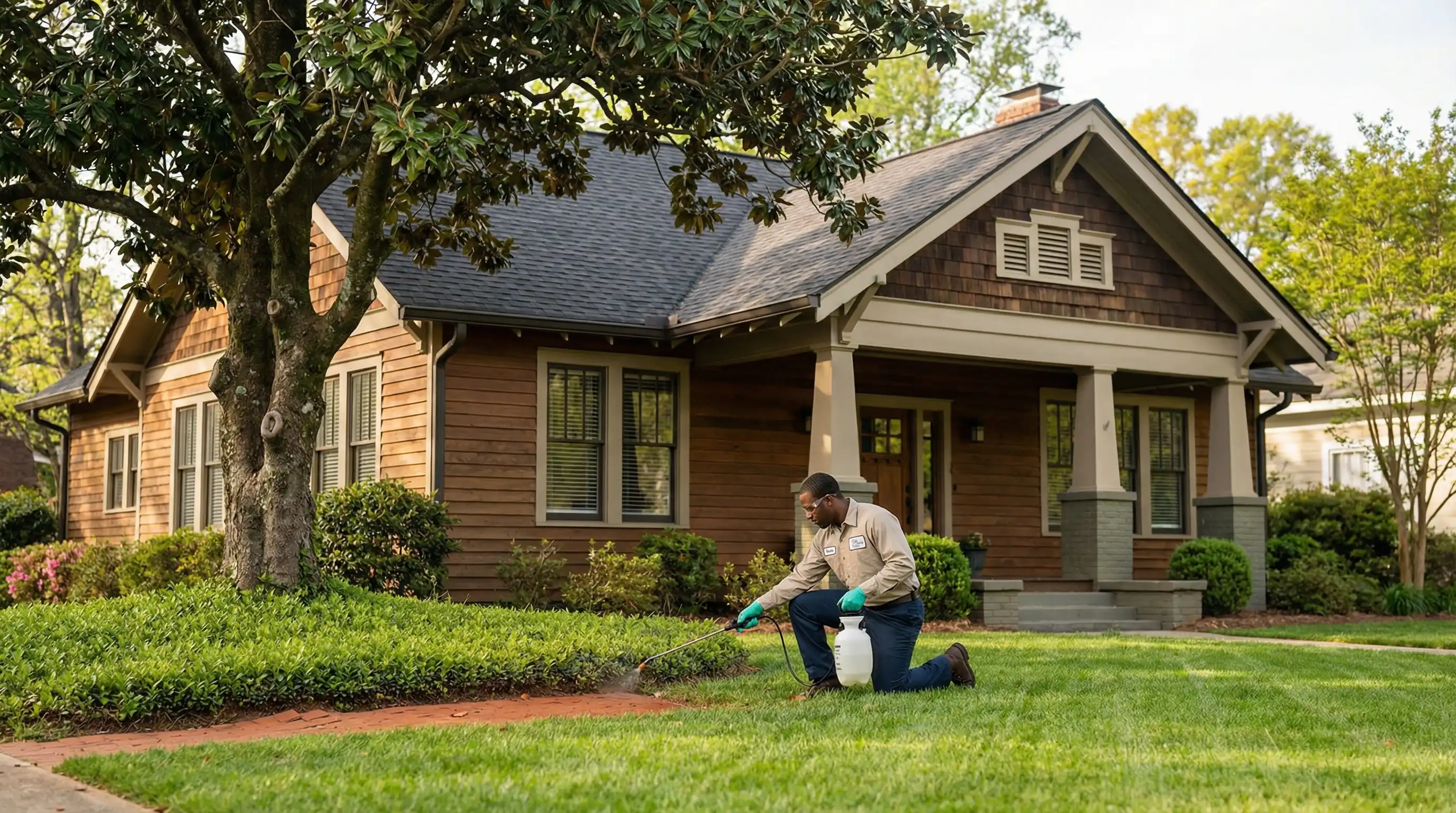
Why Do Pest Control PPC Campaigns Fail in Macon, GA?
Pest control PPC in Macon seems like a manageable market — lower CPCs than roofing or law, a predictable seasonal rhythm, and a relatively thin local advertiser pool. But that thin local pool is precisely the problem: the primary competition isn't other local pest control companies. It's Orkin, Terminix, and Rentokil Steritech — three national chains with national PPC budgets, sophisticated bid management platforms, and brand recognition built over decades. Local independents who run generic campaigns with generic messaging get outbid and out-converted before the first week is done.
The National Chain Disadvantage: Where Local Operators Win
Orkin and Terminix dominate branded searches and run high-volume campaigns on general terms. Their weakness is specificity. A national pest control chain cannot credibly claim to know that Macon's aging housing stock creates specific German cockroach pressure in the older apartment buildings near Mercer University, or that the Georgia red clay soil around central Macon neighborhoods provides ideal termite habitat. Local independents with Macon-specific knowledge can own that positioning in their PPC copy and landing pages — and it converts at measurably higher rates than generic national messaging.
The three established local operators — Blitz Exterminators LLC (3327 Vineville Ave, since 1997), Bug House Pest Control (3663 Vineville Ave, 30+ years), and White & Lavender Pest Control (since 1955, termite specialty) — have the local credibility but represent thin digital competition. Their review profiles and longevity are their organic strength; in PPC, a newcomer with a well-structured campaign and strong landing pages can compete effectively against all three simultaneously.
Subscription vs. One-Time: The Campaign Structure Failure
Most pest control campaigns in mid-size markets treat all leads as equivalent. They're not. A general pest control subscription lead (valued at $80–$150/month recurring) is worth $960–$1,800 annually. A one-time bed bug treatment lead is worth $400–$800. A termite inspection lead that converts to a multi-year prevention contract is worth $1,500–$3,000. Running all three through the same ad group and landing page — the default for non-specialized campaigns — means the copy optimizes for none of them effectively.
The subscription buyer responds to plan clarity, pricing transparency, and contract flexibility. The termite buyer responds to urgency, damage cost framing ("termite damage averages $3,000 per affected structure"), and certification credentials. The bed bug buyer is in crisis mode — they want same-day response and discreet service language. A campaign that treats these as the same search intent is leaving conversion rate on the table across all three segments.
PPC Strategies for Pest Control Companies in Macon, GA
Macon's pest control PPC market rewards specificity. The contractors and companies that segment by pest type, by buyer intent, and by service tier — rather than running a single "pest control Macon GA" campaign — outperform competitors at every CPC level. Here's the structure that works.
Four-tier keyword architecture by pest type and intent:
- General/recurring pest control: "pest control Macon GA," "exterminator Macon," "pest control companies Macon GA," "monthly pest control Macon" — CPCs $5–$9. These are the highest-volume terms. Landing page: lead with plan options and pricing, subscription vs. one-time comparison, coverage list (roaches, ants, spiders, rodents). CTA: "Get a free quote in 60 seconds." Subscription offer ("first treatment free with annual plan") converts well in Macon's price-sensitive market.
- Termite-specific: "termite inspection Macon GA," "termite treatment Macon," "termite exterminator Macon GA" — CPCs $8–$14. Higher ticket, longer decision cycle. Landing page: lead with inspection offer, average termite damage cost framing ($3,000+ per structure), certification credentials. White & Lavender's 70+ years of termite specialty is the competitive benchmark — a new campaign needs to credibly address termite expertise.
- Mosquito control: "mosquito control Macon GA," "mosquito treatment Macon," "mosquito yard treatment Macon" — CPCs $5–$9, peak March–October. Subscription model works well here — monthly yard treatments. Landing page: family and pet safety messaging, before/after results framing, subscription plan with seasonal pricing.
- Urgency/emergency: "bed bug exterminator Macon GA," "roach exterminator Macon," "wildlife removal Macon GA" — CPCs $7–$12. These buyers are in active problem mode. Landing page: availability prominent, response time guarantee, discreet service language for bed bugs. Same-day service messaging converts urgency searchers 40–60% better than standard scheduling language.
Geographic strategy: Target Macon-Bibb County core, with expansion to Warner Robins (25 miles south, Robins Air Force Base housing creates consistent pest control demand) for contractors willing to serve that area. Military housing has specific pest control requirements — a campaign note that explicitly mentions military housing in the Warner Robins radius can differentiate effectively.
Seasonal bid management: Macon's mosquito season runs March–October — allocate 60% of annual mosquito campaign budget to this window. Termite swarm season peaks in spring (March–May) — increase termite campaign bids 30–40% during swarming season when homeowners discover evidence and search urgently. General pest control is relatively flat year-round, with modest increases in summer (June–August) when ant, roach, and spider activity peaks.
Google Partner Agency
We're a certified Google Partner Agency, which means we don’t guess — we optimize withGoogle’s full toolkit and insider support.
Your campaigns get pro-level execution, backed by real expertise (not theory).

What Market Trends Should Macon Pest Control Businesses Know?
Three structural factors shape Macon's pest control market in ways that most PPC campaigns don't account for: the subscription economy shift, Macon's specific termite risk geography, and an entirely unserved Spanish-language searcher segment.
The Subscription Shift: Recurring Revenue Through PPC
Macon homeowners are increasingly open to subscription-based pest control models — monthly or quarterly treatment plans at $60–$120/month replacing one-off treatments. The drivers are Macon-specific: Georgia's year-round pest pressure means one treatment doesn't solve the problem, and the 19.5% poverty rate makes predictable monthly costs (vs. emergency one-time bills) more financially manageable for many households. A subscriber acquired for $50 CPL at a $80/month plan generates $960/year in revenue. The LTV calculation makes pest control one of the strongest ROI channels in the home services category.
PPC campaigns that lead with subscription offers — "Macon's year-round pest protection, $79/month, cancel anytime" — outperform campaigns that lead with service categories for the subscription-intent segment. The key message elements: predictable pricing, coverage clarity, and flexibility on cancellation. Macon's price-sensitive market is receptive to monthly budgeting framing; one-time emergency pricing framing triggers resistance.
Termite Geography: Central Macon's Specific Risk
Georgia is classified in Termite Infestation Probability Zone 1 — the highest risk category. Within Macon specifically, the red Georgia clay soil throughout central and older neighborhoods creates specific subterranean termite habitat conditions. Homes with wood-to-soil contact in foundation areas — common in Macon's older brick ranch and craftsman bungalow stock — are at materially elevated termite risk.
- Highest-risk Macon neighborhoods: Vineville, College Hill, Pleasant Hill, Ingleside — older housing stock with wood frame construction elements and mature landscaping creating soil contact points
- Termite swarm season in Central Georgia: March–May, peaking in April when reproductive termites emerge — the highest-intent search period for "termite inspection Macon GA"
- Average treatment cost: $1,500–$3,000 for subterranean termite treatment; annual prevention contracts run $200–$400/year after initial treatment
The Spanish-language opportunity deserves direct attention. Macon's Hispanic community (4.7% of population, concentrated in specific census tracts) is actively searching for home services but is almost entirely unaddressed by local pest control PPC. "Control de plagas Macon GA" and "exterminador Macon Georgia" run near-zero CPC competition — any operator running Spanish-language ads for these terms captures the segment with minimal cost.
Why Macon Pest Control Companies Need a Local PPC Specialist
Competing against Orkin and Terminix in a market like Macon isn't about out-spending them — it's about out-positioning them. National chains win on brand and volume; local operators win on specificity, trust, and response speed. Translating those advantages into PPC requires campaigns that speak specifically to Macon's pest landscape, Macon's housing stock, and Macon's searcher intent — not generic home services copy that could apply to any city.
MB Adv Agency builds pest control campaigns with four-tier keyword segmentation, subscription-first landing pages for recurring revenue clients, and urgency-optimized paths for the bed bug and termite buyer. We track lead-to-LTV by campaign segment, so you understand the difference between a one-time job lead and a subscription lead — and we weight bidding accordingly. In a recurring-revenue service category like pest control, that distinction drives every structural decision in the account.
We also manage the Spanish-language opportunity — near-zero competition, unserved demand, and a segment that no local competitor is currently reaching through paid search. For the right operator, that's an entirely open lead channel at pennies-per-click while it lasts.
If your current campaign is competing on "pest control Macon GA" against Orkin's national budget without differentiated positioning or intent-segmented ad groups, that's a campaign structure problem, not a market problem. See our PPC pricing and lead generation services to understand what a properly structured campaign looks like.

Frequently Asked Questions
How much should a Macon pest control company spend on Google Ads?
A Macon pest control company can generate meaningful lead volume starting at $700–$1,200 per month — lower than most home service categories because pest control CPCs run materially cheaper than HVAC or roofing. At $1,000–$1,200/month targeting Macon-Bibb County and Warner Robins, a well-structured four-tier campaign (general, termite, mosquito, urgency) produces 25–50 leads per month, with CPLs ranging from $25 for general pest control inquiries to $70 for termite inspection leads. The budget floor is lower, but scaling above $1,200/month accelerates results significantly: at $1,500–$2,000/month, coverage extends to all pest types and includes Spanish-language ad groups, generating an additional 15–25 leads per month from an entirely uncompeted segment. Subscription-focused campaigns prioritize volume over immediate ticket size — a $40 CPL for a subscription lead that generates $960/year in revenue is a significantly better ROI than a $25 CPL one-time repair call at $300 job value.
Termite campaigns have their own budget logic. Because termite leads are higher-ticket ($1,500–$3,000 treatment + annual prevention contract) and lower-volume, a focused termite campaign at $400–$600/month alongside a general pest control campaign produces the best blended ROI. Termite CPL of $70–$100 is justified by a job value of $2,000–$3,500 for initial treatment plus ongoing annual contracts.
Seasonal budget reallocation improves annual efficiency. Shift 25–30% of annual budget to the March–May mosquito and termite swarm window, when both search volume and lead intent peak simultaneously. Pull back 15–20% in November–January, when general pest control volume is lowest. The savings fund the spring push at the moment when CPL is highest but lead quality is also at its best.
Can a local Macon pest control company compete with Orkin and Terminix on Google Ads?
Yes — and local operators consistently outperform national chains on specific intent terms in mid-size markets like Macon. The mechanics are straightforward: Orkin and Terminix run high-volume national campaigns optimized for brand terms and broad category queries. Their landing pages are nationally generic. Their call centers route to out-of-state representatives who can't speak to Macon's specific pest landscape or schedule same-day service with local credibility. A local Macon pest control company running Macon-specific ads — "locally owned since [year], serving Vineville and College Hill" — with a local landing page showing Macon reviews and a local phone number that rings a Macon technician will consistently outperform the national chain's landing page on conversion rate even when the chain outbids you on CPC.
The key is targeting the right terms. Don't compete head-to-head on "exterminator Macon" at the exact match level if the chain is bidding $12 per click there. Compete on specific pest terms ("termite inspection Macon GA," "mosquito yard treatment Macon," "bed bug exterminator Macon GA") where the national campaign's generic creative underperforms. These terms carry the same buyer intent at 20–40% lower CPC in most cases.
Review profile is the multiplier. A local pest control company with 80+ Google reviews at 4.7+ stars and a Google Ads campaign showing those ratings via review extensions will outconvert a national chain landing page almost every time in a trust-driven category like pest control. The campaign generates the click; the review profile closes the lead. Building that review profile — and promoting it in ad extensions — is as important as the campaign structure itself in Macon's relationship-driven market.