Roofing PPC Virginia Beach, VA
Virginia Beach's 179,800-unit housing stock — 60% built between 1970–1999 — means more than 107,000 roofs are at or past their 20-year replacement threshold, sitting in a coastal environment where Atlantic salt air and nor'easter systems accelerate deterioration faster than inland markets. <!-- stats-article-link --> <p><em>See how this city's Roofing PPC costs compare nationally in our <a href="/resources/roofing-ppc-statistics">Roofing PPC Statistics</a> report, featuring data from 40+ US cities.</em></p>
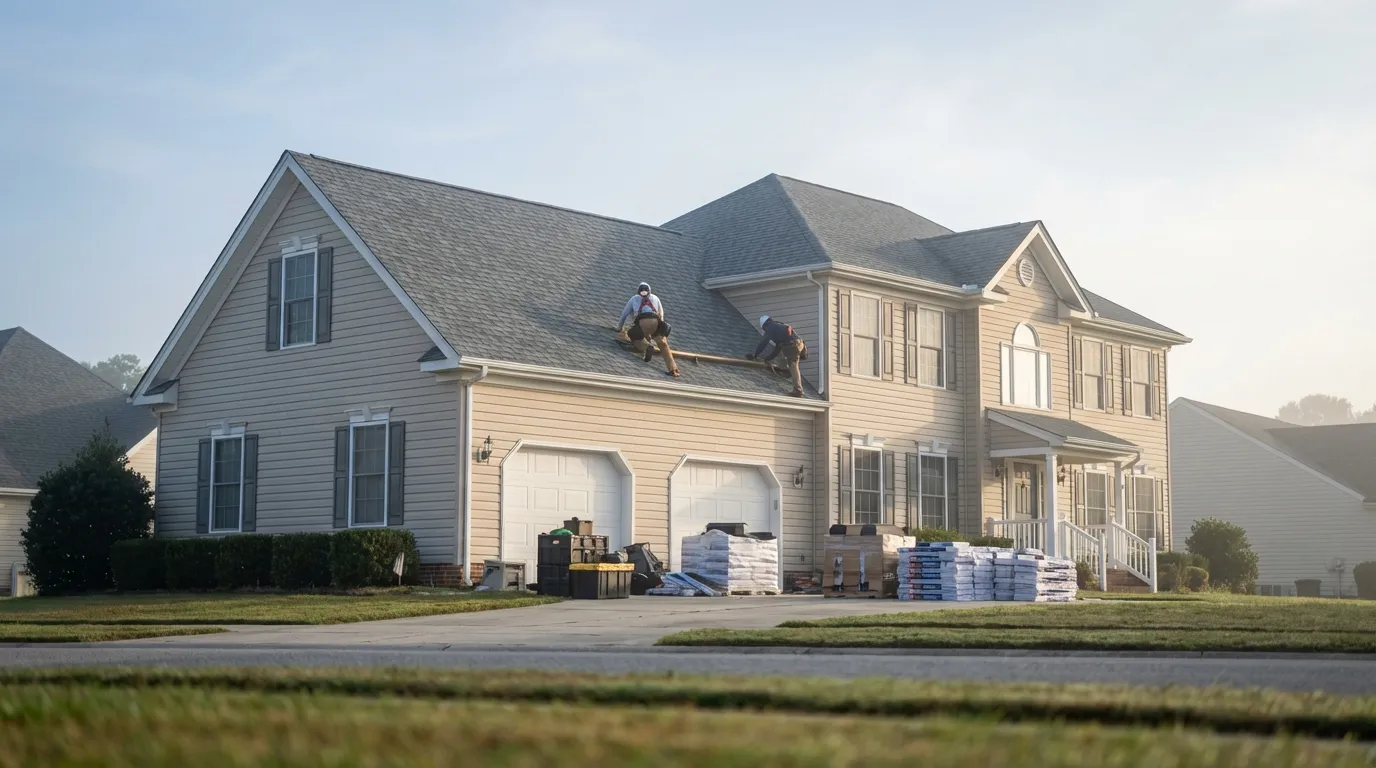
With more than 3,027 roofing contractor listings on BBB near Virginia Beach, the roofing Google Ads market is one of the most contested in the home services category — and it becomes more chaotic after every major weather event. The challenge for local roofing contractors isn't finding customers; it's beating hundreds of competitors to the top of the search results page before a homeowner calls the first number they see.
Storm Chasers and the Post-Event PPC Arms Race
Virginia Beach's coastal exposure — approximately 46 inches of annual rainfall, multiple tropical systems or nor'easters passing within 200 miles each season — creates a predictable post-storm spike in roof-related searches. Within 24–48 hours of a significant weather event, out-of-area "storm chaser" contractors flood the Virginia Beach market: not just with door-knocking and truck caravans, but with hastily launched Google Ads campaigns targeting high-urgency queries like "emergency roof repair Virginia Beach" and "storm damage roofing." These campaigns spike CPCs in the $30–$60 range for emergency keywords — a 50–100% increase over baseline.
Local contractors who haven't pre-established their Google Ads presence face a compounding disadvantage in these windows. New campaigns require 2–4 weeks to build Quality Score and conversion history. A campaign launched the day after a nor'easter is bidding against campaigns with months of established history — and paying significantly more per click for lower ad positions. The contractors who win post-storm PPC are the ones who maintained consistent campaigns before the event and simply increased bids during peak demand. Named local operators like Domi Roofing LLC and DA Arnold, Inc. — both BBB Accredited A+ in Virginia Beach — have the brand foundation; what separates them in search is the campaign infrastructure behind the brand.
The Insurance Claim Complexity and DSO Lead Aggregators
A significant percentage of Virginia Beach roofing demand is insurance-driven — homeowners filing claims after storm events who need a contractor recommendation from an adjuster or want to initiate the claim process themselves. Insurance claim searches ("roof insurance claim contractor Virginia Beach," "storm damage roof inspection") are high-intent but require a different landing page approach than general replacement quotes. Most local roofing ads don't distinguish between the insurance-claim customer and the out-of-pocket replacement customer — serving both with the same generic "free estimate" message misses the conversion opportunity on both.
Beyond storm chasers, national lead aggregators like Angi (formerly Angie's List) and HomeAdvisor appear prominently in roofing searches and siphon leads before homeowners reach a contractor's direct landing page. A homeowner who clicks an Angi result enters a lead auction where their contact information is sold to 3–5 contractors simultaneously — driving up competitive pressure and reducing close rates. PPC campaigns to direct contractor websites bypass this dynamic entirely, generating exclusive leads that aren't shared with competitors.
The metal roofing niche represents a specific underserved segment in Virginia Beach's PPC landscape. Despite the clear ROI argument for coastal properties — metal roofing's resistance to salt-air corrosion, wind uplift, and storm debris impact — most local contractors don't run metal-specific campaigns. Keywords like "metal roofing Virginia Beach" and "metal roof installation Virginia Beach" carry CPCs of $8–$20, significantly below asphalt replacement terms, with less competition and a high-ticket average job ($18,000–$35,000). The first local contractor to build a metal roofing PPC landing page with a coastal durability angle owns that niche.
Virginia Beach roofing PPC performs best when campaigns are built around the market's three distinct demand modes: steady-state replacement (aging housing stock year-round), emergency/urgent repair (post-storm or active leak), and specialty upgrade (metal, architectural premium). Running these as a single campaign dilutes budget and keyword relevance — and loses the Quality Score advantage that segment-specific campaigns build over time.
Campaign Structure by Demand Mode
- Track 1 — Replacement / General: "roofing contractor Virginia Beach," "roof replacement Virginia Beach," "new roof Virginia Beach," "roof estimate Virginia Beach" — CPC range $12–$28. Landing page: trust signals (BBB badge, years in business, local photos), free estimate form, and financing options. Budget allocation: 40% of monthly roofing spend.
- Track 2 — Emergency / Storm Damage: "emergency roof repair Virginia Beach," "storm damage roofing Virginia Beach," "leaking roof Virginia Beach," "roof repair after storm" — CPC range $20–$45. Ad scheduling: 24/7 with bid modifiers for evenings and weekends. Call extensions mandatory — emergency customers call, they don't fill forms. Dedicated storm-damage landing page with insurance claim process explanation. Budget allocation: 35% — scaled up to 50–60% during and immediately after storm events.
- Track 3 — Metal / Specialty: "metal roofing Virginia Beach," "metal roof installation Hampton Roads," "standing seam metal roof Virginia Beach" — CPC range $8–$20. Low-competition niche with high-ticket average job. Landing page: coastal durability angle, 50-year warranty messaging, before/after imagery of metal vs. asphalt on coastal homes. Budget allocation: 25% — modest spend to own an underserved niche.
Pre-Storm Campaign Activation Protocol
The highest-ROI roofing PPC tactic in Virginia Beach is pre-storm campaign activation. When the National Hurricane Center or National Weather Service issues watches or warnings for the Hampton Roads region, Quality Score is already established, ad copy is already written, and bid adjustments can be made within hours rather than days. Contractors who activate a dedicated "storm prep" campaign before a weather event — targeting "roof inspection before hurricane," "storm-ready roofing Virginia Beach," "prepare your roof for hurricane season" — capture homeowners in the pre-event anxiety window at CPCs of $8–$18, a fraction of the post-event emergency spike.
Insurance claim landing pages are a campaign element most Virginia Beach contractors skip. A dedicated page explaining the insurance claim process — "what to document," "how to work with your adjuster," "what to expect from an inspection" — converts insurance-driven leads at 30–40% higher rates than a generic "free estimate" page, because it answers the specific concern that insurance-claim customers have. Combined with keywords targeting insurance-related search phrases, this creates a conversion path that most competitors don't offer.
Google Partner Agency
We're a certified Google Partner Agency, which means we don’t guess — we optimize withGoogle’s full toolkit and insider support.
Your campaigns get pro-level execution, backed by real expertise (not theory).

Virginia Beach's housing stock tells a story that most markets don't: an estimated 107,000–115,000 homes built between 1970 and 1999 are sitting in a salt-air coastal environment, now 25–55 years old. Asphalt shingle roofs have a 20–25 year lifespan in ideal conditions — and Virginia Beach's coastal conditions are decidedly not ideal. Salt-air humidity accelerates granule loss, flashing corrosion, and sealant degradation faster than inland markets. A 25-year-old roof in Kempsville performs worse than a 25-year-old roof in Richmond, all else equal.
The Storm Damage Multiplier
Virginia Beach sits in a geographic position that generates consistent storm exposure without being a hurricane direct-hit zone. The city averages 46 inches of annual precipitation, with a significant proportion falling during the Atlantic hurricane season (June–November) as tropical moisture and nor'easter systems track up the coast. Since 1950, Virginia Beach has experienced more than 40 named tropical systems passing within 200 miles — each one capable of generating 50–75 mph gusts sufficient to cause shingle loss, flashing failure, and gutter damage on aging roofs.
Key insight: The combination of aging housing stock and persistent coastal storm exposure means Virginia Beach roofing demand is not cyclical — it's structural. Unlike inland cities where roofing demand clusters around major storm events, Virginia Beach generates consistent replacement demand year-round simply from the cumulative effect of salt corrosion and storm fatigue on pre-2000 roofs. A contractor running PPC 12 months per year captures this baseline demand; a contractor who only advertises after storms misses the steady-state replacement market that represents 60–70% of total annual job volume.
The insurance claim segment adds a demand layer that amplifies every storm event. Virginia Beach homeowners with homeowner's insurance policies — approximately 85–90% of the city's 114,700 homeowner households — are eligible to file claims for storm-caused damage. Each named storm or severe nor'easter that affects Virginia Beach generates 2,000–8,000 potential insurance claim assessments across the city's housing stock. A roofing contractor running claim-aware PPC — with landing pages that explain the claims process and emphasize "we work with all insurance companies" — can convert a significant portion of post-storm searchers into booked inspections at CPLs of $65–$130.
- March–May: Pre-storm season inspection campaigns; homeowners preparing for hurricane season; post-winter damage assessment
- June–November: Peak storm season; emergency repair and insurance claim campaigns activated; budget increases 50–75%
- September–October: Post-summer assessment; schools back in session, homeowners re-engage home improvement projects
- December–February: Insurance approvals from fall storm claims drive winter installations; nor'easter season generates ongoing repair demand
Virginia Beach roofing PPC is not a set-it-and-forget-it campaign. The market requires active budget management tied to weather events, seasonal demand cycles, and post-storm competitive surges. A generic roofing campaign left on autopilot will underperform the market's demand curve every time — bidding flat when emergency CPCs spike and wasting money during low-demand winter months without seasonal reallocation.
At MB Adv Agency, we build Virginia Beach roofing campaigns with three tracks: replacement/general, emergency/storm damage, and specialty (metal). We implement pre-storm bid modifier protocols so your campaign is positioned before competitors launch their scramble campaigns. We build dedicated insurance claim landing pages for the post-event conversion window. And we track cost-per-booked-inspection — not just cost-per-click — because a roofing business is measured in jobs started, not leads submitted.
We've managed home services PPC in coastal markets long enough to know that the contractors who win Virginia Beach roofing are the ones with consistent presence, not the ones who turn campaigns on and off. The Quality Score advantage built over 3–6 months of consistent campaigns is worth 20–35% lower CPCs than cold-launch competitors — compounding over every storm season.
See our roofing PPC pricing options to find the budget tier that fits your current ad spend. Our lead generation framework covers how we structure storm-response and replacement campaigns for home services contractors. The Virginia Beach PPC management page has local competitive context specific to roofing and other home services.
Frequently Asked Questions
How much does roofing PPC cost per lead in Virginia Beach?
Roofing CPL in Virginia Beach ranges from $65–$180 under normal market conditions — but this range shifts significantly based on the demand environment. During and immediately after storm events, emergency roofing CPCs spike to $30–$60 per click, which can push CPL to $150–$250 for contractors without pre-established Quality Scores. Contractors with well-maintained campaigns entering peak demand windows with strong Quality Scores typically maintain CPL in the $80–$130 range even during post-storm competition surges.
At a per-job average of $8,500–$18,000 for a standard asphalt replacement and $18,000–$35,000 for metal roofing, even a $180 CPL delivers a 47:1 revenue-to-lead-cost ratio on a mid-range job. The math on roofing PPC is favorable even at the high end of CPL — which is why roofing is consistently one of the highest-ROI home services PPC categories nationally. The real variable is conversion rate: a well-structured landing page with trust signals (BBB accreditation, local photos, financing options, insurance claim process explanation) converts at 8–14%, while a generic "contact us" page may convert at 3–5%.
Seasonal budget strategy matters: a flat $3,000/month annual budget is less efficient than a $2,000/month baseline with $4,000–$7,000 surge allocation during June–November storm season. Pre-positioning budget for storm months before they arrive — rather than scrambling to increase spend after an event — is the tactical difference between capturing storm demand and chasing it.
Should a Virginia Beach roofing contractor run Google Ads year-round or only during storm season?
Year-round, without question. The reasoning is both strategic and technical. Strategically, Virginia Beach's aging housing stock generates consistent replacement demand across all 12 months — the 107,000+ homes built before 2000 don't stop needing roofs in January. Homeowners schedule inspections, request quotes, and book replacements throughout the year, with storm events generating spikes on top of an always-present baseline. A contractor who turns off ads in winter misses that baseline and concedes it to always-on competitors.
Technically, pausing campaigns and restarting them resets the Quality Score learning curve. Google's ad auction rewards campaigns with consistent history: click-through rates, conversion rates, and ad relevance signals built over months determine the Quality Score that determines your ad rank at any given CPC. A campaign paused for 3–4 months loses freshness signals and may require 6–8 weeks of re-establishment to return to prior performance levels. A roofing contractor who turns campaigns off in December and back on in March enters spring and pre-storm season with a degraded Quality Score — paying 20–35% more per click than a competitor who maintained year-round presence.
The optimal structure is a year-round baseline spend of $2,000–$3,000/month on replacement and specialty tracks, with a storm season surge budget of $4,000–$7,000/month from June through November. This maintains Quality Score continuity while concentrating budget in the highest-demand window — and positions the campaign to activate storm-response ad copy within hours of a weather event, rather than days.