Transportation & Logistics PPC Newark, NJ
Port Newark-Elizabeth Marine Terminal is the largest containerport on the East Coast, and 16,969 Newark workers — growing at 10% year-over-year — depend on the freight ecosystem it anchors. For SMB logistics operators competing against C.H. Robinson and XPO on lead generation, hyper-local PPC is the only channel where a $2,000/month budget beats a national broker's seven-figure marketing spend.
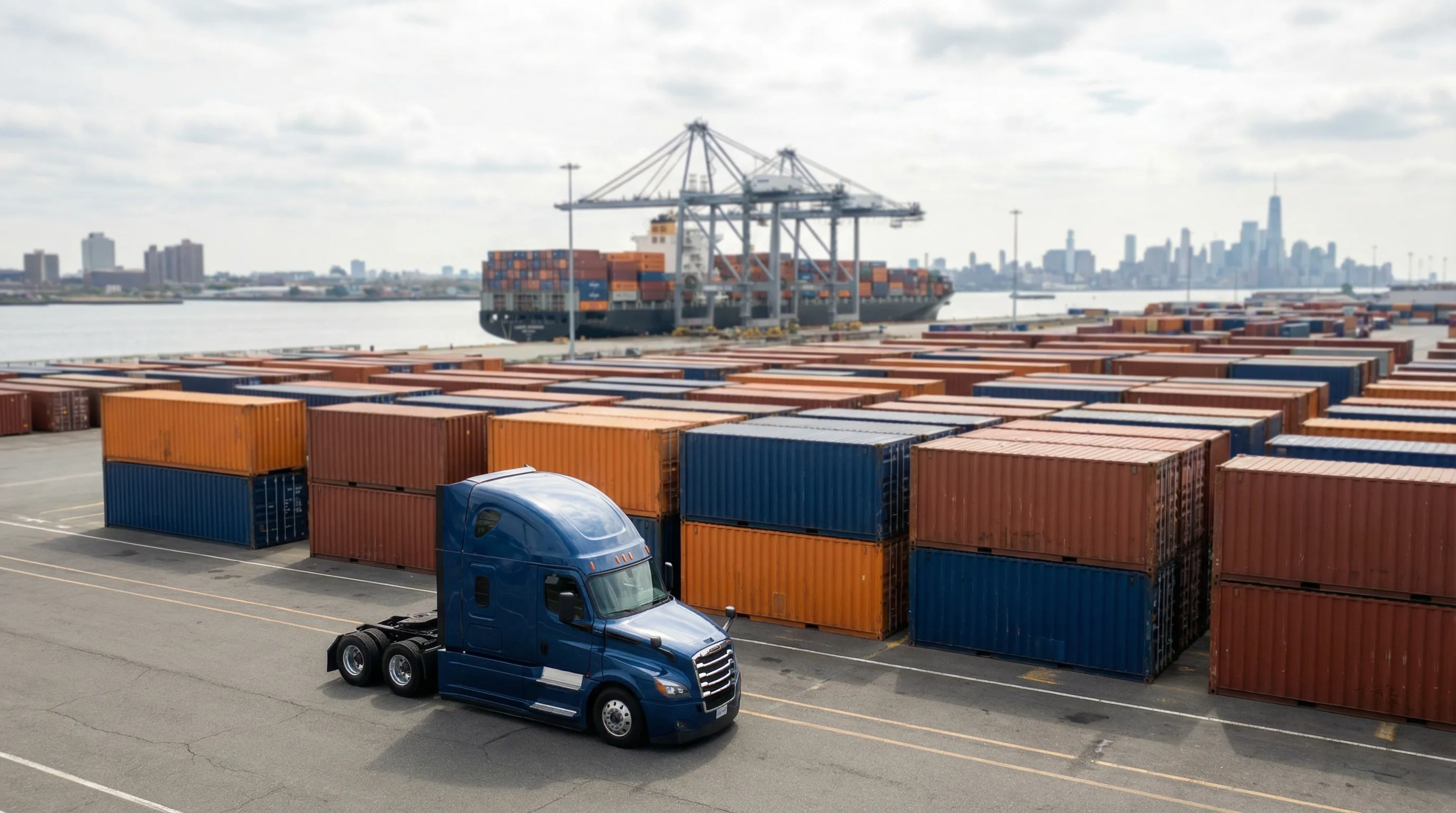
Why Do Transportation & Logistics PPC Campaigns Fail in Newark?
The default approach to logistics PPC fails in Newark because it treats a hyper-specialized port market like a generic freight market. Operators bid on "freight broker NJ" or "logistics company Newark" — and immediately collide with C.H. Robinson, XPO Logistics, Coyote Logistics, and Echo Global, all of whom maintain substantial Google Ads budgets targeting exactly those terms. The result: CPCs spike, Quality Scores drop, and SMB operators spend $3,000/month to win zero contracts because their ads appear alongside national brands with recognizable names, established reviews, and enterprise client lists.
The second failure is ignoring the port's operational vocabulary. Shippers searching for drayage don't type "trucking company Newark NJ" — they type "drayage Port Newark," "container pickup EWR," "chassis pool Newark." These are high-intent, low-competition terms that no national broker bothers to bid on because they're too geographically specific. SMB operators who have physical proximity to Port Newark — their actual competitive advantage — fail to activate it digitally because their campaigns don't use the port-specific language their customers use.
The B2B Intent Mismatch Problem
Logistics PPC requires a fundamentally different campaign architecture than consumer services. A roofing company can optimize for a single conversion event — a homeowner calls for a quote. A 3PL operator needs to capture a procurement manager who is six weeks into evaluating vendors and has visited four websites, downloaded two capability decks, and is preparing an RFP. Running a single-touch, call-now campaign against that buyer journey is guaranteed to miss them.
Newark's 3PL and warehousing SMBs consistently run campaigns that treat B2B logistics buyers like consumer-intent searchers. They use the same ad copy, the same landing pages, and the same bidding strategy for "warehouse space Newark NJ" — a high-value B2B search — as a consumer-facing roofing campaign. The result: clicks from logistics buyers who don't convert because the landing page doesn't speak to their procurement criteria: capacity specs, bonded warehouse status, DEA licensing, WMS systems, insurance levels.
Last-Mile vs. Long-Haul Confusion
Newark's logistics market contains at least four distinct buyer segments — port drayage, last-mile commercial delivery, 3PL/warehousing, and air cargo/customs brokerage — with completely different search behaviors, buying timelines, and conversion actions. Campaigns that mix these segments in a single ad group produce diluted Quality Scores and irrelevant ad-to-query matching. A same-day courier serving Newark restaurants and a freight forwarder handling pharma cold-chain shipments through EWR are not the same buyer, and they should never see the same ad.
- Port drayage / container trucking: "drayage company Newark," "container pickup Port Newark," "chassis rental NJ" — $5–$12 CPC, near-zero SMB PPC competition, hyper-local operators win
- Last-mile commercial delivery: "same-day courier Newark NJ," "local delivery service Newark commercial" — $4–$9 CPC, strong volume from Newark's dense SMB market
- 3PL / warehousing B2B: "warehouse storage Newark NJ," "fulfillment center Newark," "third-party logistics NJ" — $6–$15 CPC, high contract value ($5K–$50K/month), national brands don't compete on local terms
- Air cargo / EWR specialists: "freight forwarder Newark airport," "air cargo customs broker NJ," "pharma cold chain shipping NJ" — $7–$16 CPC, time-sensitive buyers, near-zero local PPC competition
- Construction logistics: "crane rental Newark NJ," "heavy equipment transport Newark," "construction materials delivery NJ" — $5–$13 CPC, seasonal spike Q2-Q3 aligned with Newark's urban renewal pipeline
The fix isn't a bigger budget — it's campaign segmentation. Every operator subtype gets its own campaign, its own keyword set, and its own landing page that uses their language, addresses their procurement criteria, and makes the case for why a Newark-based operator with direct port access is worth a discovery call. National brokers can't make that case. You can.
PPC Campaign Architecture for Newark Logistics Operators
A winning Newark logistics PPC strategy starts with one structural principle: each buyer segment is its own campaign. Port drayage buyers and last-mile commercial clients don't search the same way, don't convert the same way, and don't respond to the same value proposition. Building one campaign that serves all of them produces mediocrity across the board.
Campaign 1 — Port & Drayage (Highest Priority for Port-Adjacent Operators):
- Port-specific drayage keywords: "drayage Port Newark," "container trucking Newark Elizabeth," "chassis rental Port Newark" — $5–$12 CPC, essentially no direct SMB PPC competition
- Container handling terms: "container pickup NJ," "port drayage company East Coast," "intermodal trucking Newark" — $6–$13 CPC
- Match types: Phrase match on port-specific terms; exact match on service + port combinations. Avoid broad match — it bleeds budget into generic trucking terms dominated by nationals
- Landing page requirement: Port proximity, TWIC-certified drivers, chassis availability, real-time container tracking. These are procurement criteria — the page must answer them above the fold
Campaign 2 — 3PL / Warehousing B2B:
- Warehousing intent keywords: "warehouse storage Newark NJ," "fulfillment center Newark NJ," "3PL logistics Newark" — $6–$15 CPC, high contract value justifies cost
- Capacity-specific terms: "bonded warehouse Newark NJ," "temperature-controlled storage NJ," "FDA-registered warehouse NJ" — $8–$18 CPC, strong buyer qualification built into the search
- B2B bidding approach: Target CPA bidding set to $300–$500 per qualified lead; manual CPC during the first 60 days to build conversion data before switching to automated bidding
Campaign 3 — Last-Mile Commercial Delivery:
- Commercial delivery keywords: "same-day courier Newark NJ," "local delivery service Newark commercial," "business courier service Newark" — $4–$9 CPC
- Urgency modifiers: Add "same-day," "urgent," "next-hour" as keyword qualifiers to capture the highest-intent, lowest-comparison buyers
- Ad scheduling: Heavy weighting 7 AM–3 PM weekdays (business shipping decisions); reduce bids after 5 PM and weekends when SMB demand drops
Campaign 4 — Air Cargo & EWR Specialists:
- EWR-specific freight terms: "freight forwarder Newark airport," "EWR cargo agent," "air freight NJ customs broker" — $7–$16 CPC, time-sensitive buyers with minimal price sensitivity
- Pharma cold chain: "pharmaceutical cold chain shipping NJ," "temperature-controlled air freight EWR" — $10–$20 CPC, extremely high contract value; worth aggressive bidding
- Competitor gap: National forwarders (Expeditors, Kuehne+Nagel) bid on brand terms, not local EWR service terms. This is an open window for local specialists
Seasonal Bid Strategy — Peak vs. Off-Peak:
Newark logistics has the most pronounced seasonal pattern of any industry in the market: October through December is very high demand (port volumes surge pre-holiday, EWR air cargo at maximum capacity, last-mile demand at annual peak). Bid adjustments of +30–40% during peak season are warranted. Q1 contract renewal season (January–March) is the second highest period — budget accordingly. Summer (July–September) is moderate; reduce bids 15–20% and redirect savings to September for the fall budget cycle.
Google Partner Agency
We're a certified Google Partner Agency, which means we don’t guess — we optimize withGoogle’s full toolkit and insider support.
Your campaigns get pro-level execution, backed by real expertise (not theory).

What Market Trends Should Newark Logistics Businesses Know Before Running PPC?
Newark's logistics market is in a structural growth phase that most local operators are underestimating. The numbers are stark: Transportation & Warehousing is the city's #2 employment sector at 16,969 workers, growing at 10% year-over-year (DataUSA 2024). That growth rate is faster than any other major sector in the city and reflects a convergence of three macro trends — e-commerce volume through EWR's cargo hub, post-pandemic supply chain reshoring pulling East Coast port traffic from West Coast alternatives, and Newark's urban renewal pipeline generating construction logistics demand.
Key insight: Port Newark-Elizabeth handles millions of TEUs annually — a volume that makes it the dominant East Coast entry point for goods from Europe, the Mediterranean, and increasingly, diverted Asia-origin cargo that no longer routes through LA/Long Beach. This isn't a temporary trade pattern. Panama Canal expansion and East Coast port infrastructure investment have permanently shifted a portion of trans-Pacific freight east. SMB operators near Port Newark are positioned to benefit for the next decade.
The Last-Mile E-Commerce Build-Out
Amazon Air's cargo hub at EWR, combined with FedEx and UPS regional sort facilities in the Newark area, has created a secondary ecosystem of independent last-mile delivery contractors and regional parcel services. These SMBs — typically 5–50 van fleets — compete for commercial delivery contracts from Newark's dense business community: restaurants receiving daily produce, medical suppliers delivering to clinics, retailers managing B2B replenishment. The search volume for "same-day courier Newark" and "local delivery service Newark commercial" has grown substantially as e-commerce normalization shifts shipper expectations from "2 days" to "same day."
Critically, national courier services (DHL Express, OnTrac) bid on metro-level terms — not neighborhood or industry-specific terms. A courier targeting "same-day delivery Ironbound Newark" or "medical supply delivery Newark NJ" faces almost no direct competition from nationals. These terms are effectively free for local operators willing to build the campaign.
Construction Logistics as an Underserved Vertical
Newark's urban renewal pipeline — Mulberry Commons, Penn Station redevelopment corridor, Passaic River waterfront conversion — is generating multi-year demand for construction logistics: materials delivery, crane rental, heavy equipment transport, and site logistics management. These searches ("crane rental Newark NJ," "construction materials delivery Newark," "heavy equipment transport NJ") carry moderate CPCs ($5–$13) and high project values. The buyer is a project manager or GC, not a consumer — they search once, evaluate two or three options, and issue a PO. A well-structured campaign with strong landing page credibility (bonded, insured, local project photos) converts this buyer efficiently.
The seasonal alignment is important: construction logistics peaks in Q2-Q3, exactly when port drayage is at moderate levels. This creates a natural budget rotation opportunity — shift emphasis toward construction logistics May–September, rotate back to port and 3PL as Q4 peak approaches in October.
Why Newark Logistics PPC Requires a Local PPC Partner
Running Google Ads for a Newark port drayage operator or a Newark 3PL is not a national logistics campaign with a geo-filter applied. It requires knowing that "Port Newark" and "Port Newark-Elizabeth" are different search terms with different volumes. It requires understanding that pharma cold-chain shippers at EWR operate on completely different procurement timelines than a Newark restaurant needing same-day produce delivery. It requires knowing which months to push budget and which months to scale back — and that peak season for port traffic starts in October, not December.
MB Adv Agency builds PPC campaigns for B2B service businesses that compete against national platforms with local expertise. Our campaigns for logistics operators use port-specific vocabulary, separate buyer segment targeting, and landing pages built for procurement-level decision-making — not consumer-style call-now CTAs.
If your current Google Ads campaign isn't using port-specific terms, isn't separated by buyer type, and isn't adjusted for Newark's freight seasonality, you're paying for traffic you can't convert.
See how MB Adv structures B2B lead generation campaigns — then review our pricing to find the right tier for your logistics operation. For Newark-specific campaign strategy, visit the Newark PPC services page.

Frequently Asked Questions
How much should a Newark logistics SMB spend on Google Ads to win B2B contracts?
A Newark logistics SMB targeting B2B freight and warehousing contracts should plan for a starter budget of $2,000–$4,000 per month. At that spend level, a well-structured campaign targeting port drayage, last-mile commercial delivery, or 3PL warehousing terms generates 8–20 qualified B2B leads per month, depending on the subvertical. Port drayage terms ($5–$12 CPC) and last-mile courier terms ($4–$9 CPC) deliver the most volume per dollar. 3PL and warehousing B2B terms ($6–$15 CPC) generate fewer leads but at higher contract value — a $10,000/month warehousing contract justifies a $500 CPL. Air cargo and pharma cold-chain campaigns require $3,000–$5,000/month minimum due to higher CPCs ($7–$20) but the contract values ($50K–$500K/year) make ROI compelling.
The key budgeting principle for B2B logistics: unlike consumer services where a single call is the conversion, B2B buyers go through 3–5 touchpoints before committing. Budget for remarketing alongside the primary search campaign — a $500/month remarketing allocation keeps your brand visible to procurement managers who visited your site but haven't yet issued an RFP. In peak season (October–December), plan to increase budget by 30–40% as port volumes and last-mile demand surge simultaneously. Q1 (January–March) is the contract renewal season — another high-investment period worth increased spend.
Seasonality rule: Never cut budget in October. It's the highest-ROI month of the year for Newark port-adjacent operators.
Can a small Newark freight broker or courier compete against C.H. Robinson and XPO on Google Ads?
Yes — but not by competing on the same keywords. A Newark SMB freight broker or courier competing head-to-head with C.H. Robinson or XPO on "freight broker NJ" or "logistics company" is guaranteed to lose. National brokers spend millions annually on broad freight terms and have Quality Scores, landing page authority, and brand recognition that no SMB can match at scale. The winning approach is surgical geographic and service-specific targeting that nationals don't bother with. "Drayage Port Newark," "container pickup Newark Elizabeth Marine Terminal," "same-day courier Ironbound Newark NJ" — these terms have near-zero competition from nationals because they're too hyper-local to appear in national campaign structures.
The competitive moat for Newark SMBs is port proximity and local operational knowledge. A local drayage operator with direct port relationships and TWIC-certified drivers can make a compelling case that C.H. Robinson cannot — and they can make that case on a landing page that costs $2,000/month to keep visible to every shipper searching for Newark port services. Port-specific terms convert at 4–7% for operators with credible landing pages. At $6–$10 CPC and 5% CVR, that's a $120–$200 CPL for a lead that could turn into a $5K–$50K/month contract. The ROI math is favorable — but only if the campaign is built around what makes local operators different, not trying to out-spend nationals on generic freight terms.