How GBP Impacts Local Rankings (2026)

GBP & Local Rankings 2026
3
Google documents exactly three local ranking factors — relevance, distance, and prominence. Your Business Profile is the primary data source the local pack draws from, and it directly feeds two of them.
GBP itself is free ($0) · local pack shows about 3 listings · proximity is the single largest factor (~55%, Whitespark 2026 expert-survey estimate)
How Does a Google Business Profile Affect Local Rankings?
Google says local results are mainly based on relevance, distance, and prominence — and your Business Profile is the primary data source the local pack draws from, so it directly influences the first and third. The short answer to "how does a Google Business Profile affect local rankings?" and "does Google Business Profile help SEO?" is the same: an accurate, complete, well-categorized, review-rich profile is what makes you eligible to rank and improves the two factors you can control.
Google's own help page is unambiguous: "Local results are mainly based on relevance, distance, and prominence" (support.google.com/business/answer/7091). Relevance is how well your profile matches what someone searched. Distance is how far you are from the searcher or the location term in their query. Prominence is how well-known and well-regarded your business is — informed partly by links, articles, directories, and your number of reviews. Everything else you read about local ranking — categories, review velocity, NAP consistency, photos, site authority — is not a fourth factor. It is an input that rolls up into one of these three.
The mechanical reason the profile matters is that it is not a listing you submit to a ranking system; it is the source record the ranking system displays. The local pack pulls a business name, rating, review count, category, hours, and photos primarily from the Business Profile. A thin, wrong-category, review-poor profile does not just rank lower — it gives Google worse data to match against a query in the first place. If you are new to how the profile relates to Maps and Search, what a Google Business Profile is covers the GMB-to-GBP rebrand and how the profile differs from Google Maps.
| Factor | What Google says it means | What feeds it | Can you influence it? |
|---|---|---|---|
| Relevance | How well your local profile matches what someone is searching for | Primary category (the strongest lever), additional categories, business name, services, description, attributes — complete, accurate profile data helps Google match your listing to the query | Yes — directly. The most controllable factor; category choice and completeness are the primary levers |
| Distance | How far each result is from the location term in a search, or from the searcher's location if none is specified | Your verified address (storefront) or service-area relative to the searcher; Google calculates from known location data | Mostly no. You cannot move closer to every searcher; a correct address or service-area is the only control. Per Whitespark, the single biggest factor (~55%) |
| Prominence (Google also calls it "popularity") | How well-known and well-regarded a business is — Google's example is that famous landmarks are prominent in local results | Informed "partly by links," articles, and directories about your business; your number of reviews and review score; overall web presence and site authority | Yes — indirectly, over time. Reviews, links, citations, and a strong website build prominence; it cannot be toggled on instantly |
Source: Google, "Improve your local ranking on Google" (support.google.com/business/answer/7091 — "Local results are mainly based on relevance, distance, and prominence"; prominence is "also based on information Google has about a business from across the web, like links, articles, and directories," and "Google review count and review score factor into local search ranking"). Completeness, accuracy, and verification affect eligibility to show. Not mbadv data.
MB Adv Agency starts every local-search conversation from Google's three words: relevance, distance, prominence. Two of the three are within a business owner's control, and the single strongest of those levers is the primary category — covered in detail in optimizing business categories for better visibility.
Relevance, Distance, Prominence: Three Factors, Not 200 Mystery Signals
The most common overcomplication in local-SEO content is the promise of a long, mysterious list of "200 ranking signals." There is no secret list. Google documents exactly three factors, and the discipline that wins the local pack is optimizing the handful of controllable inputs that roll up into them — not chasing signals Google never confirmed.
Categories, reviews, NAP consistency, photos, completeness, verification, and website authority are not additional factors. They are inputs. A business optimizing "200 signals" is usually neglecting the three that Google actually named at support.google.com/business/answer/7091. The correct model is three buckets, each fed by a short list of controllable inputs: relevance is fed by your primary category and profile completeness; prominence is fed by reviews, links, and a strong website; distance is fed by your verified address.
This reframing changes where a local business spends its energy. The value MB Adv Agency brings is not a secret checklist; it is the discipline to optimize the inputs Google rewards and to ignore the ones content mills invented. The businesses that pull ahead in the local pack pick the most specific primary category, complete every field, earn reviews steadily, and back it with an authoritative website — four moves, mapped to Google's three factors, instead of a scattershot chase. Category choice is the highest-leverage of these; choosing the right primary and additional categories is where most of the relevance gain lives.
What Local Businesses Search For: The Ranking Cluster
The demand behind this pillar splits into two shapes: the broad "local seo" category at 46,000 US searches a month, and a definitional cluster around "local pack" and "google map pack" that arrives wanting to know what those results are and how to get into them.
| Keyword | US monthly volume | Global volume | KD | Role in this pillar |
|---|---|---|---|---|
| local seo | 46,000 | 86,000 | 86 | Broad category anchor — highest volume, hardest term |
| local pack | 1,100 | 3,300 | 40 | Definitional intent from the absorbed local/map-pack explainer → the id="local-pack" section |
| google map pack | 600 | 1,100 | 0 | Same definitional cluster; KD 0, a low-competition capture |
Source: Ahrefs Keywords Explorer, US 12-month average, pulled 2026-07-01 (data JSON: data/google-business-profile/how-gbp-impacts-local-rankings.json). This is search demand, not a ranking metric. The three absorbed URLs currently show 0 clicks and 0 impressions in the trailing 90 days (2026-04-02 to 2026-07-01) — the demand is a target, not current capture. Not mbadv data.
The definitional cluster ("local pack," "google map pack," "3-pack") is the toehold folded into this pillar under the id="local-pack" section below, so a reader searching those terms lands on the answer. Once you understand how the profile earns local visibility, the natural next question is what that free presence costs to run — how much a Google Business Profile costs answers it (the profile is free; you pay only for Google Ads and Local Services Ads).
How Much Does Each Local Ranking Factor Weigh?
Google publishes the three factors but no weights. The credible source for how much each one counts is Whitespark's "2026 Local Search Ranking Factors" — an expert survey of about 47 local SEOs, framed here as an estimate of relative influence, not Google's algorithm. Its headline finding reframes the entire strategy.
| Signal category | Estimated weight (local pack) | Maps to Google factor | Direction |
|---|---|---|---|
| Proximity / distance to searcher | ~55% (single largest) | Distance | Stable — the dominant local-pack factor; largely uncontrollable |
| Google Business Profile signals (primary category, completeness, attributes) | ~32% | Relevance (+ eligibility) | The most controllable bucket; primary category is the top sub-signal |
| On-page / website signals | ~19% | Prominence / Relevance | Where the website-link signal plugs in (see the website-link section) |
| Review signals (count, velocity, score, keywords) | ~16–20% | Prominence | Rising — reviews carry growing weight in recent surveys |
| Link signals (inbound links to your site or profile) | Contributory (rolled into prominence) | Prominence | Reinforces the "partly by links" language in Google's own docs |
| New for 2026: social signals + AI-search signals | Newly entered (weight not yet quantified) | Prominence / emerging | Whitespark's 2026 report added a distinct "AI Search Visibility" category |
Source: Whitespark, "2026 Local Search Ranking Factors" (Darren Shaw; published Nov 6, 2025; an expert survey of ~47 local SEOs). These are expert-survey estimates of relative influence, NOT Google's published algorithm weights — Google discloses no factor weights, and the four charted values are secondary-summarized and do not sum to 100% (link, social, and AI-search categories also contribute). ⚠ Ranking-factor weights come from Whitespark only — never attribute weight percentages to BrightLocal, which publishes the Local Consumer Review Survey (consumer behavior), not a weighted ranking table. Moz's older ranking-factors study is effectively superseded by Whitespark's. Not mbadv data.
The single biggest local-pack factor is the one you cannot optimize. Whitespark puts proximity/distance at roughly 55% of local-pack weight — the largest single factor. You cannot move your storefront to the center of every searcher's map. What that number should do is redirect your energy to the factors you can control: GBP signals (~32%), dominated by your primary category; on-page/website signals (~19%); and reviews (~16–20% and rising). The businesses that win the map pack are not the ones chasing proximity they cannot change — they are the ones who pick the most specific primary category, complete every field, and earn reviews steadily.
One sourcing correction travels with this table everywhere it is cited: ranking-factor weights come from Whitespark, never from BrightLocal. BrightLocal publishes the Local Consumer Review Survey, which measures consumer behavior — it is not a weighted ranking table. Any page presenting a "BrightLocal ranking-factor weighting" is misattributing consumer-survey data to an algorithm study. For the reviews half of prominence, customer reviews as a local-SEO signal covers how to earn and respond to reviews as a ranking factor, not just a reputation one. For a broader paid-and-organic local plan, our PPC services run the paid side that complements a well-optimized free profile.
The Local Pack, Map Pack & Local Finder: The Three Local Surfaces
The local pack, the map pack, the "3-pack," and the Local Finder are the same index at different depths — and your Business Profile is the data behind all of them. Understanding what each surface is clears up most of the confusion behind "how do I rank in the local pack?"
The local pack — industry shorthand "3-pack" or "map pack," never an official Google term — is the block of roughly three business listings shown with a map above the organic results for location-intent queries; the count can vary. When a searcher taps "More places" or "More businesses," they enter the Local Finder, the expanded, scrollable list. Both pull their name, rating, review count, category, hours, and photos primarily from the Business Profile. This is the mechanical reason the profile matters so much: it is the source record the ranking system displays, not a form you submit to it.
The third surface is new. AI Overviews — and Gemini-powered "Ask Maps" — increasingly appear above or in place of the traditional pack, and they generate their answers from the same profile fields (categories, attributes, services, hours, and review text). That is why optimizing the profile compounds: it feeds the pack, the Local Finder, and the AI answer at once. The by-intent breakdown of where each surface actually shows up is in the AI Overviews section below.
| Surface | What it is | Typical result set | Data source | 2025–2026 note |
|---|---|---|---|---|
| Local pack ("3-pack" / "map pack" — industry terms, not official) | The block of business listings shown with a map above organic results for location-intent queries | ~3 listings + map (count can vary) | Primarily the Business Profile — name, rating, review count, address, hours, photos | Still dominant on transactional "near me" intent; Whitespark Q2 2025: on about 39% of local searches |
| Local Finder | The expanded, scrollable list reached via "More places" / "More businesses" | Long list (dozens) + interactive map and filters | Same underlying local index as the pack — the Business Profile | Where businesses just outside the top ~3 still earn visibility |
| AI Overviews (and Gemini "Ask Maps") | AI-generated answers that appear above or in place of the traditional pack on many queries | Narrative summary + a handful of cited or recommended businesses | Draws on GBP categories, attributes, services, hours, and review text | Whitespark Q2 2025: on about 68% of local searches; skews informational / upper-funnel |
Sources: Search Engine Land local-pack guide (updated Nov 27, 2025 — the local pack shows about 3 listings with a map above organic results; the count can vary; data drawn primarily from the Business Profile; the Local Finder is the expanded list via "More places / More businesses"). Whitespark, Q2 2025 local-search analysis (AI Overviews on about 68% of local searches vs local packs about 39%; AIOs dominate informational intent, local packs dominate transactional intent). ⚠ The 68%/39% figures are Whitespark estimates, not Google-published data — attributed and softened. "3-pack" and "map pack" are industry shorthand, not official Google terms. Not mbadv data.
Once you are ranking in these surfaces, the payoff shows up in the profile's Performance report — understanding Performance reports in GBP covers the search-terms, calls, directions, and website-click metrics that show whether your local visibility is converting.
Linking Your GBP to Your Website: The Off-Profile Prominence Signal
Linking your Google Business Profile to your website is a prominence signal — and the profile's website field is where an off-profile ranking factor plugs in. Google says prominence is informed "partly by links," and Whitespark's estimate gives on-page/website signals about 19% of local-pack weight.
The website URL on your Business Profile is the bridge. It connects your listing to a domain whose authority, local relevance, and on-page signals — city and service in titles, headings, and content, plus a real location page — feed prominence. This is what the older "linking your GBP to your website for better SEO" advice was really about: not a magic toggle, but the correct plumbing. Put your true website on the profile, make that site demonstrably about your service and your location, and the two reinforce each other. A business with a strong local site and a linked profile has a prominence advantage over a competitor with an identical profile and a weak or missing site.
MB Adv Agency cares about the site's local-signal quality even when the immediate goal is the free GBP presence, because the paid campaigns we run often point at that same well-built local site. Turning local visibility into booked work is the other half of the job: our lead-generation PPC services run the paid side (Google Ads and Local Services Ads) that complements a well-optimized free Business Profile. Home-services businesses like roofers live and die by the map pack, which is why our roofing PPC work pairs paid search with the local visibility a strong profile-plus-website pairing earns organically.

How Each Profile Element Feeds a Ranking Factor
This is the "what should I actually optimize, and why" reference. Every profile element maps to the factor it moves, so the work is never guesswork — each field feeds relevance, distance, prominence, or your basic eligibility to show at all.
| Profile element / signal | Primary factor it feeds | Why it matters |
|---|---|---|
| Primary category | Relevance | The single strongest relevance/local-pack signal (Whitespark ranked category the #1 GBP local-pack factor); the wrong primary is a top negative |
| Additional categories, services, description, attributes | Relevance | Broaden the queries you match without diluting the primary; feed AI answers too |
| Verified address / service area | Distance (+ eligibility) | Sets how Google calculates proximity; an accurate, verified location is the only distance lever |
| Reviews (count, score, velocity, keywords) | Prominence | Google states review count and score factor into local ranking; estimated weight is rising (Whitespark) |
| Website URL on the profile | Prominence / Relevance | Bridges the listing to your domain's authority and on-page local signals (the off-profile signal — see the website-link section) |
| Profile completeness + verification | Eligibility (all three) | Completeness/accuracy and verification affect whether you are eligible to show at all; unverified or incomplete profiles are handicapped |
| Off-profile links, citations, directories, articles | Prominence | Google says prominence is informed "partly by links" and web mentions; consistent NAP citations reinforce it |
Sources: Google, "Improve your local ranking on Google" (relevance/distance/prominence; "Google review count and review score factor into local search ranking"; prominence informed "partly by links"); category strength per Whitespark Local Search Ranking Factors (primary category ranked the #1 GBP local-pack factor). Categories: 1 primary + up to 9 additional (10 total); the primary is the strongest relevance signal, and over-adding dilutes relevance. Not mbadv data.
Two rows carry most of the leverage. The primary category is the strongest relevance signal a business owns, so the most specific accurate primary beats a broad one; reviews feed prominence, and Google states their count and score factor into ranking. Completeness and verification are the gate: an unverified or thin profile is handicapped before ranking even applies, which is why creating and verifying the profile correctly unlocks ranking eligibility in the first place.
Are AI Overviews Replacing the Local Pack?
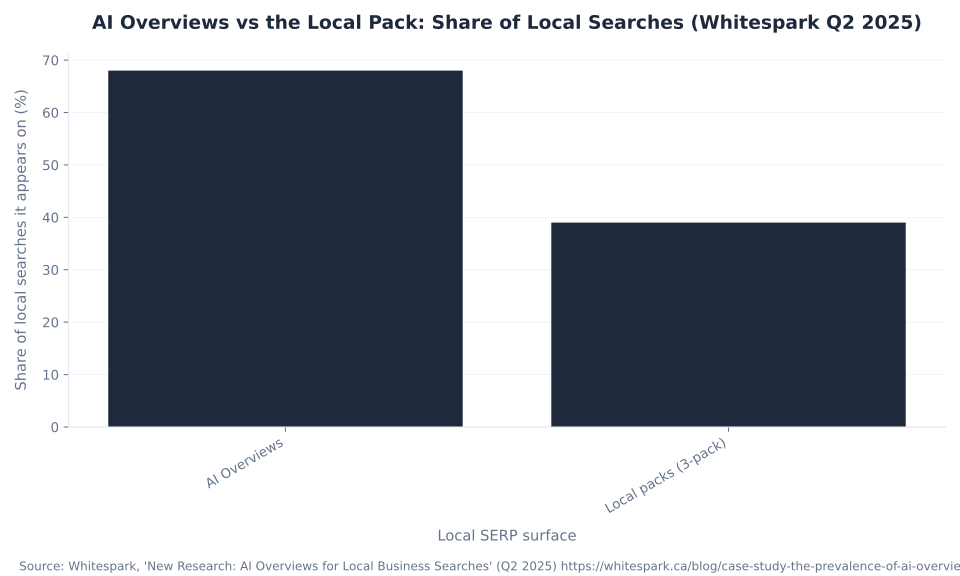
AI Overviews are reshaping the local SERP — but the profile now feeds both the AI answer and the map pack, so the work compounds instead of becoming obsolete. Whitespark's Q2 2025 data found AI Overviews on about 68% of local searches versus traditional local packs on about 39%. Read as "the local pack is dying," that is wrong in two ways.
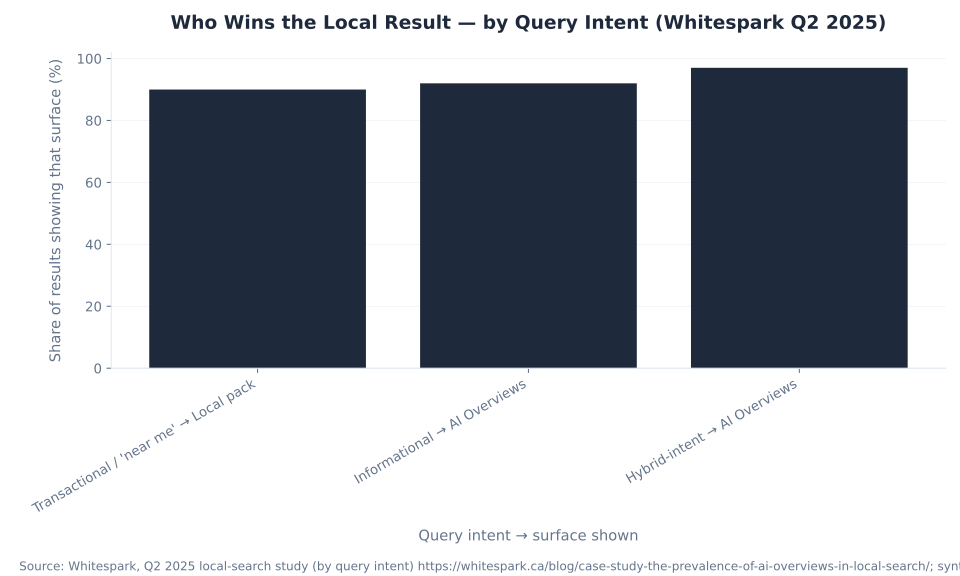
First, the split is by intent. AI Overviews dominate informational and upper-funnel queries ("what should I look for in a roofer"), while the traditional local pack still dominates transactional "near me" intent — the exact queries that produce calls and bookings. Second, and more important, the AI answers are generated from the same Business Profile fields (categories, attributes, services, hours, and review text) that power Google's Gemini-driven "Ask Maps." Optimizing your profile for relevance and prominence improves your odds in both surfaces at once.
| Query intent → surface shown | Share of results showing that surface | Source |
|---|---|---|
| Transactional / "near me" → Local pack | Above 90% (a conservative floor; "near me" reportedly triggers a Maps pack close to every time) | Whitespark Q2 2025 via ALM Corp |
| Informational → AI Overviews | ~92% | Whitespark Q2 2025 via ALM Corp |
| Hybrid-intent → AI Overviews | ~97% | Whitespark Q2 2025 via ALM Corp |
Sources: Whitespark, Q2 2025 local-search study (by query intent), synthesized in ALM Corp, "How AI Is Impacting Local Search" (Mar 17, 2026). Whitespark estimates, not Google-published; bars mix two surfaces intentionally to show the intent split. Trend context (Semrush, 10M+ keywords, via ALM Corp): the transactional share of AI-Overview-triggering queries grew from 1.98% (Jan 2025) to 13.94% (Oct 2025). Not mbadv data.
The businesses MB Adv Agency sees pull ahead in 2026 are not the ones treating AI as a threat to the map pack; they are the ones feeding a rich, accurate profile that both surfaces draw from. The trend context matters too: per a Semrush analysis synthesized by ALM Corp, AI Overviews are slowly expanding into commercial and transactional intent over time — a reason to keep the profile rich, not a reason to abandon the local pack. If you are weighing the free profile against paid search, GBP vs Google Ads decodes where each one fits.

Distance Is the Honest Ceiling — So Compete on the Other Two
The most useful practical insight in local SEO is also the least flattering: proximity is the largest factor and the one you control least. A perfectly optimized profile will not win the map pack across an entire metro. What optimization does is win among the businesses already in contention near a given searcher.
| Factor | How much you control it | Your lever | Strategic implication |
|---|---|---|---|
| Relevance | High | Primary + additional categories, services, description, completeness | The place to invest first — category choice is the single strongest controllable signal |
| Prominence | Medium | Reviews (count + score), links, citations, a strong linked website | Builds over time; compounding, not instant — earn reviews and links steadily |
| Distance | Low | Only an accurate, verified address or service area | Accept it as a constraint; win among the businesses already eligible near a searcher |
Source: Google, "Improve your local ranking on Google" (the three factors; distance measured from the searcher's location) and Whitespark 2026 (proximity ~55% the largest, GBP signals ~32%, reviews rising). Controllability is directional guidance synthesized from Google's factors and Whitespark's estimates, not a Google-published ranking. Not mbadv data.
This is why the honest strategy accepts distance as a constraint and competes hard on the two factors it can move. Where you are physically eligible to appear — set by your verified address or service area — you win on relevance (the most specific primary category and a complete profile) and prominence (reviews, links, and a strong website). For high-value local verticals such as law firms, where map-pack position and paid search reinforce each other, our legal PPC work shows how the paid and organic sides combine within a fixed geography.
Local-Ranking Myths That Waste a Business Owner's Time
Four recurring myths cost local businesses more optimization time than any algorithm change. Each one is declarative to refute, because each is traced to Google's own documentation or a named source — not to opinion.
| What stale content says | The correct 2026 fact | Source |
|---|---|---|
| "There are 200 secret local ranking factors" | Google documents exactly three: relevance, distance, prominence. Everything else is an input that rolls up into one of them | Google (answer/7091) |
| "BrightLocal publishes the ranking-factor weights" | Ranking-weight percentages come from Whitespark only; BrightLocal publishes the consumer-behavior Local Consumer Review Survey, not a weighted ranking table | Whitespark; BrightLocal |
| "AI Overviews are killing the local pack" | AI Overviews appear more often but skew informational; the local pack still owns transactional "near me" intent, and the profile feeds both | Whitespark Q2 2025 |
| "A great profile ranks you anywhere in the city" | Distance (~55% per Whitespark) caps where you are eligible; you win on relevance + prominence within that area, not across a whole metro | Google; Whitespark |
| "Google My Business is the current product name" | "Google My Business" (GMB) was renamed Google Business Profile (GBP) on Nov 4, 2021; GMB is the legacy name | Google (rebrand, 2021) |
Sources: Google local-ranking documentation; Whitespark "2026 Local Search Ranking Factors" and Whitespark Q2 2025. BrightLocal is referenced only as the "never attribute ranking weights to BrightLocal" correction. Not mbadv data.
The through-line is discipline: three factors, one credible weighting source, honest AI framing, and correct legacy-term usage. A business that internalizes these four corrections spends its effort on the levers that move rankings instead of the ones content mills invented. For an end-to-end paid-media plan that works alongside your organic local presence, see our PPC services.
How to Rank Higher in the Local Pack: The Checklist
This is the "what do I do Monday morning" reference. It turns the analysis into an ordered checklist — each action mapped to the factor it moves and a priority, so a business owner works the highest-leverage levers first.
| Action | Factor moved | Priority | Note |
|---|---|---|---|
| Set the most specific primary category (and 2–3 tightly relevant additional) | Relevance | Highest | The #1 controllable lever; over-adding categories dilutes relevance |
| Verify the profile + complete every applicable field | Eligibility (all three) | Highest | Unverified or incomplete profiles are handicapped before ranking even applies |
| Earn reviews steadily + respond to them (no gating or incentivizing) | Prominence | High (rising) | Count and score factor into ranking; velocity and replies help "most relevant" sorting |
| Put your true website URL on the profile + strengthen its local relevance | Prominence / Relevance | High | The off-profile signal; a strong local site and a linked profile reinforce each other |
| Keep NAP consistent across your site, citations, and directories | Prominence | Medium | Consistent name/address/phone reinforces the "info from across the web" prominence signal |
| Add photos, services, attributes, and accurate hours; keep them current | Relevance / Eligibility | Medium | Enriches the data the pack and AI Overviews draw from |
| Accept distance as a constraint — compete on relevance + prominence within your area | Distance (strategy) | Context | You cannot outrank proximity everywhere; where you are eligible, win on the other two |
Sources: Google, "Improve your local ranking on Google" (relevance/distance/prominence; completeness + verification affect eligibility; review count + score factor in); Whitespark Local Search Ranking Factors (primary category the top GBP local-pack signal; reviews rising); Google review policy (no gating or incentivizing). Priorities are directional guidance synthesized from Google's factors and Whitespark's estimates, not a Google-published ranking. Not mbadv data.
The order is deliberate: category and verification are the highest priority because they set relevance and eligibility, the two things a business fully controls. Reviews and the website link come next as the rising prominence signals, and distance sits at the bottom as strategy rather than a task. Category selection and review earning are the two deep-dive playbooks behind the top rows. Dental practices and similar high-competition local verticals get the most from this sequence — our dental PPC work pairs it with paid search.
Turn Local Visibility Into Booked Leads
Ranking in the local pack is half the job — converting that visibility is the other half
A well-optimized free Business Profile earns the organic local presence. MB Adv Agency runs the paid side — Google Ads and Local Services Ads — that complements it and turns nearby searches into calls and bookings.
Talk to our team →Local Search in 2026: What the AI Shift Means for Your Profile
The direction of travel in 2026 is clear: AI-generated answers are taking more of the local SERP, and Whitespark's 2026 report added a distinct "AI Search Visibility" category alongside social signals. The right response is not to abandon the profile — it is to make the profile richer, because the AI answers draw on the same fields.
The Semrush data synthesized by ALM Corp shows the transactional share of AI-Overview-triggering queries climbing from 1.98% in January 2025 to 13.94% by October 2025. In plain terms: AI Overviews are creeping from purely informational questions toward the commercial and transactional queries that used to be local-pack territory. That expansion is a reason to keep categories, attributes, services, hours, and review text complete and accurate — the AI answer is only as good as the profile data it summarizes.
For a local business, the practical takeaway is that the free profile is more valuable in an AI-search world, not less, because one well-maintained profile now feeds three surfaces. The paid complement to that organic work sits in a specific market the same way it always has — our HVAC PPC in Flagstaff, AZ guide shows how paid and organic local presence combine in one geography, and a periodic Google Ads audit keeps the paid side efficient as the local SERP keeps shifting. The prevalence figures here are Whitespark and Semrush estimates, not Google-published data, and are attributed as such.
How to Improve Your Google Business Profile's Local Ranking
Improving local ranking is a sequence, not a scramble: get eligible, win relevance with your category, build prominence with reviews and a linked website, then accept distance and track the payoff. Each step maps to a factor Google actually documents.
- Set the most specific primary category, plus 2–3 tightly relevant additional categories. The primary category is the strongest relevance signal you control; the wrong primary is a top negative. Over-adding additional categories dilutes relevance, so keep them tight.
- Verify the profile and complete every applicable field. Completeness and verification affect whether you are eligible to show at all. Google auto-assigns the available verification methods by business type and region; complete the profile fully before expecting to rank.
- Earn reviews steadily and respond to them. Review count and score factor into local ranking, and the estimated weight is rising. Review gating and incentivizing are prohibited — do not offer goods for reviews or solicit only positive ones; earn them honestly and reply to build the "most relevant" sorting.
- Put your true website URL on the profile and strengthen its local relevance. This is the off-profile prominence signal: a site that is demonstrably about your service and your location, with a real location page, reinforces the linked listing.
- Keep NAP consistent across your site, citations, and directories. Consistent name, address, and phone reinforce the "information from across the web" prominence signal Google describes.
- Accept distance as a constraint and compete on relevance and prominence within your service area. You cannot outrank proximity across a whole metro; win among the businesses already eligible near a searcher.
- Track visibility in the profile's Performance report and watch for AI Overviews on your queries. The Performance report shows the search terms, calls, directions, and website clicks that reveal whether local visibility is converting. The setup and verification steps live in how to create a Google Business Profile, and the reporting detail in understanding Performance reports.
MB Adv Agency runs this loop for the local businesses we work with before layering paid campaigns on top — get the free profile eligible and relevant first, then use campaign management to run the Google Ads and Local Services Ads that complement it. The organic profile and the paid campaigns share the same local site and the same geography, so the work reinforces itself.
GBP and Local Ranking: Frequently Asked Questions
Answers grounded in Google's local-ranking documentation and Whitespark's local-search research. For the category deep-dive, see optimizing business categories. Not mbadv data.
Local Pack Plus Paid Search
The strongest local results pair a great profile with efficient paid campaigns
Your free Business Profile handles organic local visibility; paid search captures the high-intent "near me" queries where it counts. Our team builds the paid layer that reinforces your organic presence.
Lead-generation PPC →All PPC servicesMethodology
This pillar is an upgrade-in-place of the existing how-gbp-impacts-local-rankings URL, and it absorbs two sibling explainers — the local/map-pack definition and the GBP-to-website linking guide — via 301 redirects into the local-pack and website-link sections. Every ranking claim traces to a named source, verified 2026-07-01. Google's three factors and the review and link language come from Google, "Improve your local ranking on Google" (support.google.com/business/answer/7091). Local ranking-factor weights (proximity ~55%, GBP signals ~32%, on-page ~19%, reviews ~16–20%) come only from Whitespark's "2026 Local Search Ranking Factors" (Darren Shaw; Nov 6, 2025; an expert survey of about 47 local SEOs) — an expert-survey estimate of relative influence, not Google's algorithm, and never BrightLocal, which publishes the consumer-behavior Local Consumer Review Survey. AI-Overviews prevalence (68% vs 39% overall; the by-intent split) comes from Whitespark's Q2 2025 local-search study, with the by-intent cut and Semrush intent-shift context synthesized by ALM Corp (Mar 17, 2026) — Whitespark and Semrush estimates, not Google-published, attributed and softened throughout. Search-demand context is from Ahrefs (US, 2026-07-01). WordStream and LocaliQ have zero GBP or local-SEO coverage and are cited nowhere; the profile itself is free, per Google. No mbadv client metrics appear anywhere — the agency point of view is qualitative, and the primary CTA is /contact. Reviewed by MB Adv Agency, July 2026.
The digital landscape has rapidly evolved, making local businesses imperative in capturing market share. With the increasing reliance on local search, the importance of Google Business Profile (GBP) in determining local rankings cannot be overstated. This article delves into how GBP impacts local rankings, why it is crucial for local SEO, how businesses can optimize their profiles, and offers examples of successful strategies to enhance visibility.
How GBP Impacts Local Rankings
Google Business Profile plays a pivotal role in how potential customers find local businesses. When users search for services or products near them, Google curates results based on various factors, with GBP being at the forefront. A well-optimized GBP increases the chances of appearing in local search results, particularly in the coveted Google Local Pack, which displays a map and a short list of businesses relevant to the search query.
The impact of GBP on local rankings is multifaceted. It collects critical information about your business, including your address, phone number, hours of operation, and services offered. Google uses this information to determine the relevancy of your business to a user's search intent. Moreover, user-generated content such as reviews, ratings, and questions further influences how Google assesses your business's authority and relevance.
The Role of Relevance, Distance, and Prominence
When determining local search results, Google factors in three primary components: relevance, distance, and prominence.
- Relevance: This measures how closely a business matches a user's search intent. A well-completed GBP can ensure that Google understands your offerings well.
- Distance: This considers how far each potential search result is from the location specified in the query. GBP allows you to establish your service areas, which helps Google associate your business with local searches.
- Prominence: Prominence relates to how well-known a business is. This can be impacted by online presence, citations, backlinks, and most importantly, customer reviews visible on your GBP.
The Importance of Citations and Reviews
Citations are mentions of your business across different websites and directories. The consistency and accuracy of these listings enhance your GBP’s credibility. Google favors businesses with consistent information across the web, as it signals reliability. Similarly, reviews play a critical role in influencing local rankings. Positive reviews enhance your GBP's credibility, demonstrating to potential customers that your business offers quality products or services.
Moreover, the quantity of reviews can also impact your visibility. Businesses with a higher volume of reviews tend to rank better, as they appear more trustworthy to both Google and users. Encouraging satisfied customers to leave feedback can be a strategic way to boost your online presence. Additionally, responding to reviews—both positive and negative—shows potential customers that you value their input and are engaged with your community. This interaction can foster a sense of trust and loyalty, which is increasingly important in today's competitive marketplace.
Another crucial aspect of GBP is the ability to post updates and share content directly on your profile. This feature allows businesses to communicate promotions, events, or new offerings directly to potential customers. Regularly updating your GBP with fresh content not only keeps your audience informed but also signals to Google that your business is active and engaged, which can positively influence your local rankings. By leveraging these tools effectively, businesses can create a dynamic online presence that resonates with local consumers and enhances their visibility in search results.
Importance of GBP for Local SEO
For businesses aiming to improve their local SEO strategies, GBP is an essential tool. It connects you directly with your customers at the moment they are looking for services or products you offer. Without an optimized GBP, a business can struggle significantly to gain visibility in local searches.
Consider the following reasons why GBP is vital for local SEO:
- Visibility: Having a robust GBP increases your visibility on Google Search and Maps; thus, potential customers can easily find you.
- Control Over Business Information: GBP allows you to directly manage your business information, ensuring accuracy about your offerings, which is crucial for user experience.
- Engagement with Customers: GBP facilitates direct communication with customers through Q&A, messaging, and reviews, enhancing customer relations.
- Insights and Analytics: GBP provides valuable insights into how customers find your business, allowing for data-driven decisions to enhance your marketing strategies.
Driving Traffic and Leads
An optimized GBP not only increases visibility on search engines but drives traffic to your website or physical location. It allows customers to call your business directly from the search results or generate directions to your shop with ease. This seamless interaction enhances the likelihood of turning a casual searcher into a customer.
Moreover, the integration of features like booking appointments or making reservations directly through GBP can significantly streamline the customer journey. This convenience not only improves user satisfaction but also positions your business as accessible and customer-focused, which can lead to repeat visits and referrals. As more consumers rely on their mobile devices for local searches, ensuring that your GBP is mobile-friendly becomes increasingly important, as it caters to the on-the-go lifestyle of many potential customers.
A Competitive Advantage
In a competitive market, having a fully optimized GBP can be a decisive factor distinguishing you from competitors. Local businesses that actively engage with their GBP—updating information, responding to reviews, and providing up-to-date images—are more likely to see improvements in their search rankings and customer engagement.
Additionally, leveraging the visual aspects of GBP, such as high-quality photos and videos, can create a more compelling narrative about your business. Showcasing your products, services, and even the ambiance of your location can entice potential customers and encourage them to choose your business over others. Furthermore, regularly posting updates, offers, or events can keep your audience engaged and informed, fostering a sense of community and loyalty that can be invaluable in today’s marketplace.
How to Optimize for Better Rankings
Optimizing your GBP is essential for improving local rankings. Here’s how to get started:

- Complete Your Profile: Ensure all sections of your GBP are filled out, including business name, address, phone number, category, and services.
- Add Quality Photos: High-quality images of your business, team, and products can enhance engagement and create a strong first impression.
- Encourage Reviews: Prompt customers to leave positive reviews and respond promptly to both positive and negative feedback, showcasing your commitment to customer service.
- Utilize Posts: Use the posts feature on GBP to share updates, offers, and news about your business, keeping your audience informed and engaged.
Keep Information Up-to-Date
Regularly check and update your GBP to reflect changes in your business, such as new services, hours of operation, or even promotions. An up-to-date profile not only helps in retaining current customers but also attracts new ones. This is particularly important during seasonal changes or special events when your offerings may vary. For instance, if you run a restaurant, updating your menu to reflect seasonal ingredients or special holiday dishes can entice potential customers and encourage them to visit your establishment.
Leverage GBP Insights
Take advantage of the insights provided by GBP to assess how well your profile is performing. Understand how customers find your profile, what actions they take, and adapt your strategies based on these insights for better outcomes. By analyzing metrics such as the number of views, clicks to your website, and requests for directions, you can gain valuable information about customer behavior. This data can guide your marketing efforts, helping you to tailor your services and promotions to better meet the needs and preferences of your target audience.
Furthermore, consider integrating your GBP insights with other analytics tools to create a comprehensive view of your online presence. This can help you identify trends over time, allowing you to make informed decisions about your marketing strategies and resource allocation. By continuously refining your approach based on these insights, you can enhance your visibility and engagement, ultimately leading to improved local search rankings.
Examples of Successful Strategies
Several businesses have deployed successful strategies using GBP to improve their local rankings and customer engagement. Here are a few noteworthy examples:

- A Local Coffee Shop: This coffee shop optimized its GBP by regularly posting updates about new brews, special events, and seasonal specials. They encouraged reviews and responded to every comment, leading to a significant uptick in foot traffic.
- A Landscaping Company: After enhancing their GBP with detailed service offerings and high-resolution images, this company saw its visibility increase dramatically. They also collected reviews, objected to negative comments gracefully, and maintained a strong local presence online.
- A Boutique Retail Store: By presenting well-curated posts of their latest arrivals and incorporating customer testimonials, they successfully drove more local inquiries and walk-in sales, resulting in improved rankings.
These businesses showcase how the effective management of a Google Business Profile can lead to tangible improvements in local rankings and customer interaction.
Conclusion
In an age where local search is increasingly significant for businesses, Google Business Profile remains a powerful tool for local rankings. By fully utilizing GBP’s features—optimizing profiles, encouraging reviews, and maintaining updated information—businesses can secure a competitive edge and effectively connect with their local consumer bases. Understanding and leveraging the elements that influence local rankings can significantly enhance visibility and drive traffic, ultimately leading to business growth.

As a Google Ads expert, I bring proven expertise in optimizing advertising campaigns to maximize ROI.
I specialize in sharing advanced strategies and targeted tips to refine Google Ads campaign management.
Committed to staying ahead of the latest trends and algorithms, I ensure that my clients receive cutting-edge solutions.
My passion for digital marketing and my ability to interpret data for strategic insights enable me to offer high-level consulting that aims to exceed expectations.
Google Partner Agency
We're a certified Google Partner Agency, which means we don’t guess — we optimize withGoogle’s full toolkit and insider support.
Your campaigns get pro-level execution, backed by real expertise (not theory).

4.9 out of 5 from 670+ reviews on Fiverr.
That’s not luck, that’s performance.
Highly recommend Matteo to set up your server side tracking. He has a deep understanding of e-commerce tracking and will go above and beyond to make sure everything is set up correctly and working 100%. If you are scaling your store this set up is non-negotiable in my opinion and there isn't many people who have this much knowledge or put the effort in to get it right. Thanks again!
avorodesign.com
I can only recommend Matteo! He was very patient, professional and very knowledgeable about GA4, Consent Mode v2, and GDPR compliance. Communication was clear, and the setup was done professionally and efficiently. Highly recommend him for anyone needing reliable tracking implementation.

www.natureiki.life
Matteo shines in the realm of online professionals. His work is not only deep in data but also complemented by his proactive communication and cooperation, setting a new standard for freelancers. If you want someone who truly exceeds expectations, look no further. Highly recommended!

www.omanbeverlysmyth.com
Exceptional Service Beyond Expectations - Outstanding Service Impeccable depth, flawless delivery, and exceptional language fluency—this service exceeded all expectations. Highly recommended. Matteo truly ROCKS!!!

ium-paris.com
Top-notch, always highly value working with Matteo. An absolute Google Ads Genius. This is approximately the 8th time I have hired him and he's helped us get 6-7 ROAS. We are excited in continuing to improve our lead flow. Hire this guy if you need Google Ads help. Thanks Matteo!

www.dleeventgroup.com
I finally found the guy who can setup server side tracking and all the ecosystem properly. I definitely recommend Matteo. He is very responsive, kind and wants to dig into things. He configured GA4, Meta, Google Ads, Outbrain and google consent v2 with Cookiebot. Thanks Matteo.

inomega.fr
MB Adv delivered exceptional work with outstanding professionalism and lots of patience, taking time to see effects of changes made and not just do the work and submit it. The proactive communication and video summaries of the work completed made working with Matteo a pleasure, as he consistently went above and beyond. Highly recommended for web analytics projects! We are already working on another project.

www.withnellsensors.co.uk
Working with Matteo on my Google Ads was a game-changer. He's not just a strategist, he's a true partner. He understood my goals and tailored a campaign that perfectly reached my target audience. I'm grateful for his expertise and dedication.
dccargo.com
Click-driven mind
with plastic-brick obsession.
We build Google Ads campaigns with the same mindset we use to build tiny brick worlds: strategy, patience, and zero tolerance for wasted pieces.
Data is our blueprint. Growth is the only acceptable outcome.