Start
$590$990/month
1 platform · Google or MetaGoogle + Meta- Ad spend
- up to $3,000
- New creativesmade by us
- Google + Meta only4 a month
 By Matteo Braghetta, Founder · Google Ads
Long Beach's dental market is defined by two contrasting forces: 4,311 dental-related businesses in the BBB Pacific Southwest directory, and a 43.8% Hispanic population that most of those businesses are barely reaching. West Coast Dental and Gold Coast Dental run corporate PPC budgets targeting English-speaking patients. The Spanish-language dental market — direct-pay, underserved, and high-volume — is available to any independent Long Beach practice willing to build the campaign.
See how this city's Dental PPC costs compare nationally in our Dental PPC Statistics report, featuring data from 40+ US cities.
In Long Beach, CA, people search for dental services about 7,120 times a month on Google; a top-of-page click costs $9–$33, and demand peaks in September.
Google Keyword Planner · Oct 2025 – Sep 2026
| Search | Monthly searches | Top-of-page CPC |
|---|---|---|
| dentist near me | 2,900 | $10–$34 |
| dentist | 1,600 | $10–$43 |
| invisalign | 480 | $2–$15 |
| orthodontist | 320 | $8–$33 |
| veneers | 260 | $3–$18 |
| teeth whitening | 210 | $2–$15 |
| dental implants | 170 | $10–$40 |
| family dentist | 170 | $5–$20 |
| dental implants cost | 170 | $7–$40 |
| wisdom teeth removal | 170 | $7–$20 |
US: $21
Google Keyword Planner · Oct 2025 – Sep 2026
Source: Google Keyword Planner (Google Ads), Google Search, English, Long Beach, CA, Oct 2025 – Sep 2026. Volumes are Google's monthly averages; CPC is the top-of-page bid range, weighted by search volume. How we collect these figures.
Long Beach's dental market is dense, funded by DSO chains, and structured in a way that creates specific traps for independent practices running Google Ads without the right strategy. The failures are predictable — and they're avoidable with the right campaign architecture.
The dominant competitive threat is scale. West Coast Dental and Gold Coast Dental operate multi-location California chains with centralized PPC management teams, branded bidding campaigns, and the ability to run Google Search, Display, and YouTube simultaneously across every market they serve. Pacific Dental Services-affiliated practices in Long Beach add another DSO layer with AI-powered bidding tools and HIPAA-compliant tracking infrastructure that most independent practices don't have. Competing on broad terms like "dentist Long Beach" against these operators means entering a bidding war where the independent dentist is outspent 5:1 on budget and 3:1 on management sophistication.
Long Beach has an 8.38% uninsured population — above California's average — generating real demand for direct-pay dental care. But this audience searches for "affordable dentist Long Beach" and "low cost dental Long Beach" — and when they reach a landing page designed for Invisalign or implant consultations, they bounce immediately. The mismatch between search intent and landing page experience is one of the most common campaign failures in Long Beach dental PPC. Direct-pay patients and cosmetic patients are different buyers with different price sensitivities, different decision timelines, and different conversion triggers. Sending both to the same page converts neither efficiently.
The second failure mode is ignoring the Spanish-speaking market entirely. Long Beach's 43.8% Hispanic population represents approximately 200,000 residents — the largest single ethnic group in the city. The demand for bilingual dental care is enormous and structurally underserved: most Long Beach dental PPC runs English-only campaigns, leaving "dentista Long Beach" and "dentista cerca de mi Long Beach" with near-zero DSO competition. A bilingual practice running Spanish-language ads against this backdrop is the only advertiser in the auction for a large, high-intent audience.
Beyond raw budget, DSO chains have built technical PPC advantages that independent practices rarely replicate. They use HIPAA-compliant call tracking at the phone number level (not session-level, which risks PHI exposure), enhanced conversion modeling that accounts for form-to-appointment rates, and automated audience segmentation by procedure type. Independent dentists using basic Google Ads setup with a phone number swap script and a general contact form are operating with structural disadvantages in every auction:
These technical gaps inflate CPCs and reduce conversion rates simultaneously — the worst possible combination for an independent practice trying to compete with a funded chain. The solution isn't spending more. It's building the same infrastructure at the right scale for a single-location practice.
Independent Long Beach dental practices succeed on Google Ads when they stop competing head-on with DSOs on broad terms and start winning in the segments DSOs can't or don't serve. Here's the campaign architecture that delivers qualified patients at sustainable CPAs.
Campaign Structure — 5 Core Segments:
Keyword Groups With CPC Ranges:
HIPAA-Compliant Tracking: Standard Google Ads conversion tracking at the session level risks exposing PHI if healthcare-related page URL parameters are included in tag data. Long Beach dental practices must use server-side conversion tracking or a HIPAA-compliant call tracking platform (CallRail Healthcare, WhatConverts with BAA). Without this, remarketing is legally prohibited — and that means losing the 70–80% of website visitors who don't convert on the first visit.
Implant Campaign Landing Pages: Separate pages for implant patients in Long Beach's affluent coastal neighborhoods (Belmont Shore, Naples, Los Altos). These pages convert best when they show financing options (CareCredit, Lending Club Patient Solutions), before/after photos from actual Long Beach patients, and a clear $0-down consultation CTA. Price anchoring is critical: "starting at $3,500 per implant with financing from $99/month" converts better than avoiding cost discussion entirely.
Spanish-Language Campaign Management: Spanish PPC requires native Spanish ad copy — not Google Translate outputs. Keywords should include both exact translations and natural conversational variants ("cuánto cuesta un implante dental en Long Beach," "dentista que acepta Medi-Cal Long Beach"). Landing pages must be entirely in Spanish with Spanish-speaking phone coverage confirmed. A Spanish ad driving to an English landing page with English-only staff generates zero appointments from this audience.
Three trends are reshaping dental patient acquisition in Long Beach — and each represents a distinct opportunity for independent practices willing to build campaigns around them.
Long Beach's 43.8% Hispanic population — approximately 200,000 residents — represents one of the largest bilingual dental markets in California outside Los Angeles proper. The combination of significant direct-pay patient demand (uninsured rate 8.38%, above CA average), Spanish as the primary home language for a substantial share of this population, and near-zero DSO competition in Spanish-language PPC creates an exceptional first-mover opportunity. Spanish dental keywords in Long Beach draw almost no competing bids while English implant keywords run $10–$40/click — yet the conversion intent and urgency are equivalent for Spanish-speaking patients seeking emergency care, family dentistry, and cosmetic procedures.
The bilingual dental market also has a strong referral multiplier: within tight-knit Hispanic communities, a trusted dental practice recommendation spreads rapidly through family networks. An initial Google Ads lead from a Spanish-language campaign frequently generates 3–5 family member referrals over a 12–18 month period — making the true LTV of a bilingual patient acquisition significantly higher than a single-patient calculation suggests.
Long Beach's coastal neighborhoods — Belmont Shore, Naples Island, Los Altos, and the Upper Bluff Park corridor — are home to a segment of the city's population with homeownership rates well above the city's 41.2% average, median property values at $1.2M–$2.5M, and genuine discretionary income for elective dental procedures. Full-arch dental implant cases (All-on-4, All-on-6) in Long Beach's premium neighborhoods generate $25,000–$50,000 per patient — and these patients search Google with deliberate, research-oriented intent. They read reviews, compare before/after photos, evaluate financing options, and visit 2–3 practice websites before booking a consultation. The Long Beach implant market is won by the practice with the most comprehensive, credibility-building digital presence — not necessarily the largest PPC budget.
The 4M Dental Implant Center on Long Beach Blvd is the established implant specialist in the market. Independent general practices offering implants don't need to outspend a dedicated implant center; they need to position around convenience, full-service care, and relationship continuity — angles that resonate with Long Beach's family-oriented residential communities outside the Belmont Shore premium zone.
Long Beach's CSULB student population (~35,000 enrolled) and its large family demographics create two predictable demand spikes that most dental practices don't build campaigns around. August–September brings back-to-school pediatric dental demand — well-child dental visits, orthodontic consultations, and sports mouthguard fittings. January is the insurance benefit reset — patients who put off treatment in November and December rush to book appointments the first week of the new benefit year. These two windows — August and January — typically represent 30–40% of a dental practice's new patient acquisition volume for the year, and campaigns that increase budget and adjust messaging for these periods outperform flat annual campaigns significantly. Practices that don't prepare for these windows simply cede patients to competitors who do.
Independent dental practices in Long Beach don't fail at Google Ads because the platform doesn't work. They fail because they're competing against DSO chains with specialized teams, using unstructured campaigns with no procedure-level segmentation, ignoring the largest underserved market in the city (Spanish-speaking patients), and operating without HIPAA-compliant conversion tracking.
The practices that win in Long Beach dental PPC do exactly three things differently: They segment campaigns by procedure and patient type (not one campaign for everything). They run Spanish-language ads and actually support them with bilingual staff. And they track conversions properly — so their budget is optimized against actual appointment bookings, not just form submissions or website sessions.
At MB Adv Agency, we've built dental campaigns for practices navigating exactly this competitive landscape — DSO market pressure, high CPCs on English terms, and an underserved bilingual patient market that rewards the first mover. We structure campaigns that generate real appointments, not just traffic, and we build the HIPAA-compliant tracking infrastructure that makes optimization possible.
Management is a fixed monthly fee set by your ad spend, with the tracking set up first: see the plans and prices.
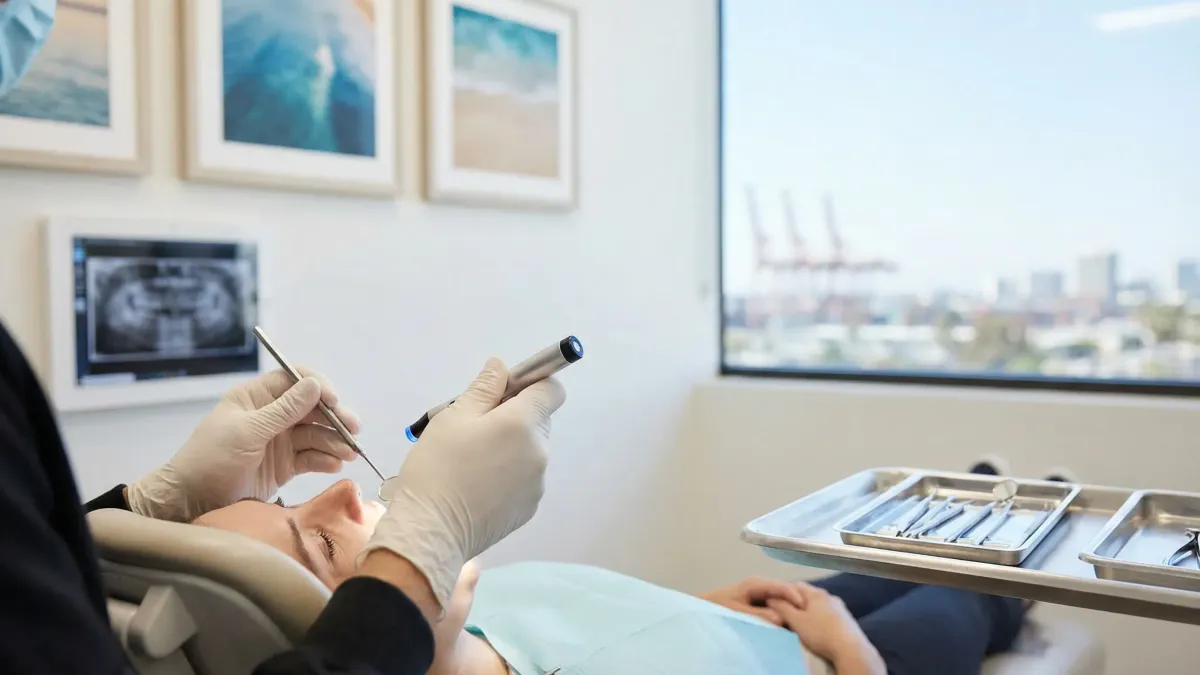
The cost to acquire a new dental patient from Google Ads in Long Beach varies significantly by procedure type. For general family dentistry and new patient campaigns, expect CPLs of $55–$120 per qualified appointment request — broadly in line with LocaliQ's national benchmark of $43.38 CPL for general dentistry, adjusted upward for Long Beach's competitive market pressure. Emergency dentistry CPLs run $80–$160 per call, but emergency patients convert to new patient relationships at 65–75% rates, making LTV substantially higher than the initial job. Implant and cosmetic campaigns carry the highest CPLs ($150–$300 per qualified lead) but justify the cost: a single All-on-4 case at $35,000 covers 3–5 months of implant campaign spend. The Spanish-language campaign is the clear efficiency leader: with near-zero DSO competition, it delivers significantly lower cost per acquisition than any English-language campaign in the same market.
Budget allocation matters as much as total spend. A Long Beach practice spending $4,000/month with poor segmentation — one general campaign, one landing page, no Spanish ads — will see $140+ CPLs across the board. The same $4,000 properly allocated (emergency campaign $1,000, implants $1,500, Spanish bilingual $1,000, general new patient $500) produces average CPLs of $75–$110 with a much higher proportion of high-LTV procedure leads in the mix.
Management is a fixed monthly fee set by your ad spend, with the tracking set up first: see the plans and prices.
Dental implant Google Ads in Long Beach are profitable for practices that build campaigns correctly around the procedure's economics and patient decision process. Single implant keywords ("dental implants Long Beach CA") run $10–$40/click — high by absolute standards, but justified by job values of $3,500–$6,500 per single implant and $25,000–$50,000 for full-arch cases. At a 4–6% conversion rate on well-optimized implant landing pages, a practice spending $2,000/month on implant keywords generates 8–12 consultation requests per month. Converting 2–3 of those to single implant cases at $5,000 average produces $10,000–$15,000 in revenue against $2,000 in ad spend — a 5:1–7:1 ROAS before any upsell, referral, or ongoing restorative dentistry from the same patient relationship.
Full-arch cases require a longer sales cycle but produce exceptional economics. An All-on-4 case at $40,000 represents a 20:1 return on a $2,000/month campaign if one case closes per month. These patients take 4–8 weeks from initial search to consultation booking — the campaign needs to stay visible throughout that research period, which means running both Search and remarketing (HIPAA-compliant) to stay top of mind. The Long Beach homeowner segment in Belmont Shore, Naples, and Los Altos is the highest-conversion implant audience in the city: median property values of $1.2M–$2.5M, strong discretionary income, and the motivation to invest in long-term oral health solutions rather than bridge or denture alternatives. Target these zip codes specifically (90803, 90815) with implant campaigns and expect conversion rates 30–50% above city-average benchmarks.
How to read this Cost per click and monthly searches are measured with Google Keyword Planner (see above). Cost per lead, conversion rate, budget and leads are estimates compiled from public benchmarks such as WordStream, not measurements.
Sources LocaliQ Healthcare Benchmarks (General Dentistry CPL $43.38, CPC $6.42 national); Long Beach SoCal premium applied; WordStream dental vertical benchmarks (2024)
$590$990/month
1 platform · Google or MetaGoogle + Meta$790$1,290/month
1 platform · Google or MetaGoogle + Meta$1,140$1,940/month
1 platform · Google or MetaGoogle + MetaChatGPT Ads: a separate pilot, $250/month, added to a plan. See the pilot →

Matteo Braghetta founded MB Adv and runs its Google Ads accounts. He takes the first call with every new client, reads the accounts every week and writes the agency’s guides.
The other half of his job is measurement: GA4, Consent Mode and server-side tracking, so the platforms learn from real sales.
MB Adv is a Google Partner agency managing about $4.4M a year in ad spend for clients in the US, the UK and Europe.
Managed on numbers you can check.
Plans for the US