Start
$590$990/month
1 platform · Google or MetaGoogle + Meta- Ad spend
- up to $3,000
- New creativesmade by us
- Google + Meta only4 a month
 By Matteo Braghetta, Founder · Google Ads
Long Beach HVAC companies compete in a market shaped by coastal salt air, a 58.8% renter rate, and over 121 verified local providers — including Long Beach Heating & Air, which has held market dominance for 58 years. Getting clicks isn't the problem. Getting the right clicks, from the right segments, at the right time of year, is where most campaigns fail.
See how this city's HVAC PPC costs compare nationally in our HVAC PPC Statistics report, featuring data from 40+ US cities.
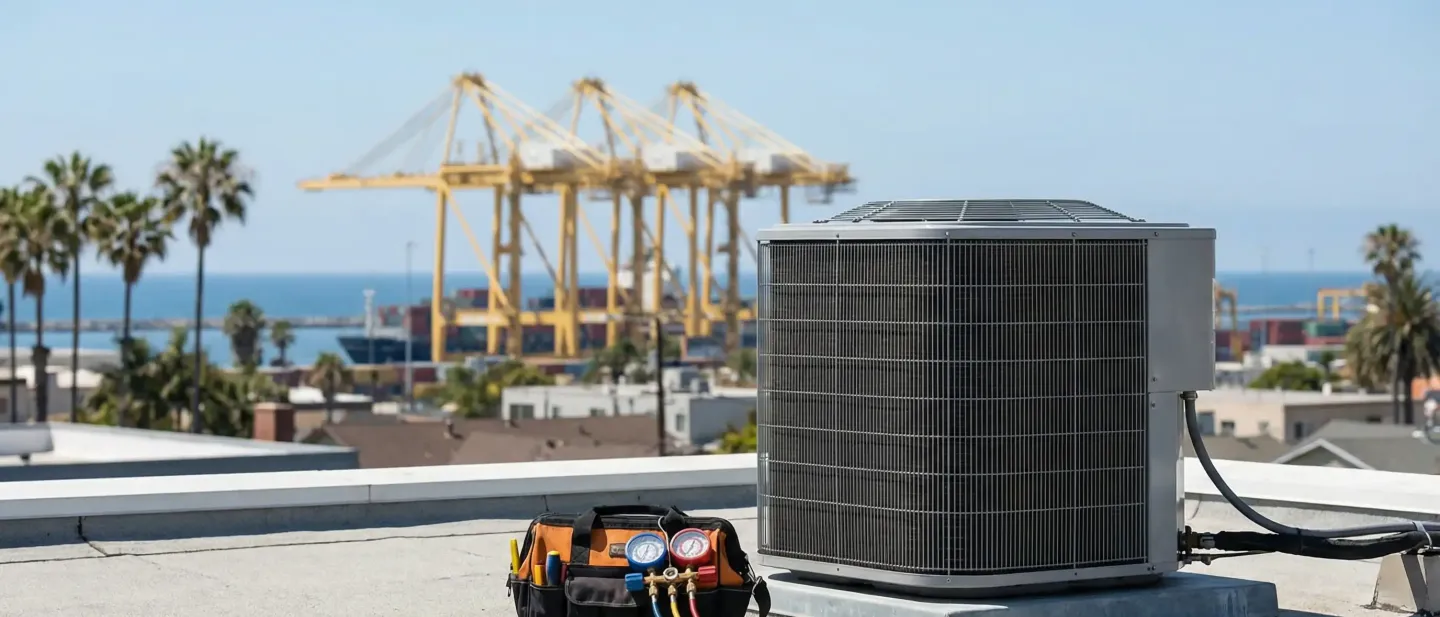
In Long Beach, CA, people search for HVAC services about 1,460 times a month on Google; a top-of-page click costs $10–$64, and demand peaks in July.
Google Keyword Planner · Oct 2025 – Sep 2026
| Search | Monthly searches | Top-of-page CPC |
|---|---|---|
| ac repair | 320 | $11–$73 |
| air conditioning repair | 320 | $11–$73 |
| hvac contractor | 110 | — |
| air conditioner repair near me | 90 | $11–$52 |
| hvac company | 70 | $5–$46 |
| furnace repair | 70 | — |
| hvac near me | 70 | $13–$64 |
| hvac repair | 50 | — |
| ac installation | 40 | $7–$36 |
| air conditioner installation | 40 | $7–$36 |
US: $83
Google Keyword Planner · Oct 2025 – Sep 2026
Source: Google Keyword Planner (Google Ads), Google Search, English, Long Beach, CA, Oct 2025 – Sep 2026. Volumes are Google's monthly averages; CPC is the top-of-page bid range, weighted by search volume. How we collect these figures.
Long Beach's HVAC market looks straightforward from the outside: warm Southern California weather, 455,000 residents, aging housing stock. Run Google Ads, get calls. The reality is a market with structural complexity that breaks generic campaigns within 90 days.
The first problem is brand dominance. Long Beach Heating & Air Conditioning has operated at 2525 Cerritos Ave for 58 years — a Bryant Circle of Champions winner twice over, Best of Long Beach contractor, with a review legacy that newer entrants cannot replicate by bidding. When a Long Beach homeowner searches "HVAC Long Beach," they already have a mental shortlist. A generic ad doesn't interrupt that. A specific, differentiated offer does.
Long Beach sits directly on the Pacific. Salt air from the ocean accelerates condenser coil corrosion, fastener degradation, and heat exchanger breakdown — homes within one mile of the beach see 30–40% faster equipment degradation than inland Los Angeles properties at the same age. This is a real service trigger that most HVAC advertisers ignore entirely. Campaigns that speak to coastal-specific issues — "salt air HVAC inspection," "corroded condenser replacement near the beach" — attract high-intent searchers with no competing ads targeting the same message.
The second structural problem is the dual market. Long Beach's 58.8% renter rate means a large share of HVAC calls come from tenants calling on behalf of landlords, or from property management companies managing multi-family buildings. These are fundamentally different buyers with different decision timelines and authorization chains. A tenant calls for an emergency fix; a property manager negotiates a preferred vendor contract. Treating both segments with the same campaign copy produces poor conversion rates from both.
Emergency AC keywords in Long Beach cost more per click during summer. Competitors include Sturges Heating and Air Conditioning, Donahue Heating & Air, Sharony HVAC Services, and multiple national lead aggregators all bidding simultaneously. Broad keyword strategies burn budget fast — the $300 in daily ad spend disappears by noon on a hot August day with no qualified calls to show for it.
The solution isn't spending more. It's spending differently. HVAC campaigns in Long Beach succeed when they:
CA Title 24 energy efficiency compliance adds another layer. Long Beach homeowners replacing equipment must use compliant units — ads that specifically mention "Title 24 compliant HVAC installation" outperform generic replacement ads by filtering for ready-to-buy customers who already understand the regulatory requirement.
Without this structural segmentation, Long Beach HVAC campaigns run hot and produce cold results — high click costs, mixed lead quality, and a general contractor spending $4,000/month to compete head-on with a firm that's been in the market for six decades.
The Long Beach HVAC market rewards specificity. Here's how campaigns should be structured to generate qualified leads at sustainable CPAs in this coastal urban market.
Campaign Architecture — 4 Core Segments:
Keyword Groups With CPC Ranges:
Bidding Strategy: Emergency campaigns run Target CPA bidding ($120–$180 target) during business hours, with bid multipliers of +40% on mobile (most emergency HVAC calls originate from a phone). Budget rules automatically increase daily budget by 30% when LA County issues excessive heat warnings — the highest-conversion window in the HVAC calendar.
Landing Pages by Segment: A property management company landing page is completely different from a homeowner emergency page. Property managers want service contracts, guaranteed response times, and multi-unit pricing. Homeowners want a phone number to call right now. One campaign feeding one landing page loses both audiences. Separate pages, separate campaigns, separate conversion tracking.
Ad Copy Angles That Convert in Long Beach:
Call extensions are mandatory. In HVAC, 70–80% of emergency conversions happen via phone call, not form submission. Campaigns without prominent click-to-call extensions leave money on the table in a mobile-heavy market like Long Beach's diverse rental corridor.
Google Local Service Ads (LSA) run in parallel with Search — they appear above standard ads, include the Google Guarantee badge, and generate pay-per-lead calls. In the Long Beach HVAC market, LSA typically delivers lower CPL ($65–$110) than Search ($95–$160) for emergency intents, but Search allows more creative control and landing page optimization. Running both is the standard configuration.
Long Beach's HVAC market has three structural trends reshaping demand — and most local advertisers aren't positioning around any of them.
California's AB 68 (2020) and subsequent state legislation made it dramatically easier to add ADUs (accessory dwelling units) to existing properties. Long Beach has been among LA County's top ADU permit cities — and every new ADU requires a dedicated HVAC solution. Central systems can't extend to detached ADUs; mini-split systems are the default installation. This creates a high-frequency, high-LTV installation category ($3,500–$7,500 per mini-split job) that most Long Beach HVAC advertisers aren't actively targeting. "Mini split installation Long Beach" searches have grown consistently YoY and remain underbid relative to the job value.
The ADU trend also extends to garage conversions and room additions — both generating additional mini-split demand in older Long Beach neighborhoods like Bixby Knolls, Cambodia Town, and the North Long Beach residential corridor.
Coastal corrosion is not a future problem for Long Beach HVAC companies — it's the present reality for every home within three miles of the Pacific. Homes in Belmont Shore, Naples, Alamitos Beach, and the Bluff Park neighborhoods experience accelerated coil and condenser degradation that drives above-average equipment replacement cycles. A 15-year-old AC unit in inland San Gabriel Valley may still function; the same unit in Belmont Shore is likely due for replacement at year 10–12 due to salt-air oxidation.
This represents a recurring, geographically targetable market. HVAC companies running geo-targeted campaigns in coastal zip codes (90803, 90804, 90814) with salt-air maintenance messaging are fishing in a pond with very few other lines in the water — and the fish are large (full equipment replacement jobs averaging $7,500–$10,500).
Long Beach's 58.8% renter rate means tens of thousands of rental units need HVAC maintenance, emergency repair, and eventual replacement — all managed by property management companies or landlords rather than individual homeowners. A single property management contract covering 50 rental units generates $15,000–$60,000/year in recurring HVAC work. These clients are acquired via different channels than homeowners — they search Google less impulsively and more deliberately, with vendor evaluation timelines of weeks rather than minutes.
PPC for property management works best with long-tail keywords, benefit-specific messaging (response time guarantees, 24/7 availability, multi-unit pricing), and form-based lead capture (not just phone calls). A property manager filling out a contact form at 10am is worth 20 homeowner emergency calls in LTV terms — campaigns should treat them accordingly.
The final trend worth tracking: California's Title 24 efficiency standards are tightening continuously, and Long Beach's coastal air quality management rules add local compliance layers. HVAC advertisers who position as compliance experts — not just fix-it shops — attract the renovation and remodel segment, where contractors and designers actively recommend HVAC partners to their clients. That word-of-mouth amplification doesn't start with a Google click; it starts with a reputation for specification-grade work.
Long Beach's HVAC market isn't a simplified version of Los Angeles. It has its own competitive dynamics, its own coastal-specific service demands, and its own dual-market structure that rewards advertisers who understand the difference between a Belmont Shore homeowner with a corroded condenser and a North Long Beach property manager with 30 units on a service contract.
Generic PPC — broad keywords, one landing page, flat bidding — produces mediocre results in this market. The advertisers winning in Long Beach HVAC run 4–6 segmented campaigns, separate budgets for each buyer type, and ad copy that reflects the city's actual character: coastal, dense, diverse, and dual-market.
At MB Adv Agency, we build HVAC campaigns around data from this city specifically. We know the peak emergency windows, the coastal zip codes that drive replacement demand, and the property management keyword segments competitors ignore. Our campaigns don't guess — they're built on Long Beach research, not national templates.
See our Google Ads management services and pricing tiers to understand how we structure HVAC campaigns for Long Beach contractors.
One AC replacement job at $7,500 covers multiple months of campaign spend. The math works. The strategy has to match the market.

A Long Beach HVAC company generating its first PPC leads should budget $2,500–$4,500/month to compete effectively in the residential market. At that spend level, targeting emergency AC repair and seasonal replacement keywords, expect 15–25 qualified calls per month at a CPL of $95–$160. For HVAC companies already running $4,500–$9,000/month, the model expands to include property management campaigns, salt-air maintenance targeting, and mini-split/ADU installation keywords — each with distinct CPL targets. Management is a fixed monthly fee set by your ad spend, with the tracking set up first: see the plans and prices. One property management contract covers a year. Budget decisions should be calibrated against job LTV, not just monthly spend totals.
Seasonal budget strategy matters. Long Beach's HVAC peak runs July–September (emergency calls, 60–70% of annual emergency volume). Pre-season April–June is the time to acquire maintenance customers and replacement leads at lower competition CPCs. November–January handles heating calls but at lower volume. A flat monthly budget wastes money in winter; a seasonally tiered budget maximizes efficiency year-round.
Match the budget tier to the lead volume the operation can actually service — there's no value in generating 40 calls per month if the install team can only handle 20.
Most Long Beach HVAC companies running well-structured Google Ads campaigns see positive ROI within the first 45–60 days — not because PPC is magic, but because HVAC emergency calls are high-intent, fast-closing leads. A homeowner whose AC fails in August is ready to book today. Emergency AC repair keywords in Long Beach ($11–$73/click) typically convert at 8–12% on a strong landing page. The average repair call is worth $600–$800 on the first transaction alone — before LTV from maintenance agreements, upsells, or eventual replacement is factored in.
Replacement campaigns take longer to optimize — typically 60–90 days to accumulate enough conversion data to tune bidding. But the economics justify the patience: one AC replacement at $8,500 average (SoCal-installed) at a $150–$220 CPL produces 38:1–57:1 ROAS per acquired job.
Property management campaigns have the longest sales cycles (2–8 weeks to close a new vendor contract) but the best lifetime economics. A 50-unit property management client at $15,000/year in HVAC work — acquired via a $180 CPL lead — justifies the wait. Build separate campaigns with separate expectations: emergency calls are fast-close, replacement is medium-cycle, property management is a long-game that pays off substantially when it converts.
How to read this Cost per click and monthly searches are measured with Google Keyword Planner (see above). Cost per lead, conversion rate, budget and leads are estimates compiled from public benchmarks such as WordStream, not measurements.
Sources ServiceTitan/Hatch contractor PPC benchmarks (2024); SoCal market premium applied; Long Beach coastal market estimates
$590$990/month
1 platform · Google or MetaGoogle + Meta$790$1,290/month
1 platform · Google or MetaGoogle + Meta$1,140$1,940/month
1 platform · Google or MetaGoogle + MetaChatGPT Ads: a separate pilot, $250/month, added to a plan. See the pilot →

Matteo Braghetta founded MB Adv and runs its Google Ads accounts. He takes the first call with every new client, reads the accounts every week and writes the agency’s guides.
The other half of his job is measurement: GA4, Consent Mode and server-side tracking, so the platforms learn from real sales.
MB Adv is a Google Partner agency managing about $4.4M a year in ad spend for clients in the US, the UK and Europe.
Managed on numbers you can check.
Plans for the US