HVAC PPC Baltimore, MD
Baltimore's 80,000+ row houses — most with aging ductwork, boilers, or inadequate AC — create one of the most persistent HVAC replacement markets on the East Coast, and the contractors who structure their Google Ads around both emergency response and the city's specific housing challenges consistently outpace regional franchise competitors running generic national campaign templates. <!-- stats-article-link --> <p><em>See how this city's Hvac PPC costs compare nationally in our <a href="/resources/hvac-ppc-statistics">Hvac PPC Statistics</a> report, featuring data from 40+ US cities.</em></p>
Why Baltimore HVAC Campaigns Bleed Budget on the Wrong Keywords
The defining problem in Baltimore HVAC PPC is campaign structure built for a generic suburban market applied to a city with a genuinely distinct housing stock. Most HVAC campaigns run broad match "AC repair Baltimore" and "furnace replacement Baltimore" — keywords dominated by franchise brands like One Hour Heating & Air, Horizon Services, and Sila Services, all of which have years of Quality Score history on exactly these terms. An independent HVAC contractor bidding broad on "HVAC Baltimore" competes directly against franchise networks with national ad budgets and institutional click-through rate history. The CPC for broad HVAC terms in Baltimore runs $14–$22 in peak summer and winter seasons — and the conversion rate at that CPC level rarely justifies the spend for a small to mid-size operator.
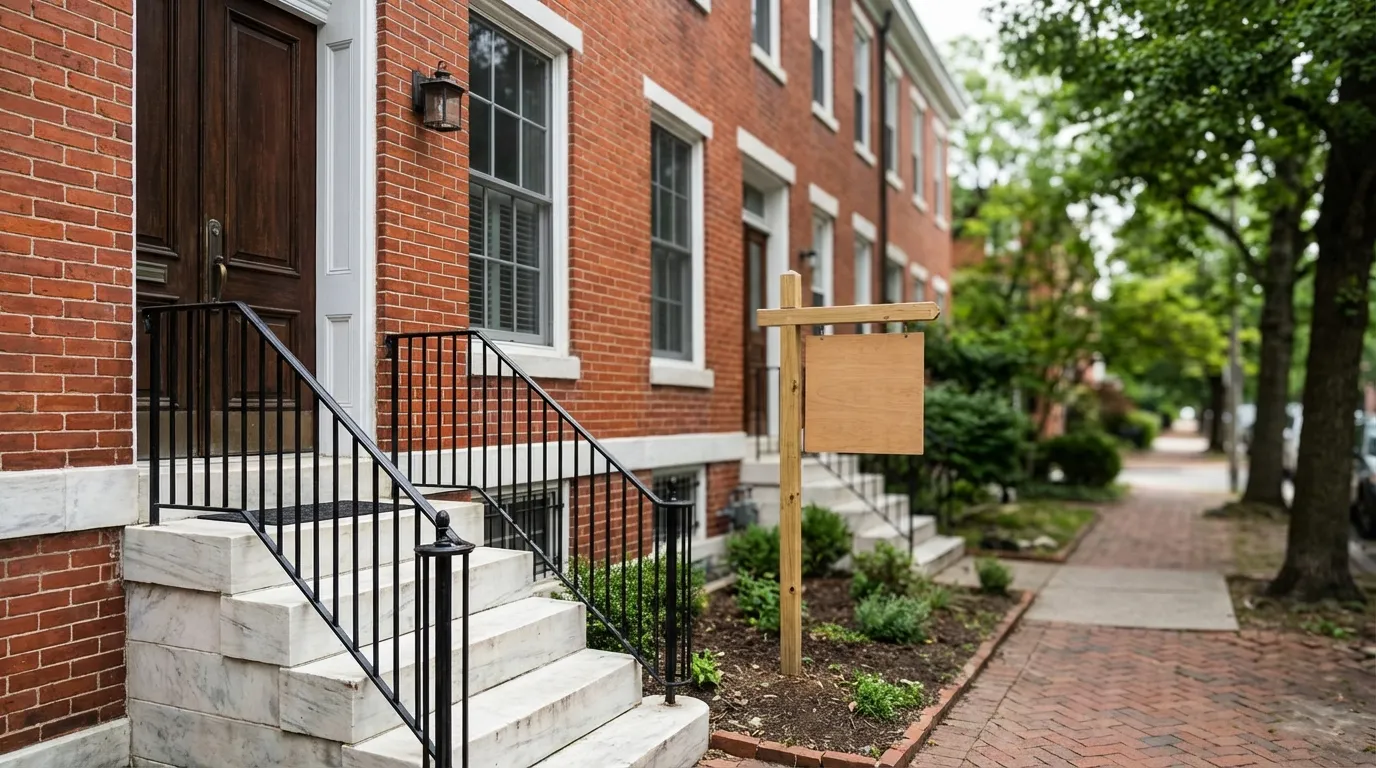
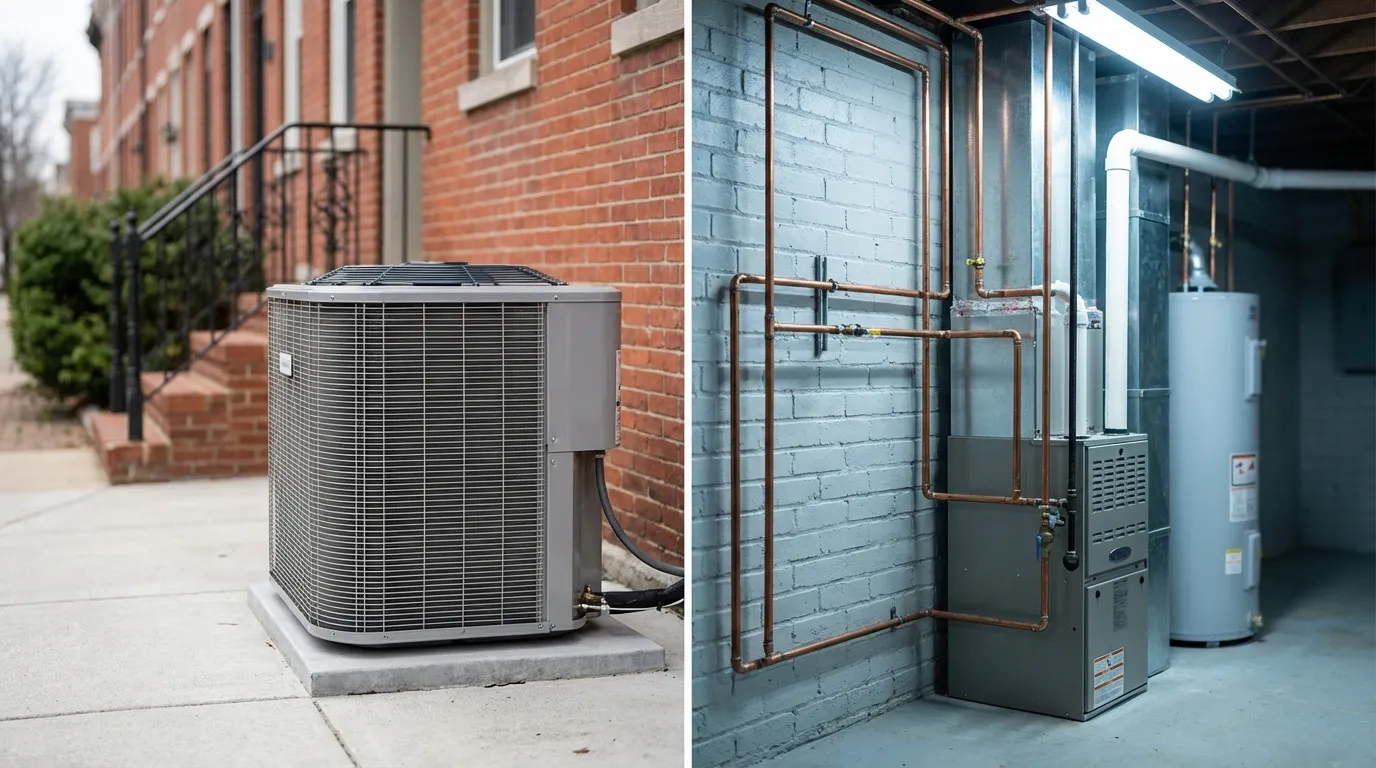
The deeper problem is that Baltimore's housing stock requires a fundamentally different campaign strategy than HVAC in Phoenix or Atlanta. Baltimore runs tens of thousands of row houses with original radiator/boiler systems, improper or absent ductwork, and attic or crawl space constraints that make standard HVAC installations complicated. A homeowner searching "ductless mini-split Baltimore row house" or "boiler replacement Baltimore MD" is not searching for the same service as someone searching "AC unit replacement Baltimore" — they have a more specific, less price-sensitive need, and the contractors who speak to it directly win the estimate at a fraction of the CPC of generic terms.
The Emergency Response Window
Baltimore's most valuable HVAC PPC leads — and the highest-converting keyword category — are emergency searches: "AC not working Baltimore," "furnace broken Baltimore MD," "emergency HVAC Baltimore." These searches happen in July at 9 PM when the humidity is 80% and a family's air conditioning has failed, or in January when a furnace stops working on a 28-degree night. The buyer has no price sensitivity, no comparison shopping instinct, and one goal: fix this today.
Emergency HVAC CPCs in Baltimore run $15–$22, but conversion rates are 12–18% — significantly above the 7.5% category average. Campaigns that run 24/7 with call extensions, location-specific copy ("Baltimore emergency HVAC — same day"), and a landing page that leads with phone number and availability convert emergency clicks at 2–3x the rate of campaigns that route emergency searches to a generic homepage.
Yet most Baltimore HVAC operators don't separate emergency keywords into their own campaign. They run mixed campaigns where emergency searches compete with tune-up searches for the same budget allocation and landing page — and the result is mediocre performance in both categories. The fix is structural: three separate campaigns for emergency response, planned replacement/installation, and maintenance/tune-up, each with its own budget floor, bid strategy, and dedicated landing page.
- Emergency AC/heat: "AC not working Baltimore," "emergency furnace repair Baltimore" — CPC $15–$22, CVR 12–18%
- Replacement/installation: "new AC unit Baltimore," "HVAC replacement Baltimore MD" — CPC $12–$18, longer decision cycle
- Row house specific: "ductless mini-split Baltimore," "boiler replacement Baltimore row house" — CPC $9–$15, lower competition
- Maintenance/tune-up: "HVAC tune-up Baltimore MD," "AC maintenance Baltimore" — CPC $6–$11, relationship-building
- BGE rebate: "energy efficient HVAC Baltimore BGE rebate" — CPC $8–$13, strong CTR from financially-motivated buyers
How Baltimore HVAC Operators Win Against Franchise Competitors
The strategic framework for Baltimore HVAC PPC is housing-stock specificity + seasonal budget acceleration. Rather than running year-round generic campaigns at flat budget, the winning approach targets Baltimore's two peak urgency windows — summer AC emergencies (June–August) and winter heating emergencies (November–February) — at maximum budget, while running maintenance and replacement campaigns at reduced spend in the shoulder seasons.
The Row House Advantage
The single highest-ROI targeting opportunity in Baltimore HVAC PPC is the row house-specific keyword category. Terms like "ductless mini-split Baltimore," "no ductwork AC Baltimore row house," "boiler replacement Baltimore MD," and "steam heat conversion Baltimore" have CPCs of $9–$15 — 40–50% below generic HVAC replacement terms — and they attract buyers who have a specific, complex problem that franchise brands with national cookie-cutter campaigns can't credibly claim to solve. A local HVAC contractor who leads with "We install ductless systems in Baltimore row houses — no ductwork required" is speaking directly to a buyer's actual situation in a way that One Hour Heating & Air's national ad copy cannot.
This is the local moat: row house HVAC is a service category where local expertise signals outperform national brand recognition. The contractor who owns this keyword territory at $9–$15 CPC gets to compete on local expertise while franchise brands fight each other for $18–$22 CPC on generic terms.
- "ductless mini-split Baltimore MD" — $10–$15 CPC, conversion rate 10–14%
- "boiler replacement Baltimore row house" — $9–$14 CPC, high-ticket, low competition
- "steam radiator repair Baltimore" — $8–$13 CPC, niche, near-zero competition
- "HVAC conversion row house Baltimore" — $9–$14 CPC, Baltimore-specific intent
BGE Rebate Campaigns
Baltimore Gas and Electric offers energy efficiency rebates for high-efficiency HVAC installations — up to $300–$800 depending on equipment type. Campaigns that reference BGE rebates in ad copy ("HVAC Replacement + BGE Rebate Up to $800 — Free Estimate Baltimore") consistently generate higher CTR than generic replacement ads. This is because the rebate framing shifts the buyer's mental model from "expensive replacement" to "subsidized upgrade" — a meaningful psychological shift that improves both click rate and landing page conversion.
Budget allocation: 40% to emergency campaigns (24/7, call-forward bidding), 35% to replacement/row-house specific (business hours, form + call), 25% to maintenance (spring and fall activation only). Emergency campaigns should never be paused — a 2 AM emergency search in July represents the single highest-intent buyer moment in HVAC, and a paused campaign at that moment is revenue permanently lost.
Google Partner Agency
We're a certified Google Partner Agency, which means we don’t guess — we optimize withGoogle’s full toolkit and insider support.
Your campaigns get pro-level execution, backed by real expertise (not theory).

The Baltimore HVAC Insight That Changes Budget Timing
Baltimore sits in NOAA Climate Zone 4 — a mixed-humid zone with genuinely cold winters (average January low 26°F) and genuinely hot, humid summers (average July high 87°F, humidity consistently above 65%). This climate dual-peaks HVAC demand in a way that Sun Belt markets don't experience: an Arizona HVAC operator focuses almost entirely on cooling; a Chicago operator focuses primarily on heating. Baltimore operators need full-season campaign coverage, which means budget planning is more complex — and the operators who get it right capture demand in both peak windows rather than cannibalizing one for the other.
The highest-ROI HVAC month in Baltimore is July — not June. Search volume for emergency AC repair peaks in the second week of July when Baltimore's first sustained heat wave (temps 90°F+, humidity 70%+) arrives. By this point, homeowners who thought their AC was "probably fine" through June discover it isn't. The contractors who have been running campaigns since May with established Quality Score and campaign history win these July emergencies at better CPCs than latecomers who ramp up after the heat wave starts.
The Aging Boiler Replacement Window
An underutilized Baltimore HVAC search category is late-fall boiler assessment — specifically, October and November searches from homeowners who haven't turned on their heat yet and are anxious about whether an aging system will survive the winter. "Boiler inspection Baltimore," "furnace check before winter Baltimore," and similar queries spike in October with CPCs well below peak heating-season levels (because demand is pre-urgency, not emergency) and very high eventual ticket sizes — a homeowner who books an October inspection and discovers a failing 25-year-old boiler is likely buying a full replacement, not a repair.
Baltimore's median home age and the prevalence of original boiler/radiator systems in row houses means this pre-winter inspection category is larger here than in almost any other East Coast city. The contractor who captures October inspection leads at $8–$12 CPC and converts 25–35% to replacement projects in November and December is running one of the most capital-efficient HVAC acquisition strategies available in this market.
Baltimore HVAC PPC requires understanding the city's housing DNA — that the row house isn't just an architectural quirk but a specific service category with its own keyword territory, its own installation challenges, and its own customer psychology. Generic HVAC campaigns built for suburban tract homes miss this entirely, and they pay franchise-level CPCs to do it.
At MB Adv Agency, we build Baltimore HVAC accounts around three campaign tracks — emergency, replacement, and row-house-specific — each with dedicated landing pages and seasonal budget calendars that pre-fund July and January emergencies before the heat wave and cold snap arrive. We run BGE rebate campaigns as a fourth track during installation season because the rebate framing changes the economics of the conversion.
For row house HVAC specialists, we build the keyword infrastructure that no franchise competitor can credibly occupy — ductless mini-split, boiler replacement, steam heat conversion — and we own those terms at 40–50% below generic HVAC CPC rates.
See our Google Ads management for HVAC companies and review our Growth Mode tier starting at $497/month for HVAC operators running $2,000–$3,000/month in ad spend.
Frequently Asked Questions
How do Baltimore HVAC companies compete against franchise brands in Google Ads?
Franchise brands like One Hour Heating & Air and Horizon Services have Quality Score advantages on generic Baltimore HVAC keywords — they've accumulated click history on "AC repair Baltimore" and "HVAC company Baltimore" over years of continuous advertising. An independent contractor trying to match Quality Scores on these exact terms in the short term will overpay per click and underconvert relative to competitors with established account history.
The competitive strategy is keyword territory segmentation: independent operators compete on the terms that franchise national templates can't address with specificity. Row house-specific terms ("ductless mini-split Baltimore row house," "boiler replacement Baltimore MD") have CPCs 40–50% below generic terms and attract buyers whose problem — installing HVAC in a 100-year-old brick row house — requires local expertise rather than a franchise dispatch center. This is territory where a local contractor's expertise signals better than a national brand name.
The second lever is ad copy quality on neighborhood-specific terms: "We install ductless mini-splits in Baltimore row houses — same-day quotes" outperforms "Top-Rated HVAC Service in Baltimore" because it speaks to the buyer's actual situation. Baltimore homeowners in rowhouses know their housing situation is unusual; ads that acknowledge it convert better than generic copy that ignores it.
What Google Ads budget does a Baltimore HVAC company need to generate consistent leads?
The minimum effective budget for a Baltimore HVAC operator targeting all season types is $2,000/month. At this level, you can maintain presence in emergency, replacement, and row-house-specific campaigns simultaneously, though not at maximum impression share in peak season. At $3,000/month, you achieve competitive coverage in peak summer and winter windows. At $4,000+/month, you can run full seasonal campaigns with dedicated landing pages for each track and maintain consistent top-3 position on emergency terms during peak hours.
Seasonal budget allocation matters as much as monthly average. A Baltimore HVAC operator spending $2,500/month flat achieves mediocre results year-round. The same $30,000 annual budget, front-loaded to July ($4,500), January ($4,000), and August ($3,500), with maintenance-level spend in shoulder months, produces substantially more emergency and replacement leads per dollar — because it concentrates investment where Baltimore buyer urgency peaks.
Expected lead volume at $2,500/month in a well-structured account: 20–30 leads/month in peak season (June–August, November–February), 12–18/month in shoulder seasons. At a 30% close rate and average ticket of $4,500 for replacement or $180 for repair, the math for a well-run Baltimore HVAC campaign is straightforward and strongly positive within the first 60–90 days.