Start
$590$990/month
1 platform · Google or MetaGoogle + Meta- Ad spend
- up to $3,000
- New creativesmade by us
- Google + Meta only4 a month
 By Matteo Braghetta, Founder · Google Ads
Chesapeake's HVAC market runs on urgency — with July highs hitting 89°F and humidity above 70%, a failed AC unit drives immediate search behavior that converts at 10–12%. The challenge is competing against 3,880 Hampton Roads HVAC businesses while protecting your ad budget from the 28–35% waste rate typical in this metro.
See how this city's HVAC PPC costs compare nationally in our HVAC PPC Statistics report, featuring data from 40+ US cities.
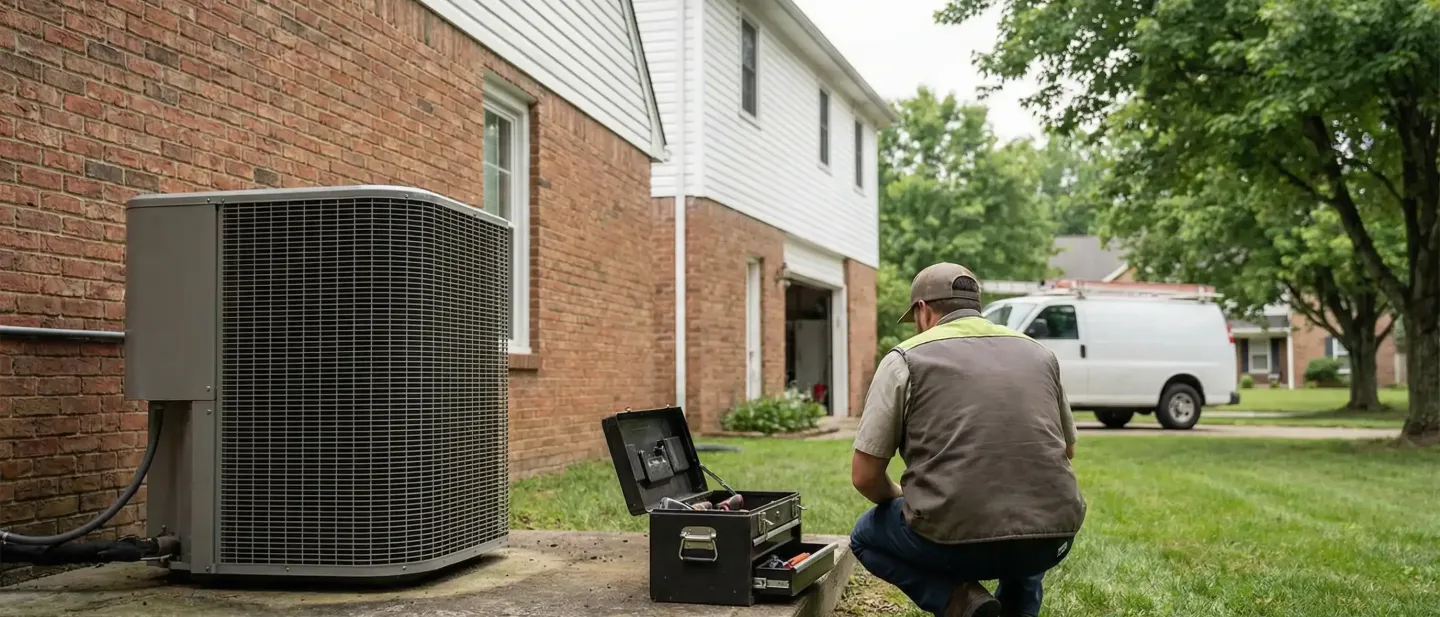
In Chesapeake, VA, people search for HVAC services about 1,380 times a month on Google; a top-of-page click costs $32–$97, and demand peaks in July.
Google Keyword Planner · Oct 2025 – Sep 2026
| Search | Monthly searches | Top-of-page CPC |
|---|---|---|
| ac repair | 260 | $36–$113 |
| air conditioning repair | 260 | $36–$113 |
| furnace repair | 110 | — |
| hvac near me | 110 | $30–$100 |
| air conditioner repair near me | 90 | $41–$87 |
| hvac repair | 70 | $7–$72 |
| hvac company | 70 | $27–$67 |
| heat pump repair | 70 | — |
| duct cleaning | 50 | $12–$40 |
| hvac maintenance | 50 | — |
US: $83
Google Keyword Planner · Oct 2025 – Sep 2026
Source: Google Keyword Planner (Google Ads), Google Search, English, Chesapeake, VA, Oct 2025 – Sep 2026. Volumes are Google's monthly averages; CPC is the top-of-page bid range, weighted by search volume. How we collect these figures.
Chesapeake's HVAC market looks straightforward on paper — high homeownership, hot summers, cold winters, aging systems — but most Google Ads campaigns underperform because they treat Hampton Roads like a generic metro area. The structural reality is more specific: 53% of Chesapeake homes were built between 1970 and 1999, meaning heat pump systems from the 1980s and 1990s are reaching the end of their 15–20 year lifespan simultaneously. That creates a replacement demand cycle unlike almost any other coastal Virginia market. Campaigns that don't segment replacement intent from emergency repair intent bleed budget on low-value clicks.
The competitive landscape compounds the problem. RS Andrews of Tidewater (A+, 4550 Bainbridge Blvd) and House Call Company (A+, 3028 S Military Hwy) operate large fleets with substantial ad budgets covering the full Hampton Roads metro. Virginia Beach and Norfolk contractors geo-target Chesapeake from the outside, meaning Chesapeake-based businesses compete against operators with larger service areas and wider budgets. CPCs in this market run $32–$97 and are under continuous upward pressure during summer peak season.
Hampton Roads runs almost exclusively on heat pump systems — a product of the region's mild coastal climate that made gas furnaces less economical. A home built in 1987 in Greenbrier or Great Bridge is almost certainly running a heat pump installed within a few years of construction. Those systems are now 35–40 years old. The manufacturer's rated lifespan is 15–20 years. The replacement wave is already underway, and homeowners who haven't experienced a failure yet are still running on borrowed time. Campaigns targeting "heat pump replacement Hampton Roads" and "aging HVAC system Chesapeake" capture this replacement-intent traffic before it becomes a competing-bids emergency scenario.
Emergency demand creates a different failure mode: campaigns structured for planned replacement get overwhelmed during summer heat events. When July temperatures hit 89°F with humidity above 70% and a compressor fails, homeowners search "AC repair near me" and call the first result that loads. Call-only campaigns with dayparted bid boosts between 10 AM and 8 PM capture this behavior — but only if the account is structured to separate emergency from planned-purchase intent. Campaigns that mix these intent types see quality scores collapse and CPLs climb toward $130–$150.
Chesapeake houses 14,389+ Gulf War-era veterans and tens of thousands of active-duty households proximate to Naval Station Norfolk. Military families treat HVAC maintenance as a non-negotiable budget item — they're highly likely to purchase service contracts, not just one-time repairs. But they also relocate on PCS orders every 2–4 years, which creates an interesting search pattern: new-arrival military families actively search for HVAC service contracts within their first 90 days, while outbound families often trigger a repair-or-replace decision before listing the home. Campaigns that don't account for this military household lifecycle leave a reliable conversion segment unaddressed.
The waste rate in Chesapeake HVAC campaigns averages 28–35%. The primary drivers are broad-match keywords pulling in "HVAC jobs Chesapeake," "HVAC parts store," and "HVAC school near me" — clicks with zero conversion intent. Without a disciplined negative keyword list updated monthly, a $4,000/month budget loses $1,100–$1,400 to non-commercial searches before a single qualified lead is generated.
The highest-performing Chesapeake HVAC accounts share one structural principle: campaign segmentation by intent type. Mixing emergency repair, planned replacement, and service contract keywords into a single campaign forces Google's algorithm to optimize for average performance — which means it will underbid on high-value emergency clicks and overbid on low-value browse traffic. The winning structure separates these intent signals into dedicated campaigns with independent budgets and bid strategies.
Campaign 1 — Emergency AC Repair (Summer Priority)
Run as call-only with dayparted bid boosts: +40% from 10 AM–8 PM, June–August. This campaign captures the highest-urgency traffic in the market — a homeowner in an 89°F house who needs a technician today. Mobile bid adjustment should be +30% minimum (over 70% of emergency HVAC searches happen on smartphones).
Campaign 2 — Heat Pump Replacement (Year-Round)
Hampton Roads' heat pump dependency makes replacement the primary high-ticket conversion target. Target homeowners with systems 15+ years old through neighborhood-level targeting (Greenbrier, Great Bridge, Deep Creek — all built primarily 1980–1999) combined with system-age keywords.
Campaign 3 — Service Contracts (Military Household Focus)
Service contract campaigns perform best when the ad copy explicitly addresses military household needs: flexible scheduling, transferable agreements, and multi-year discounts. Target ZIP codes with highest military household density: 23320 (Deep Creek/South Chesapeake) and 23322 (western Chesapeake).
Campaign 4 — Winter Heating Repair
Nor'easter systems periodically bring hard freezes to coastal Virginia, creating heating repair spikes in December–February. Bid pre-loaded audiences of prior emergency AC customers (RLSA) at +50% during freeze events — these are homeowners who have already experienced system failure and will convert faster than cold audiences.
Bid Strategy: Target CPA ($90 target) for emergency campaigns with sufficient conversion volume (30+ conversions/month). Manual CPC for replacement campaigns where ticket sizes vary widely. Starter budget: $3,000–$5,000/month, with seasonal allocation: 50% to emergency during June–August, 35% to replacement year-round, 15% to service contracts.
Landing page requirements: separate pages per campaign intent type. An emergency repair landing page should load in under 2 seconds, display a phone number in the header, and have a single CTA (call or book today). A replacement landing page can support a longer form with system age, property details, and timeline questions — which feeds the HVAC company's estimating pipeline directly.
Chesapeake's HVAC market has a timing advantage that most operators haven't fully monetized: the replacement wave peaks in summer but the decision window opens in spring. Homeowners with aging heat pump systems — especially the 35–40 year old units installed in Greenbrier and Great Bridge during the housing expansion of the 1980s — typically don't think about replacement until a failure event. The gap between "system showing age symptoms" (higher utility bills, uneven cooling, unusual sounds) and "system fails in peak summer" is a 60–90 day window where a well-targeted campaign can convert a non-emergency homeowner into a planned replacement customer at $8,500–$14,000 average ticket vs. the $350–$800 emergency repair alternative.
The Chesapeake HVAC market has three distinct seasonal phases that require different budget and bid strategies:
Key insight: The 74.4% homeownership rate in Chesapeake (vs. 65% national average) means there is no apartment-building manager buffer in this market. When a Chesapeake homeowner's heat pump fails, they search Google immediately — not a landlord, not a property manager. This directness drives the 10–12% CVR that makes HVAC one of the most efficient PPC verticals in the city.
The military household dynamic adds a counter-seasonal demand signal that most competitors miss. PCS orders peak in May–July, which means military families receiving orders are making HVAC decisions (service contract before they leave, inspection before listing, new system evaluation for the incoming family) during the exact window when every other HVAC advertiser is competing for emergency clicks. Separating military-targeted messaging from emergency repair campaigns lets HVAC operators run a secondary conversion stream at lower CPCs during the highest-competition summer period.
Home appreciation data reinforces the replacement market opportunity: Chesapeake home values have grown 8.13% annually (NeighborhoodScout 2025). A homeowner who purchased a home for $280,000 in 2018 now holds a $430,000+ asset. Replacing a failing HVAC system before listing — or before a pre-purchase inspection surfaces it as a negotiating chip — is a straightforward financial decision for most Chesapeake homeowners. Campaigns framing replacement as "protect your home value" resonate strongly in this appreciation-driven market.
Running HVAC Google Ads in Hampton Roads requires understanding what makes this market different from national benchmarks: the heat pump dependency, the military household churn, the aging 1980s–1990s housing stock, and the nor'easter seasonality. Generic HVAC campaign templates built for Sun Belt markets or New England oil-heat markets won't perform here. The account structure, bid schedules, landing pages, and ad copy all need to reflect Chesapeake's specific competitive environment.
At MB Adv Agency, we build HVAC campaigns from the ground up using local market data — not national averages. That means separate campaigns for emergency repair, heat pump replacement, and service contract acquisition, with bid schedules calibrated to Chesapeake's seasonal demand patterns and negative keyword lists that eliminate the 28–35% waste rate typical in this market. Our accounts target Chesapeake ZIP codes at the neighborhood level, so Great Bridge homeowners see ads referencing their specific neighborhood — not a generic "Hampton Roads" campaign that treats Chesapeake as an afterthought.
We work with HVAC companies generating $500K–$5M in annual revenue who need Google Ads to produce predictable lead flow, not unpredictable cost-per-lead swings. If you're spending more than $3,000/month on HVAC PPC and your cost-per-lead exceeds $110 consistently, the campaign structure is the problem — not the market.
See how we price HVAC PPC management at mbadv.agency/ppc-pricing, or explore our lead generation services for home service businesses. Your Chesapeake city landing page is at mbadv.agency/local-ppc-service/ppc-consultant-campaign-management-chesapeake-va.
A Chesapeake HVAC company needs a minimum monthly budget of $3,000 to generate consistent lead flow from Google Ads — and $4,500–$5,000 during June–August to compete effectively during peak emergency season. At $3,000/month with a CPC of $32–$97 and a 10–12% conversion rate, a well-structured campaign generates approximately 3–11 leads per month. Those leads are worth chasing in a market where emergency repairs average $350–$800 and heat pump replacements run $8,500–$14,000. Budget below $2,500/month and the campaign won't generate enough click volume to give Google's algorithm sufficient conversion data to optimize bids — the account runs in learning mode indefinitely, CPLs spike, and the business concludes "Google Ads doesn't work" for a structural reason, not a market reason.
Budget seasonality matters as much as monthly totals: Flat monthly budgets underperform because demand is heavily seasonal. The right approach allocates 40–50% more to summer (June–August) and winter freeze events while pulling back slightly during shoulder months (October–November, March–April) when competition is lower and CPCs are softer. A $45,000 annual budget deployed evenly produces worse results than the same $45,000 deployed with a demand-weighted schedule.
Starter vs. scaling: $3,000–$3,500/month is appropriate for a company with under $800K in annual revenue testing Google Ads for the first time. Companies with established service areas, technician capacity, and revenue above $1.5M should invest $4,500–$6,000/month to compete for top ad positions year-round — the CPL economics work at that level because LTV is proven and the only constraint is lead volume.
In Chesapeake's HVAC market, the highest-ROI keywords are emergency intent terms with geographic qualifiers — "AC repair Chesapeake VA," "emergency HVAC near me," "heat pump repair Hampton Roads." These terms convert at 11–13% because searchers are already in decision mode: the system has failed, the house is hot, and they need a technician today. At a 12% CVR, each lead can generate a $500+ repair ticket on average, before any service contract or repeat booking. Heat pump replacement keywords ("heat pump replacement Chesapeake VA," "new HVAC system cost Hampton Roads") convert high-ticket jobs at $8,500–$14,000 per installation, making even a $130 CPL economically exceptional.
Keywords to avoid or tightly negative-match: Any term with "jobs," "careers," "school," "parts," "wholesale," or "DIY" attached to HVAC modifiers. These pulls account for the majority of budget waste in poorly structured HVAC campaigns. "HVAC near me" without location qualifiers also pulls national directories (HomeAdvisor, Angi) in competitor positions, making the search commercial but not direct — lower CVR at the same CPC.
Seasonal keyword shifts: Summer prioritizes "AC repair" and "emergency cooling" terms. Winter shifts to "furnace repair Chesapeake," "heat pump not heating," and "heating emergency" — especially valuable during the 48–72 hour window after a nor'easter forecast is issued, when click volume spikes 3–4x and a pre-loaded bid increase rule can capture top position before competitors manually adjust.
How to read this Cost per click and monthly searches are measured with Google Keyword Planner (see above). Cost per lead, conversion rate, budget and leads are estimates compiled from public benchmarks such as WordStream, not measurements.
Sources PPCChief 2026 (Feb 18, 2026 dataset) + Chesapeake market estimates
$590$990/month
1 platform · Google or MetaGoogle + Meta$790$1,290/month
1 platform · Google or MetaGoogle + Meta$1,140$1,940/month
1 platform · Google or MetaGoogle + MetaChatGPT Ads: a separate pilot, $250/month, added to a plan. See the pilot →

Matteo Braghetta founded MB Adv and runs its Google Ads accounts. He takes the first call with every new client, reads the accounts every week and writes the agency’s guides.
The other half of his job is measurement: GA4, Consent Mode and server-side tracking, so the platforms learn from real sales.
MB Adv is a Google Partner agency managing about $4.4M a year in ad spend for clients in the US, the UK and Europe.
Managed on numbers you can check.
Plans for the US