Start
$590$990/month
1 platform · Google or MetaGoogle + Meta- Ad spend
- up to $3,000
- New creativesmade by us
- Google + Meta only4 a month
 By Matteo Braghetta, Founder · Google Ads
Chesapeake home values have appreciated 8.13% over the past 12 months — outperforming 92.68% of U.S. cities — with a median value of $471,751 and 54.35% growth over five years. Combined with the constant PCS-order buyer pipeline from Naval Station Norfolk, this is one of the most structurally strong real estate PPC markets in Virginia, with year-round transaction demand that doesn't depend on seasonal civilian market cycles.
See how this city's Real Estate PPC costs compare nationally in our Real Estate PPC Statistics report, featuring data from 40+ US cities.
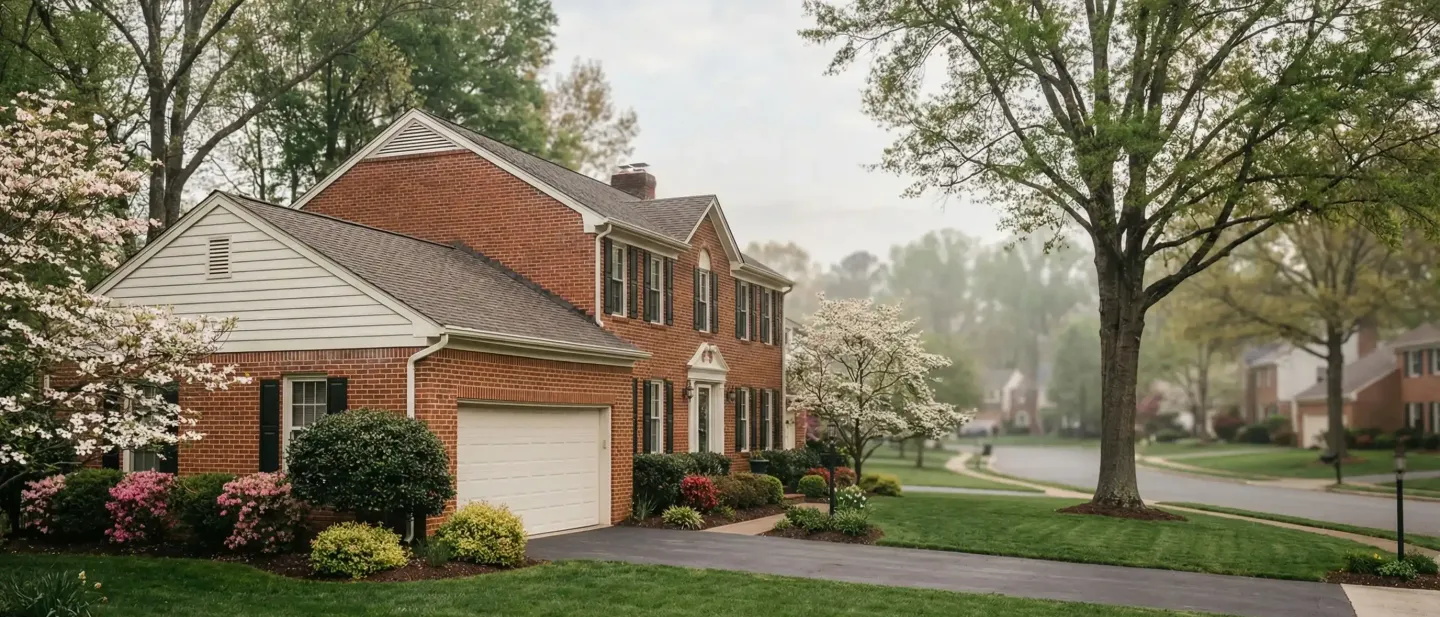
In Chesapeake, VA, people search for real estate services about 1,270 times a month on Google; a top-of-page click costs $1.43–$8.60, and demand peaks in July.
Google Keyword Planner · Oct 2025 – Sep 2026
| Search | Monthly searches | Top-of-page CPC |
|---|---|---|
| homes for sale | 320 | $0.19–$3.85 |
| houses for sale | 320 | $0.20–$4.07 |
| real estate agent | 110 | — |
| commercial real estate | 70 | $0.39–$3.60 |
| property management | 70 | $2–$14 |
| realtor near me | 50 | $9–$29 |
| condos for sale | 40 | $0.15–$1.74 |
| real estate broker | 40 | $1.36–$4.84 |
| first time home buyer | 40 | $2.68–$8.24 |
| real estate agents near me | 30 | $3–$31 |
US: $9.02
Google Keyword Planner · Oct 2025 – Sep 2026
Source: Google Keyword Planner (Google Ads), Google Search, English, Chesapeake, VA, Oct 2025 – Sep 2026. Volumes are Google's monthly averages; CPC is the top-of-page bid range, weighted by search volume. How we collect these figures.
Real estate PPC failure in Chesapeake is almost always caused by one structural mistake: building campaigns for a generic buyer audience when the market's highest-value, highest-converting leads come from military relocation. PCS orders from Naval Station Norfolk create a buyer population that is deadline-driven, pre-qualified by BAH income, and transacts on 30–60 day timelines — the opposite of the civilian browse-phase buyer who takes 4–9 months from first search to close. Campaigns that don't separate these audiences treat them as equivalent and optimize for neither.
The second failure mode is scale. Hampton Roads real estate advertising is dominated by national portals — Zillow and Realtor.com maintain significant Google Ads presence in the metro — and large regional brokerages: Howard Hanna and BHHS Towne compete metro-wide with substantial budgets. Independent Chesapeake agents who bid on broad, metro-wide terms ("Hampton Roads homes for sale," "Virginia Beach real estate") are outgunned at the budget level. The win is not in competing on volume — it is in geo-targeting at the neighborhood level that large metro campaigns structurally ignore.
Chesapeake's residential market is not monolithic. The city's neighborhoods — Great Bridge, Greenbrier, Deep Creek, South Chesapeake, and the Battlefield Boulevard corridor — have distinct buyer profiles, price ranges, and search behaviors. A Greenbrier buyer searching "Greenbrier Chesapeake homes" is looking for something fundamentally different from a Deep Creek buyer searching "Deep Creek VA waterfront homes." Large metro campaigns run broad Hampton Roads geo-targeting that never gets this specific, which means neighborhood-focused ads from local agents achieve relevance scores and CTRs that mega-campaign budgets cannot match.
The Chesapeake BBB real estate dataset shows 97 local real estate agents and brokers competing for the city's buyer traffic. But the effective competitive set is larger — Hampton Roads metro agents from Virginia Beach, Norfolk, and Suffolk all compete across the metro on Google Ads, creating an auction environment where CPCs are compressed by regional competition even when the actual conversion comes from a Chesapeake-specific search. This dynamic makes Quality Score optimization — achieved through precise geo-targeting, hyper-local ad copy, and city-specific landing pages — the primary lever for reducing CPL below the $65–$110 range that generic campaigns achieve.
Military relocation buyers arrive in Chesapeake's search results with a fundamentally different urgency profile than civilian buyers. A family receiving PCS orders to Naval Station Norfolk commands has a hard reporting date — typically 30–45 days from receipt of orders. That deadline transforms what would be a multi-month civilian home search into a compressed, high-conversion event. Ad copy that acknowledges this reality ("new to Hampton Roads? PCS homes near Naval Station Norfolk") converts at 2–3x the rate of generic "homes for sale Chesapeake" campaigns for this audience, because it communicates immediate relevance to a deadline-driven buyer who doesn't have time for generic browse-phase real estate advertising.
Chesapeake real estate PPC requires a five-campaign structure that separates military relocation, home sellers, first-time buyers, neighborhood-specific search, and luxury/move-up demand. The most common mistake is funneling all buyer traffic into one campaign — military relocation buyers, first-time buyers, and luxury buyers have different CPCs, different conversion rates, and different landing page requirements. Mixing them in one campaign averages the signals and prevents the algorithm from optimizing for the highest-LTV audience in each segment.
Campaign 1 — Military Relocation Buyers
The highest-conversion campaign in this market. Military families with PCS orders convert within 30–60 days from first search to closed transaction. Landing pages must include: "homes near Naval Station Norfolk," BAH calculator link, school district information for military families, and an agent bio that mentions experience working with military relocations. Response time matters — military buyers who don't get a callback within 2–4 hours often move to the next agent.
Campaign 2 — Home Sellers (Listing Acquisition)
Chesapeake's 8.13% appreciation and 54.35% five-year gain creates a motivated seller audience — long-term owners ready to cash in on equity. Seller lead landing pages convert best when they lead with the appreciation figure immediately: "Your Chesapeake home may have appreciated $80,000+ in the past year. Find out your current market value." Seller CVR for this market runs 3–4% on value estimate-focused landing pages, versus 1.5–2% on generic "list your home" pages.
Campaign 3 — First-Time Buyers
Chesapeake's 3.8% vacancy rate and $3,031/month average rent make ownership economics highly favorable — renters paying $3,000/month have strong financial motivation to explore FHA purchase options. First-time buyer ad copy should lead with the rent-vs-own math: "Why rent $3,000/month in Chesapeake when you could own for less with FHA financing?"
Campaign 4 — Neighborhood-Specific Buyer Search
The highest-relevance campaign structure for independent agents. Great Bridge, Greenbrier, Deep Creek, and South Chesapeake each have their own buyer profile and search vocabulary. A neighborhood-specific landing page with local school ratings, recent sales data, and community information converts at 3–5x the rate of a generic MLS search page.
Campaign 5 — Luxury/Move-Up Buyers
Five-year sellers capturing 54% appreciation are now buyers for the $500K–$700K+ Chesapeake new construction segment. This audience needs luxury-tier ad copy and landing pages that feature new construction, luxury community amenities, and trade-up equity framing.
Budget: $2,000–$4,000/month. Allocation: 35% military relocation, 25% sellers, 20% first-time buyers, 15% neighborhood-specific, 5% luxury. High season: March–August, with PCS surge June–August requiring +25–35% budget increase on military relocation campaigns.
The most underutilized insight in Chesapeake real estate PPC is the structural duality of the market's demand engine. Civilian buyer demand follows the standard spring-summer seasonality curve — peaking March through July. Military buyer demand follows PCS order issuance timing — peaking June through August but present year-round as orders arrive outside the standard spring PCS window. An agent who builds campaigns only around the civilian seasonality pattern captures roughly 60% of the available buyer search demand and misses the year-round military pipeline entirely.
June, July, and August are both civilian peak season AND PCS order peak season — making the summer months the highest-volume, highest-conversion window in Chesapeake's real estate calendar. Military families receiving orders in May for a July reporting date are searching in earnest in late May and June, creating a compressed buying window where agents with active campaigns capture enormous transaction volume relative to budget spent. A $3,500/month campaign scaling to $4,500–$5,000 during May–July is not discretionary — it is a mandatory budget adjustment for any agent serving the military buyer segment.
Key insight: The equity play is the seller side story for 2026. Chesapeake homeowners who purchased in 2019–2021 have seen 35–54% appreciation — meaning a 2020 purchase at $310,000 is now worth $420,000–$478,000. That $110,000–$168,000 in unrealized equity is the most powerful motivator in seller lead campaigns. Ads that lead with the specific appreciation percentage ("Chesapeake homes up 8.13% this year — what is your home worth now?") generate 40–60% higher CTR than generic "thinking of selling?" copy, because they make the financial opportunity concrete and immediate rather than abstract and future-oriented.
The first-time buyer opportunity deserves a specific note on market timing: Chesapeake's 3.8% vacancy rate creates a tight rental market that pushes rents toward their statistical ceiling. Average rents at $3,031/month in a market where FHA purchases are available at 3.5% down on $350,000 homes mean the monthly cost differential between renting and owning is narrowing rapidly. First-time buyer campaigns that quantify this math — showing the actual monthly mortgage payment versus the comparable rental cost — convert renters at significantly higher rates than campaigns that simply offer to "help you find your first home."
Chesapeake real estate PPC done correctly means two things: military relocation campaigns structured around PCS timelines, and seller campaigns built around an 8.13% appreciation story that motivates equity-rich homeowners to act. A generic real estate campaign delivers some leads at some CPL — but it systematically underperforms in the two highest-value segments that define Chesapeake's market.
At MB Adv Agency, we structure real estate accounts with separate military relocation and civilian buyer campaigns, neighborhood-specific ad groups for Great Bridge, Greenbrier, and Deep Creek, and seller lead pages that lead with Chesapeake's specific appreciation data. We scale military relocation budgets June–August to capture peak PCS season, and we build landing pages designed for compressed 30-day buyer timelines — not the 6-month civilian research cycle.
At $65–$110 CPL with median transaction value of $471,751, real estate PPC in Chesapeake generates some of the best ROAS economics in the lead generation category. A single closed military relocation transaction covers 100–160x the acquisition cost. See our PPC pricing and real estate lead generation services. City landing page: mbadv.agency/local-ppc-service/ppc-consultant-campaign-management-chesapeake-va.

Military relocation real estate PPC in Chesapeake targets active-duty families receiving PCS orders to Naval Station Norfolk and surrounding Hampton Roads commands — the largest naval base in the world with thousands of inbound transfers annually. These campaigns run on keywords like "military relocation realtor Chesapeake VA," "PCS move Hampton Roads homes," and "homes near Naval Station Norfolk". At a 3–4% conversion rate, military relocation campaigns generate leads with favorable economics when a closed military relocation transaction at $400,000–$500,000 generates $10,000–$15,000 in commissions. The defining characteristic of military buyer PPC is conversion speed: families with PCS orders have hard reporting dates, typically 30–45 days after order receipt. This creates compressed search-to-offer timelines that civilian buyer campaigns never experience — an agent with an active campaign, a militarily tailored landing page, and a sub-2-hour response protocol can close 2–3 transactions per month from a $1,200–$1,500/month military relocation campaign alone.
Campaign structure requirements for military relocation PPC: Military-specific keywords must be in dedicated campaigns — not blended with civilian buyer campaigns. Ad copy must include references to BAH eligibility, proximity to Naval Station Norfolk, and experience with PCS timelines. Landing pages should include school district data for military families and a direct agent contact with stated response time.
Seasonal scaling is critical: June–August is peak PCS season. Military relocation campaigns should scale 25–35% above baseline in May–July to capture the surge, then return to baseline in September. Flat-budget campaigns through summer miss the highest-volume window in the military buyer calendar.
A Chesapeake realtor needs a minimum of $2,000/month to generate consistent buyer and seller leads from Google Ads — and $3,000–$4,000/month to compete across military relocation, seller acquisition, and first-time buyers simultaneously. At $2,000/month with CPCs of $1.43–$8.60 and a 3% conversion rate, a correctly structured campaign generates approximately 12 leads per month at about $167 CPL, at a typical click of about $5.02. At even a 10% lead-to-client close rate — standard for well-qualified real estate leads — that's about 1 new client per month. At Chesapeake's $471,751 median value and 2.5–3% commission, each closed buyer transaction generates $11,800–$14,100. One closing per month from a $2,000 ad spend is a 6–7x monthly ROAS before overhead — among the highest return categories in local service PPC.
Budget seasonality framework: Baseline $2,500/month October–February (off-peak civilian market). Scale to $3,500/month March–May (civilian spring buying season). Scale to $4,000–$4,500/month June–August (peak civilian + PCS season combined — the highest-value window). Return to baseline in September. This seasonal structure captures peak demand without over-spending in the off-peak winter months.
Solo agents vs. team budgets: A solo Chesapeake agent should focus budget on one primary campaign — military relocation or neighborhood-specific buyer — and max it out before expanding to a second campaign. Team budgets of $3,500+ can support parallel seller acquisition and buyer campaigns simultaneously. Spreading $2,000 across five campaign types dilutes all of them below effective volume; concentrating it on the highest-LTV audience first (military relocation for most Chesapeake agents) builds a conversion baseline that can then fund expansion.
How to read this Cost per click and monthly searches are measured with Google Keyword Planner (see above). Cost per lead, conversion rate, budget and leads are estimates compiled from public benchmarks such as WordStream, not measurements.
Sources WordStream/PPCChief 2026 + Chesapeake market estimates + NeighborhoodScout 2025
$590$990/month
1 platform · Google or MetaGoogle + Meta$790$1,290/month
1 platform · Google or MetaGoogle + Meta$1,140$1,940/month
1 platform · Google or MetaGoogle + MetaChatGPT Ads: a separate pilot, $250/month, added to a plan. See the pilot →

Matteo Braghetta founded MB Adv and runs its Google Ads accounts. He takes the first call with every new client, reads the accounts every week and writes the agency’s guides.
The other half of his job is measurement: GA4, Consent Mode and server-side tracking, so the platforms learn from real sales.
MB Adv is a Google Partner agency managing about $4.4M a year in ad spend for clients in the US, the UK and Europe.
Managed on numbers you can check.
Plans for the US