HVAC PPC St. George, UT
St. George's desert summers regularly exceed 110°F — HVAC failures here aren't inconveniences, they're medical emergencies. With 16% population growth since 2020 generating constant new-install demand alongside peak emergency repair volume, this market rewards campaigns built for urgency and specificity, not generic home services templates.
Why Do HVAC PPC Campaigns Fail in St. George?
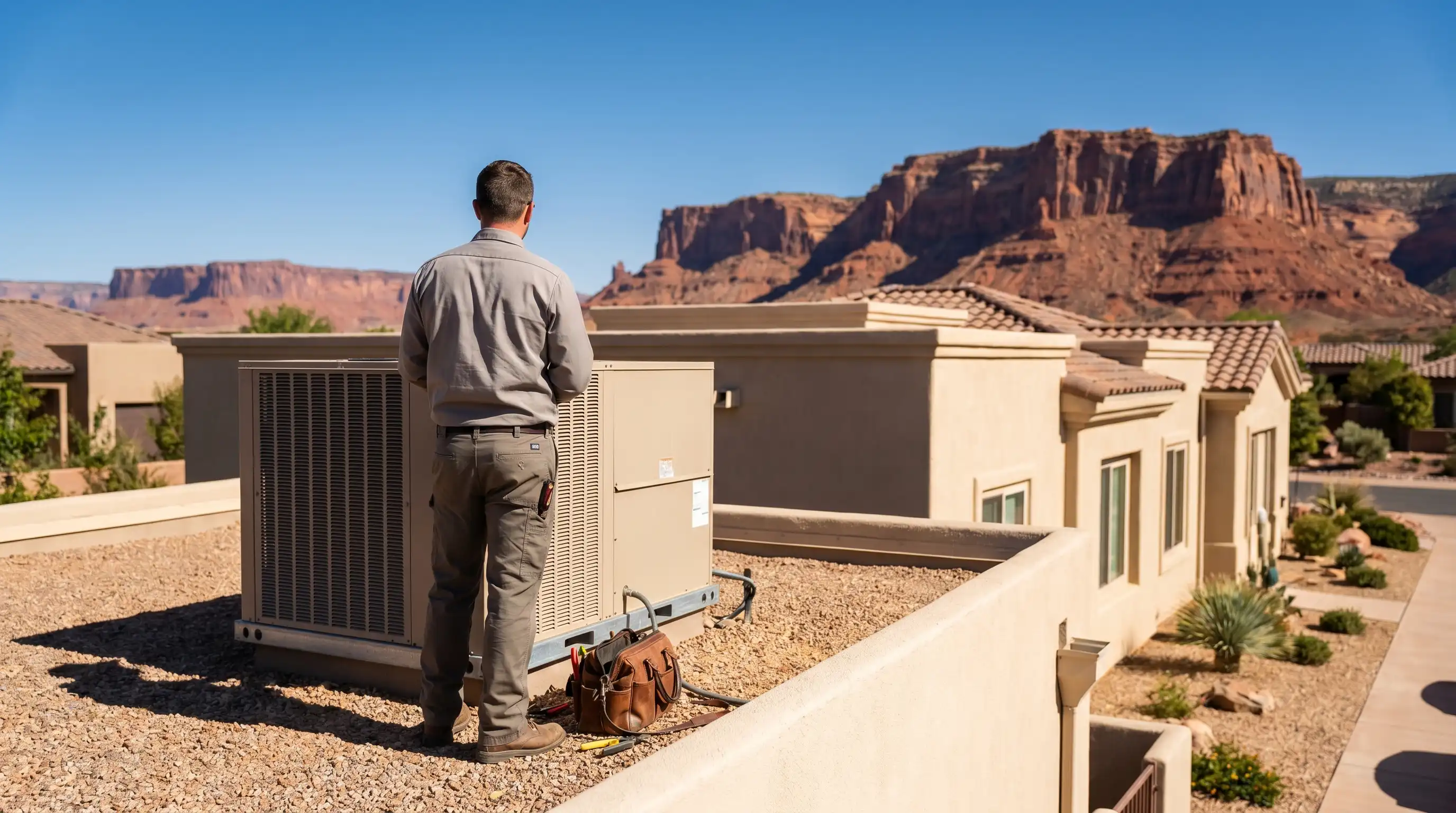
St. George doesn't have a summer — it has a furnace. When temperatures climb past 110°F for weeks at a stretch, an AC failure isn't a comfort problem, it's a medical emergency. HVAC search intent in this market is dominated by urgency, and campaigns built for feature-comparison browsing — the standard national playbook — bleed budget against competitors who've structured specifically for emergency response. That's the first and most common failure mode: treating St. George like a moderate-climate market when the reality demands an entirely different campaign architecture.
Five Established Competitors With Deep Local Recognition
The St. George HVAC market has five to seven established operators who have spent years — in some cases decades — building local trust. Air Care Professionals leads with 60+ years of combined technician experience and premium-tier positioning. S&S Mechanical Plumbing, Heating & Cooling bundles multi-service offerings that capture plumbing and cooling queries simultaneously, lowering their effective cost per acquisition across a broader search footprint. Dutton Air Care covers Hurricane, Washington, Ivins, and Santa Clara in addition to St. George, operating as a regional player with strong regional query capture. Walker Plumbing, Heating & Air and Five Star Air Conditioning, Heating & Plumbing complete the primary competitive set, each with 20+ years of local brand recognition behind their ads.
Running standard search campaigns against this field — the same emergency keywords, the same "experienced technicians" copy, the same flat-rate budget — produces predictable results: quality scores erode, CPCs climb into the upper range of the $90–$250 bracket, and cost per lead inflates until the campaign is paused. The market rewards campaign specificity and intent segmentation, not raw spend.
The Monsoon Variable Most Campaigns Miss
July through September brings a demand type that campaign managers relying on national HVAC playbooks routinely miss: monsoon-season humidity. When afternoon storms push relative humidity above 40–60% in a desert system built for 10–15%, evaporator coils saturate, drainage lines back up, and system efficiency drops sharply — triggering a distinct category of service calls separate from pure heat-failure emergencies. Campaigns that don't pivot messaging and landing pages during the monsoon window leave meaningful seasonal volume unclaimed, particularly because the emergency competitive tier is slightly less crowded in July–August than in June, when the pure-heat spike hits every operator simultaneously.
Washington County's construction boom compounds the challenge further: 6,200+ active construction jobs growing at +4.4% annually means new builds require HVAC installs on builder timelines — a demand stream with completely different search behavior, different decision horizons, and different campaign structure than residential emergency repair. Mixing new-install and emergency-repair keywords into a single campaign elevates CPCs on both intent types without serving either effectively.
HVAC PPC Strategy Built for Desert Emergency Intent
The campaign architecture that wins in St. George separates search intent into three distinct tiers: emergency repair, planned maintenance, and new installation. Each tier requires different bid levels, different ad scheduling, and a dedicated landing page. Mixing intent types into a single campaign is the most common structural error in this market — and the one that inflates CPLs fastest when peak-season pressure hits.
Emergency Repair: The Revenue Engine
Emergency keywords convert at 15–25% when ad copy mirrors the crisis tone of the search. The high-intent emergency tier dominates campaign spend from June through August and requires 24/7 ad scheduling with click-to-call extensions as the primary conversion path.
- Immediate repair queries: "AC repair St. George," "AC broken St. George," "emergency HVAC repair near me" — $90–$250 CPC; phone extension dominant; mobile bid adjustment +40–50%
- Same-day service: "same day AC repair," "HVAC technician today," "air conditioning service now" — $80–$180 CPC; response time promise in ad headline; dedicated urgency landing page required
- After-hours and 24/7: "emergency AC repair," "24 hour HVAC St. George," "AC repair weekend" — $100–$220 CPC; highest conversion rate in portfolio; time-of-day bid increases from 5 PM–10 PM
Landing page design is the conversion variable most competitors fail to address: a click from an emergency query landing on a homepage or services overview page loses 40–60% of potential conversions. Emergency campaigns require a dedicated page with the phone number dominant above the fold, a visible response time promise ("Technician en route in 60 minutes"), and a sub-3-field form for searchers who prefer not to call immediately.
Planned Maintenance and New Installation Tracks
Maintenance campaigns run at significantly lower CPCs and convert on form fills rather than phone calls. These campaigns build a recurring service base at better cost-per-lead economics than emergency campaigns — but require separate budgeting and pre-season launch timing to perform correctly.
- Maintenance and tune-up: "AC tune-up St. George," "HVAC maintenance plan," "annual cooling check" — $20–$55 CPC; launch April–May before peak demand; form-fill conversion path
- New installation: "new AC system St. George," "HVAC installation quote," "central air installation cost" — $120–$200 CPC; 5–14 day decision cycle; remarketing sequence required to close
- Efficiency upgrades: "energy-efficient HVAC," "replace old AC unit," "high-efficiency air conditioner St. George" — $80–$150 CPC; strong angle for the growing solar-plus-efficiency segment
Seasonal budget allocation that adjusts monthly outperforms flat-spend campaigns by 40–60% in extreme-climate markets. The optimal St. George distribution: 60% to emergency repair (June–August), 30% to planned maintenance (April–May, September–October), and 10% to new installation year-round. Reallocating budget from underperforming shoulder-season inventory into the pre-season maintenance ramp consistently reduces CPLs entering the summer peak.
Google Partner Agency
We're a certified Google Partner Agency, which means we don’t guess — we optimize withGoogle’s full toolkit and insider support.
Your campaigns get pro-level execution, backed by real expertise (not theory).

What Market Trends Should St. George HVAC Businesses Know?
St. George is one of the fastest-growing small cities in the United States — 16% population growth since 2020, adding more than 15,000 permanent residents to the Washington County area in six years. Every new household represents a new HVAC system within 2–3 years, and every system installed during the 2020–2023 construction boom reaches its first major maintenance cycle in 2025–2027. The compounding effect: sustained install demand layered on top of growing repair and replacement volume at a scale most comparable-sized markets don't replicate.
The 290-Day Revenue Window
St. George's annual sunshine exceeds 290 days per year — creating an AC-dependency season that stretches from late April through early October, roughly 6–7 months of elevated search volume. Most US HVAC markets operate at peak for 3–4 months. The St. George window is nearly double, meaning the annual ROI on advertising investment here is structurally better than comparable-sized cities with shorter hot seasons. Per dollar of annual campaign spend, more revenue-generating search events occur here than in most northern or mid-Atlantic markets of similar population.
The Rocky Mountain Power Wattsmart Battery Program adds an emerging upgrade angle: homeowners investing in solar and battery storage are simultaneously evaluating new high-efficiency HVAC systems to reduce total electrical draw and maximize solar payback. This creates cross-sell search behavior — homeowners researching "energy-efficient HVAC upgrade" alongside "solar installation St. George" — that HVAC operators can capture with campaigns positioned around energy independence rather than emergency repair alone.
New Residents Are PPC-First Buyers
In-migration from California, Nevada, and Arizona is continuous and growing. New residents settling in Red Cliffs Ranch, Sunbrook, Desert Canyons, and the expanding southern corridor arrive with zero established relationships with local HVAC contractors. These buyers enter the market at maximum search dependency — no yard-sign familiarity, no neighbor referrals, no multi-year service history. A well-structured Google Ads campaign captures this segment at the precise moment of highest receptivity, before any organic familiarity with local brands develops through repetition and word of mouth.
The cost-per-lead reality in St. George also favors well-run campaigns: at $89–$150 per qualified HVAC lead against average replacement job values of $3,000–$12,000, the return on ad spend for managed campaigns consistently outperforms national home services benchmarks. The question isn't whether HVAC PPC works in this market — it's whether the campaign is built to match the specific demand patterns driving search here.
Why St. George HVAC Businesses Choose MB Adv Agency
Managing HVAC PPC in a desert market requires campaign structure that most generalist agencies never build. The seasonal extremes, emergency-intent dominance, and monsoon-season demand variations in St. George produce different performance curves than the standard home services playbooks used in moderate-climate markets. Getting it wrong means overspending on low-intent keywords during peak season — when every dollar matters most.
At MB Adv Agency, we build HVAC campaigns in St. George around the three-tier intent structure the market demands: emergency repair campaigns with click-to-call optimizations and 24/7 scheduling, pre-season maintenance campaigns built for April–May launch windows, and new installation campaigns with multi-touch remarketing sequences. Our PPC lead generation service is purpose-built for the high-urgency, high-CPC home services environment where St. George HVAC operators compete.
Washington County's growth trajectory means the HVAC market will grow more competitive each year as new operators enter and established ones increase ad spend. The operators who build proper campaign infrastructure now — intent segmentation, dedicated emergency landing pages, seasonal budget frameworks — hold a compounding advantage over those who enter later. View our HVAC PPC pricing plans to see how a managed campaign fits your current budget.
Frequently Asked Questions
How Much Should an HVAC Company in St. George Budget for Google Ads?
An HVAC company in St. George should budget a minimum of $2,000–$3,000 per month to generate a meaningful volume of emergency repair and maintenance leads. At $2,000/month, a well-structured campaign targeting high-intent emergency keywords at $90–$250 CPC generates roughly 12–20 qualified leads per month, with cost per lead typically running $89–$150 on optimized campaigns. Operators aiming to dominate the market during peak summer — when June–August emergency volume is highest — should target $3,000–$5,000/month to outbid competitors who also increase spend during that window. The seasonally adjusted approach (higher in peak, reduced in shoulder months) outperforms flat-monthly budgets by 40–60% in terms of annual leads per dollar invested. Emergency campaigns at the higher CPC tier require a minimum daily budget of $100–$150 to remain competitive in ad auctions throughout daylight hours when intent is highest.
The budget split matters as much as the total. Emergency campaigns during June–August should receive 60% of monthly budget; planned maintenance campaigns in April–May and September–October should receive 30%; new installation can run year-round on the remaining 10%.
Budget minimums exist because the St. George market has 5–7 active competitors running campaigns simultaneously. Underbidding produces quality score penalties and impression share below 20% — the campaign effectively disappears in peak-demand auction windows, exactly when the spend matters most.
When Is the Best Time to Launch HVAC PPC Campaigns in St. George?
The optimal launch window for HVAC PPC in St. George is late April to early May — 4–6 weeks before the June peak heat season. Launching pre-season allows campaigns to accumulate Quality Score data, refine ad copy performance, and establish conversion tracking before emergency CPC rates spike in June. Operators who launch in June — when intent is highest but so is competitive spend — pay a first-month penalty: lower Quality Scores, higher CPCs, and diminished ad positions until the campaign earns performance history. The pre-season window also captures the maintenance and tune-up segment at CPLs 20–30% lower than peak-season rates, building a recurring service base before emergency volume peaks. Year-round operation produces better annual ROAS than summer-only campaigns because the algorithm accumulates conversion data across all demand types and bidding becomes more efficient over a longer performance window.
The monsoon season (July–September) is a secondary launch opportunity for operators focused on the efficiency and maintenance segment — humidity-related service calls peak in this window at lower competitive intensity than pure emergency queries in June.
For new operators entering the St. George market for the first time, a September–October launch runs at lower CPCs (post-summer demand drop) and builds campaign history before the critical pre-season window in April, when maintenance and pre-summer checkup campaigns produce the best annual ROAS in this market.