Start
$590$990/month
1 platform · Google or MetaGoogle + Meta- Ad spend
- up to $3,000
- New creativesmade by us
- Google + Meta only4 a month
 By Matteo Braghetta, Founder · Google Ads
Charleston's real estate market has appreciated 133.37% over the past decade, with the median city home now at $509,700 — driven by military relocation, Silicon Harbor tech migration, and a coastal lifestyle demand that doesn't slow down. Real estate agents who rely on referrals alone are leaving a flood of high-intent buyer and seller traffic to competitors who know how to capture it with paid search.
See how this city's Real Estate PPC costs compare nationally in our Real Estate PPC Statistics report, featuring data from 40+ US cities.
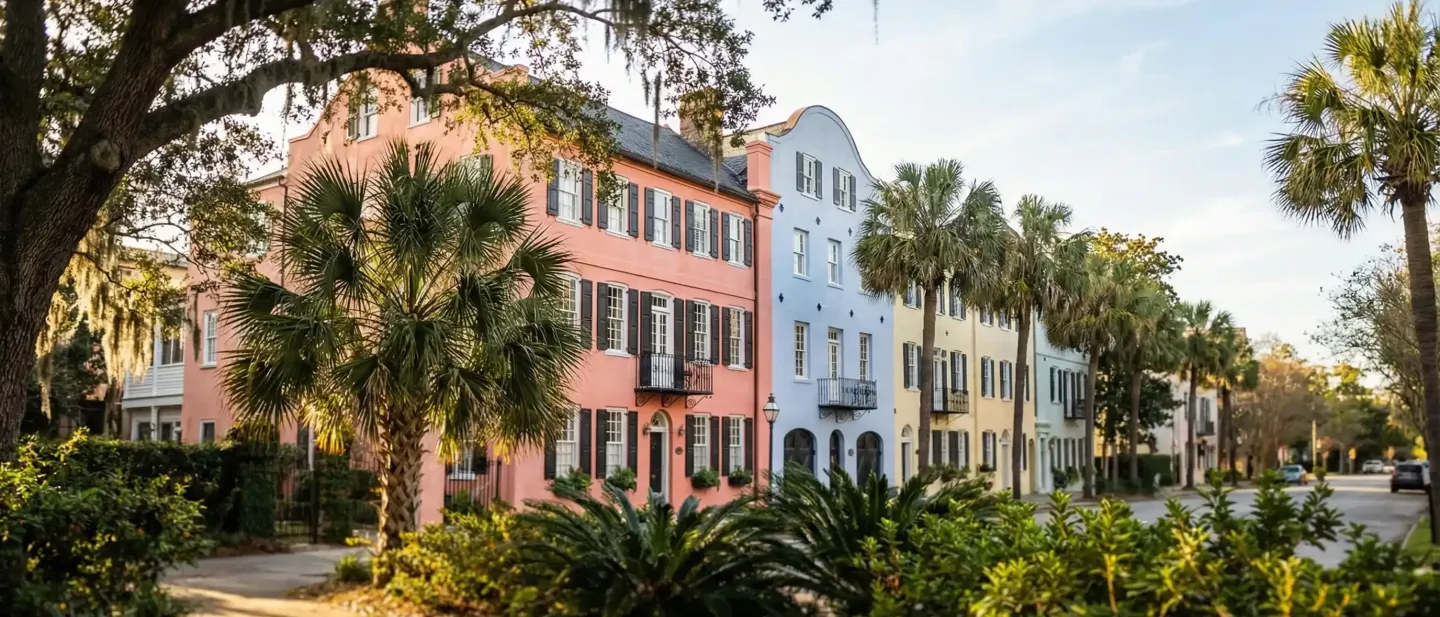
In Charleston, SC, people search for real estate services about 1,550 times a month on Google; a top-of-page click costs $2–$11, and demand peaks in March.
Google Keyword Planner · Oct 2025 – Sep 2026
| Search | Monthly searches | Top-of-page CPC |
|---|---|---|
| houses for sale | 390 | $0.26–$5.67 |
| homes for sale | 320 | $0.26–$6.56 |
| real estate agent | 170 | $8–$22 |
| commercial real estate | 140 | $0.40–$3.18 |
| property management | 110 | $2–$12 |
| realtor near me | 70 | $5–$34 |
| real estate broker | 50 | — |
| first time home buyer | 40 | $3–$13 |
| real estate agents near me | 30 | $7–$49 |
| condos for sale | 30 | $0.22–$3.05 |
US: $9.02
Google Keyword Planner · Oct 2025 – Sep 2026
Source: Google Keyword Planner (Google Ads), Google Search, English, Charleston, SC, Oct 2025 – Sep 2026. Volumes are Google's monthly averages; CPC is the top-of-page bid range, weighted by search volume. How we collect these figures.
Real estate PPC in Charleston presents a deceptive challenge: the market is hot, buyer intent is high, and the search volume is substantial — yet most independent agents and small brokerages see mediocre results from their Google Ads. The problem is rarely the market. It's the campaign structure, the audience targeting, and the failure to address what makes Charleston buyers different from buyers in every other market.
Zillow, Realtor.com, and Homes.com dominate organic search for Charleston real estate listings. These portals spend millions in national PPC budgets; competing with them on broad listing searches like "homes for sale Charleston SC" is expensive and inefficient. CPCs for broad real estate terms in Charleston run $0.26–$6.56 — and at the national CVR of 2.47% for real estate, lead costs add up quickly. For independent agents, those economics only work with exceptional lead quality and a disciplined follow-up system.
Local agents and boutique brokerages — Carolina One Real Estate, Matt O'Neill Real Estate, The Boulevard Company, and Keller Williams affiliates — compete at this tier. Luxury-focused firms like Daniel Ravenel Sotheby's and Handsome Properties run separate campaigns for the $1M+ segment with higher CPCs on branded and neighborhood-specific luxury terms. The SMB opportunity — independent buyer's agents working the $400K-$900K segment — is being squeezed from above by portals and from below by discount brokerages running lead-capture ads.
Charleston receives two distinct relocation buyer streams that behave fundamentally differently: military PCS transfers and lifestyle migration from the Northeast and Midwest. Both groups are high-intent, often pre-qualified, and working against a timeline — but they search differently and need different messaging to convert.
Military buyers searching during PCS season (April-August) use specific terminology: "PCS to Charleston SC," "homes near JBCHARLESTON," "VA loan Charleston realtor," "military relocation Charleston." These are high-intent, low-competition keywords that most civilian agents aren't buying — which means the agents who do buy them face modest CPCs on searches where the buyer is already motivated and timeline-constrained.
Northeast lifestyle migrators — often searching from New York, Boston, or Washington D.C. metro areas — use broader intent signals: "moving to Charleston SC," "cost of living Charleston SC vs NYC," "Charleston SC neighborhoods for families." These out-of-market searchers are earlier in the funnel but represent some of the highest transaction-value buyers in the market — they're typically selling high-equity homes in expensive metros and arriving in Charleston with substantial purchasing power.
The campaign failure mode for most agents: running a single generic campaign targeting "Charleston real estate agent" and wondering why the leads don't convert. A relocation buyer from Boston has different objections, different questions, and different timelines than a local move-up buyer or a military family on PCS orders. Campaigns that don't segment these audiences convert at half the rate of those that do.
Charleston's real estate market also has a strong investor tier that most agents run generic ads into. The city receives over 6 million annual visitors, generating persistent short-term rental demand. Investor-focused searches ("Charleston investment property," "Airbnb properties Charleston SC," "rental property ROI Charleston") represent a distinct segment with higher average transaction values — and far lower ad competition than consumer buyer searches.
The highest-performing Charleston real estate PPC accounts don't try to compete with Zillow on listing searches. They dominate the niches where portals are structurally weak: military relocation, out-of-state migration, investor acquisition, and neighborhood-specific searches. Here's the campaign architecture that works.
Landing page strategy: never send paid traffic to a generic homepage or IDX search page. Each campaign segment needs a dedicated landing page that speaks directly to that buyer's situation. A military PCS buyer landing page should address VA loan eligibility, BAH rates for Charleston, and timeline-friendly agent services. An out-of-state buyer page should address the relocation process, Charleston neighborhood overview, and a clear call to schedule a consultation.
Call extension and lead form extensions are mandatory in this market. Many buyers — especially military families — prefer phone consultations over form fills. Agents who only accept form leads lose a significant portion of the highest-intent traffic.
Charleston's real estate market has a structural characteristic that creates a durable PPC advantage for agents who understand it: the buyer pool is continuously refreshed by external forces. Unlike static metros where buyer demand depends on organic population growth, Charleston receives a reliable annual injection of new, motivated buyers from three external sources.
First, the military pipeline. JBCHARLESTON processes an estimated 10,000-12,000 PCS moves annually. Each PCS transfer is a forced buying or renting event on a fixed timeline — military families cannot postpone a move because the market feels uncertain. They arrive in Charleston with VA loan eligibility, BAH housing allowances ($2,100-$2,700/month for E-5 and above with dependents in the Charleston MSA), and an urgent need to establish housing within 30-60 days. This creates a highly predictable, seasonally concentrated (April-August) surge of buyer demand that flows almost entirely through Google search — because these buyers have no local network to rely on.
Second, the Silicon Harbor migration. Charleston has attracted significant tech-sector relocations from Northeast metros over the last five years. The city's combination of no state income tax on Social Security, no estate tax, a 45-minute drive to the beach, and median home prices 40-60% below Boston or D.C. creates a compelling financial case for technology professionals and remote workers seeking cost arbitrage without sacrificing quality of life. These buyers typically arrive pre-qualified with substantial equity from their origin market, making them some of the highest-value buyers a Charleston agent can work with.
Third, the tourism-to-resident pipeline. Charleston receives 6M+ annual visitors. A meaningful percentage of those visitors — particularly those from Midwest markets with strong disposable incomes — return as second-home buyers or full-time relocators. "I visited Charleston and decided to move here" is a conversion story that Charleston agents hear regularly. These buyers typically enter the market through vacation-rental searches before transitioning to real estate agent searches. Remarketing campaigns targeting tourism-intent searchers who revisit Charleston real estate terms capture this pipeline efficiently.
Charleston's decade of real estate appreciation — 133.37% from 2014 to 2024 — is not just a market statistic. It's a conversion tool. For fence-sitting buyers who are waiting for the "right time," this data makes the argument that waiting has already cost them. For investors evaluating Charleston versus competing markets, it provides the track record that justifies allocation decisions.
PPC campaigns that surface this data in ad copy and landing page headlines consistently see 15-25% higher CTR than generic "find your dream home" messaging. "Charleston home values up 133% in 10 years — don't wait for the next 10" is a specific, credible, locally-sourced claim that portals can't make and national franchises won't bother to personalize. It's exactly the kind of message that converts high-intent local buyers who already know the market is moving.
Charleston real estate PPC isn't a generic Google Ads problem — it's a market-intelligence problem. The agents who win here understand that military buyers, lifestyle migrants, and local move-up buyers each need a different message, a different landing page, and a different conversion path. Campaigns that treat all three as the same lead type consistently underperform.
At MB Adv Agency, we build Charleston real estate PPC campaigns around the three-stream buyer reality. Military campaigns with VA loan language, BAH-aware messaging, and JBCHARLESTON area targeting. Out-of-state migration campaigns targeting departing Northeast metro audiences with lifestyle and financial comparison content. Investor campaigns segmented by property type and STR intent.
We don't manage campaigns from a national playbook. We manage them from the data: what keywords your buyers actually use, which neighborhoods convert, and which audiences have the highest transaction-value LTV. Every Charleston real estate campaign we build starts with a market audit — keyword competition by segment, existing competitor ad copy analysis, and a clear CPL target based on your average transaction value and commission structure.
See our lead generation approach at mbadv.agency/services/ppc-lead-generation-agency, or review pricing at mbadv.agency/ppc-pricing. The strategy call is free — and it starts with your market data, not a pitch deck.

A starter budget of $2,000-$4,000 per month generates 10-25 qualified leads at a CPL of $100-$180, depending on campaign focus. Military relocation and investor campaigns run at the lower end of the CPL range ($100-$140) due to high buyer intent and lower keyword competition. Broad buyer and seller campaigns targeting Charleston-wide terms run at the higher end ($160-$220) due to competition from national portals and franchise brokerages.
The right budget depends on your average transaction value and conversion rate from lead to close. Charleston's median home value of $509,700 and the typical 2.5-3% commission means a single closed transaction generates $12,700-$15,300. At a $150 CPL with a 10% lead-to-close rate (typical for referral-supplemented agents), the math is: 27 leads to close one deal at $150 each = $4,050 in ad spend generating $12,700-$15,300 in commission. That's a 3-4x ROAS on a single transaction — and the buyers you close typically refer, come back for their next purchase, or send their military colleagues your way.
Seasonality matters: April through August is peak PCS season and the highest-intent period for military buyers. Increasing budget by 25-40% during this window to capture the PCS surge is one of the highest-ROI campaign decisions a Charleston real estate agent can make.
Yes — but only if you compete where portals are structurally weak, not where they're strong. Zillow and Realtor.com dominate broad listing searches. They do not dominate agent-specific, relocation-specific, or investor-specific searches — and those are exactly the searches that produce the highest-converting, highest-value leads.
"Best real estate agent for military PCS Charleston SC," "VA loan specialist Mount Pleasant," and "Charleston SC investment property buyer's agent" are searches that Zillow cannot answer — their product is a listings portal, not a specialist agent. These keywords convert at 3-5% CVR, making them dramatically more efficient than competing for portal-dominated broad terms.
The practical approach: concede the listing-search territory to the portals and allocate your budget to the segments where you have a natural advantage as a local specialist — military relocation, out-of-state migration, investor acquisition, and neighborhood expertise. A $2,500/month campaign structured around these niches will outperform a $4,000/month generic campaign competing with Zillow. The agents who understand this dynamic — and build campaigns around it — consistently achieve CPLs under $130 and close ratios above 12%. PPC works for Charleston real estate agents. It just has to be built for Charleston, not copied from a national template.
How to read this Cost per click and monthly searches are measured with Google Keyword Planner (see above). Cost per lead, conversion rate, budget and leads are estimates compiled from public benchmarks such as WordStream, not measurements.
Sources WordStream 2025 Google Ads Benchmarks (Real Estate) + Charleston market adjustments based on Phase 1/2 research
$590$990/month
1 platform · Google or MetaGoogle + Meta$790$1,290/month
1 platform · Google or MetaGoogle + Meta$1,140$1,940/month
1 platform · Google or MetaGoogle + MetaChatGPT Ads: a separate pilot, $250/month, added to a plan. See the pilot →

Matteo Braghetta founded MB Adv and runs its Google Ads accounts. He takes the first call with every new client, reads the accounts every week and writes the agency’s guides.
The other half of his job is measurement: GA4, Consent Mode and server-side tracking, so the platforms learn from real sales.
MB Adv is a Google Partner agency managing about $4.4M a year in ad spend for clients in the US, the UK and Europe.
Managed on numbers you can check.
Plans for the US