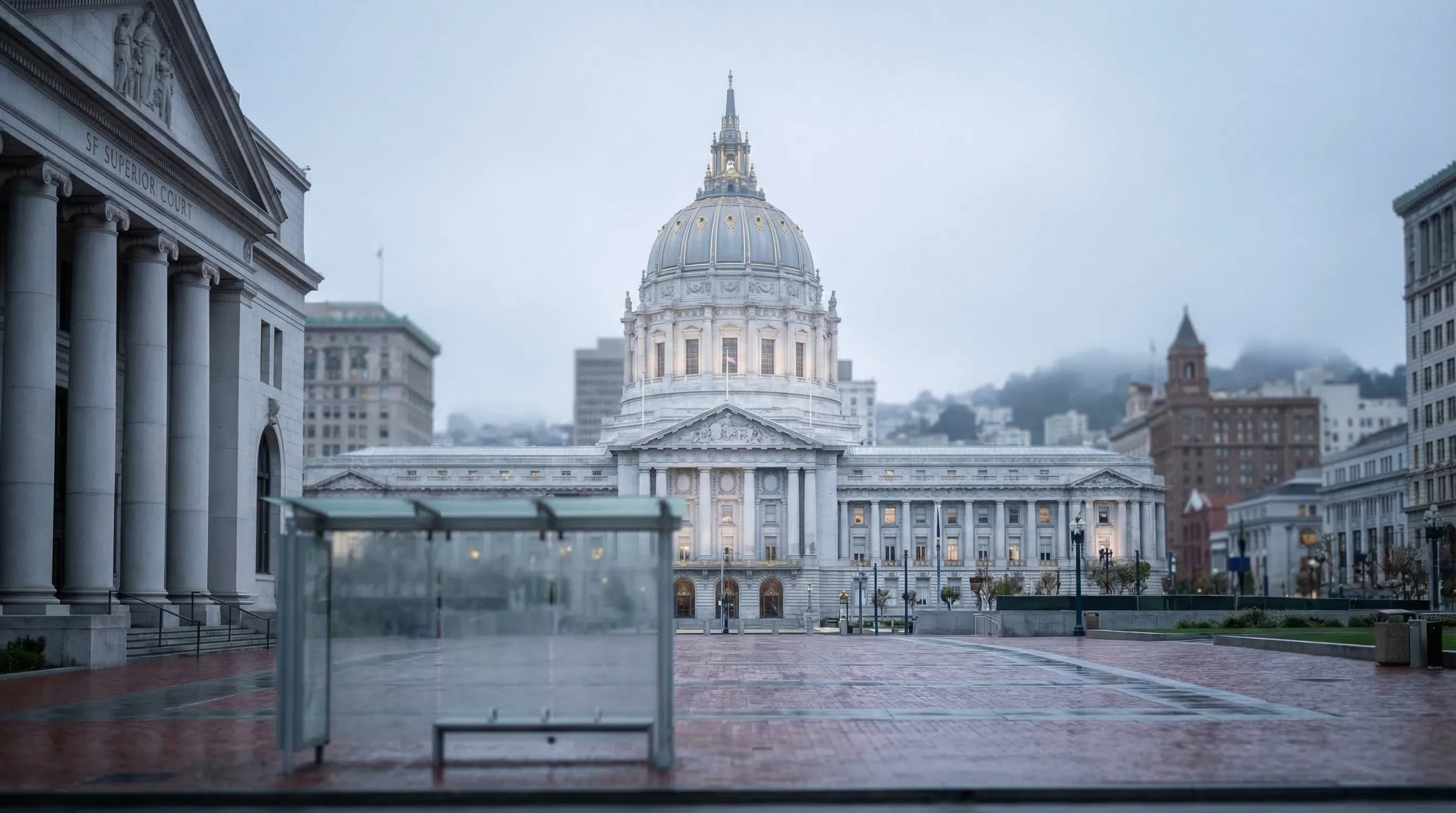
Real Estate PPC San Francisco, CA
San Francisco's median home price of $1,299,230 makes every closed transaction worth $26,000–$52,000 in commission — yet most SF real estate agents compete head-to-head with Zillow on broad keywords where they're outspent 20-to-1, while neighborhood-specific and Chinese-language campaigns with a fraction of the CPC sit unclaimed. <!-- stats-article-link --> <p><em>See how this city's Real Estate PPC costs compare nationally in our <a href="https://www.mbadv.agency/ppc-industry-statistics/real-estate-ppc-statistics">Real Estate PPC Statistics</a> report, featuring data from 40+ US cities.</em></p>
Zillow runs the most aggressive real estate PPC operation in the United States. In San Francisco, Zillow outspends the average individual real estate agent by 20–50 times on Google Ads, holding dominant positions on every broad transaction term — "homes for sale San Francisco," "buy a house SF," "San Francisco real estate listings." An individual agent entering the auction on these terms isn't competing with other local agents; they're competing with a technology company that has $1.9 billion in annual revenue and a dedicated search marketing team. This is the defining structural problem of SF real estate PPC.
The secondary competition layer makes it worse. Redfin, Realtor.com, Homes.com, and Compass all run city-level campaigns with institutional budgets. Each of these platforms bids on the same broad SF real estate keywords, each has a higher Quality Score than most individual agents (due to massive ad history and landing page authority), and each is willing to pay CPCs that generate only marginal returns at scale. Individual agents who enter these auctions find their $3,000/month budget depleted in days without generating meaningful lead volume.
The Commission Math That Reshapes the Problem
Here's what most SF real estate agents don't model: a $1,299,230 median home generates a seller's agent commission of $32,480–$38,975 at 2.5–3%. A buyer's agent commission on the same home runs $25,985–$32,480. One closed transaction from PPC — just one — returns 8–12 months of a $3,000/month ad budget in a single commission check. The agent who decides SF real estate PPC is too expensive because the CPLs look high is misapplying the unit economics of their own business.
The agents losing in SF real estate PPC aren't losing because the economics don't work — they're losing because they're competing in the wrong auctions. Broad SF real estate keywords are Zillow's home turf. Hyper-local neighborhood keywords, Chinese-language buyer campaigns, tech RSU buyer campaigns, and post-NAR settlement messaging are territory where Zillow's size becomes a liability. A platform that serves 30 million users can't craft ad copy specific to "Noe Valley homes for sale" that resonates with the neighborhood's culture, school quality, and micro-market dynamics. A local agent can.
SF-Specific Market Complications
San Francisco's real estate market operates differently from almost every other major US city, and those differences create specific PPC challenges:
- Inventory scarcity: SF's housing supply is severely constrained by geography (a 7x7 mile peninsula), zoning laws, and historical preservation rules. In months where listed inventory drops below 800 units, some buyers exhaust the public MLS without finding a match — and off-market listings become a critical differentiator that no portal can surface. Agents who advertise off-market access are selling something Zillow structurally cannot provide.
- Condo vs. single-family split: 65–70% of SF residential transactions are condos or multi-unit properties. Most national real estate PPC templates are optimized for single-family suburban markets. SF agents need separate campaigns and landing pages for the condo buyer/seller segments — different search behavior, different commission structures, different buyer concerns (HOA fees, litigation history, rental restrictions).
- NAR settlement fallout: The August 2024 NAR settlement changed buyer broker compensation rules nationwide. In SF — where buyers and sellers are financially sophisticated and paying close attention to commission structure changes — ad copy around "how buyer representation works now" captures high-intent research traffic from confused buyers. This is a new search intent category with zero established PPC competition.
- TIC ownership complexity: Tenancy-in-Common (TIC) properties are common in SF multi-unit conversions — a legal ownership structure unique to California. "TIC real estate San Francisco" has dedicated search volume from buyers specifically seeking this structure, and no major portal serves this segment with meaningful PPC.
Each of these is an opening — a place where the market structure has created demand that the dominant platforms haven't captured. SF real estate PPC isn't about competing with Zillow; it's about finding the seventeen different places where Zillow's scale makes it structurally unable to serve the buyer or seller in front of you.
Winning SF real estate PPC starts with one principle: never compete on Zillow's terms. Every dollar spent on broad SF real estate keywords like "homes for sale San Francisco" is a dollar entering an auction dominated by a $1.9B revenue competitor. The winning approach segments campaigns by neighborhood, buyer type, and language — capturing specific intent at dramatically lower CPCs where Zillow's generic platform messaging can't compete.
Hyper-Local Neighborhood Campaign Structure
The campaign architecture that outperforms in SF real estate:
- Neighborhood-specific buyer campaigns: "Noe Valley homes for sale" ($3–$8 CPC), "Pacific Heights condos for sale" ($4–$9), "Mission District real estate agent" ($3–$7), "Cole Valley homes San Francisco" ($2–$6). These long-tail terms have meaningfully lower CPCs than broad SF terms and convert at higher rates because search intent is specific — the searcher already knows where they want to live.
- Seller-intent campaigns: "Sell my home San Francisco" ($6–$14), "home value San Francisco" ($5–$12), "list my condo SF" ($5–$10), "[neighborhood] home value estimate" ($3–$7). Seller campaigns are disproportionately underinvested relative to buyer campaigns in SF real estate PPC — while buyer terms have heavy Zillow/Redfin competition, seller intent keywords have notably less. Listings are the lifeblood of SF real estate; the agent who generates seller leads builds inventory advantage.
- Chinese-language buyer campaigns: Mandarin and Cantonese real estate search terms — targeting Richmond District (94118, 94121), Sunset District (94116, 94122), and Chinatown (94108) — run at 50–70% below English CPC equivalents. Chinese buyers are the #1 foreign buyer segment in SF real estate. Mainland China buyers specifically target luxury condos in Rincon Hill, SoMa, and the Financial District. A Mandarin-language "luxury condos San Francisco" campaign faces near-zero competition.
- Tech RSU buyer campaigns: "Buying a home after RSU vesting SF" ($4–$9), "using stock options to buy San Francisco home" ($3–$7), "SF home buying for tech employees" ($4–$8). These highly specific terms attract the highest-capacity buyer segment in the market — tech employees at Salesforce, Airbnb, Databricks, and pre-IPO startups who receive significant equity events and need a buyer's agent who understands their financial situation.
- Post-NAR settlement capture: "How buyer's agents work San Francisco 2024" ($3–$6), "buyer's agent commission SF" ($4–$8), "do I need a buyer's agent San Francisco" ($2–$5). New search intent created by the August 2024 NAR settlement. Zero established competition. High CVR because the searcher is deep in the research phase and primed to engage an agent who explains the new rules clearly.
Google LSAs + IDX Integration
Google Local Services Ads for real estate (Google Screened Agent badge) generate CPLs of $80–$160 in SF — well below the $200–$400 CPLs seen on standard search for broad terms. LSAs appear above standard ads in local search results and carry the Google verification badge, which matters specifically in SF where tech-savvy buyers have high skepticism of unverified digital advertisers.
Landing page architecture for SF real estate PPC requires IDX (Internet Data Exchange) integration — active listing feeds that update in real time. A buyer searching "Noe Valley homes for sale" who clicks an ad and lands on a page without current, searchable listings abandons immediately. The platforms that dominate SF real estate PPC all have live search functionality. Local agents without IDX integration on their PPC landing pages are competing with a key feature missing.
Budget allocation for a $3,500/month SF agent campaign: 50% neighborhood-specific buyer campaigns, 25% seller lead campaigns (underinvested by most agents, highest marginal value), 15% Chinese-language buyer campaigns, 10% remarketing (real estate requires 12–15 touchpoints before contact; past site visitors need follow-up ads to convert).
Google Partner Agency
We're a certified Google Partner Agency, which means we don’t guess — we optimize withGoogle’s full toolkit and insider support.
Your campaigns get pro-level execution, backed by real expertise (not theory).

San Francisco real estate has a data pattern that shows up nowhere in national benchmark reports: the relationship between tech equity events and buyer search volume. When major SF-area tech companies have RSU vesting dates, tender offers, or secondary stock sales, buyer search activity for specific SF neighborhoods increases measurably. This isn't anecdotal — it's a documented pattern in SF real estate agent communities where experienced practitioners have tracked vesting calendars and real estate search volume for years.
The Equity-Buyer Pipeline
Salesforce, Airbnb, OpenAI, Databricks, and Chime collectively employ tens of thousands of Bay Area workers with RSU compensation. Salesforce alone has approximately 9,700 SF-area employees with typical annual RSU awards of $30,000–$150,000. When the quarterly vesting date hits — typically in February, May, August, and November — a subset of these employees receive liquid capital that didn't exist the prior week and immediately consider major purchases. Real estate is the primary SF wealth-building vehicle.
The buyer conversion timeline for tech RSU purchases is 30–90 days from vesting event to offer submission — condensed by the fear of missing the property they want, the availability of liquidity from the vesting event, and the social dynamics of tech communities where homeownership is a status marker. An agent who activates RSU-specific Google Ads before the quarterly vesting cycle captures buyers at peak motivation with near-zero PPC competition.
The Chinese Buyer Opportunity
Mainland China buyers remain a significant force in SF luxury real estate despite restrictions on outbound capital flows from China. SF Chinese-American buyers (second and third generation) represent a larger and more consistent segment — residents of the Richmond and Sunset Districts who buy within SF or relocate to Bay Area suburbs, and who conduct real estate search primarily in Cantonese or Mandarin.
The Richmond District (94118, 94121) and Sunset District (94116, 94122) together house approximately 180,000–200,000 SF residents, a majority of whom are Chinese-American. Mandarin and Cantonese real estate PPC targeting these zip codes runs at $3–$8 CPC — compared to $5–$14 for English-language neighborhood-specific terms. The differential exists because no major SF real estate advertiser runs Chinese-language campaigns at scale. Redfin doesn't. Zillow doesn't. Compass doesn't. The agent who does owns an entire buyer segment by default.
The Post-NAR Settlement Confusion Market
The August 2024 NAR settlement changed the rules around buyer broker compensation disclosure and negotiation. SF's financially sophisticated buyer population — tech workers, attorneys, finance professionals — immediately began researching the implications. "How do buyer's agents get paid after NAR settlement" search volume jumped 180%+ nationally in the weeks following the settlement announcement. In SF, where buyers are primed to scrutinize every transaction cost on $1.3M+ properties, this created a durable new search category.
Agents who build landing pages that clearly explain the post-settlement buyer representation landscape — what the new rules mean, how their fees work, why buyer representation still makes sense on a $1.3M SF transaction — are capturing the research phase of buyers who are actively evaluating whether to use an agent at all. Converting a buyer who was skeptical about representation into a committed client is a higher-value outcome than converting a buyer who was already convinced. The PPC opportunity is in the uncertainty: the agent who explains the new rules clearly wins the relationship.
San Francisco real estate PPC doesn't operate like any other market in the country. The city's combination of extreme home values, tech equity buyer cycles, multilingual demand, and a post-NAR settlement landscape requires campaign strategy specific to how SF buyers and sellers actually make decisions — not a national template scaled down to a local budget.
At MB Adv Agency, we've built the research infrastructure to run SF real estate PPC from the neighborhood level up. That means understanding which SF zip codes have the highest Chinese-speaking buyer concentration, when Salesforce and Airbnb quarterly vesting dates fall, and how to craft post-NAR settlement ad copy that converts confused buyers into booked consultations. Our Plastic-Brick methodology eliminates the fundamental mistake most SF real estate agents make: spending budget on Zillow's terms instead of the specific terms where local expertise wins.
The economics of SF real estate PPC are exceptional when the campaign strategy matches the market. One closed transaction from a $3,500/month ad campaign returns the full annual budget in a single commission. See how we structure campaigns that earn that return at mbadv.agency/ppc-services, or review transparent pricing at mbadv.agency/ppc-pricing. We work with individual agents, boutique brokerages, and teams across SF's neighborhoods — building campaigns designed for the specific micro-market dynamics of this city, not the macro-market generics that Zillow already owns.
The SF real estate agents winning with PPC right now aren't outspending Zillow — they're targeting the seventeen specific places where Zillow's scale is a weakness. Our San Francisco PPC page explains the approach. The opportunity to own a neighborhood or a buyer segment in this market is real, measurable, and available right now.

Frequently Asked Questions
Can a San Francisco real estate agent realistically compete with Zillow on Google Ads?
Not on broad terms — but absolutely on specific ones. The strategic reality of SF real estate PPC is that competing with Zillow on "homes for sale San Francisco" is an unwinnable budget war. Zillow spends hundreds of millions annually on real estate PPC nationally and maintains structural advantages in Quality Score and landing page experience that individual agents cannot replicate. Any budget invested in these broad auctions is budget burning against a 50:1 spending disadvantage.
The competitive opportunity exists on hyper-local and niche terms where Zillow's platform can't serve intent specifically enough. "Noe Valley real estate agent" has 40–60% lower CPC than "San Francisco real estate agent" — and the searcher has already made a neighborhood decision. Zillow's generic SF listings page doesn't address why Noe Valley specifically, what the micro-market dynamics are, or why a neighborhood specialist brings value. A local agent with a Noe Valley-specific landing page (current listings, recent sales, market stats, neighborhood expertise bio) outconverts Zillow's generic results page on these terms even if Zillow is in a higher ad position.
The same logic applies to Chinese-language campaigns, tech RSU buyer campaigns, and post-NAR settlement capture keywords. Zillow is a platform optimized for broad real estate searches at scale. The local agent's competitive advantage is precision — knowing SF's neighborhoods, buyer demographics, and market cycles intimately enough to create campaigns that Zillow's engineering team would never think to build.
What budget does a San Francisco real estate agent need for PPC, and when does it pay off?
Individual agents: $2,500–$4,000/month minimum. Teams or boutique brokerages: $5,000–$10,000/month for multiple campaign types (buyer + seller + Chinese-language + remarketing). Below $2,500/month in SF real estate PPC, campaigns don't generate enough click volume to exit Google's learning phase in any reasonable timeframe — particularly for hyper-local neighborhood campaigns where individual keyword search volumes are lower.
The payoff timeline in SF real estate is different from most industries. Real estate has an inherently long consideration cycle — buyers average 12–15 touchpoints before contacting an agent, and 6–18 months from initial search to closing. PPC-generated leads that don't convert in month 1 aren't lost — they enter a nurture sequence and close in months 3–9. Agents who evaluate PPC purely on 30-day lead volume and abandon campaigns before the 90-day optimization window exit the market exactly when their algorithm is beginning to optimize for their ideal lead type.
The ROI math in SF real estate PPC is straightforward once you account for the full sales cycle. A $3,500/month campaign generating 10–15 buyer leads per month, converting 20–30% to consultations, and closing 2–3 transactions per quarter produces $52,000–$105,000 in commissions quarterly against a $10,500/quarter ad spend. That's a 5–10x ROAS over 90 days — exceptional by any industry standard. The catch is that months 1–2 are investment, months 3–6 are optimization, and months 6–12 are harvest. Agents with the patience to run the full cycle consistently outperform agents who treat every month as a standalone cost center.