Start
$590$990/month
1 platform · Google or MetaGoogle + Meta- Ad spend
- up to $3,000
- New creativesmade by us
- Google + Meta only4 a month
 By Matteo Braghetta, Founder · Google Ads
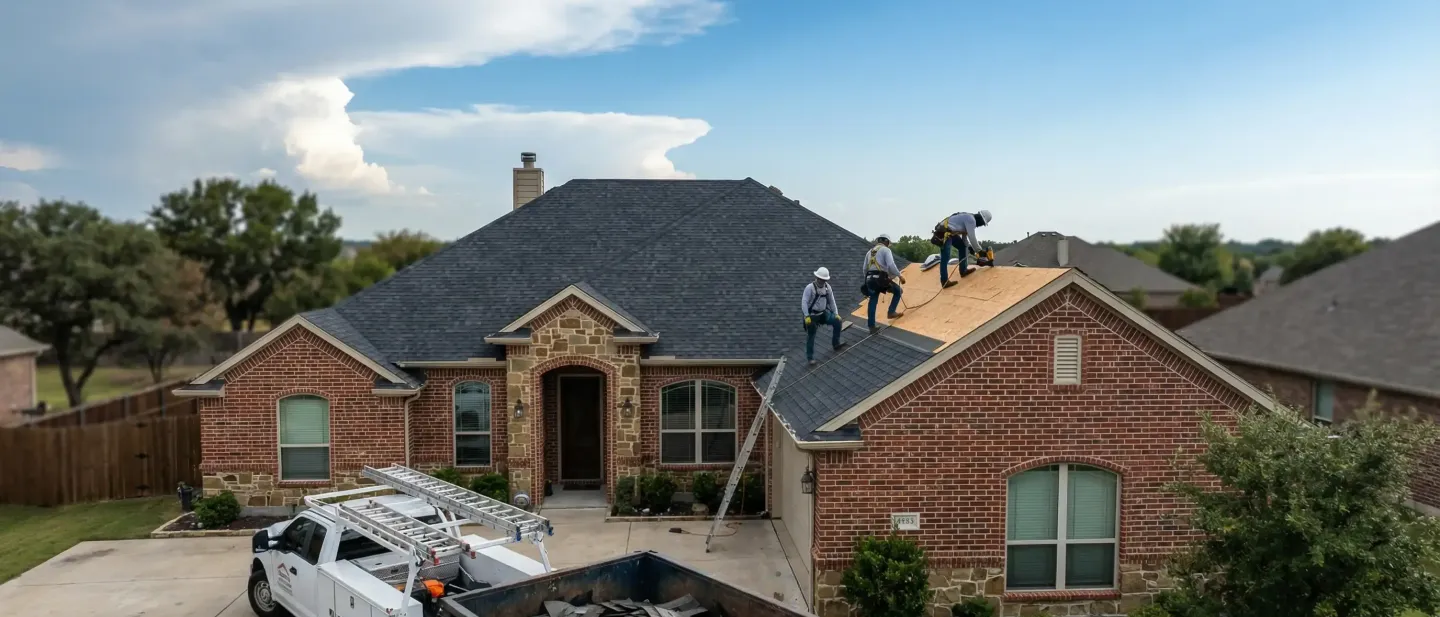
Denton County sits at the southern edge of Texas Hail Alley — 5–8 major hail events per year, a housing stock tilted toward newer construction that isn't immune to storm damage, and a post-hail search market that can see CPCs spike as out-of-state storm chasers flood in within 48 hours. The roofing companies that win in Denton aren't the ones who react fastest to a storm — they're the ones whose PPC campaigns were already running when the hail started falling.
See how this city's Roofing PPC costs compare nationally in our Roofing PPC Statistics report, featuring data from 40+ US cities.
In Denton, TX, people search for roofing services about 560 times a month on Google; a top-of-page click costs $25–$72, and demand peaks in August.
Denton, TX has few searches for these services, and Google reports no figure for some of them: read these numbers as indicative.
Google Keyword Planner · Oct 2025 – Sep 2026
| Search | Monthly searches | Top-of-page CPC |
|---|---|---|
| roofer near me | 140 | $38–$83 |
| roofing contractor | 70 | — |
| roofers | 70 | $6–$60 |
| roof repair | 40 | — |
| roofing company | 30 | — |
| metal roofing | 20 | $6–$37 |
| gutter installation | 20 | — |
| roof replacement | 10 | — |
| new roof cost | 10 | — |
| roof leak repair | 10 | — |
US: $61
Google Keyword Planner · Oct 2025 – Sep 2026
Source: Google Keyword Planner (Google Ads), Google Search, English, Denton, TX, Oct 2025 – Sep 2026. Volumes are Google's monthly averages; CPC is the top-of-page bid range, weighted by search volume. How we collect these figures.
Roofing PPC in Denton has a specific failure pattern that plays out repeatedly: a local contractor sees a major hail event, rushes to activate Google Ads, spends $3,000–$5,000 in two weeks competing against storm chasers and national franchises, generates expensive leads that are already two days behind the competition's timeline, and concludes that "PPC doesn't work for roofing." The problem isn't PPC — it's the reactive strategy.
The storm-chaser problem is real and structural. After any significant hail event in Denton County — and NOAA data shows the DFW area receives 5–8 major events annually — out-of-state roofing companies arrive within 24–48 hours and immediately activate Google Ads targeting Denton and surrounding zip codes. They have pre-built campaigns, pre-staged landing pages, and experience running surge budgets at $150–$200/day. They will outbid local companies on "hail damage roof repair Denton" and "storm damage roofing Denton" for 7–14 days, complete quick jobs, and leave. Local roofing companies that try to compete at peak post-storm CPCs are paying to compete against operators who've done this in 40 markets.
Farha Roofing and other large DFW regional operators run always-on PPC campaigns across Denton County regardless of weather events. They set the CPC floor even in quiet periods — estimated $25–$72/click for standard roofing terms like "roofing company Denton TX" and "roof replacement Denton TX." For a local Denton roofing SMB spending $2,500/month at $25–$72 per click (a typical click of about $49), that's roughly 50 clicks. At a 4% CVR (slightly above the LocalIQ 2025 benchmark of 3.70%), that's about 2 leads. The math is survivable only if the CPL is managed precisely — and most roofing campaigns in Denton are not managed with that precision.
The second franchise-related problem is brand recognition. Farha Roofing, Blue Nail Roofing, and national chains have invested in brand campaigns for years. When a Denton homeowner searches "roofing company Denton TX" and sees a familiar name alongside an unknown local contractor, they often click the familiar name even if the local company has better reviews. Ad copy differentiation — specifically, leading with local trust signals and Denton-specific credentials — is the counter-strategy.
A significant portion of Denton roofing revenue comes from insurance restoration work — hail and wind damage claims where the homeowner's insurer pays for the repair. This creates a PPC challenge: Google Ads policies restrict certain insurance-related claims in ad copy ("free roof," "file a claim now"), and insurance restoration leads have a longer sales cycle than straight replacement inquiries. The homeowner may need to file a claim, get an adjuster out, and receive approval before the job starts — a process that can take 2–6 weeks. Attribution tracking through this cycle requires proper CRM integration and UTM management that most roofing companies running DIY PPC don't have configured.
The result: campaigns that look like they're generating leads but produce a poor close rate — because the leads are insurance restoration inquiries being tracked alongside straight replacement leads, distorting conversion data and making it impossible to optimize bid strategy correctly.
The campaigns that perform in Denton's roofing market have one thing in common: they're built for the full cycle — always-on baseline campaigns for steady demand, pre-staged surge campaigns for post-storm windows, and proper segmentation between job types so the budget never gets diluted.
Three-campaign structure is the foundation:
Weather-trigger activation is the key operational advantage. Configure budget rules to automatically increase storm damage campaign spend when Denton County receives a qualifying hail event (0.75"+ hail threshold). Weather-triggered rules in Google Ads or a connected third-party tool can activate within 6–12 hours of a confirmed event — before most reactive local competitors have even opened their Google Ads account.
Negative keywords for Denton roofing must include: storm chaser company names, DIY roofing terms ("how to patch a roof," "shingles buy"), supply and material queries ("roofing materials Denton," "metal roofing sheets"), and geographic spill terms (Dallas, Fort Worth, Plano — unless you actively serve those markets).
Denton's roofing market has structural features that aren't visible from a generic DFW roofing benchmark — and they create real opportunity for local operators running informed campaigns.
The new construction paradox creates consistent non-storm demand. Denton was the 13th fastest-growing US city by numeric population gain in 2022–2023. New residential construction is accelerating in Corinth, Northlake, Argyle, and north Denton — and new-build roofing represents a category that's largely invisible to storm-focused competitors. Homebuilder subcontracting isn't a PPC play, but warranty service and new-to-Denton homeowner campaigns are. Keywords like "roof inspection Denton TX" and "new home roof warranty Denton" capture a segment of homeowners who just bought in a new subdivision and are thinking about their first post-purchase service relationship. These are lower CPCs and generate long-term client relationships, not just one-time jobs.
The storm-chaser problem has an often-missed flip side: chasers leave. They're in Denton for 10–21 days maximum. Once they're gone, there's a secondary wave of homeowners who were solicited by chasers, received an estimate, and then had second thoughts — they want a local company they can call back if there's a workmanship issue. The 4–8 week post-storm window sees a meaningful volume of "second estimate" and "insurance restoration review" searches. A campaign that stays active after the storm surge — when CPC drops back from surge levels — captures this anxious second-opinion market at far lower cost per lead.
Running a post-storm reassurance campaign: "Already Got an Estimate? Get a Second Opinion from a Local Denton Roofer" — with a landing page focused on warranty comparison and contractor license verification — is a niche strategy that most Denton roofers don't run. It converts at 5–8% because the intent is high and the competitive field has thinned.
Denton County's hail season runs March–June (primary) and September–October (secondary). This means a roofing company that manages budget strategically can reduce spend significantly in December–February — when CPCs are lower but so is search volume — and redirect that saved budget toward the March pre-season push. Arriving at hail season with Quality Score history built from a January–February brand-maintenance campaign means lower effective CPCs when volume hits. Key insight: the cost of staying active in off-peak months is far lower than the cost of re-entering a competitive market from zero Quality Score in March.
LocalIQ 2025 data shows roofing as the highest CPL home services category nationally ($228.15 CPL) — but that average includes storm-surge periods where CPCs spike dramatically. In Denton's off-peak months (November–February), a well-managed roofing campaign can achieve CPL as low as $90–$140 — building lead pipeline at a fraction of peak-season cost.
Roofing PPC in Denton requires a campaign infrastructure that can shift gears in hours — not days. When hail hits Denton County, the competitive window for local contractors is measured in hours before out-of-state chasers activate their pre-built campaigns. Our roofing clients don't scramble when the storm hits — we pre-stage surge campaigns every March and September, with automated weather-trigger rules that activate within 6–12 hours of a qualifying event.
We also build the infrastructure the storm doesn't care about: the always-on baseline campaign that captures steady replacement demand, the insurance restoration campaign structure that's compliant with Google Ads policy, and the post-storm "second opinion" campaign that most local roofers miss entirely.
Review our Google Ads management services and our pricing options. Most Denton roofing operators that compete in the insurance restoration market run — the case economics support it when a single restoration job brings $8,000–$18,000 in revenue.
A Denton roofing company should budget a minimum of $2,500 per month for baseline Google Ads presence — enough to maintain always-on replacement and inspection campaigns and pre-stage emergency ad groups before hail season. At that budget with CPCs of $25–$72 and a 4% conversion rate, expect 1–4 leads per month in non-storm periods. During post-hail surge windows (March–June), CPCs on storm damage keywords climb sharply — budget should scale to $5,000–$10,000 for the 2–4 week peak window. This isn't overspending: a single insurance restoration job worth $10,000–$18,000 returns the entire month's ad budget. The ROI math makes roofing one of the most defensible PPC categories for Denton SMBs, despite the nationally high average CPL of $228.15 (LocalIQ 2025). At $10,000+ per job LTV, even a $350–$400 CPL is a strong return.
Budget allocation across the year matters: plan for $2,500/month baseline in off-peak months (October–February), $5,000–$8,000 during March–June hail season, with 72-hour surge activation capability of $10,000–$15,000 after a major event. Keep insurance restoration budget separate from standard replacement — the longer sales cycle and different conversion patterns require independent campaign management to optimize correctly. Don't conflate the two: a $400 CPL for a hail restoration lead is excellent; a $400 CPL for a routine shingle replacement inquiry is too high.
Denton roofing companies compete with storm chasers on Google Ads through pre-positioned campaigns, ZIP-level targeting, and trust-differentiated ad copy — not by outspending them at peak CPC. Storm chasers have pre-built campaigns they activate across every hail-affected market; they spend big for 10–21 days and leave. The local competitive advantage is being already live with Quality Score history when the storm hits, so your effective CPC is lower than a fresh campaign the chaser just activated. A local Denton company with 90 days of campaign history entering a storm window competes against a chaser's fresh campaign at a higher effective CPC — that gap compounds into meaningful lead-volume advantage over the surge window.
Ad copy differentiation is the second lever. Storm chaser ads read: "Hail Damage? Get a Free Estimate!" — templated, identical across markets. Local counter-messaging: "Denton's Trusted Roofer Since [Year] — Licensed, Insured, Here After the Storm" — answers the homeowner's unspoken concern about contractor accountability. In a post-storm market flooded with unfamiliar names, "local since [year]" is a meaningful trust signal. Pair this with Google Business Profile optimization and a call extension set to 24/7 — the homeowner calling at 7pm after spotting roof damage goes to the contractor who answers, not the one who routes to a national call center. Seasonal note: post-storm, second-opinion campaigns (targeting homeowners who already got a chaser estimate) run below surge pricing, with higher close rates because the intent is specific.
How to read this Cost per click and monthly searches are measured with Google Keyword Planner (see above). Cost per lead, conversion rate, budget and leads are estimates compiled from public benchmarks such as WordStream, not measurements.
Sources LocalIQ 2025 Roofing & Gutters ($10.70 CPC, $228.15 CPL, 3.70% CVR); DFW premium applied; Denton off-peak CPL estimates lower than national avg
$590$990/month
1 platform · Google or MetaGoogle + Meta$790$1,290/month
1 platform · Google or MetaGoogle + Meta$1,140$1,940/month
1 platform · Google or MetaGoogle + MetaChatGPT Ads: a separate pilot, $250/month, added to a plan. See the pilot →

Matteo Braghetta founded MB Adv and runs its Google Ads accounts. He takes the first call with every new client, reads the accounts every week and writes the agency’s guides.
The other half of his job is measurement: GA4, Consent Mode and server-side tracking, so the platforms learn from real sales.
MB Adv is a Google Partner agency managing about $4.4M a year in ad spend for clients in the US, the UK and Europe.
Managed on numbers you can check.
Plans for the US