Start
$590$990/month
1 platform · Google or MetaGoogle + Meta- Ad spend
- up to $3,000
- New creativesmade by us
- Google + Meta only4 a month
 By Matteo Braghetta, Founder · Google Ads
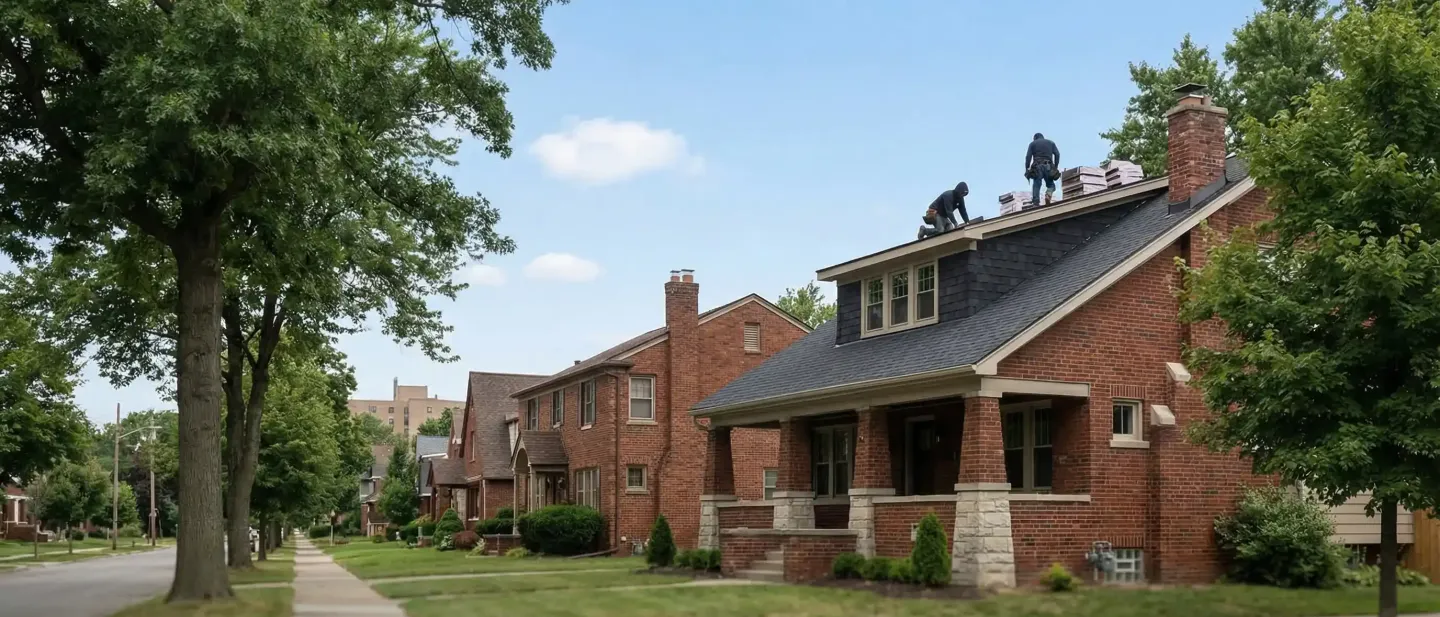
Detroit's residential roofing market is built on a demographic reality no amount of franchise advertising can change: the metro's housing stock is among the oldest in the US, with tens of thousands of homes carrying asphalt shingles past their 25-year design life, and Michigan's freeze-thaw cycles and active storm season accelerate the damage calendar every year.
See how this city's Roofing PPC costs compare nationally in our Roofing PPC Statistics report, featuring data from 40+ US cities.
In Detroit, MI, people search for roofing services about 2,190 times a month on Google; a top-of-page click costs $12–$62, and demand peaks in October.
Google Keyword Planner · Oct 2025 – Sep 2026
| Search | Monthly searches | Top-of-page CPC |
|---|---|---|
| roofers | 320 | $10–$57 |
| roofing company | 260 | $23–$110 |
| metal roofing | 260 | $4–$20 |
| roofer near me | 210 | $15–$79 |
| roof repair | 210 | $14–$55 |
| roofing contractor | 210 | $6–$38 |
| gutter installation | 170 | $11–$74 |
| roof leak repair | 90 | $17–$56 |
| roof replacement | 70 | $18–$145 |
| roof inspection | 70 | $23–$80 |
US: $61
Google Keyword Planner · Oct 2025 – Sep 2026
Source: Google Keyword Planner (Google Ads), Google Search, English, Detroit, MI, Oct 2025 – Sep 2026. Volumes are Google's monthly averages; CPC is the top-of-page bid range, weighted by search volume. How we collect these figures.
Detroit roofing PPC operates in a market defined by urgency, seasonality, and a structural demand advantage that most contractors fail to fully monetize. The city and its inner suburbs — Hamtramck, Dearborn, Warren, Eastpointe — contain some of the densest concentrations of pre-WWII residential housing in the Midwest. Craftsman bungalows, Dutch Colonials, and brick two-flats built between 1900 and 1945 are reaching the end of their second and third roofing cycles simultaneously. This isn't a market where you need to create demand — you need to capture it before a competitor does.
Michigan's weather creates Detroit's most distinctive roofing PPC dynamic: the post-storm surge. When a significant hail event or high-wind storm moves through the metro — which happens predictably 3-8 times per season between April and October — roofing search volume spikes 400-700% within 48-72 hours. Contractors who have Google Ads campaigns running before a storm event capture this surge; contractors who wait to "turn on ads after the storm" miss the first 48 hours when search volume is highest and purchase intent is most urgent.
CPCs during post-storm surges climb sharply for terms like "hail damage roof Detroit" and "storm damage roof repair Michigan." The contractors who win these moments aren't necessarily the biggest spenders — they're the ones with always-on campaigns and sufficient budget headroom to absorb the spike without hitting daily limits and going dark at 2pm on the highest-search day of the month.
A challenge unique to roofing (and amplified in Michigan's insurance-heavy market) is the insurance claim cycle. Many Detroit homeowners with legitimate hail or storm damage are covered by insurance — but they don't know how to initiate a claim, what their deductible means for out-of-pocket costs, or how to select a contractor who understands the adjuster process. Roofing contractors who address insurance claim assistance in their ad copy — "We work with your insurance adjuster. Most Detroit storm repairs: $0 out of pocket" — see 30-40% higher CTR than generic replacement ads, because they're addressing the homeowner's actual friction point, not just the service category.
Lead quality is the hidden challenge in Detroit roofing PPC. Lead aggregators like Angi and HomeAdvisor sell roofing leads to 3-5 contractors simultaneously — conversion rates on these shared leads average 10-15%. Google Ads leads are exclusive: the homeowner found you specifically, and they convert at 30-50%. Detroit homeowners who arrive via Google Ads and see a landing page with a local address, Google review count, and a photo of a local project close at 2-3x the rate of aggregator leads on equivalent quote values.
Detroit roofing PPC strategy requires separating planned replacement demand from storm-emergency demand — these are different customers with different decision timelines, and campaigns that blend them produce diluted results on both fronts.
Google Local Services Ads (LSAs): Roofing is a verified LSA category. A Google Guarantee badge for a roofing contractor in Detroit is a significant trust signal — storm-damage homeowners researching on mobile see LSA results first. LSA verification requires license, insurance, and background check, but once completed, this is a compounding asset. Combined with standard Search Ads, you appear in the Local Pack and paid results simultaneously.
Bid modifier strategy: Apply +30% bid adjustments for mobile on emergency campaigns (homeowners in storm aftermath are on phones). Apply geographic bid adjustments at zip-code level — zip codes with older housing stock (48205, 48212, 48213 in Detroit city; 48021, 48026 in Eastpointe/Roseville) should get +15-20% bid boosts for replacement campaigns. These areas have the highest percentage of aging shingle roofs in the metro.
Detroit's roofing market has a neighborhood-level demand pattern that most PPC campaigns fail to exploit. The city's housing stock isn't uniformly aged — it's stratified by neighborhood construction era, and contractors who understand this can target replacement demand with surgical precision rather than broadcasting to the entire metro.
Detroit's pre-WWII housing stock is concentrated in specific corridors: the Eastside (East English Village, Morningside, Jefferson-Chalmers), the Northwest side (Rosedale Park, Grandmont), and the inner suburbs of Hamtramck, Highland Park, and Dearborn Heights. Homes in these areas were built primarily between 1910-1945 — meaning their current roofs are 15-40 years old and many are on their second or third replacement cycle. A geo-targeted campaign featuring copy like "Does your Detroit home have a 20-year-old roof? Free inspection — we photograph every shingle" performs 35-45% better in these zip codes than generic metro-wide copy.
The seasonal revenue engineering insight: Michigan's ice dam season (December-March) is an undermonetized entry point. Ice dams form when snow melts and refreezes at the eave line, causing water to back up under shingles and into the attic. An ice dam removal call ($400-$900 emergency job) converts to a full replacement consultation at a rate of 40-60% because the ice dam itself reveals the inadequate insulation and ventilation that caused it — and the full fix is a new roof with improved attic ventilation. Running ice dam removal campaigns in December is one of the highest-ROI uses of a Detroit roofer's winter ad budget.
The certification angle is underused in Detroit roofing PPC. GAF Master Elite and Owens Corning Preferred Contractor designations are genuine differentiators in a market where any unlicensed contractor can put up a Google Ads campaign after a storm. Ad copy that leads with "GAF Master Elite Certified — Only 2% of US roofers qualify" combined with a photo of the certification badge on the landing page drives 20-30% higher conversion rates on planned replacement campaigns versus copy that doesn't mention certification.
Detroit roofing PPC requires campaign managers who know the difference between storm-chase campaign strategy and planned replacement strategy — and who understand that the same homeowner behaves completely differently depending on whether they're calling after a hail event or browsing on a Sunday afternoon. These require different ad formats, different landing pages, different bid schedules, and different conversion tracking setups.
MB Adv Agency builds Detroit roofing campaigns that separate emergency and planned demand from day one, maintain budget headroom for storm surge events, and apply zip-code-level bid adjustments targeting the aging housing corridors where replacement demand is highest. We also integrate Google Local Services Ads alongside standard Search to maximize top-of-results coverage on the queries that matter most.
For roofing contractors in Metro Detroit, the window between a competitor securing the first-page position and you capturing it is often a single well-structured campaign launch. Management is a fixed monthly fee set by your ad spend, with the tracking set up first: see the plans and prices. Contractors managing storm-season budget surges and multi-suburb coverage should review our management plans — it includes the flexible budget management and dedicated landing page builds that storm-chase campaigns require.

The most important principle: your campaign should already be running before the storm hits. Contractors who try to launch or reactivate campaigns after a storm event miss the first 24-48 hours of the search surge — the period when intent is highest and homeowners are making immediate decisions about who to call. An always-on campaign with sufficient daily budget headroom is the non-negotiable foundation of storm-chase strategy.
During a surge event, three adjustments matter most. First, increase your daily budget manually by 50-100% as soon as weather data shows a significant hail or wind event has passed through the metro — Google Ads campaigns with hard daily caps go dark mid-afternoon on high-traffic days, leaving search volume for competitors. Second, add storm-specific responsive search ad headlines immediately: "Hail Damage? Detroit's Emergency Roofers," "We Work With Your Insurance Adjuster," "Free Damage Inspection — Call Now." Third, enable call extensions and call-only ad formats on mobile — storm-aftermath homeowners are on their phones and they call, not form-fill.
Post-storm, run a separate remarketing campaign to your previous website visitors for 30 days. Detroit homeowners who researched you before the storm but didn't call are now highly motivated — a targeted display ad ("Still have storm damage? We have availability this week") converts remarketing audiences at 3-5x the rate of cold traffic in post-storm windows.
A functional starting budget for a Detroit roofing contractor is $2,500-$3,500 per month — sufficient to generate 20-30 qualified leads per month in the planned replacement category, with additional budget headroom for storm-surge events. Below $2,000/month in this market, CPCs in competitive terms like "roof replacement Detroit" ($18–$145) don't generate enough clicks to optimize campaigns effectively.
ROI math is straightforward in roofing: a single closed replacement job ($9,000-$16,000 average in Detroit metro) covers 3-6 months of ad spend. A 30-lead month with a 25% close rate (7-8 jobs) generates $63,000-$128,000 in revenue. Google Ads CPL for Detroit roofing runs $90-$130 on well-optimized campaigns — a $110 CPL on 25 leads is $2,750 in ad spend against potential revenue of $22,500-$40,000 in closed jobs.
The ROI equation changes during storm season. Post-storm CPCs spike, raising CPL. But these leads close faster (the homeowner has immediate damage) and at higher average job values (full replacements, not repairs). Running a $5,000 storm-season month and generating 8-12 replacement jobs is the most efficient capital allocation in Detroit roofing — the season is short, the demand is concentrated, and the contractors who invest aggressively during the June-September window generate disproportionate revenue relative to their competitors.
How to read this Cost per click and monthly searches are measured with Google Keyword Planner (see above). Cost per lead, conversion rate, budget and leads are estimates compiled from public benchmarks such as WordStream, not measurements.
Sources WordStream 2025 Home Services benchmarks + Detroit roofing market analysis
$590$990/month
1 platform · Google or MetaGoogle + Meta$790$1,290/month
1 platform · Google or MetaGoogle + Meta$1,140$1,940/month
1 platform · Google or MetaGoogle + MetaChatGPT Ads: a separate pilot, $250/month, added to a plan. See the pilot →

Matteo Braghetta founded MB Adv and runs its Google Ads accounts. He takes the first call with every new client, reads the accounts every week and writes the agency’s guides.
The other half of his job is measurement: GA4, Consent Mode and server-side tracking, so the platforms learn from real sales.
MB Adv is a Google Partner agency managing about $4.4M a year in ad spend for clients in the US, the UK and Europe.
Managed on numbers you can check.
Plans for the US