Roofing PPC Eugene, OR
Eugene gets 47 inches of rain per year — 9 inches above the national average — and 160+ overcast days. Composite shingles that last 30 years in Phoenix last 15–20 years in Eugene's Pacific Northwest climate, moss colonizes north-facing roofs in 3–5 years, and every October–February windstorm season resets the damage calendar. With 80–120 licensed contractors in Lane County and replacement jobs averaging $13,000–$16,000, the roofing contractor who shows up first on Google captures the work. <!-- stats-article-link --> <p><em>See how this city's Roofing PPC costs compare nationally in our <a href="/resources/roofing-ppc-statistics">Roofing PPC Statistics</a> report, featuring data from 40+ US cities.</em></p>
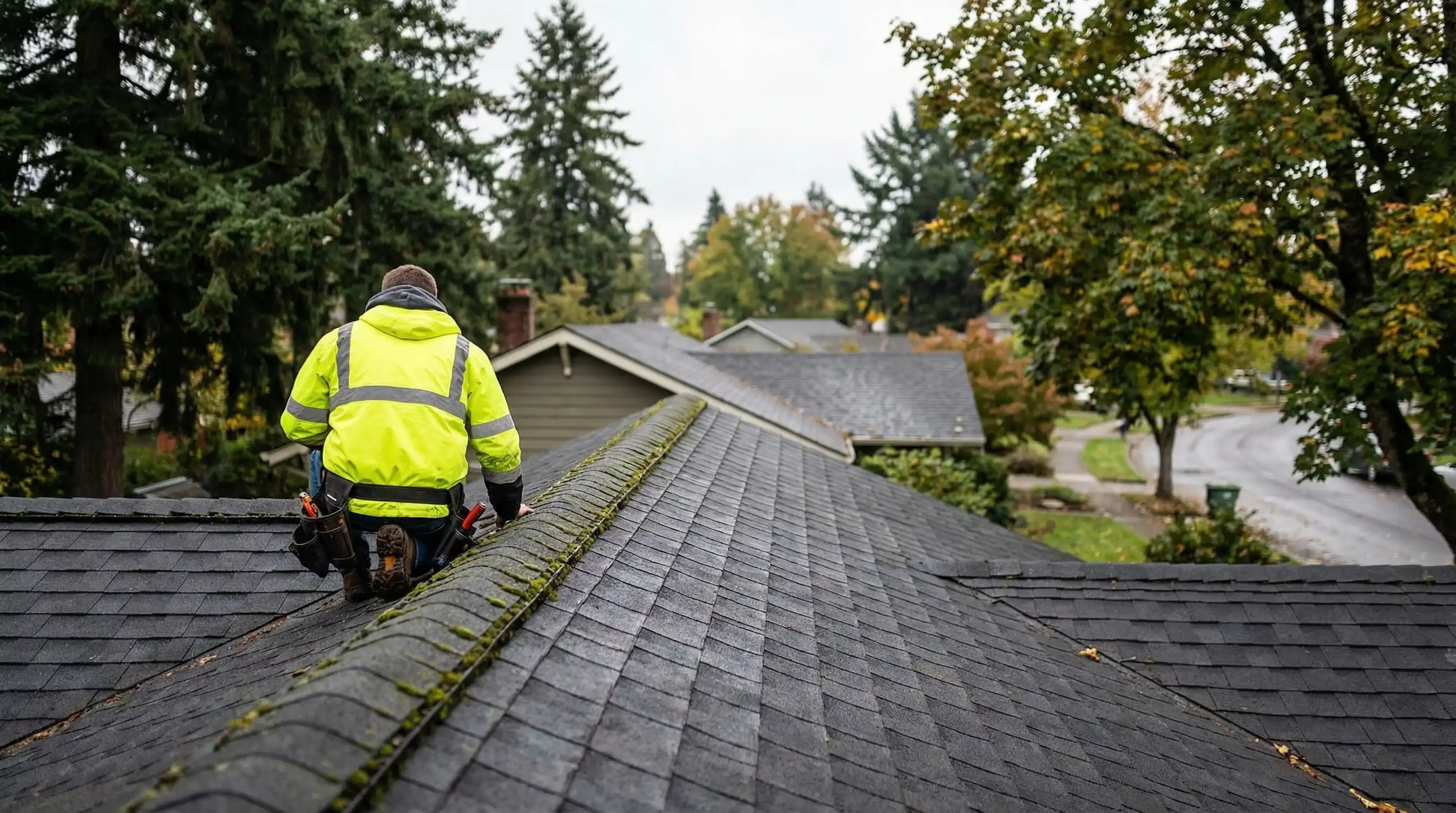
Roofing PPC in Eugene, OR operates in a market shaped by climate, housing stock, and a competitive field that is more active than the city's size suggests. Lane County has an estimated 80–120 licensed roofing contractors, making it one of the more contractor-dense markets relative to population in the Pacific Northwest — a product of the fact that Eugene's climate simply generates more roofing demand per capita than comparable-sized cities in dry climates.
The Moss Positioning Problem
One of the most overlooked challenges for Eugene roofing contractors running PPC is the disconnect between what homeowners search for and what contractors want to sell. Most roofing companies want full replacement jobs — $12,000–$24,000 tickets with strong margins. But a significant portion of Eugene homeowners search for moss treatment, gutter cleaning, or minor repairs — services with ticket sizes of $250–$2,500. The temptation is to ignore this traffic and focus campaigns exclusively on replacement keywords. That's a mistake. In Eugene's market, moss treatment and minor repair calls are the first stage of a replacement pipeline. A homeowner who calls about moss on their roof in April is a homeowner who is 12–18 months from a full roof replacement conversation — if you're the contractor who showed up first, answered well, and did quality work on the moss job, you get the replacement call without PPC cost.
Ignoring low-ticket service keywords also surrenders a competitive advantage. "Moss removal roof Eugene" and "gutter cleaning Eugene OR" are lower-CPC terms ($8–$15) with strong conversion rates because the buyer intent is clear and the ticket threshold is low enough to convert without a lengthy sales cycle. Contractors who exclude these keywords from their campaigns are essentially donating this pipeline-starter revenue to competitors.
The Insurance Work Dimension
Post-storm insurance claims represent a distinct customer segment in Eugene roofing PPC that most campaigns handle poorly. Oregon's October–February windstorm season generates a reliable annual wave of wind and hail damage claims. Homeowners filing insurance claims search differently from homeowners proactively replacing a roof — their intent signals include "roof insurance claim Eugene," "storm damage roof repair," and "insurance roofing contractor Lane County." These keywords command higher CPCs ($20–$35) but convert at high rates because the buyer has a specific, urgent need with financing already handled through their insurance policy.
The challenge is landing page relevance. Sending insurance claim searchers to a generic "roofing services" page kills conversions. These buyers need a landing page that addresses their specific situation: what to expect from the insurance process, what a roof damage assessment involves, and why hiring a contractor experienced with Oregon insurance adjusters matters. Cascade Roofing and Five Star Roofing both have local brand presence in the Lane County market — contractors without a differentiated landing page for insurance work are competing on price alone, which is a losing strategy against established players with decades of adjuster relationships.
The Seasonal Concentration Risk
Eugene roofing has two distinct peak windows — spring (April–June) and late summer (July–August) — when weather conditions allow installation work. Most contractors front-load their PPC budget into these windows, leading to CPC inflation precisely when they're spending most. The pre-winter window (September–October) is underserved by competitors but critically important for Eugene homeowners who want a new roof installed before November rains arrive. Contractors who shift 20–25% of their annual PPC budget into September–October capture buyers in a lower-CPC environment with high conversion motivation.
The Eugene roofing PPC strategy that generates the best cost-per-lead combines a tiered keyword structure, post-storm activation protocols, and neighborhood-level geographic targeting — three elements that most competing contractors are not executing simultaneously.
Keyword Tiers and CPC Ranges
- Replacement/full project keywords: "roof replacement Eugene OR," "new roof Eugene Oregon," "roofing contractor Eugene" — $18–$35 CPC; highest ticket value, 4–7% CVR; these are the primary revenue drivers
- Moss and maintenance keywords: "moss removal roof Eugene," "roof moss treatment Eugene OR," "gutter cleaning Eugene" — $8–$15 CPC; lower ticket, high pipeline value; 8–12% CVR due to low friction
- Repair and emergency keywords: "roof repair Eugene," "leaking roof Eugene OR," "roof damage repair Eugene" — $14–$22 CPC; moderate ticket ($400–$3,000), quick decision cycle
- Insurance and storm damage keywords: "storm damage roof Eugene," "roof insurance claim Lane County," "hail damage roofer Eugene Oregon" — $20–$35 CPC; insurance-financed tickets, very high conversion motivation
- Neighborhood-specific keywords: "West Eugene roofer," "South Hills roofing," "Springfield OR roofer" — $10–$18 CPC; lower competition, higher relevance signals
Post-Storm Activation Protocol
The single highest-ROI roofing PPC tactic in Eugene is a storm activation campaign — a pre-built ad set with storm damage creative that goes live within 48 hours of a significant wind event. Eugene's October–February windstorm season makes this predictable. The protocol: monitor weather events (NWS Eugene forecasts), activate the storm damage campaign when gusts exceed 45 mph or damage reports appear on local news, and run it for 5–7 days post-event while urgent search volume is elevated. Timing matters more than creative quality in post-storm campaigns — a contractor who activates within 24 hours captures homeowners in their highest-urgency, lowest-comparison-shopping state.
Photo-Heavy Landing Pages
Eugene roofing conversions depend heavily on local visual proof. Before-and-after moss removal photos, project galleries showing Eugene-specific roof types (steep-pitched craftsman roofs with heavy moss, cedar shake roofs in South Hills, architectural shingle jobs in the Fairmount neighborhood), and team photos that show local context all outperform generic stock photo landing pages. Homeowners in Eugene recognize their climate and housing styles — showing their conditions converts better than showing a dry-climate roof in perfect sun. Include neighborhood references in landing page copy to reinforce local relevance.
Google Partner Agency
We're a certified Google Partner Agency, which means we don’t guess — we optimize withGoogle’s full toolkit and insider support.
Your campaigns get pro-level execution, backed by real expertise (not theory).

Two data points about Eugene's roofing market are not widely discussed but significantly influence PPC strategy: the accelerated shingle lifespan compression from Pacific Northwest climate, and the specific pre-winter buying window that is unique to the Willamette Valley.
Shingle Lifespan Is 30–40% Shorter in Eugene Than National Average
Composite shingles rated for 25–30 years in manufacturer testing are based on dry-climate performance standards. In Eugene's humid, moss-prone environment, real-world performance consistently runs 15–20 years. This is not merely a theoretical concern for contractors — it represents a structural demand driver. Eugene has a significant portion of housing built in the 1970s, 1980s, and 1990s. Homes built in 1990 had their roofs replaced once already (in the 2005–2010 window); those second-generation roofs are now entering the end of their Eugene-climate lifespan in the 2024–2030 window. This is a demographic bulge in replacement demand, and it's happening right now.
PPC campaigns that speak directly to roof age — "Is your 15-year-old Eugene roof past its prime? Free inspection." — tap into this latent demand among homeowners who know their roof is aging but haven't been pushed toward a replacement decision. The combination of aging stock, moss growth visibility, and a free inspection offer creates a low-friction entry that converts mid-funnel homeowners before they're in emergency-repair mode.
The Pre-Winter Buying Window: September–October
Eugene's most underserved PPC window is the 8-week period from mid-September through late October. This is when homeowners who have been watching their roof age through summer decide to act before the November rainy season begins. Lane County receives most of its 47 inches of annual rainfall between November and March — and homeowners with aging or damaged roofs know that waiting until December means living under a failing roof through the full rainy season. The urgency is real and self-imposed.
PPC competitors concentrate their spend in spring and summer when installation weather is best. But September–October buyers are just as motivated — and competing against fewer active advertisers means CPCs are 15–25% lower than peak season while conversion rates remain high. A contractor who runs a dedicated pre-winter campaign with messaging like "Get your Eugene roof replaced before the rains — scheduling now for September/October installation" captures committed buyers in a buyers'-market CPC environment. This is one of the most consistent underexploited windows in Lane County roofing PPC.
Key insight: Eugene's roofing replacement demand doesn't follow national seasonality models. The most cost-efficient acquisition window isn't summer — it's the 8-week pre-winter sprint when buyers are motivated, competitors are pulling back spend, and installation slots are still available.
Roofing PPC in Eugene is not a set-it-and-forget-it account. Pacific Northwest climate creates campaign events — storm activations, moss season traffic spikes, the September pre-winter window — that require active management to capture. A static campaign built once and reviewed quarterly will consistently underperform against actively managed competitors who are adjusting bids, launching storm campaigns within 48 hours of weather events, and expanding into neighborhood-specific keywords before competition catches up.
At MB Adv Agency, we manage roofing PPC with a Pacific Northwest campaign calendar built for Lane County's actual demand patterns — not national averages. That means storm activation protocols, pre-built post-storm ad sets, moss treatment campaigns as pipeline starters, and seasonal budget reallocation that front-loads the pre-winter window rather than following the crowd into peak summer spend.
We also build the landing pages. A roofing PPC campaign linked to a generic homepage loses conversion rate to any competitor with a dedicated landing page — and in Lane County's roofing market, 70–80% of competitors still link ads to their homepage. That's your margin opportunity.
See what we build on our Google Ads services page, or review our pricing tiers for roofing contractors at different monthly ad spend levels.
Frequently Asked Questions
What does a roofing PPC campaign in Eugene, OR actually cost to run?
For a Lane County roofing contractor, a well-structured Google Ads campaign typically requires a $2,500–$4,000 monthly ad budget to achieve meaningful coverage across replacement, repair, and moss treatment keywords. Here's the economics:
Roofing CPCs in Eugene range from $14–$28 for most search keywords, with storm damage and insurance-specific terms running $20–$35. At an average $20 CPC and a 6% conversion rate, a $3,000/month budget generates approximately 9–10 leads. Given average replacement job values of $13,000–$16,000, a single closed replacement job generates a 4–5x return on the monthly ad spend. Most well-managed Eugene roofing campaigns achieve a cost-per-lead of $80–$200 — and at a 30–35% close rate on qualified leads, the cost per acquired job runs $250–$600, against a revenue base of $12,000–$22,000.
Timing matters for budget efficiency. Pre-winter (September–October) is the most cost-efficient window — CPCs are 15–25% lower than peak summer, buyer urgency is high, and installation capacity is still available. Recommended annual budget allocation:
- January–March: Baseline ($1,500–$2,000/month) — storm repair and inspection campaigns active
- April–June: Peak surge ($3,500–$4,500/month) — replacement season, spring inspection conversions
- July–August: Sustained peak ($3,000–$4,000/month) — dry install window, large replacement projects
- September–October: Pre-winter surge ($3,500–$4,500/month) — highest-efficiency window; motivated buyers, lower CPCs
- November–December: Baseline + storm activation ($1,500–$2,500/month) — storm response, end-of-year taper
Maintain a standing storm activation budget ($500–$1,000) as a line item available for immediate deployment after any significant wind event. This budget is separate from monthly campaign spend and should never be touched except for post-storm activation.
Should Eugene roofers run PPC for moss treatment and gutters, or focus on replacement only?
Eugene roofing contractors should absolutely run PPC for moss treatment and gutters — not primarily as ticket revenue, but as a pipeline development strategy that makes replacement campaigns dramatically more cost-efficient over time.
Here's the math: a moss treatment job at $350–$600 converts at 8–12% from PPC (low friction, low ticket, urgent visible problem). That single moss job puts you on-site, positions you as a trustworthy local contractor, and creates a 12–24 month pipeline to a full replacement conversation when the moss treatment confirms the roof is end-of-life. The CPL on moss treatment keywords ($8–$15 CPC, 10% CVR) is $80–$150 per lead — the same range as replacement keywords but with far more conversion volume because the barrier to scheduling a moss treatment is much lower than committing to a $14,000 roof replacement quote.
The seasonal angle: moss treatment searches spike in Eugene in late March through May, when spring rain recedes and homeowners can see what's been growing on their roofs all winter. Running moss treatment campaigns from March through June — with a landing page that mentions the word "roof inspection included" — creates a summer inspection pipeline that converts to replacement bookings in July–August. Gutter cleaning follows a similar logic: October–November pre-rain-season gutter calls are the entry point to a January roof inspection when the gutters are clean but the roofer notices three missing shingles. Don't leave this pipeline revenue on the table by treating moss and gutters as below your business.