Roofing PPC Glendale, AZ
Glendale's roofing market moves in two speeds: steady residential replacement driven by a housing stock that's aging into end-of-life cycles, and explosive post-monsoon emergency demand that compresses weeks of normal lead volume into 72 hours. Roofing companies that wait for storm season to think about their Google Ads strategy are already behind — the contractors who dominate storm aftermath leads pre-stage campaigns before July 1 and have landing pages ready the morning after each weather event. <!-- stats-article-link --> <p><em>See how this city's Roofing PPC costs compare nationally in our <a href="/resources/roofing-ppc-statistics">Roofing PPC Statistics</a> report, featuring data from 40+ US cities.</em></p>
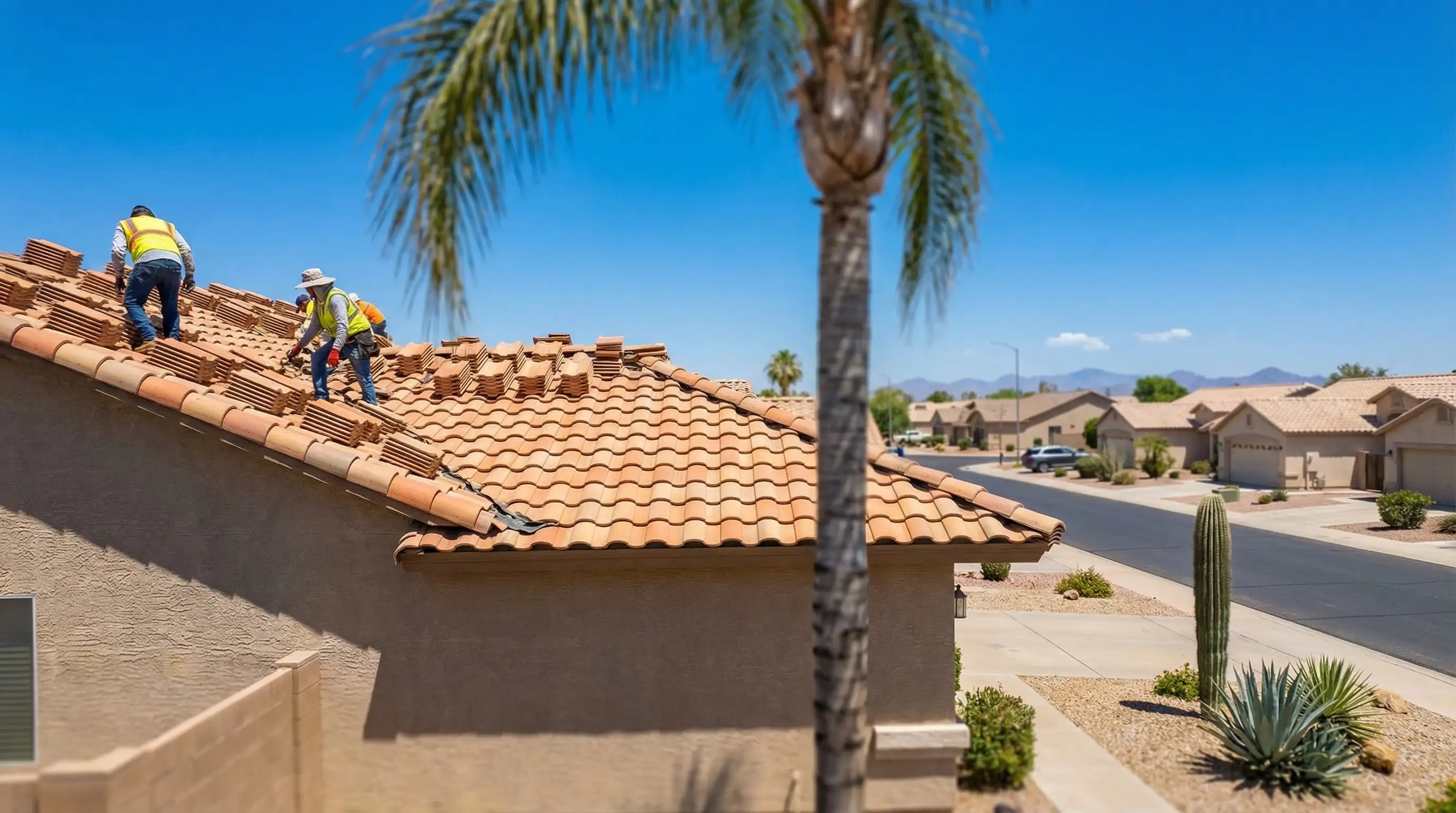
Glendale's roofing PPC market presents a challenge that most home services categories don't face: it's simultaneously a high-CPC national-brand auction and a storm-chaser market where out-of-state competitors appear overnight. Managing both simultaneously requires a fundamentally different campaign strategy than a year-round steady-state category like plumbing or dental.
The Auction Reality
Roofing is one of the most expensive home services categories in Google Ads. Nationally, the average CPC is approximately $10.70 (LocalIQ 2025). In the Phoenix metro — where large regional brands like Camelback Roofing, Lyons Roofing, Honest Abe Roofing (franchise-backed), and Universal Roofing Contractors compete alongside national brands — Glendale-area roofing CPCs run $13–$22 per click in standard conditions. Post-monsoon storm events drive emergency repair CPCs to $18–$35, sometimes higher within the first 24 hours of a major storm when every local roofer activates simultaneously.
The auction spike problem isn't just expensive — it's strategically disorienting. Companies that haven't built dedicated storm-response campaigns often respond to a major monsoon event by increasing their general campaign budgets, which throws money at broad keywords that attract quote-shoppers rather than the high-intent emergency repair searches ("roof leak Glendale AZ," "monsoon roof damage Glendale AZ") that convert at 2–3x the rate of general terms. The difference between a well-prepared post-storm campaign and an improvised budget increase is often the difference between 30 qualified storm leads and 12.
The Storm Chaser Dynamic
Arizona's monsoon season (July–September) triggers an influx of out-of-state roofing contractors — commonly called storm chasers — who drive into Glendale neighborhoods within 48 hours of a major storm event, knock on doors with insurance claim assistance pitches, and compete for the same homeowners who are searching Google for local roofers. Storm chasers rely primarily on physical presence; Google Ads is their weak point. A local Glendale roofer who activates a pre-built storm response campaign immediately after a weather event intercepts homeowners who are searching online before they open the door to a solicitor.
The insurance claim dynamic adds another layer. Glendale roofing jobs driven by monsoon or hail damage are frequently insurance-mediated — homeowners who file AZ homeowner insurance claims are looking for a contractor who can navigate the claims process, coordinate with adjusters, and document damage correctly. Roofing companies that market this capability explicitly ("We handle the insurance claim process — you don't lift a finger") convert at measurably higher rates than those who only advertise roofing services without addressing the insurance dimension.
- Standard replacement terms: "roof replacement Glendale AZ," "roofing company Glendale AZ" — $13–$22 CPC; planned purchase, multi-week decision
- Emergency/storm terms: "emergency roof repair Glendale AZ," "monsoon roof damage Glendale AZ," "roof leak Glendale" — $18–$35 CPC; post-storm 72-hour window, highest conversion rate
- Insurance angle: "roof insurance claim Glendale AZ," "storm damage roofing contractor Glendale" — $12–$20 CPC; motivated, high-LTV segment
- Real estate-driven: "pre-listing roof inspection Glendale AZ," "roof repair before selling Glendale" — $10–$16 CPC; spring season peak
Beyond the storm dynamic, Glendale has a structural demand driver that compounds every year: the city's 57.2% homeownership rate combined with a housing stock concentrated in the 1985–2005 era means that a substantial portion of Glendale homes have original roofs now 20–40 years old. Arizona's extreme UV exposure and sustained 110°F+ temperatures degrade asphalt shingles 30–40% faster than national norms. Tile roofs last longer but have underlayment degradation issues that aren't visible until water intrusion occurs. The replacement wave isn't an occasional demand event — it's a structural pipeline of homeowners whose roofs are failing on a predictable schedule.
The highest-ROI roofing PPC strategy in Glendale is built around two distinct campaign modes: a steady-state replacement campaign that runs year-round at moderate budget, and a pre-staged storm response campaign that activates at full budget the moment monsoon season begins — and surges immediately after each weather event.
The Two-Mode Campaign Structure
Mode 1 — Year-round replacement pipeline: Glendale's aging housing stock generates consistent replacement demand independent of weather events. The keyword target is homeowners in a 2–8 week research cycle: "roofing company Glendale AZ," "roof replacement cost Glendale," "tile roof replacement Glendale AZ." These clicks cost $13–$22 and convert on a landing page that leads with three elements: a phone number, a photo of a completed Glendale tile roof job, and a 5-star Google review. Average lead volume: 20–40/month at $110–$175 CPL on a $3,500–$5,000/month budget.
Mode 2 — Storm response: Pre-build this campaign before July 1 every year. The campaign is paused until activated. Activation trigger: any National Weather Service storm advisory or significant weather event in Maricopa County. Upon activation, the campaign runs at 2–3x normal budget with emergency-specific ad copy ("Storm damage last night? We assess for free.") pointing to a landing page with post-storm photos, insurance claim process description, and a 24/7 phone number. This campaign needs to be live within 12 hours of a major storm — the lead window is intense but brief. 72% of post-storm roofing searches happen within 72 hours of the event; by day 5, volume has normalized.
Keyword Groups With CPC Ranges
- Replacement planning group: "roof replacement Glendale AZ," "new roof Glendale AZ," "roofing contractor Glendale," "tile roof replacement Glendale" — $13–$22 CPC; year-round, research-phase buyer
- Emergency/storm damage group: "emergency roof repair Glendale AZ," "roof leak Glendale AZ," "monsoon roof damage Glendale," "storm roof repair near me Glendale" — $18–$35 CPC; post-storm activation, 72-hour window
- Insurance claim group: "roof insurance claim Glendale AZ," "storm damage roofing insurance Glendale," "hail damage roof Glendale AZ" — $12–$20 CPC; insurance-mediated, high-LTV
- Specialty/material group: "tile roof repair Glendale AZ," "flat roof repair Glendale," "TPO roofing Glendale AZ," "foam roof Glendale" — $10–$18 CPC; lower competition, high purchase intent
- Pre-sale/inspection group: "roof inspection Glendale AZ," "pre-listing roof inspection Glendale," "roof repair before selling Glendale" — $10–$16 CPC; spring peak, real estate-driven
LSA setup: Glendale roofing companies qualify for Google Local Services Ads with the contractor license and insurance verification. The "Google Guaranteed" badge above paid search results converts at significantly higher rates for emergency and storm-related searches — precisely the highest-value click in this category. LSA leads for roofing run $50–$90 per verified contact, below the search CPL average.
Geo-targeting precision: Lead with Glendale ZIPs 85301–85310 and 85318. Secondary expansion to Peoria (85345, 85382) and Surprise (85374, 85379) during active storm events — storm damage doesn't respect city boundaries, and a single storm cell can hit all three cities simultaneously. For standard campaigns, tight Glendale targeting keeps CPCs lower by reducing competition with Phoenix central bidders.
Landing page non-negotiables: Phone number above the fold. Real photos of Glendale-area tile roofs (not stock images). Google reviews prominently displayed. For the insurance campaign: a step-by-step explainer of how the insurance claim process works and an explicit "we handle the paperwork" message. For storm response: a hero image of storm-damaged tile (not shocking, but realistic), and a clear "Free Storm Damage Assessment" CTA. Form leads are secondary to phone calls in roofing — the average ticket is too high and the decision too visual for most homeowners to commit without a conversation.
Google Partner Agency
We're a certified Google Partner Agency, which means we don’t guess — we optimize withGoogle’s full toolkit and insider support.
Your campaigns get pro-level execution, backed by real expertise (not theory).

The most under-appreciated driver of Glendale roofing demand isn't storms — it's the intersection of the city's active real estate market and the aging housing stock. Glendale's median property value reached $387,500 in 2024, up 11.7% year-over-year. High transaction volume means high pre-sale roof inspection and repair demand: buyers request roof inspections on nearly every home purchase contract, and sellers in a competitive market frequently opt for pre-listing repairs to avoid renegotiation. This real estate-driven roofing segment operates year-round, independent of weather, and peaks in spring (February–May) when Glendale's primary selling season generates the most transactions.
The Arizona UV Degradation Factor
Glendale's climate creates a roofing demand reality that doesn't exist in most US markets. The city records 299 days of sunshine per year and sustained summer temperatures above 100°F for 4–5 months. UV exposure at Arizona intensity degrades asphalt shingles 30–40% faster than the same product in a northern US climate — a 20-year shingle rated for mild climates has a functional life of 12–14 years in Glendale. Tile roofs perform better against UV but suffer underlayment degradation from the thermal cycling (heating to 160°F on a hot roof, cooling overnight) — and underlayment failure doesn't show on the surface until water is already entering the structure.
This creates a stealth replacement market: Glendale homeowners with 15–20 year-old tile roofs who feel no urgency because their roof "looks fine" are sitting on a maintenance time bomb. PPC campaigns that lead with an educational hook — "Is your Glendale tile roof older than 15 years? Here's what to check before it fails" — convert this latent-awareness buyer into a quote request at lower competition levels than emergency repair keywords.
- Spring real estate season (Feb–May): Roof inspection and pre-sale repair demand peaks; target "roof inspection before selling Glendale" at $10–$16 CPC
- Summer storm season (July–Sept): Post-monsoon emergency demand; 2–3x budget activation; highest CPL but also highest average job ticket ($8,000–$18,000 for full re-roofs)
- UV replacement window (April–June, Sept–Oct): Shoulder season homeowner awareness campaigns; lower CPCs for higher-ticket planned replacement conversions
- Winter baseline (Nov–Feb): Lowest CPCs ($10–$14), consistent replacement demand, insurance claim deadline processing
The USAA military angle: Luke AFB is located 6 miles from downtown Glendale, creating a concentrated military homeowner segment that insures heavily with USAA. USAA has specific claims processes and tends to approve replacement rather than repair for storm damage claims — meaning military-area homeowners filing roofing insurance claims frequently become full replacement jobs rather than partial repairs. A Glendale roofing company that mentions USAA claim experience in its ad copy ("We work with USAA claims in the Glendale area") taps into a segment that larger franchise brands don't address with the same geographic specificity.
The competitive landscape in Glendale roofing skews toward medium competition rather than the very high classification seen in Phoenix central — the West Valley simply has fewer aggressive PPC spenders in the roofing category. This means that a well-funded, well-structured Glendale campaign ($5,000–$8,000/month competitive budget) can achieve top-3 positioning on most replacement and storm damage keywords without fighting the $20,000+/month spenders who dominate Phoenix central and Scottsdale. The opportunity is not cheap — but it's proportionally accessible in a way that Phoenix central roofing is not.
Roofing PPC in Arizona operates differently from roofing PPC in every other US market — the monsoon activation timing, the insurance claim landing page requirements, the tile specialization that separates Glendale from asphalt-shingle markets, and the Luke AFB military segment are all Glendale-specific factors that a generic "home services PPC" agency doesn't know to build for.
MB Adv Agency manages PPC campaigns for roofing and home services companies in the Phoenix metro. We've built storm-response campaigns that activate within hours of NWS advisories, insurance claim landing pages that convert at 2x the rate of generic contact pages, and Spanish-language roofing campaigns that compete in an auction where most of Glendale's competitors aren't even present. For Glendale roofing companies, we typically structure a baseline replacement campaign alongside a pre-staged storm response campaign — both running from the same account, with the storm campaign ready to surge the moment weather events create demand.
A properly structured Glendale roofing campaign at $3,500–$5,000/month should generate 25–45 qualified replacement leads per month in steady state, with storm response periods delivering 40–80 leads during the 72-hour post-event window. If you're spending in that range and not seeing those numbers, the issue is almost certainly campaign structure, not budget level.
See our pricing page for plan details, or visit our Glendale PPC services page to learn how we build roofing campaigns for the West Valley market specifically.
Frequently Asked Questions
When should a Glendale roofing company increase its PPC budget for monsoon season?
The answer is before monsoon season starts — not after the first storm hits. Arizona's official monsoon season runs June 15 through September 30, but the first major storm events typically occur in early July. The strategic window is to surge your budget by June 1, with storm response campaigns fully built and staged by May 31.
The budget increase is not for "more general leads" — it's specifically to pre-fund the post-storm activation. When a major monsoon event hits Glendale — wind damage, falling debris, hail in northern Glendale — search volume for roofing repair keywords increases dramatically within hours. A roofing company with a pre-funded storm campaign and a dedicated storm-damage landing page can capture 30–50 leads in the 72 hours after an event. A company that tries to activate in real-time — building a new campaign, writing new ad copy, requesting a budget increase from its billing team — typically misses the first 24–36 hours of peak demand, which is often when the most motivated (and least price-sensitive) homeowners are searching.
Practical budget guidance: if you normally run $3,500/month, budget $7,000–$10,000 for each month from June through September. Pre-pay or ensure your billing method can support rapid spend increases without daily caps triggering during storm events. Nothing is more costly in Glendale roofing PPC than a budget cap hitting at 11am the day after a major storm.
How much does a roofing lead cost in Glendale, and what's the ROI on PPC?
Glendale roofing CPLs run $110–$175 per lead in standard conditions, with emergency/storm leads running $80–$130 due to higher urgency and better conversion rates. A well-optimized campaign at $5,000/month should generate 30–45 qualified leads — enough for a 3–5 person crew to stay fully booked.
The ROI math for roofing is among the strongest in home services PPC. A typical Glendale tile re-roof on a 1,800–2,200 sq ft home runs $8,000–$15,000. An insurance-mediated replacement, common after monsoon events, averages $10,000–$18,000 with payment coming directly from the insurance company. At a $140 CPL and a 15% lead-to-sale conversion rate (industry standard for roofing), each closed job costs approximately $933 in acquisition cost — against a $12,000 average job value. That's a 12.8:1 return on ad spend, before factoring in referrals and repeat business.
Seasonal timing affects this equation significantly. Spring replacement leads (February–May) convert at lower urgency but at higher close rates — homeowners who've done their research, obtained multiple quotes, and chosen to call you are more committed than storm-emergency searchers who will call 4 roofers simultaneously. Budget allocation that prioritizes spring replacement at moderate spend and storm response at surge spend captures both segments at their optimal cost-per-close.