Roofing PPC Miami, FL
Miami-Dade County files more roofing insurance claims than any other county in the continental United States — a structural market reality driven by annual hurricane exposure, extreme UV radiation, salt-air corrosion, and building codes strict enough to make code compliance a selling point in every ad campaign. Florida's homeowners insurance crisis has turned wind mitigation certification from a roofing upgrade into a financial argument that converts above any other pitch in this market. <!-- stats-article-link --> <p><em>See how this city's Roofing PPC costs compare nationally in our <a href="/resources/roofing-ppc-statistics">Roofing PPC Statistics</a> report, featuring data from 40+ US cities.</em></p>
Roofing PPC in Miami operates on two speeds: the base competitive market and the post-storm emergency auction. Most advertisers only think about the latter and get the former wrong. The base market — year-round campaigns targeting roof replacement, wind mitigation, inspection, and flat roof work — runs at $18–$55 CPC in English with 25–40 active bidders. That's a competitive auction, but it's navigable with the right structure. The post-storm market, when a named storm hits or near-misses Miami-Dade, is something else entirely: search volume for "roof repair Miami" increases 300–500% within 48 hours, and advertisers who haven't maintained campaigns flood in at $40–$90 CPC trying to buy traffic they haven't built Quality Score for.
The Insurance Crisis Creates a Structural Selling Moment
Florida's homeowners insurance market is in collapse. Multiple major carriers have exited the state entirely. Citizens Property Insurance — the state insurer of last resort — has surging premiums and is actively offloading policies. The result for Miami homeowners: insurance costs are front of mind in a way they simply are not in other states. A roofing contractor who leads PPC ad copy and landing pages with "save $500–$2,500/year on insurance with a wind mitigation roof" is not making a roofing pitch — they're making a financial planning argument. This converts above every other roofing angle in the Miami market.
Wind mitigation certification under Florida's IBHS standards requires documentation of specific roofing features: roof deck attachment, roof covering type, roof shape, and opening protection. A roof replacement that achieves wind mitigation certification — with the documentation submitted to the insurer — generates measurable, verifiable insurance premium savings. Keywords like "wind mitigation roof Miami," "impact resistant roof Miami," and "save insurance roof replacement Miami" attract 12–20 bidders versus 25–40 for generic "roof replacement Miami" — and they convert at 20–30% above generic terms because the searcher is motivated by a specific financial benefit, not just a maintenance need.
The Post-Storm Surge: Preparation Wins the Auction
When Hurricane Ian hit Southwest Florida in 2022, search volume for roofing services in the Miami DMA — even for areas that weren't directly hit — spiked 200–300% within 72 hours as homeowners checked their roofs and assessed storm readiness. A direct hit on Miami-Dade drives 300–500% volume spikes. National chains like ONIT, 5-Star Roofing, and WeatherTight flood the market post-storm at $40–$90 CPC, having maintained Google Accounts year-round for exactly this moment.
The contractors who lose post-storm are the ones who paused campaigns in the off-season. Google's Quality Score algorithm rewards historical click-through rate, landing page experience, and account structure — factors that require months of consistent operation to build. A contractor who ran campaigns for 10 months and maintained a Quality Score of 7–9 on core keywords enters the post-storm surge with a cost-per-click advantage over advertisers who activated dormant campaigns in panic mode. The preparation that wins the post-storm auction happens in February and March, not in June.
The second post-storm dynamic: Miami's Spanish-language roofing market surges with equal intensity post-storm, but with a fraction of the competition. "Reparación de techo Miami" and "daño de techo por huracán Miami" attract 5–10 Spanish bidders during post-storm surges — versus 40–60+ English bidders. A pre-built Spanish emergency campaign, paused and ready to activate within hours of a storm event, captures this traffic at CPCs 50–60% below the English emergency auction.
- Base English market: 25–40 bidders; CPCs $18–$55; wind mitigation terms 20–30% better CVR
- Post-storm English surge: $40–$90 CPC; 300–500% volume increase; Quality Score pre-built campaigns hold advantage
- Spanish roofing market: 5–10 bidders year-round; CPCs $10–$18; post-storm Spanish surge almost uncontested
- Insurance premium argument: Wind mitigation certification saves homeowners $500–$2,500/year — the strongest conversion angle in Miami roofing PPC
- Flat roof / condo segment: 8–15 bidders; different buyer journey; TPO/EPDM/modified bitumen knowledge essential for ad credibility
The campaigns that struggle in Miami roofing aren't underfunded — they're misaligned. They treat Miami like any other storm-risk market rather than treating it as a unique intersection of insurance crisis, flat-roof density, bilingual opportunity, and hurricane preparedness culture where each of those angles needs its own campaign track.
Miami roofing PPC works best as a portfolio of specialized campaigns rather than a single broad "roofing" campaign. Each segment — wind mitigation/insurance, flat roof/commercial, Spanish-language, and the pre-built emergency activation — has different keyword intent, different landing page needs, and different competitive dynamics. Collapsing them into one campaign guarantees you're averaging across segments that shouldn't be averaged.
Campaign Structure: Four Tracks
Track 1 — Wind mitigation + insurance angle (English): The highest-converting English roofing campaign in Miami. Budget $1,200–$1,800/month. Keyword groups:
- Insurance savings: "wind mitigation roof Miami," "impact resistant roof Miami," "save insurance roof replacement" — $20–$38 CPC; 20–30% above-average CVR
- Replacement/inspection: "roof replacement Miami," "roof inspection Miami," "roofing contractor Miami-Dade" — $22–$45 CPC; high volume, competitive
- Pre-storm assessment: "roof assessment before hurricane season Miami," "roof inspection before storm," "storm damage prevention roof Miami" — $15–$28 CPC; April–May campaign focus
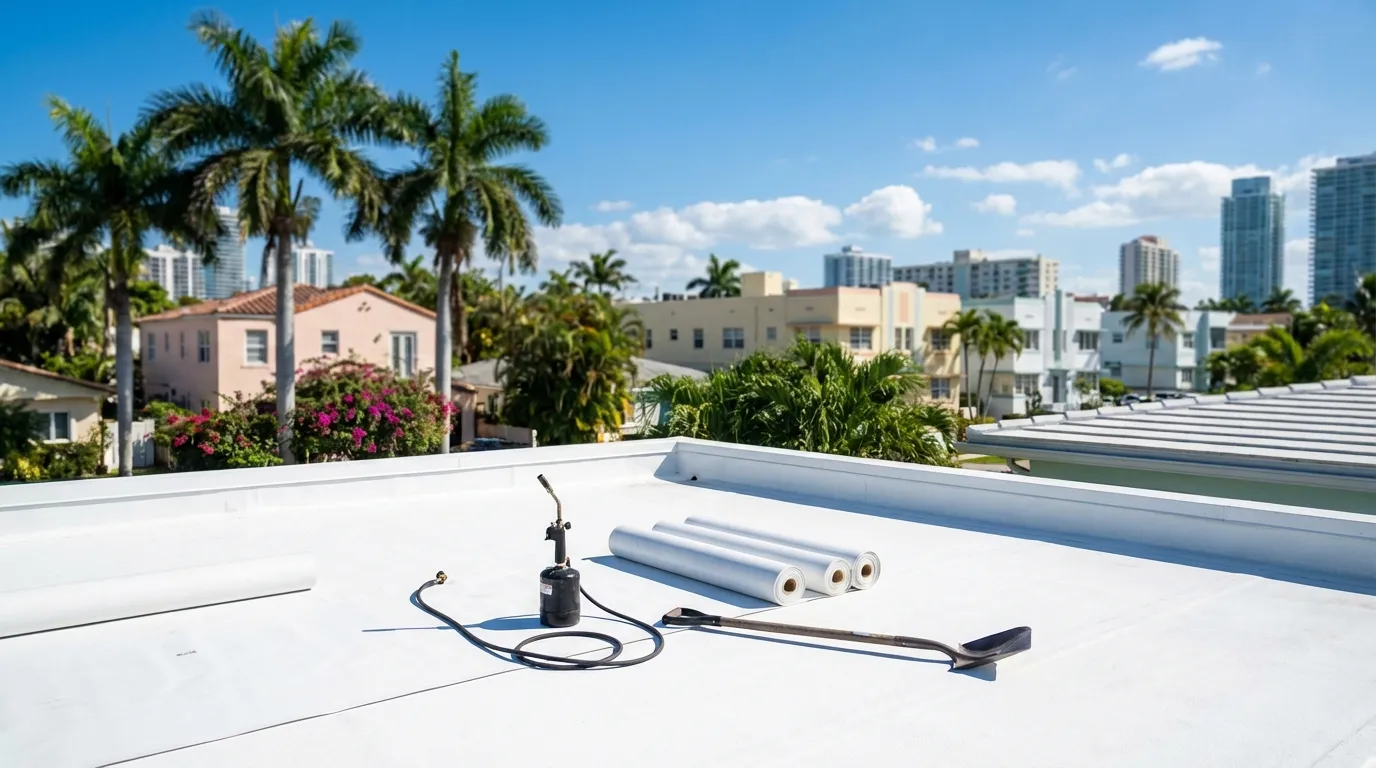
Track 2 — Flat roof + commercial: Miami has an extraordinary density of flat-roof residential and commercial buildings — condo towers, retail strips, older single-family stock in Little Havana and Overtown. TPO, EPDM, and modified bitumen systems require different maintenance and replacement than shingle roofs. Keywords:
- Flat roof: "flat roof repair Miami," "TPO roof Miami," "EPDM roof replacement Miami" — $18–$35 CPC; 8–15 bidders (well below shingle terms)
- Commercial: "commercial roofing Miami," "condo roof replacement Miami," "commercial flat roof contractor Miami-Dade" — $20–$40 CPC; high contract value ($20,000–$100,000+)
Track 3 — Spanish/bilingual: Budget $900–$1,500/month. Targets Hialeah, Doral, Little Havana, Westchester. Landing pages in Spanish with insurance premium savings calculator in Spanish. Keyword groups:
- Replacement/inspection (Spanish): "reemplazo de techo Miami," "inspección de techo Miami," "techo nuevo Miami precio" — $10–$18 CPC
- Storm/insurance (Spanish): "daño de techo por huracán Miami," "reparación techo tormenta Miami," "seguro de techo Miami reclamación" — $8–$15 CPC
- Flat roof (Spanish): "techo plano Miami," "membrana TPO Miami," "techo plano reparación Hialeah" — $7–$13 CPC
Track 4 — Emergency activation (paused): A pre-built campaign with maximum budget ceiling ($8,000–$12,000 for a 72-hour window) and emergency ad copy ready to activate within 4 hours of a named storm event. This campaign should be built during the off-season — ad copy written, landing pages tested, bid strategies configured — so activation is a single-click action, not a multi-day setup process when competition is already at maximum intensity.
Year-Round Budget Architecture
Base budget: $2,500/month across Tracks 1–3. Automated rule: increase all campaigns 2x from June 1 through November 30 (hurricane season). Emergency ceiling: $8,000–$12,000 available for 72-hour post-storm burst. This structure delivers year-round Quality Score maintenance, hurricane season amplification, and post-storm emergency capture — the full competitive spectrum of Miami roofing demand.
Google Partner Agency
We're a certified Google Partner Agency, which means we don’t guess — we optimize withGoogle’s full toolkit and insider support.
Your campaigns get pro-level execution, backed by real expertise (not theory).

Miami's roofing market has a conversion mechanism that no other major city in this pipeline offers: the real estate transaction trigger. Florida law requires a wood-destroying organism (WDO) inspection as part of most real estate closings, and many buyers also commission independent roof inspections. When a buyer's inspection reveals roof defects — age, storm damage, improper installation — the seller is typically required to either repair, replace, or credit the buyer. This creates a time-compressed, highly motivated roofing replacement demand that doesn't exist in the general consumer search market.
The Real Estate Closing Pipeline
Miami-Dade County recorded approximately 62,000 real estate transactions in 2023. Each transaction that uncovers a roof issue — estimated at 15–25% of older housing stock sales — generates a time-compressed replacement or repair demand. The homeowner is not shopping; they have a closing date. They need the work done in 2–4 weeks, they need a licensed and insured contractor with documented permit history, and they will pay a reasonable premium for speed and paperwork compliance. Keywords like "roof replacement before closing Miami," "roof repair real estate Miami," and "roof inspection letter Miami" attract 6–12 bidders — a fraction of generic replacement terms — but the lead quality is exceptionally high.
A dedicated real estate transaction campaign ($300–$500/month) targeting these keywords can generate 8–15 leads per month at CPLs of $45–$80 — among the best CPL numbers in the entire Miami roofing PPC landscape. These leads close faster (closing date deadline), require less follow-up, and generate referral pipeline with the real estate agent and title company involved in the transaction.
The Condo Insurance Renewal Trigger
Miami's 300+ high-rise towers and thousands of low-rise condo buildings face annual insurance policy renewals that increasingly require updated roof condition documentation. Since the 2021 Surfside collapse, Florida has implemented stricter building inspection requirements (SB 4-D), and insurance carriers are conditioning renewal on documented roof maintenance. Condo associations searching "condo roof inspection Miami" and "building roof recertification Miami" represent a niche with 4–8 bidders and contract values of $5,000–$30,000+.
- Key insight: Miami-Dade's 62,000 annual real estate transactions create a perpetual roofing replacement pipeline — 9,300–15,500 transactions annually trigger roof work before closing
- Pre-storm (April–May) keyword window: 8–12 bidders on assessment terms vs. 40+ on emergency terms — best CPL of the year with genuine homeowner urgency
- Post-storm ROAS benchmark: 35:1–55:1 on emergency campaigns — a single $15,000 roof replacement job from a $300–$400 CPL acquisition
- Condo/commercial flat roof: Insurance renewal trigger creates non-consumer demand with low PPC competition and high contract values
The contractors who extract maximum value from Miami's roofing PPC market are not the ones spending the most in June through November. They're the ones with year-round campaign infrastructure that captures the real estate pipeline, the pre-storm assessment window, and the Spanish-language market — then activates emergency capacity on top of an already-performing base when the storm surge arrives.
Miami roofing PPC is not a set-and-forget operation. The hurricane season budget triggers, the Spanish-language campaign infrastructure, the flat roof keyword segmentation, and the pre-built emergency activation are all moving parts that require active management — and that's before accounting for Florida's continuously shifting homeowners insurance landscape, which changes the effective messaging priorities of every campaign every time a major carrier announces an exit or Citizens announces a rate increase.
MB Adv Agency manages campaigns in high-stakes, event-driven markets like Miami roofing as a core competency. Our campaign architecture includes automated hurricane season budget triggers, pre-built emergency activation campaigns, and bilingual ad copy and landing pages maintained in parallel. We also monitor Florida insurance news cycles and update wind mitigation messaging whenever a major policy event makes the insurance premium angle newly relevant to homeowners who hadn't previously considered a roof upgrade.
We don't compete on PI legal or retail — we run PPC for service businesses in competitive markets. That focus means our Miami roofing client campaigns benefit from ongoing competitive intelligence on what Service Experts, ONIT, and 5-Star Roofing are bidding, what ad copy is converting, and where their budgets have gaps that a locally-structured campaign can exploit.
If your roofing company is in Miami-Dade and you're not running a pre-built emergency campaign, a wind mitigation insurance angle, and a Spanish-language track, you're missing the three highest-leverage components of this market. View our PPC management pricing or explore our Miami PPC services to see what a properly structured roofing campaign looks like for this market.

Frequently Asked Questions
How do Miami roofing PPC campaigns differ from campaigns in other cities?
Three things make Miami roofing PPC structurally different from almost any other market in the US. First, the hurricane surge dynamic: no other major metro has a 300–500% search volume spike tied to a predictable seasonal threat. This means campaigns need to be built for two distinct modes — base market operation (year-round, wind mitigation focus, competitive but navigable at $25–$40 CPC) and emergency surge mode (post-storm, $40–$90 CPC, Quality Score pre-built months in advance). Advertisers who don't understand this build for the base market and get crushed in the surge, or build for the surge and waste budget year-round.
Second, Florida's insurance crisis creates a selling angle that doesn't exist elsewhere. When a homeowner can verifiably save $500–$2,500/year on homeowners insurance by upgrading to a wind mitigation–certified roof, that's a financial ROI argument, not a home maintenance argument. Ad copy that leads with this angle consistently outperforms generic roofing messaging in Miami by 20–30% conversion rate premium. It is not transferable to Chicago, Dallas, or any other city where homeowners insurance isn't in structural collapse.
Third, the Spanish-language market. Roofing is a high-urgency service — when a roof leaks or fails, the homeowner calls immediately. In Miami's Spanish-dominant neighborhoods, that urgency doesn't translate into English keyword searches. The contractor who runs Spanish roofing campaigns in Hialeah and Doral captures emergency, replacement, and post-storm leads at $10–$18 CPC that English-only campaigns simply never see. Across all three of these dimensions, Miami is a market that rewards structural specificity and punishes generic roofing campaign templates.
What budget does a Miami roofing company need to compete on Google Ads?
The minimum viable budget for a Miami roofing PPC campaign is $2,000–$2,500/month for an English-only campaign targeting residential replacement and wind mitigation. Below that level, impression share on competitive terms ($22–$45 CPC) is insufficient to generate consistent lead flow — you'll appear occasionally and generate 5–8 leads per month at best, which isn't enough data volume for Smart Bidding to optimize effectively.
The recommended structure for a complete Miami market campaign is $2,500–$4,000/month across English, Spanish, and flat roof campaigns in the base season (January–May, December), with an automated rule to increase total spend by 2x from June 1 through November 30 (hurricane season). This produces a full-year budget of roughly $36,000–$48,000 — which looks significant until measured against the math: Miami residential roof replacements run $8,000–$25,000 per job. A single job acquired from the campaign pays for 1–2 months of management and ad spend. A full campaign year generating 15–25 replacement leads per month produces economics that almost no other home services PPC market can match.
For the emergency surge: pre-allocate a $8,000–$12,000 emergency budget ceiling that activates automatically when a named storm enters the Gulf or Atlantic within 500 miles of Miami. This is not additional monthly budget — it's a separate reserve that you may not spend in a given year, but that generates 35:1–55:1 ROAS in the years when a storm hits. The contractors who set up this reserve in advance are the ones who dominate the post-storm window; the ones who scramble to create it after the storm has already made landfall are bidding against pre-built Quality Scores and losing on price.