How AI Is Changing SEO in 2026

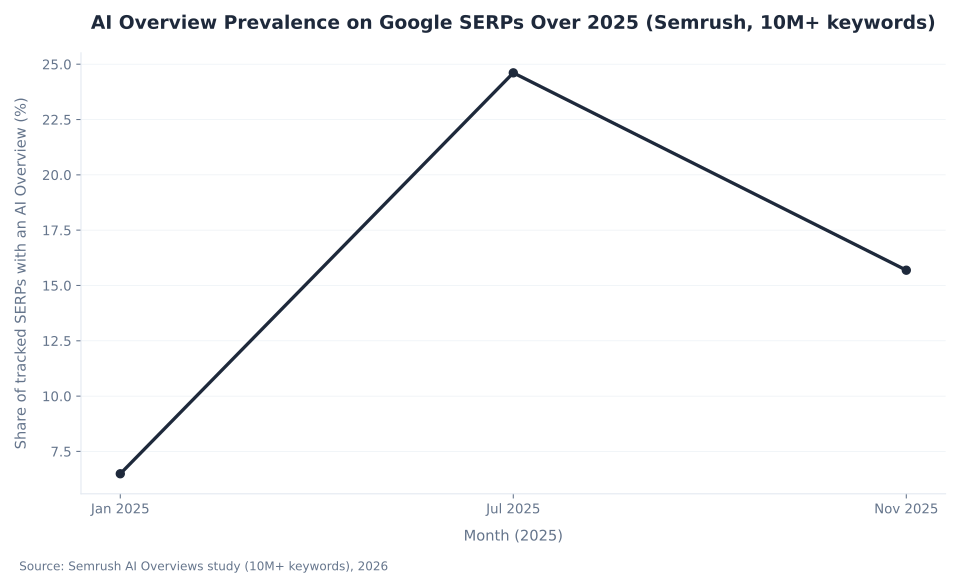
AI Overview prevalence — Semrush, 2026
~16%
of tracked Google SERPs showed an AI Overview in late 2025 (Semrush, 10M+ keywords) — about one in six searches, not the “48%” figure that circulates without a source. AI has changed where results appear, not whether search matters.
Source: Semrush AI Overviews study (10M+ keywords); figures dated Jan–Nov 2025
The AI-Search Shift: SEO Isn’t Dying, It’s Widening
The short answer to the most-asked question in SEO right now: SEO is not dying — it is widening. AI has changed where and how search results appear, not whether people search or whether content and authority decide who gets shown. People still start on Google, Google still processes the vast majority of the world’s searches, and the pages that earn visibility are still the ones with genuine topical authority and clean, structured information. What is new is that a single page can now be seen in three ways instead of one: as a blue-link ranking (SEO), as the extracted answer in a snippet or answer box (AEO), and as a cited source inside a generative response like an AI Overview (GEO).
That is the whole thesis of this page. The three concrete changes are named and sourced in the sections below — AI Overviews (Google’s generative summaries above the results), AI Mode (its conversational, multi-turn search experience), and the rise of zero-click search — and around them two new practitioner disciplines have appeared, AEO (Answer Engine Optimization) and GEO (Generative Engine Optimization), that extend SEO rather than replace it. The same fundamentals feed all three.
The MB Adv Agency read on “SEO is dead”: it is a headline, not a strategy. The businesses panicking about the death of organic are almost always the ones who treated SEO as a keyword-stuffing game; the ones who built real authority and clean structured data are the ones now getting cited in AI Overviews and AI Mode. The AI shift punishes thin content and rewards the fundamentals harder, not less. For the groundwork the whole shift is built on, see what is SEO, and for the natural-language, question-shaped queries that AI search rewards, see what are keywords in SEO.
Key Takeaways
- SEO is widening, not dying. The same fundamentals now earn visibility in three places instead of one — the organic results (SEO), extracted answers (AEO), and generative citations (GEO).
- AI Overviews appear on about 16% of searches, not 48%. Semrush’s 10M+-keyword study tracked prevalence at 6.49% (Jan 2025), 24.61% (Jul 2025 peak), and 15.69% (Nov 2025). The viral “48%” figure has no credible primary source.
- Zero-click is real and rising. 68% of US Google searches ended without a click in early 2026 (SparkToro/Similarweb), and CTR can fall ~60% on a page when an AI Overview shows.
- GEO and AEO are additive layers, not a new religion. The tactics that win them are the SEO fundamentals turned up — direct answers, clean structured data, entity clarity, and authority.
- Using AI to write content is not penalized. Google judges quality, not production method; the “scaled content abuse” policy targets scale-to-manipulate, not the use of AI.
- Voice search is no longer a separate discipline. It is folded into conversational/AI search and wins on the exact same tactics as AEO and GEO.
AI Overviews: What They Are, and How Prevalent They Really Are
An AI Overview is the short, generative summary Google places above the blue links for a query, stitched together from sources it pulls from ranked, structured pages — and it cites those sources. The history is a clean line: Google’s Search Generative Experience (SGE) launched as an opt-in Search Labs experiment in May 2023, graduated to a live feature called AI Overviews for US searchers at Google I/O on May 14, 2024, and expanded to 100+ countries by October 28, 2024.
| Milestone | Date | Detail |
|---|---|---|
| SGE (Search Generative Experience) launches in Search Labs | May 2023 | Opt-in experiment — generative answers inside Search |
| AI Overviews launch to the US at Google I/O | May 14, 2024 | SGE graduates to a live feature above the results |
| AI Overviews expand to 100+ countries | Oct 28, 2024 | Reaches 1B+ users |
| AI Overviews reach 200+ countries / 40+ languages | Google I/O, May 2025 | Broadest rollout to date |
| AI Mode (conversational search) broad US launch | May 2025 | Multi-turn, follow-up questions |
| AI Mode surpasses 1B monthly users; default model Gemini 3.5 Flash | May 19, 2026 | Biggest search-box redesign in 25+ years (multimodal); agentic features summer 2026 |
Sources: Google Blog (AI Overviews, Oct 2024); Google Blog (Search at I/O 2026). Dates web-verified 2026-07-01.
Now the number that anchors this whole page. Semrush’s study across 10M+ keywords tracked AI Overview prevalence rising from 6.49% in January 2025 to a 24.61% peak in July 2025, then falling to 15.69% in November 2025 — roughly one in six tracked SERPs, and notably volatile rather than a straight climb. A second, independent method — Similarweb/SparkToro clickstream, which measures real user sessions instead of a fixed keyword set — puts prevalence a little higher at 20%+ in early 2026. The widely shared “48% of searches” figure has no credible primary source and contradicts both defensible datasets.
AI Overview Prevalence on Google SERPs Over 2025 (Semrush, 10M+ keywords)
The MB Adv Agency view: right-sizing this matters because strategy follows the number. If you believe AI Overviews sit on half of all searches, you make panicked decisions. Once you know it is about 16% and concentrated in informational queries, you optimize sensibly — protect informational content with direct answers and structured data, and recognize that commercial and transactional queries, where the money is, show AI Overviews far less often. AI search is also reshaping how visibility is measured; for how Google’s own reporting is adapting, see GSC trends and the future of Search Console.
AI Mode: Conversational Search at 1B+ Users
AI Mode is Google’s conversational, multi-turn search experience: you ask a question, then follow-ups, and it holds context across the exchange — increasingly across text, voice, and image. That is the key difference from AI Overviews, which are shorter one-shot summaries for a single query; AI Mode is a full dialogue. At Google I/O on May 19, 2026, Google confirmed AI Mode had surpassed 1B monthly users, with Gemini 3.5 Flash as its default model, in what it called the biggest search-box redesign in 25+ years, with agentic features arriving in summer 2026.
Why it raises the stakes: AI Mode, like AI Overviews, pulls from and cites ranked, structured, authoritative pages. Being a citable source is now the visibility game, not just holding position one. See Google’s Search at I/O 2026 announcement for the full milestone set.
Zero-Click Search and the CTR Squeeze
This is the genuinely hard part of the shift. SparkToro/Similarweb clickstream data found 68% of US Google searches ended without a click in early 2026 — up from about 60% in 2024 and roughly 50% in 2019 — and when an AI Overview is present, a page’s click-through rate can drop by about 60%.
The honest read is not “traffic is over.” The clicks AI now absorbs on the results page are the low-intent, quick-fact ones (definitions, simple lookups); the clicks that still come through skew higher-intent, and visibility increasingly means being seen and cited on the page even without a click. The MB Adv Agency angle: stop measuring SEO purely by sessions. Track branded-search lift, assisted conversions, and presence in AI answers instead — see how to track SEO performance with Google Search Console and the metrics basics in what is Google Search Console. One caveat, stated plainly: the SparkToro/Similarweb panel excludes the Google mobile app, so treat 68% as a clickstream estimate, not a Google-published figure — as covered by Search Engine Land and SparkToro.
GEO and AEO: The New Disciplines That Extend SEO
AEO (Answer Engine Optimization) means being the extracted answer — featured snippets, voice results, AI answer boxes. GEO (Generative Engine Optimization) means being cited inside a generative response — AI Overviews, AI Mode, ChatGPT, Perplexity, Gemini. They are real, useful practitioner coinages, and they are not Google-official terms. The tactics that win them, though, are overwhelmingly the SEO fundamentals turned up: clear direct answers near the top of the page, clean structured data, genuine authority and citations, unambiguous entities, and content that deserves to be the source.
| Discipline | Primary goal | You optimize for | Example surfaces |
|---|---|---|---|
| SEO Search Engine Optimization | Rank in the organic (blue-link) results | Crawlability, relevance, content quality, authority, links | Google / Bing organic results |
| AEO Answer Engine Optimization | Be the extracted answer | Direct-answer formatting, structured data, concise Q&A blocks, snippet capture | Featured snippets, voice answers, AI answer boxes |
| GEO Generative Engine Optimization | Be cited inside a generative answer | Entity clarity, citations/mentions, authoritative sourcing, being quotable | AI Overviews, AI Mode, ChatGPT, Perplexity, Gemini |
Framing: Digiday, “WTF are GEO and AEO”. Consensus is SEO + AEO + GEO combined, not a replacement.
The MB Adv Agency read: do not hire a separate “GEO agency” before you have done the SEO fundamentals — GEO without topical authority and structured data is a house with no foundation. The content strategy that feeds all three layers is the same one that always won organic; see what is SEO content.
Does AI Content Hurt Your SEO? Google’s Actual Policy
The second-most-common fear on this topic, settled: Google judges content by quality and helpfulness regardless of how it is produced — human, AI, or hybrid. The “scaled content abuse” policy (March 5, 2024) targets producing content at scale primarily to manipulate rankings — “whether automation, humans, or a combination are involved” — not the use of AI itself.
So the line is helpful vs manipulative, not AI vs human. AI-assisted content that is genuinely helpful, accurate, and experience-backed is fine; AI-generated spam at scale is a violation, exactly as human-written spam always was. Use AI to draft and scale research and structure, and keep a human accountable for accuracy, first-hand experience, and editorial judgment. For the spam-policy and E-E-A-T detail, see understanding Google algorithm updates and Google’s March 2024 update.

Diversified discovery, paired with paid search
The AI Shift Makes Diversification Matter More
As organic CTR gets squeezed by AI Overviews, a controllable paid channel becomes a useful hedge. Your organic SEO does one job; the paid search our team runs does another — managed PPC services and campaign management are the lever you can turn on today while GEO and AEO compound over months. For SaaS and software brands navigating the shift, paid plus organic is the standard resilient stack (see, for example, our SaaS PPC services).
Talk to our team →Entity SEO: Recognition Over Rankings
Visibility in AI answers increasingly depends on authority, citations, entity clarity, and Knowledge-Graph presence — the prerequisites for being cited in AI Overviews, Knowledge Panels, and AI Mode answers. The framing shift is from “rank #1 for a keyword” to “be the recognized entity the AI trusts and cites,” as Search Engine Land puts it. Clean entities, consistent brand signals, and authoritative citations are how a generative system decides who is worth quoting.
Where SEO Is Heading: Future Trends
The direction is clear enough to plan around. Agentic search — where the search box completes multi-step tasks, not just answers questions — is Google’s stated 2026 roadmap. Multimodal queries (text, voice, image together) are becoming the default. AI visibility measurement — tracking whether you are cited in AI Overviews, AI Mode, and third-party assistants — is emerging as its own reporting discipline alongside rankings and traffic. AI Overviews themselves keep widening: 200+ countries and 40+ languages as of Google’s May 2025 expansion.
What does not change is the load-bearing part: helpful, well-structured, authoritative content is still what gets ranked, extracted, and cited — it is the input to every new surface. The durable move is to keep investing in the fundamentals that feed SEO, AEO, and GEO at once. Start from what is SEO and build out from there.
Voice Search, Now Folded Into Conversational AI Search
For years marketers were sold a distinct “voice search strategy.” In 2026 that framing is obsolete: Google Assistant is being replaced by Gemini, and voice queries are answered by the same conversational systems that power AI Mode and AI Overviews. Voice is now part of AI search, not a separate discipline.
The tactics that win voice — direct-answer blocks, natural-language and long-tail phrasing, question-and-answer structure, structured data, and featured-snippet capture — are identical to the tactics that win AEO and GEO. So the correct advice is simple: you do not build a voice strategy, you build a clear-answer, well-structured, authoritative content strategy, and it serves voice, snippets, and AI answers at once. The natural-language, question-shaped keywords this rewards are covered in what are keywords in SEO.
What to Actually Do About It
A short, honest checklist — none of it exotic, all of it the fundamentals aimed at the new surfaces:
- Keep the fundamentals. Crawlable, fast, well-structured pages with genuinely helpful content still decide who gets ranked and cited.
- Add direct answers and structured data. Lead sections with a clear, concise answer, and mark up your content so machines can parse it — this is 80% of AEO and GEO.
- Build entity and brand authority. Consistent entities, citations, and mentions are how AI systems decide you are worth quoting.
- Measure AI visibility, not just sessions. Track branded-search lift, assisted conversions, and whether you are cited in AI answers.
- Diversify discovery and skip the myths. Organic + AI surfaces + paid + owned channels is the resilient stack — and ignore the “48% of searches” and “SEO is dead” noise.
Frequently Asked Questions: How AI Is Changing SEO
Back to the fundamentals
The AI Shift Rewards the Basics Harder
Now that you have the correct mental model of the AI-search shift, the highest-leverage move is to keep doing the fundamentals well — because they feed SEO, AEO, and GEO at once. Start at the beginning.
Read what is SEO →Methodology & Sources
This pillar is the advanced-techniques anchor for the AI-search shift; the mechanics live in the linked siblings. It is the highest-drift topic in the glossary, so every AI-search number carries a named source and a date. AI Overview prevalence (6.49% Jan 2025, 24.61% Jul 2025, 15.69% Nov 2025) is from the Semrush AI Overviews study across 10M+ keywords; the “20%+” alternative reading is Similarweb/SparkToro clickstream. Zero-click (68% of US searches, early 2026) and the ~60% CTR drop are from SparkToro/Similarweb, covered by Search Engine Land; the panel excludes the Google mobile app and is cited as a clickstream estimate. The SGE → AI Overviews → AI Mode timeline and the AI Mode figures (1B+ users, Gemini 3.5 Flash, May 19, 2026) are from Google’s own announcements on blog.google. The AI-content policy is from Google’s March 2024 Search update; GEO/AEO framing is from Digiday; “recognition over rankings” is from Search Engine Land. The “48% of searches,” “voice = 27% of queries,” and “Assistant = 40% market share” figures are deliberately excluded — none has a credible primary source. No mbadv client metrics appear in this article; the MB Adv Agency perspective is qualitative, and mbadv runs the paid campaigns that complement organic SEO. Head-term demand is from Ahrefs Keywords Explorer (US, 2026-07-01). Reviewed by MB Adv Agency, July 2026.
The search engine optimization (SEO) landscape is undergoing a seismic shift, driven largely by the advancements in artificial intelligence (AI). As businesses strive to enhance their online visibility and user engagement, understanding how AI is influencing SEO strategies is imperative. This article delves into the pivotal role AI plays in SEO, the tools that leverage AI for improved performance, and what the future holds for this dynamic field.
How AI Is Changing SEO
AI has revolutionized how website content is optimized for search engines, enhancing traditional SEO tactics. By analyzing vast amounts of data with unmatched speed and accuracy, AI provides insights that allow marketers to make informed decisions. This transformation not only elevates the efficiency of SEO strategies but also improves user experiences on websites.

One of the fundamental ways AI is changing SEO is through natural language processing (NLP). Search engines like Google have integrated AI-powered algorithms that understand the context and intent behind queries. This ensures that users are presented with more relevant results, which can significantly impact website rankings. As a result, businesses are encouraged to focus on creating high-quality, contextually relevant content that aligns with user intent rather than merely optimizing for specific keywords.
Moreover, AI tools can analyze users' preferences and behaviors, allowing businesses to create personalized content that resonates with their target audience. With AI's ability to predict trends and shifts in consumer behavior, brands can proactively adjust their strategies, further enhancing their visibility and engagement online. This predictive capability not only aids in content creation but also in tailoring marketing campaigns, ensuring that the right message reaches the right audience at the right time.
Role of AI in search engine algorithms
The algorithms that power search engines are becoming increasingly sophisticated, thanks to AI. Google’s RankBrain, which is part of its core algorithm, uses machine learning to process search results. It assesses the relevance of content based on user engagement, click-through rates, and other factors, thereby continuously improving its accuracy. This dynamic approach means that SEO strategies must evolve in tandem with these algorithms, emphasizing the importance of staying informed about ongoing changes in search engine technology.
Additionally, AI helps search engines identify high-quality content more effectively. By evaluating factors such as readability, tone, and topic relevance, search engines can rank content based on its potential to satisfy a user’s query. This shift rewards content that genuinely serves users over content that simply employs SEO tricks. Consequently, businesses are encouraged to invest in content quality and user engagement metrics, fostering a more authentic connection with their audience.
Furthermore, AI also assists in tackling the issue of spam and low-quality content. Search engines deploy AI to filter out irrelevant or manipulative content, which leads to a more trustworthy search environment. In this way, AI contributes not only to enhancing the SEO process for legitimate businesses but also to improving overall user experience. By prioritizing high-quality content, search engines are effectively raising the bar for all online content creators, compelling them to deliver value and relevance.
Tools for AI-driven SEO
The rise of AI has led to the development of a variety of tools that streamline SEO processes. One noteworthy tool is Clearscope, which uses AI to analyze top-performing content around specific keywords. It provides recommendations on related topics and keyword densities, enabling marketers to optimize their content strategically. This not only aids in improving search rankings but also enhances the overall quality of the content produced.
Another valuable tool is SEMrush, which incorporates AI to provide insights into the competitive landscape. It analyzes competitors’ strategies, keyword performance, and backlink profiles, allowing marketers to craft data-driven SEO plans that can outperform the competition. By leveraging these insights, businesses can identify untapped opportunities and refine their approaches to capture more organic traffic.
Lastly, MarketMuse utilizes AI algorithms to help marketers understand content gaps in their domains. By identifying areas lacking in quality content, it assists businesses in creating comprehensive strategies that ensure their content meets both user needs and search engine criteria. This focus on content optimization not only drives traffic but also fosters brand loyalty, as users are more likely to return to a site that consistently delivers valuable information.
These tools exemplify how AI not only enhances the effectiveness of SEO strategies but also automates several processes, reducing the manual workload for marketers. The insights provided by these tools empower brands to make agile adjustments and stay ahead in the fast-paced digital landscape. As AI continues to evolve, the potential for even more innovative SEO solutions is vast, promising an exciting future for digital marketing professionals.
Predictions for the future
As AI continues to evolve, the implications for SEO will be profound. Experts predict that the future of SEO will be characterized by an even greater emphasis on personalized experiences. AI will enable websites to tailor content specifically to users based on their preferences, behaviors, and location.

Moreover, advancements in voice and visual search technologies will lead to a shift in how users query search engines. As more consumers rely on voice-activated devices, businesses will need to optimize their content for conversational queries, which require an understanding of natural language patterns and context.
AI is also expected to play a significant role in improving local SEO strategies. As search engines become better at serving localized results, businesses will be poised to leverage AI to enhance their visibility in specific geographical areas through more precise targeting and optimized local content.
Furthermore, the ethical dimension of AI in SEO will come into sharper focus. As AI tools gain prevalence, marketers will need to be vigilant about ethical practices, ensuring that AI-generated content remains authentic and transparent to users. This will reinforce the importance of trust in the digital landscape, where consumers demand honesty and reliability.
In addition to these developments, the integration of AI with augmented reality (AR) and virtual reality (VR) could redefine user engagement. Imagine a scenario where users can interact with products in a virtual space before making a purchase decision. This immersive experience will not only enhance user satisfaction but also provide businesses with valuable data on consumer preferences and behaviors, further refining their SEO strategies.
Moreover, as AI continues to analyze vast amounts of data, predictive analytics will become a cornerstone of SEO. Businesses will be able to anticipate trends and user needs with greater accuracy, allowing them to create content that not only meets current demands but also aligns with future interests. This proactive approach will be essential in staying ahead of competitors in an increasingly crowded digital marketplace.
Conclusion
In conclusion, the integration of AI into SEO is not just a trend but a defining shift that will shape the future of digital marketing. Understanding the role of AI in search algorithms, leveraging the right tools, and paying attention to emerging trends will be essential for businesses aiming to stay competitive. As AI continues to develop, marketers who embrace these changes will forge ahead in enhancing their SEO strategies and ultimately driving growth.

As a Google Ads expert, I bring proven expertise in optimizing advertising campaigns to maximize ROI.
I specialize in sharing advanced strategies and targeted tips to refine Google Ads campaign management.
Committed to staying ahead of the latest trends and algorithms, I ensure that my clients receive cutting-edge solutions.
My passion for digital marketing and my ability to interpret data for strategic insights enable me to offer high-level consulting that aims to exceed expectations.
Google Partner Agency
We're a certified Google Partner Agency, which means we don’t guess — we optimize withGoogle’s full toolkit and insider support.
Your campaigns get pro-level execution, backed by real expertise (not theory).

4.9 out of 5 from 670+ reviews on Fiverr.
That’s not luck, that’s performance.
Highly recommend Matteo to set up your server side tracking. He has a deep understanding of e-commerce tracking and will go above and beyond to make sure everything is set up correctly and working 100%. If you are scaling your store this set up is non-negotiable in my opinion and there isn't many people who have this much knowledge or put the effort in to get it right. Thanks again!
avorodesign.com
I can only recommend Matteo! He was very patient, professional and very knowledgeable about GA4, Consent Mode v2, and GDPR compliance. Communication was clear, and the setup was done professionally and efficiently. Highly recommend him for anyone needing reliable tracking implementation.

www.natureiki.life
Matteo shines in the realm of online professionals. His work is not only deep in data but also complemented by his proactive communication and cooperation, setting a new standard for freelancers. If you want someone who truly exceeds expectations, look no further. Highly recommended!

www.omanbeverlysmyth.com
Exceptional Service Beyond Expectations - Outstanding Service Impeccable depth, flawless delivery, and exceptional language fluency—this service exceeded all expectations. Highly recommended. Matteo truly ROCKS!!!
ium-paris.com
Top-notch, always highly value working with Matteo. An absolute Google Ads Genius. This is approximately the 8th time I have hired him and he's helped us get 6-7 ROAS. We are excited in continuing to improve our lead flow. Hire this guy if you need Google Ads help. Thanks Matteo!

www.dleeventgroup.com
I finally found the guy who can setup server side tracking and all the ecosystem properly. I definitely recommend Matteo. He is very responsive, kind and wants to dig into things. He configured GA4, Meta, Google Ads, Outbrain and google consent v2 with Cookiebot. Thanks Matteo.

inomega.fr
MB Adv delivered exceptional work with outstanding professionalism and lots of patience, taking time to see effects of changes made and not just do the work and submit it. The proactive communication and video summaries of the work completed made working with Matteo a pleasure, as he consistently went above and beyond. Highly recommended for web analytics projects! We are already working on another project.

www.withnellsensors.co.uk
Working with Matteo on my Google Ads was a game-changer. He's not just a strategist, he's a true partner. He understood my goals and tailored a campaign that perfectly reached my target audience. I'm grateful for his expertise and dedication.

dccargo.com
Click-driven mind
with plastic-brick obsession.
We build Google Ads campaigns with the same mindset we use to build tiny brick worlds: strategy, patience, and zero tolerance for wasted pieces.
Data is our blueprint. Growth is the only acceptable outcome.