Automotive PPC Austin, TX
Automotive repair has the highest conversion rate (14.67%) and lowest cost-per-lead ($28.50) of any local service category nationally — and Austin's 660,000–880,000 registered vehicles, 24-minute average commute, and 100°F+ summers that stress every car's AC, coolant, and battery system create structural demand that makes the math even more compelling locally. <!-- stats-article-link --> <p><em>See how this city's Automotive PPC costs compare nationally in our <a href="https://www.mbadv.agency/ppc-industry-statistics/automotive-ppc-statistics">Automotive PPC Statistics</a> report, featuring data from 40+ US cities.</em></p>
Dealerships, Chains, and the Multi-Location Advantage
Austin's automotive service market is contested on two flanks simultaneously. From above: dealership service departments at Toyota of Austin, Leander Honda, Round Rock Kia, and every other OEM franchise in the metro run make-specific search campaigns with brand authority and national-level budgets. A Toyota owner searching "Toyota service Austin" is going to find Sewell Toyota's Google Ads well before a generic independent shop's campaign. From below: national franchise chains — Christian Brothers Automotive (5+ Austin locations), Firestone Complete Auto Care (10+ locations), Jiffy Lube / Valvoline (everywhere) — dominate routine service keywords with multi-location budgets and systematic advertising programs. Independent shops are squeezed between the dealer prestige play and the chain convenience play.
The opportunity isn't to out-spend Christian Brothers across the metro. It's to out-specialize them within a geographic or service-type niche. Christian Brothers runs "trustworthy auto repair" positioning across every Austin zip code simultaneously. An independent shop with 5 miles of radius targeting in Cedar Park, 4.9-star reviews, and a specialty in European vehicles or EV-capable service runs a campaign that the franchise model fundamentally cannot replicate at the same conversion rate — because the local specificity and specialty credentials convert the specific subset of searchers who care about them.
The Google Business Profile Problem
Automotive is one of the highest proximity-search categories in local services. "Auto repair near me" and "oil change near me" are among the most frequently searched automotive terms — and both of those searches resolve primarily through Google Maps, not Google Search ads. A shop with a perfectly optimized Google Ads campaign but a poorly maintained Google Business Profile (outdated hours, no photos, 30 reviews at 4.1 stars) loses a significant portion of its potential traffic before the paid campaign even has a chance to work.
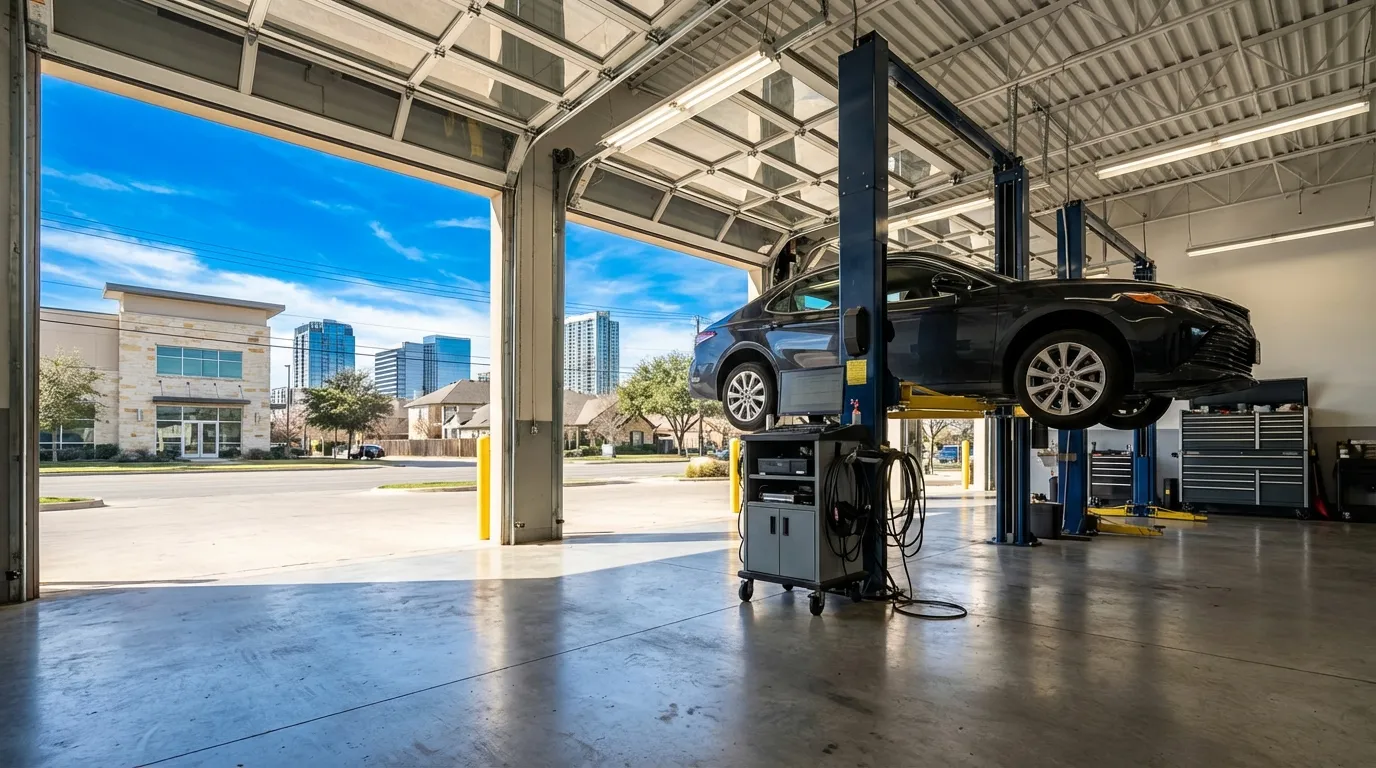
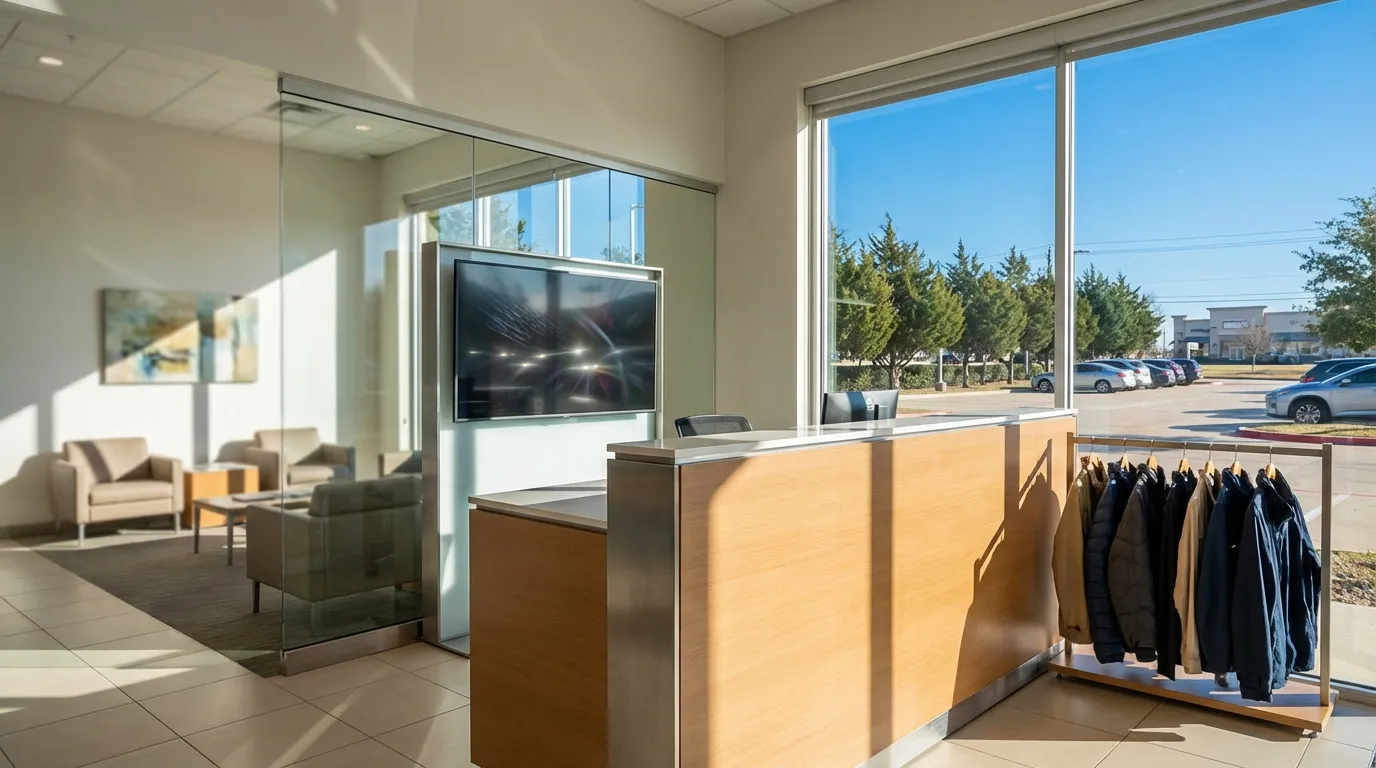
- GBP photo completeness: Shops with 20+ photos on their GBP receive 42% more direction requests and 35% more website clicks than those with fewer than 10 photos (Google internal data). Service bay photos, waiting area, exterior signage, and team photos — all matter for the proximity-search conversion that Google Maps drives.
- Review velocity: Google Maps automotive rankings weight recent review frequency heavily. A shop with 200 reviews acquired over 3 years ranks lower than a shop with 120 reviews acquired in the last 12 months. New review requests must be systematic — automated post-service text with direct Google review link sent within 2 hours of checkout.
- Hours accuracy: Automotive is the category where GBP hours errors most frequently cause lost customers — someone searching "oil change open now Austin" and finding your listing shows "open" but you're actually closed loses that customer permanently. GBP hour management must be manual-verified monthly, not set-and-forget.
The dealership competition is real but narrow in scope. Dealership service departments win on make-specific keywords ("Toyota service near me") and warranty work. They lose on price (dealer labor rates run 40–80% above independent shop rates), wait times (1–3 day scheduling vs. same-day independent), and multi-make capability. An independent shop campaign that explicitly addresses these dealership weaknesses — "Same-Day Service. All Makes. No Dealer Markup." — converts the searcher who knows what they're comparing to. Austin's tech workforce, which often drives Teslas, BMWs, and other premium vehicles, is particularly responsive to transparent pricing messaging because these drivers know exactly how much dealer service costs.
Austin is also a Tesla city in a way that no other Texas market is. Tesla Gigafactory and Tesla's relocated headquarters have made Austin one of the highest Tesla per-capita ownership markets in the US. Tesla non-powertrain service (tires, brakes, AC, 12V battery, wipers, detailed inspections) can all be performed by independent shops, yet dealerships have waitlists for these appointments. "Tesla tire rotation Austin TX," "Tesla AC service Austin," and "Tesla brake service Austin independent shop" are searches with meaningful volume, zero independent shop advertising, and customers who are actively frustrated with Tesla's service scheduling backlog. This niche is entirely uncaptured in Austin's automotive PPC landscape.
Segmented Campaigns for Austin's Service Demand Patterns
The highest-performing Austin automotive PPC campaigns don't run a single "auto repair Austin TX" campaign and call it done. They segment by service type — because the urgency, conversion speed, and customer lifetime value differ dramatically between an emergency diagnosis and a routine oil change. A well-segmented campaign structure also allows bidding strategies and landing pages to match the specific searcher's intent.
Keyword clusters with estimated Austin CPCs:
- Emergency/diagnostic intent ($7–$14 CPC, fastest conversion): "check engine light Austin TX," "car won't start Austin," "oil leak repair Austin," "AC not working car Austin TX" — these searches indicate a vehicle problem that needs resolution today. Mobile-dominant, click-to-call with "same-day diagnosis available" is the only CTA that matters. CVR on well-targeted emergency automotive searches exceeds 18–22% because the searcher has no luxury of deliberation.
- Routine service keywords ($5–$9 CPC, highest volume): "oil change Austin TX," "tire rotation near me Austin," "brake service Austin TX," "car inspection Austin" — highest search volume, most price-competitive, highest repeat customer acquisition value. Compete on convenience and transparency, not price. "Same-Day Oil Change — No Appointment Needed" beats "Cheapest Oil Change Austin" for quality lead conversion.
- Specialty/make-specific ($8–$18 CPC, low competition on niche terms): "BMW service Austin TX," "Mercedes repair Austin independent," "Tesla tire rotation Austin TX," "European auto repair Austin" — make-specific or specialty terms have lower volume but higher average ticket values ($400–$2,000 per visit for luxury/European repairs) and near-zero competition from national chains who don't run make-specific targeting. First-mover advantage is available on most of these terms in Austin's market.
- Summer heat-specific seasonal ($6–$12 CPC, spike June–August): "car AC recharge Austin TX," "coolant flush Austin," "AC repair car near me Austin" — Austin's 100°F+ summers create measurable seasonal spikes in HVAC-for-vehicles and cooling system service. June–August keyword volume for automotive cooling terms increases 150–200% above baseline. Pre-campaign these keywords in May for June deployment.
Geographic and Competitive Strategy
Austin automotive PPC rewards tight geographic targeting more than most categories. Customers don't drive 20 miles for an oil change. A shop in Pflugerville (78660) is not competing for Cedar Park (78613) customers — they're competing for a 5–8 mile radius around their service bays. Campaigns should reflect this: tight geo radius, neighborhood-specific ad copy ("Pflugerville's Trusted Auto Shop — Just off TX-130"), and bid strategies that maximize impression share within that radius rather than spreading thin across the metro.
Negative keyword management is critical for automotive because the category has substantial irrelevant traffic: "auto repair jobs," "mechanic school," "tire rack shipping," "auto parts store near me," "how to change oil yourself," "AutoZone," "O'Reilly Auto Parts," "Carmax," "used car dealer." A comprehensive negative list — minimum 80 terms — prevents 15–25% of automotive ad spend from going to searches that will never convert to a service appointment.
Google Partner Agency
We're a certified Google Partner Agency, which means we don’t guess — we optimize withGoogle’s full toolkit and insider support.
Your campaigns get pro-level execution, backed by real expertise (not theory).

Austin's Summer Heat: A Unique Automotive Demand Driver
Austin's automotive demand pattern has a seasonality that's more intense than comparable Texas markets. The city's 100°F+ summer days create accelerated wear patterns on multiple vehicle systems simultaneously: AC compressor failures and refrigerant loss occur at higher rates than in cooler climates; coolant systems work harder and experience more expansion/contraction cycles; tire pressure fluctuations (1 PSI for every 10°F temperature change) increase blowout risk; and battery degradation from combined heat stress and deep AC draws is documented to reduce Texas battery lifespan to 3–4 years vs. 5–6 years in northern markets.
These are not hypothetical demand drivers — they're measurable in search volume. Austin Google search trends for "AC recharge car" and "car AC not working" spike in June and hold elevated through August. "Battery replacement Austin" spikes in late January–February (post-Uri battery cold stress) and again in August (heat-stressed batteries failing under heavy AC load). A properly timed automotive campaign that boosts these seasonal keywords by 40–60% in May (before the demand peak) and January (before the post-cold-front battery failures) captures the surge at pre-season CPCs.
The Tesla Opportunity No One Is Taking
Austin's Tesla fleet is documented and growing. The Gigafactory on SH-130 in southeast Austin is one of Tesla's highest-output production facilities globally, and Tesla's Austin headquarters presence has accelerated local ownership. Reliable estimates suggest Austin ranks in the top 5 US cities for Tesla per-capita ownership. The service implication: thousands of Austin Tesla owners are experiencing the same service challenge — Tesla's mobile service and service center have multi-week wait times for non-emergency appointments, and owners with tire wear, brake service needs, or 12V battery issues are actively seeking alternatives.
Independent automotive shops that are Tesla-capable (tire mounting for 20–21" Tesla wheels, regenerative braking-aware brake service, 12V battery replacement protocols) and that run PPC campaigns explicitly targeting "Tesla service Austin TX" and "Tesla repair near me Austin" are capturing a high-value, underserved audience. Tesla owners skew toward high-income tech workers ($120K–$250K household income common in the Austin tech corridor) who pay premium for quality service and are highly loyal to shops that earn their trust. The average Tesla service ticket at an independent shop runs $200–$800 per visit for tire/brake/battery work. The CPC for "Tesla service Austin" is currently below $12 because no other independent shop is running it. That window will not stay open indefinitely.
Key insight: Automotive repair nationally has a 14.67% CVR — the highest of any local service category benchmarked (LocalIQ 2025, from 3,500+ campaigns). At a national CPC of $3.90 and 14.67% CVR, the national average CPL is $28.50 — the lowest of any industry tracked. Austin's market adds a 25–35% CPC premium, pushing estimated Austin CPL to $35–$50. At a $350–$600 average repair ticket and 60% repeat customer rate within 12 months, a $40 CPL generating a $480 first-year customer value produces a 12:1 ROAS before any consideration of long-term LTV. No other category in this pipeline has comparable unit economics at entry-level budget.
Austin automotive PPC delivers the fastest ROI and lowest CPL of any local service category — which makes it one of the lowest-risk PPC investments an independent shop can make. The market conditions amplify this further: Austin's high vehicle density, extreme summer heat that accelerates service needs, and the entirely uncaptured Tesla niche create demand patterns that a well-structured campaign can convert into booked appointments within 24 hours of launch.
MB Adv Agency manages automotive PPC campaigns for independent Austin shops that want to compete against Christian Brothers' multi-location campaigns without matching their budget. Our PPC management process for automotive includes make-specific keyword targeting (European, Tesla, domestic), seasonal bid adjustments for Austin's summer heat and post-winter battery spikes, and geographic precision that maximizes impression share in the 5–10 mile radius where conversion actually happens. We also ensure Google Business Profile optimization runs alongside the paid campaign — because for automotive, the GBP proximity ranking is as important as the search ad placement.
At our Growth Mode tier ($497/month management), an independent Austin auto shop gets campaigns that generate first appointments within 24–48 hours of launch, with tracking that captures both call and form conversions — because in automotive, the majority of appointments are still booked by phone. Shops that implement call tracking alongside their PPC campaigns routinely discover they were generating 40–60% more conversions than their digital-only tracking showed. That's not just a reporting fix — it's the difference between correctly attributing ROI and prematurely killing a campaign that was actually working.
Frequently Asked Questions
What's the fastest way to get automotive PPC leads in Austin?
Emergency and urgent service keywords generate automotive leads faster than any other local PPC category. "Check engine light Austin TX," "oil leak repair near me Austin," and "car AC not working Austin TX" are searches where the customer has an active vehicle problem and a decision timeline measured in hours, not days. A campaign targeting these terms with click-to-call extensions, "same-day diagnosis available" ad copy, and a landing page that prominently displays your phone number and hours can generate first calls within hours of campaign activation — literally within the same day for afternoon launches during business hours.
The fastest-to-ROI path for an Austin automotive shop:
- Step 1: Launch an emergency/diagnostic campaign (check engine, AC failure, oil leak, won't start keywords) with a 5-mile geographic radius. Top-of-page bid targets. Click-to-call extension. This campaign runs and generates calls within 24–48 hours in Austin's vehicle-dense market.
- Step 2: Add routine service keywords (oil change, tire rotation, brakes, inspection) at broader geo radius (8–10 miles). These generate higher volume but lower urgency — conversion timeline is 1–7 days from first click. Add this campaign in week 2 of operations.
- Step 3: Layer in seasonal campaigns 4–6 weeks before demand peaks. AC service keywords launch in May; battery replacement keywords launch in January and July; tire campaigns launch in October before winter. Seasonal pre-loading at pre-surge CPCs improves campaign efficiency 25–35% vs. launching reactively when the surge has already started.
The single biggest acceleration lever is call tracking. Austin automotive shops discover, on average, that 40–60% of their PPC conversions are phone calls — not form submissions. Without call tracking, the campaign appears to convert at 2–4% and looks marginal. With call tracking revealing the full conversion picture, actual CVR is 10–16%, and CPL drops from an apparent $120 to a real $35–$45. Set up call tracking before launching any automotive campaign; without it, the reported numbers will consistently understate performance.
How should an Austin auto shop approach EV and Tesla service PPC?
EV-capable automotive PPC in Austin is one of the clearest first-mover opportunities in the local services market right now. The demand is documented (Austin's large Tesla fleet with backlogged service center appointments), the keyword competition is near-zero (almost no Austin independent shop is running Tesla-specific paid search), and the customer demographic (high-income tech workers) has above-average LTV and above-average likelihood of becoming long-term shop loyalists if service quality meets expectations.
The practical campaign setup:
- Keyword targets ($8–$14 CPC, minimal competition): "Tesla tire rotation Austin TX," "Tesla brake service Austin," "Tesla 12V battery replacement Austin," "EV service Austin TX," "Tesla repair independent shop Austin," "non-dealer Tesla service Austin" — all low-competition, high-intent terms with motivated searchers who are actively trying to avoid 3-week Tesla service center wait times.
- Landing page requirements: Explicit statement of EV/Tesla capability, technician certification or training evidence, photos of EV/Tesla work completed, specific services listed (tire mounting for Tesla wheel sizes, regenerative brake service, 12V battery specification compatibility), and customer testimonials from Tesla owners if available. The Tesla owner's primary concern is "can this shop actually service my vehicle correctly?" — the landing page must answer this directly and specifically.
- Pricing transparency: Tesla owners know what their Tesla Service Center charges. Publishing "Tesla tire rotation: $X" (realistically priced, not artificially cheap) combined with "typically available same-week vs. 3-week Tesla SC wait" is a conversion message that speaks directly to the frustration driving the search. Price is secondary to availability and confidence — lead with availability, support with transparent pricing.
Budget allocation for a Tesla/EV campaign: $400–$700/month as an add-on to your existing automotive PPC campaign. The volume is not high enough to justify primary campaign budget, but the lead quality (high ticket, loyal demographic, word-of-mouth among Austin Tesla owner communities) makes the economics favorable at any lead volume above 5–8 per month. Austin's Tesla owner communities on Reddit and local Facebook groups also amplify word-of-mouth for shops that earn Tesla owner trust — making each PPC-acquired Tesla customer worth substantially more than the initial transaction suggests.