Start
$590$990/month
1 platform · Google or MetaGoogle + Meta- Ad spend
- up to $3,000
- New creativesmade by us
- Google + Meta only4 a month
 By Matteo Braghetta, Founder · Google Ads
Mesa is built for cars — 138.8 square miles of suburban grid, 2 vehicles per household average, zero functional light rail for most of the city, and 300 days of sun that hits 115°F in summer and destroys batteries, AC compressors, and coolant systems faster than anywhere else in the country. With DriveTime Automotive Group headquartered in Mesa and national chains like Jiffy Lube, Firestone, and Valvoline all running PPC campaigns, independent auto repair shops compete in a market where the right Google Ads strategy is the difference between a full service bay and an empty one.
See how this city's Automotive PPC costs compare nationally in our Automotive PPC Statistics report, featuring data from 40+ US cities.
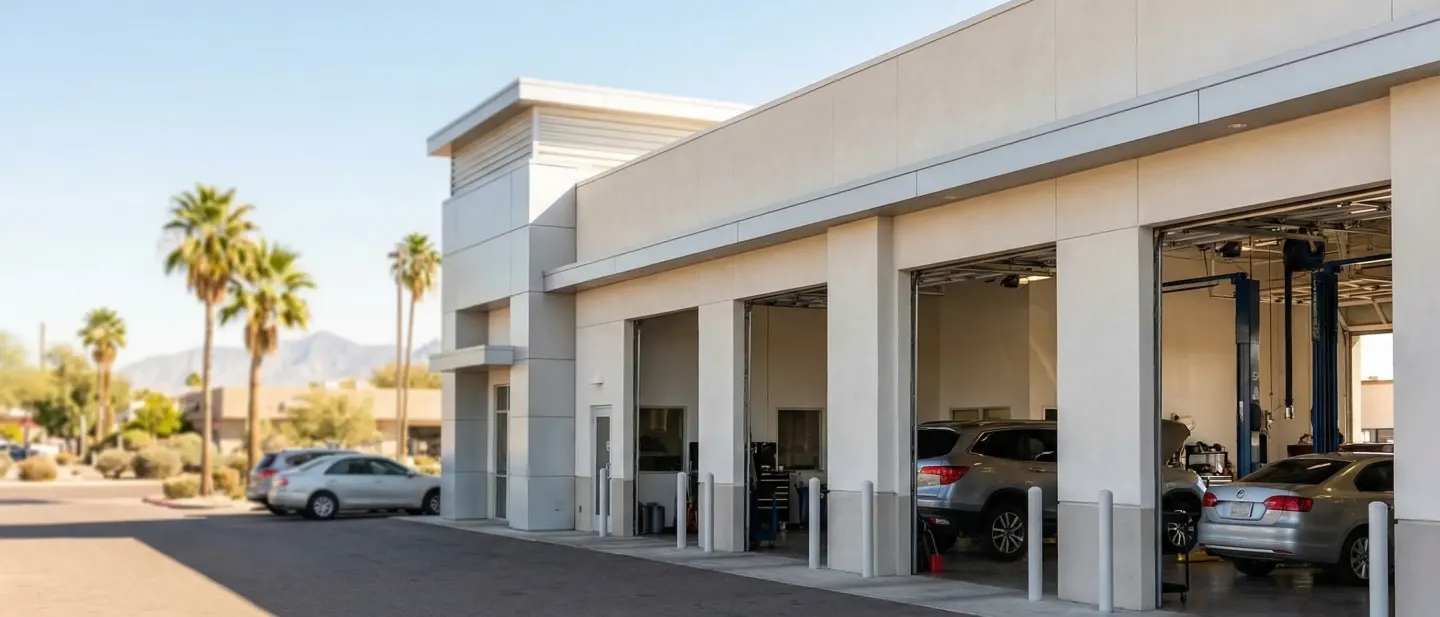
In Mesa, AZ, people search for automotive services about 6,730 times a month on Google; a top-of-page click costs $3–$13, and demand peaks in October.
Google Keyword Planner · Oct 2025 – Sep 2026
| Search | Monthly searches | Top-of-page CPC |
|---|---|---|
| auto repair near me | 1,000 | $3–$16 |
| mechanic near me | 1,000 | $4–$18 |
| tire shop | 1,000 | $1.88–$5.49 |
| oil change | 590 | $2.43–$6.83 |
| car ac repair | 590 | $3–$15 |
| auto repair | 480 | $5–$19 |
| mechanic | 480 | $3–$16 |
| check engine light | 260 | $2.34–$7.68 |
| car battery replacement | 260 | $1.60–$5.31 |
| car repair | 170 | $3–$18 |
Source: Google Keyword Planner (Google Ads), Google Search, English, Mesa, AZ, Oct 2025 – Sep 2026. Volumes are Google's monthly averages; CPC is the top-of-page bid range, weighted by search volume. How we collect these figures.
Mesa's auto repair PPC market has a structural challenge that makes it unlike most service business advertising: the primary competitors — national chains — are simultaneously your biggest advertisers and your cheapest service offerings. Jiffy Lube, Valvoline, Firestone, Midas, and Pep Boys all operate multiple Mesa locations, run national PPC campaigns, and advertise prices that reflect loss-leader oil change specials designed to generate upsell revenue inside the service bay. Competing against that model on price is a losing proposition for an independent shop. The PPC strategy has to position around what chains can't provide.
National chain PPC in Mesa follows a predictable formula: aggressive bid on "oil change Mesa AZ" and "auto repair near me," low-price headline ($19.99 oil change, $0 diagnostic), and drive volume for upsell in-store. The CPC for "oil change Mesa AZ" runs $2.43–$6.83 locally — accessible enough that chain PPC produces volume at scale. An independent shop that bids on the same oil change terms against a Jiffy Lube with 400+ national locations in the Quality Score auction is fighting an uphill battle for commodity service.
The conversion reality for independent shops is that customers choose them for different reasons than they choose chains: trust, relationship, diagnostic capability, and the belief that the independent shop won't upsell them into unnecessary repairs. These are exactly the qualities that can't be communicated in a price-based chain ad — and they're the conversion levers that independent shop PPC must pull.
Mesa's climate creates both the highest demand opportunity and the highest operational challenge for auto repair PPC. The opportunity: 115°F summer heat generates genuine automotive emergencies — dead batteries, failed AC compressors, overheating radiators, and degraded tires at a rate that exceeds national averages significantly. The challenge: this demand is hyper-seasonal. Vehicle AC repair searches spike 400–600% from May through August compared to October through February. A shop that budgets flat across the year either wastes money in slow months or leaves peak-season revenue on the table.
Mesa's vehicle fleet age compounds the opportunity. The national average vehicle age has reached a record ~13 years. Mesa's combination of older vehicles, high daily mileage from the suburban commute (24.7-minute average each direction, largely by personal vehicle), and extreme climate stress means Mesa households are running vehicles that need more frequent and more varied repairs than the national average. Two cars per household at 13 years average age = substantial, repeat maintenance demand — and the shop that acquires a customer acquires their household's fleet, not a single vehicle.
DriveTime Automotive Group, headquartered in Mesa with 1,367 employees, is the nation's largest used car dealer network, selling primarily to value-oriented buyers with moderate credit — buyers who purchase used vehicles that may arrive needing service sooner than a new car. DriveTime's Mesa customer base (used, value-oriented vehicle buyers) is exactly the demographic that actively searches for affordable, trustworthy independent auto repair rather than the higher-priced dealer service center. A Mesa shop that runs campaigns targeting "auto repair Mesa" with trust-centric copy — transparent pricing, no hidden fees, honest estimates — captures this customer demographic at the moment when they're searching for a reliable shop for their newly-acquired used vehicle.
Dealership service centers compete for post-warranty maintenance on late-model vehicles, but their pricing and impersonal service experience drives many Mesa car owners to independent shops after the warranty period ends. The post-warranty segment — "my car is 5 years old and out of warranty; who do I trust for maintenance now?" — is a specific search behavior that independent shop PPC can target with "dealer-quality service without dealer prices" positioning.
Mesa automotive PPC strategy for independent shops starts with seasonal architecture — the climate-driven demand spikes are too large to ignore, and a flat year-round campaign structure misses the revenue opportunity of Mesa's 4-month heat peak.
Divide the Mesa automotive calendar into three campaign phases:
Independent shop PPC copy should never compete on chain price points. The conversion mechanism for independent shops in Mesa is trust, transparency, and honest service — not matching Jiffy Lube's $19.99 oil change. Headlines that work: "Honest Auto Repair Mesa — No Upsell Pressure," "Mesa's Trusted Shop Since [Year]," "Fair Prices, Real Mechanics — Not a Chain." Landing pages must reinforce this with Google review stars, specific review quotes, and a visible local phone number answered by a person — not a call center.
Mesa's automotive PPC market has a specific demand pattern that most campaigns miss — and capitalizing on it produces below-average CPLs with above-average customer lifetime value.
Phoenix metro car batteries last 2–3 years on average — roughly half the 4–5-year national lifespan due to heat-accelerated chemical degradation. Mesa has approximately 517,000 residents with an average of 2 vehicles per household — that's approximately 517,000 vehicles in the market, each with a battery cycling through a 2–3 year replacement timeline. At any given time, 170,000–260,000 Mesa vehicles are within 12 months of needing a battery replacement.
The PPC opportunity: most Mesa drivers don't know their battery is failing until they're stranded. A proactive campaign — "Phoenix heat kills car batteries in 2–3 years. Is yours next? Free battery test at our Mesa shop." — converts well precisely because it's educational. The driver hasn't searched "dead battery" yet; they're responding to the awareness that their battery is on borrowed time. CPCs for proactive battery terms are lower than emergency breakdown terms, and the customer who comes in for a battery test and free health check typically books additional service items found during the inspection.
Mesa's 2-vehicle household average is not a footnote — it's a fundamental customer acquisition framing opportunity. The independent shop that wins a new Mesa customer acquires not just one vehicle but two vehicles in the same household on overlapping maintenance schedules. Average annual maintenance spend per vehicle in the Phoenix market runs $800–$1,400 depending on vehicle age and type; a two-vehicle household represents $1,600–$2,800 in annual potential revenue.
Multi-vehicle offers in PPC outperform single-vehicle generic ads for this exact reason: "Bring both cars for a combined oil change and save $15" speaks directly to the Mesa household reality. The offer is marginal (small discount), but the conversion signal is strong — it acknowledges the customer's reality and positions the shop as a household automotive partner rather than a one-visit transaction shop.
Summer is the highest-ROAS window for Mesa auto repair PPC — not just because of higher search volume, but because emergency urgency dramatically compresses the decision cycle. A Mesa driver whose AC fails on a 110°F July afternoon is not reading three Google reviews before calling — they're calling the first shop that shows up and promises same-day service. A Mesa automotive shop that maintains an active summer PPC campaign while competitors reduce summer budgets (common mistake: assuming summer is slow when it's actually peak urgent-repair season) owns the distressed-customer segment for the entire summer.
Mesa's automotive market rewards independent shops that can out-trust the chains — not out-price them. A family-owned shop that's been in Mesa for 15 years has a relationship asset that Jiffy Lube's national PPC budget can't buy. The PPC strategy is to make that relationship visible to Mesa's new residents, new vehicle owners, and households that have aged out of the dealership warranty umbrella.
MB Adv Agency builds Mesa automotive PPC campaigns around the seasonal reality of desert vehicle ownership: high-urgency summer emergency campaigns for AC and battery, proactive pre-summer preparation campaigns for March–April, and relationship-building maintenance campaigns for the fall/winter season. We structure campaigns to capture the multi-vehicle household — Mesa's most common automotive customer profile — with offers that reflect the 2-car household reality. Our campaigns run under our PPC management service, with campaign architecture built for the high-conversion emergency window and the year-round maintenance relationship.
If you're an independent Mesa auto shop paying CPLs that exceed what your service margins support — or running flat campaigns that miss the summer urgency peak — the problem is campaign structure, not budget. See our pricing plans and let's build a campaign around Mesa's actual automotive demand calendar.
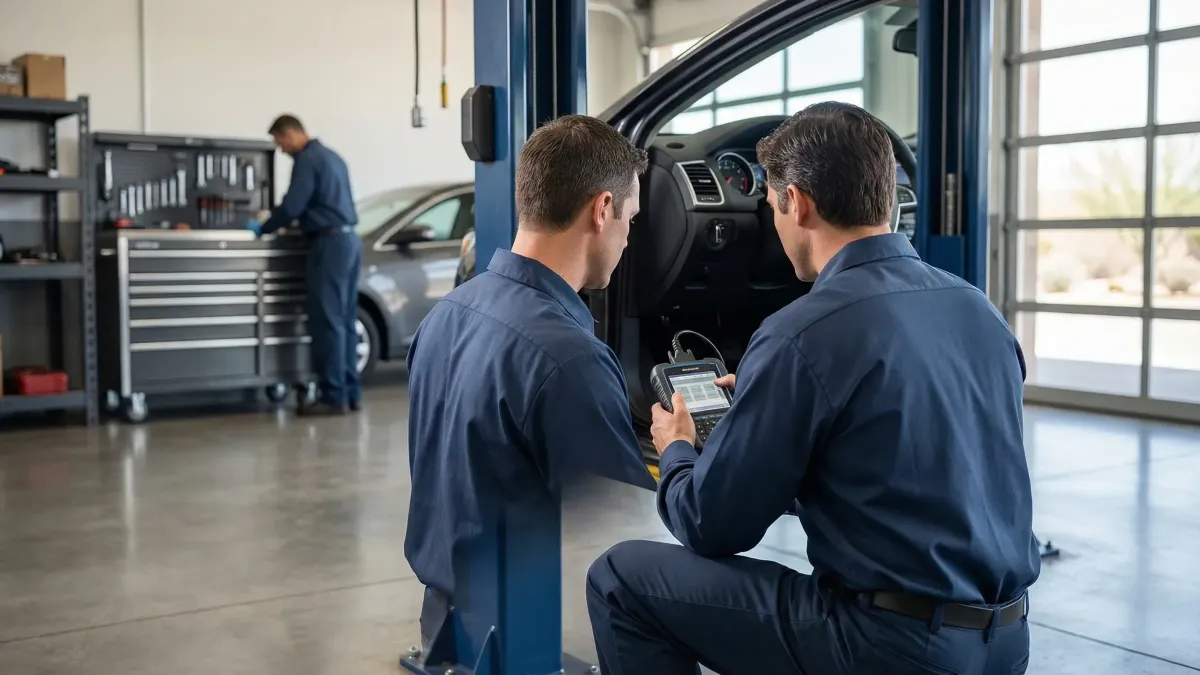
Independent shops in Mesa can't match national chain PPC budgets — Firestone, Jiffy Lube, and Valvoline each have national Google Ads budgets running across hundreds of metro markets simultaneously. The strategy is to out-qualify them, not out-spend them. National chains optimize for volume; independent shops win on trust, specificity, and local presence.
Three competitive tactics that consistently work for Mesa independents:
The seasonal window is the most powerful competitive advantage. National chains maintain flat budgets year-round. A Mesa independent shop that surges budget 50–70% in June–August — when AC repair urgency is at its peak and the competitive field of well-optimized campaigns is smaller than in the shoulder months — captures distressed high-conversion customers at lower competitive CPCs than the year-round baseline.
Mesa auto repair services divide into three ROI tiers based on ticket value, urgency level, and seasonal demand concentration:
Tier 1 — Highest urgency, best in-season ROI (May–August):
Tier 2 — Year-round steady performers:
Timing guidance: Surge AC/battery/cooling campaigns 50–60% above your base budget from May through August. Maintain brake and oil change campaigns year-round. Run pre-summer prep campaigns in March–April at moderate budget. December–February is the lowest-competition window in Mesa auto repair PPC — CPCs drop to seasonal lows, but quality new-customer relationships formed in winter translate to summer urgency revenue when the customer's first thought is to call the shop they already trust.
How to read this Cost per click and monthly searches are measured with Google Keyword Planner (see above). Cost per lead, conversion rate, budget and leads are estimates compiled from public benchmarks such as WordStream, not measurements.
Sources LocaliQ 2025 Automotive Search Ads Benchmarks (2,000+ campaigns) + WordStream 2025 Auto benchmarks + Phoenix/Mesa market adjustment for desert climate demand patterns and chain competition
$590$990/month
1 platform · Google or MetaGoogle + Meta$790$1,290/month
1 platform · Google or MetaGoogle + Meta$1,140$1,940/month
1 platform · Google or MetaGoogle + MetaChatGPT Ads: a separate pilot, $250/month, added to a plan. See the pilot →

Matteo Braghetta founded MB Adv and runs its Google Ads accounts. He takes the first call with every new client, reads the accounts every week and writes the agency’s guides.
The other half of his job is measurement: GA4, Consent Mode and server-side tracking, so the platforms learn from real sales.
MB Adv is a Google Partner agency managing about $4.4M a year in ad spend for clients in the US, the UK and Europe.
Managed on numbers you can check.
Plans for the US