Start
$590$990/month
1 platform · Google or MetaGoogle + Meta- Ad spend
- up to $3,000
- New creativesmade by us
- Google + Meta only4 a month
 By Matteo Braghetta, Founder · Google Ads
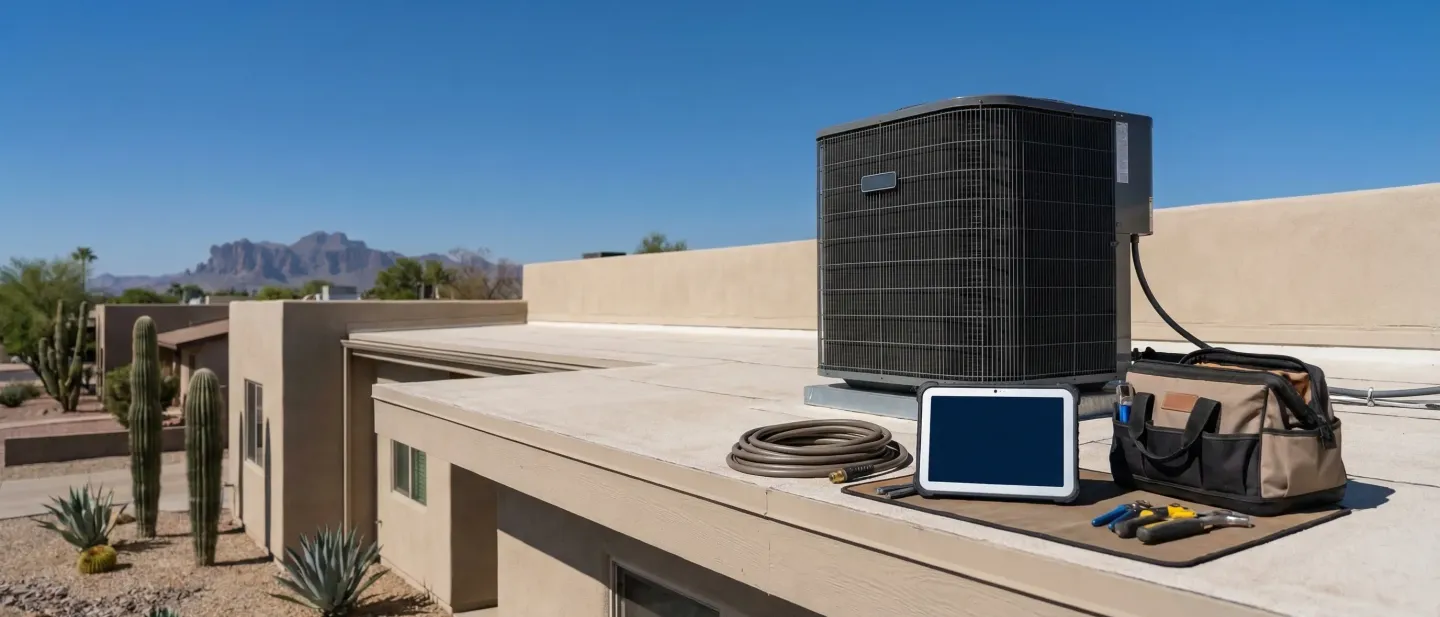
Mesa, AZ averages 110–115°F summer highs and runs air conditioning 7–9 months per year — making HVAC the most competitively bid service category in the East Valley, with emergency AC repair keywords reaching $89–$175 CPC. With 124 HVAC businesses competing for the same overheated homeowners, campaigns that aren't built for Mesa's desert heat cycle leave money on the table.
See how this city's Hvac PPC costs compare nationally in our Hvac PPC Statistics report, featuring data from 40+ US cities.
In Mesa, AZ, people search for HVAC services about 4,380 times a month on Google; a top-of-page click costs $67–$147, and demand peaks in March.
Google Keyword Planner · Oct 2025 – Sep 2026
| Search | Monthly searches | Top-of-page CPC |
|---|---|---|
| air conditioner repair near me | 1,000 | $69–$160 |
| ac repair | 720 | $85–$160 |
| air conditioning repair | 720 | $85–$160 |
| hvac near me | 320 | $33–$100 |
| hvac company | 170 | $29–$150 |
| ac installation | 170 | — |
| air conditioner installation | 170 | — |
| duct cleaning | 170 | $10–$40 |
| furnace repair | 140 | — |
| hvac repair | 110 | $43–$160 |
US: $83
Google Keyword Planner · Oct 2025 – Sep 2026
Source: Google Keyword Planner (Google Ads), Google Search, English, Mesa, AZ, Oct 2025 – Sep 2026. Volumes are Google's monthly averages; CPC is the top-of-page bid range, weighted by search volume. How we collect these figures.
Running HVAC PPC in Mesa is not like running it in Denver or Dallas. The extreme desert climate creates a market where demand spikes violently in June, competitors double their bids overnight, and a badly structured campaign burns through a $5,000/month budget in two weeks without a single booked job. Mesa's 517,151 residents and sprawling 138.8-square-mile suburban grid create high search volume — but the same volume that makes Mesa attractive also makes it one of the most unforgiving PPC markets for HVAC operators in Arizona.
From June through September, Mesa HVAC PPC operates on different economics than the rest of the year. Emergency AC repair keywords — "AC not working Mesa," "emergency HVAC repair Mesa AZ," "AC out in heat" — spike in cost per click during peak summer. The operators driving those bids include regional giants like Goettl Air Conditioning and Parker & Sons, national chains like ARS Rescue Rooter and One Hour Air, and a dense field of 82+ curated local competitors catalogued by Expertise.com — 19 of whom are ranked as top picks in the Mesa market.
Most small HVAC operators make the same mistake: they run the same campaign year-round with a fixed daily budget, then get outbid by national chains in July when clicks cost 60–80% more and the conversion window is narrowest. A homeowner whose AC failed at noon on a 114°F day calls the first three numbers they can reach — not necessarily the one with the best Google Ads relevance score. Speed of response and bid dominance in the critical 10am–7pm summer window is the entire game.
Mesa's HVAC field features strong established players: Child Air Conditioning & Heating (operating since 2005 as a Carrier dealer), Valley Heating, Cooling & Appliances (40+ years, Trane Comfort Specialist), Dukes of Air (BBB A+ with significant brand presence across the Phoenix metro), and Mountain Peak Air. Each brings credible local history, strong review profiles, and experienced PPC management. Against this field, generic campaigns built on broad match keywords with no seasonal bid strategy fail immediately.
The campaigns that fail in Mesa HVAC share common traits: broad match keywords that pull in unqualified traffic ("HVAC jobs Mesa," "how much does AC cost"), flat daily budgets that run out by early afternoon on peak demand days, and ad copy that reads the same as six other ads on the page. Mesa homeowners in crisis mode scan fast — they click on the first ad that names their city, offers same-day service, and gives a phone number without requiring a form fill.
Mesa's large housing stock — heavily built from 1985 to 2005 — is now entering the phase where 15–25-year-old units are failing at increasing rates. That replacement demand runs alongside repair demand, but the keyword strategy and landing pages for each must be completely separate. Lumping them together produces campaigns that convert neither well.
A Mesa HVAC PPC campaign built for profit operates in three distinct modes throughout the year, each with a different bid strategy, keyword mix, and budget allocation. Here's the framework that works.
Mode 1 is the summer emergency campaign (June–September), where premium-CPC keywords demand tight ad scheduling, aggressive bid multipliers, and a dedicated budget pool separate from maintenance and replacement campaigns. This campaign targets one thing: the homeowner with a dead AC right now. Emergency repair keywords should run on exact and phrase match only, with day-parting focused on 9am–8pm when call intent is highest.
Mode 2 is the replacement campaign (year-round, peak October–November and March–May). Mesa homeowners replace AC units when the current one fails catastrophically or when it hits the 15-year mark and a major repair estimate makes replacement look smarter. Replacement keywords — "AC replacement Mesa AZ," "new AC unit cost Mesa," "central AC install Mesa" — run at lower CPCs in shoulder season and require landing pages that lead with financing options. A $10,000–$15,000 AC replacement decision does not happen on an emergency call; it requires a consultative close, and the landing page must set that expectation.
Mode 3 is the maintenance/tune-up campaign (February–April), when CPCs drop and Mesa homeowners are reachable before the summer crunch. This window is the most cost-efficient lead acquisition opportunity of the year. A $75 spring tune-up converts at high rates, builds customer relationships, and positions the HVAC company for priority service call scheduling when July heat hits.
Negative keyword hygiene is critical in Mesa HVAC — "HVAC jobs," "HVAC school," "how to fix AC," "DIY air conditioner" and similar research/employment queries must be excluded from day one, not after $500 in wasted spend.
Ad extensions drive Mesa HVAC performance more than in most markets. Call extensions with local Mesa numbers (not 800 numbers) see higher CTR from homeowners who distrust call centers. Sitelink extensions for emergency service, maintenance plans, and financing turn a single click into three potential entry points. Location extensions with a Mesa address build local trust against Phoenix-metro-wide operators whose ads lack city-specific presence.
For Mesa HVAC specifically, Google Local Services Ads (LSA) run alongside standard search ads create double SERP coverage on "HVAC near me" queries — Mesa homeowners running mobile searches during an AC failure see both the LSA panel and the paid search ad, which dramatically increases brand recognition and click-through rate versus single-placement ads.
Mesa's HVAC market has an economic structure that most operators understand only superficially: the emergency season drives revenue, but the maintenance contract model builds the business. Understanding the seasonal mechanics changes how you allocate PPC spend across the year.
Mesa AC units run an average of 2,400–3,000 operating hours per year — compared to 800–1,200 hours for a comparable unit in Chicago or Seattle. That's 3–4x the wear rate. The city's housing stock is heavily concentrated in the 1985–2005 construction era, meaning tens of thousands of units are in the 15–25-year range where compressor failure rates increase exponentially. The replacement market in Mesa is structural, not cyclical — it doesn't depend on economic conditions, it depends on physics. A 20-year-old AC unit running in 115°F heat doesn't consult the housing market before failing.
This creates a predictable PPC opportunity: operators who run replacement-focused campaigns in October–November (when summer bills are fresh and homeowners are doing their first cold-weather mental resets) capture pre-planned replacement decisions at lower CPCs rather than paying peak prices for emergency replacement decisions in July. The October window is consistently underserved by Mesa HVAC advertisers — most pull back spend after summer, leaving the conversion window open.
Mesa's extended AC season makes maintenance agreements a uniquely valuable product. A twice-annual maintenance contract ($149–$249/year typical price) delivers two guaranteed seasonal touchpoints — spring pre-season and fall post-season check — and positions the HVAC company as the household's default service provider. When that same household's system fails in July, they call their maintenance contractor first, not Google.
PPC campaigns targeting maintenance agreement signups convert best in February–March at lower CPCs, and each converted maintenance customer reduces the cost of future emergency lead acquisition. A Mesa HVAC company with 400 maintenance agreement customers enters each summer with 400 priority service relationships — and the ad spend to acquire those relationships costs far less than chasing emergency calls in peak season.
Key insight: Mesa homeowners on maintenance plans churn at low rates — the desert climate makes the twice-annual check feel genuinely necessary, unlike in temperate climates where it can feel optional. The lifetime value of a Mesa maintenance customer (5–8 years × $200/year = $1,000–$1,600) plus the 40–60% probability that they also buy their next system replacement from the same company makes the $120–$180 CPL for a maintenance lead one of the best-returning ad spend decisions in the Mesa HVAC market.
Seasonality targeting should shift messaging by quarter:
Mesa's HVAC PPC market rewards operators who know the city's specific demand patterns and punishes those running generic Phoenix-metro campaigns. The difference between a well-managed Mesa HVAC campaign and a poorly structured one isn't a few percentage points — it's the difference between $80/lead and $200+/lead on identical budget spend.
At MB Adv Agency, we build Mesa HVAC campaigns around the three-mode seasonal framework: emergency response mode in summer, replacement campaigns in fall, and maintenance acquisition in early spring. Each mode runs on separate budgets, keyword groups, bid strategies, and landing pages — because Mesa homeowners searching "AC not working" in July and "spring tune-up special" in March are entirely different buyers requiring entirely different ad experiences.
We've managed PPC for service businesses across the Phoenix metro and understand that Mesa's East Valley geography — 18 miles east to west, distinct neighborhoods from Dobson Ranch to Superstition Springs — requires geo-bid adjustments that broad Phoenix-metro targeting misses. Our campaigns use enhanced CPC with manual bid adjustments by location, time of day, and device, not set-it-and-forget-it automated bidding that burns budget on early-morning mobile searches from homeowners who aren't ready to call.
Explore our PPC services for home service businesses or review our pricing tiers to see how we structure Mesa HVAC campaigns. The Mesa market has room for operators who show up right — the question is whether your current campaign is doing that.
Learn more about how we approach PPC lead generation for service businesses or our Mesa, AZ local PPC services.
The honest answer depends on which season you're asking about — and most Mesa HVAC operators get this wrong by applying a single monthly budget year-round. A flat $3,000/month budget that looked adequate in January is drastically under-funded in July, when emergency AC repair CPCs climb sharply and competitors are spending $8,000–$12,000/month to dominate summer leads.
The framework that works in Mesa: tier your spend by season. Off-peak months (December–February) can run efficiently at $2,000–$3,000/month targeting maintenance agreements and replacement planning queries. Shoulder season (March–May, October–November) runs well at $3,000–$5,000/month — lower CPCs and high-quality replacement/tune-up leads. Peak season (June–September) requires $5,000–$10,000/month to maintain visibility on emergency repair keywords without getting outbid by Goettl, Parker & Sons, and the Phoenix metro's regional chains.
A Mesa HVAC company doing $1.5M–$3M in annual revenue should target 3–5% of revenue for Google Ads — that's $4,500–$12,500/month averaged across the year, with intentional seasonal surges. The operators spending consistently year-round — including the January and February months when competitors go dark — build Quality Scores and campaign history that delivers dramatically lower CPCs when summer competition spikes. The best time to invest in Mesa HVAC PPC is not June — it's February, when you're building the campaign infrastructure that dominates summer without overpaying for clicks.
Mesa HVAC conversion rates vary dramatically by keyword intent tier, and most campaigns bleed budget on the wrong tier. Here's the breakdown from actual Phoenix metro campaign data.
Highest conversion rate keywords (8–14% CVR): Emergency and urgency-signal queries — "AC not working Mesa AZ," "HVAC emergency Mesa," "emergency air conditioning repair," "AC repair same day Mesa." These convert because the searcher is in active distress with zero price sensitivity. A click on an emergency keyword converts at 10–14% and books a $400–$800 repair job. That's a CPL that works for an $800 job — profitable even at peak summer CPC.
Moderate conversion rate keywords (5–8% CVR): Replacement intent queries — "new AC unit Mesa AZ," "AC replacement cost Mesa," "best HVAC company Mesa." These require longer consideration cycles and convert better with landing pages that offer financing options upfront. Average CPL for replacement leads runs $150–$250, but each replacement job is worth $8,000–$15,000 — making even a $250 CPL deliver 30–60x return.
Lower but strategic conversion keywords (3–6% CVR): Maintenance and brand terms — "AC tune-up Mesa AZ," "HVAC maintenance agreement Mesa," branded terms for competitors. These build long-term customer relationships and reduce future emergency lead costs. Budget allocation: 15–20% of total spend during non-peak months.
Seasonal nuance: avoid "how to" and cost estimation queries ("how much does AC cost in Mesa," "how to fix AC Mesa") — these pull in research-phase traffic that rarely converts to booked jobs and inflates spend without results. Add them as negatives from day one.
How to read this Cost per click and monthly searches are measured with Google Keyword Planner (see above). Cost per lead, conversion rate, budget and leads are estimates compiled from public benchmarks such as WordStream, not measurements.
Sources LocalIQ 2025 Home Services benchmarks (n=3,200+ campaigns) + Phoenix/Mesa market adjustment for desert climate HVAC seasonality
$590$990/month
1 platform · Google or MetaGoogle + Meta$790$1,290/month
1 platform · Google or MetaGoogle + Meta$1,140$1,940/month
1 platform · Google or MetaGoogle + MetaChatGPT Ads: a separate pilot, $250/month, added to a plan. See the pilot →

Matteo Braghetta founded MB Adv and runs its Google Ads accounts. He takes the first call with every new client, reads the accounts every week and writes the agency’s guides.
The other half of his job is measurement: GA4, Consent Mode and server-side tracking, so the platforms learn from real sales.
MB Adv is a Google Partner agency managing about $4.4M a year in ad spend for clients in the US, the UK and Europe.
Managed on numbers you can check.
Plans for the US