Start
$590$990/month
1 platform · Google or MetaGoogle + Meta- Ad spend
- up to $3,000
- New creativesmade by us
- Google + Meta only4 a month
 By Matteo Braghetta, Founder · Google Ads
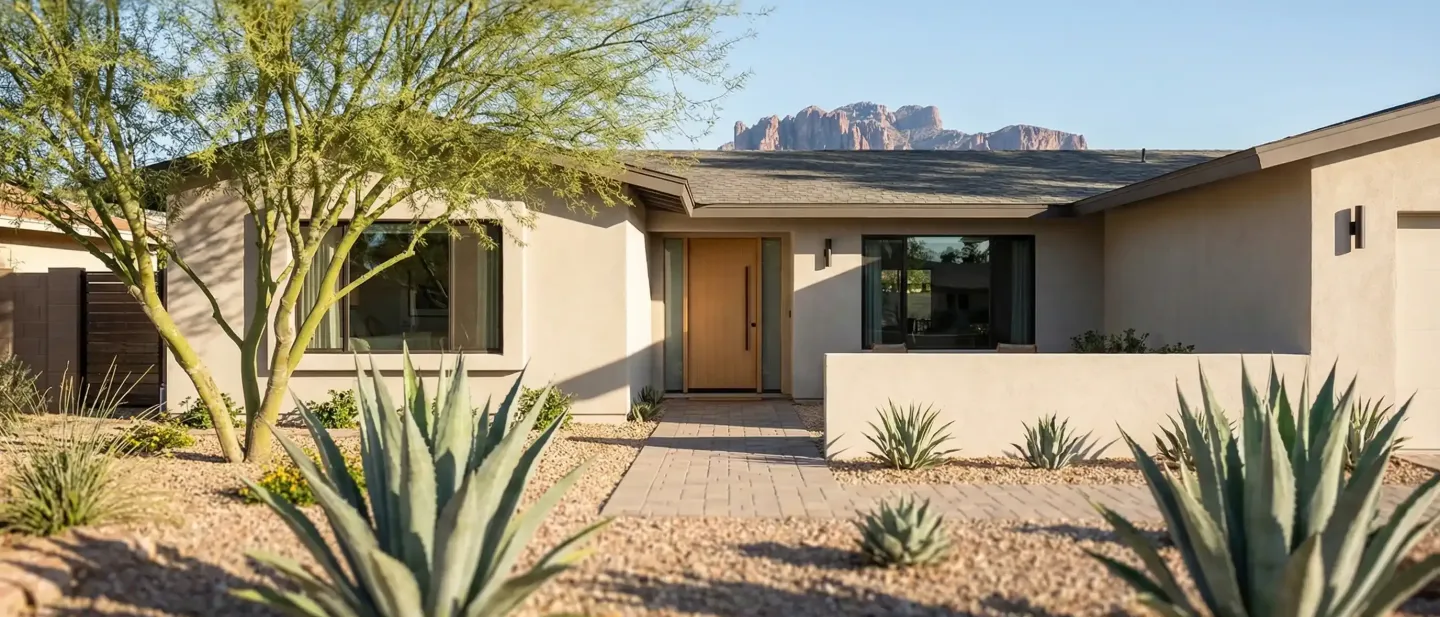
Mesa real estate is moving — median property values hit $408,000 with 12% year-over-year appreciation, Phoenix metro in-migration is sustaining buyer demand, and 194 agents compete for the same qualified leads in a market where Zillow, Realtor.com, and Opendoor also run paid search campaigns. The agents winning new clients in Mesa aren't the ones with the biggest total budgets — they're the ones running neighborhood-specific PPC that captures the buyer who already knows they want Superstition Springs, or the seller whose Red Mountain Ranch equity has made listing suddenly look very attractive.
See how this city's Real Estate PPC costs compare nationally in our Real Estate PPC Statistics report, featuring data from 40+ US cities.
In Mesa, AZ, people search for real estate services about 2,230 times a month on Google; a top-of-page click costs $4–$15, and demand peaks in March.
Google Keyword Planner · Oct 2025 – Sep 2026
| Search | Monthly searches | Top-of-page CPC |
|---|---|---|
| houses for sale | 590 | $0.23–$4.68 |
| homes for sale | 480 | $0.19–$4.96 |
| property management | 260 | $7–$25 |
| real estate agent | 210 | $3–$13 |
| realtor near me | 110 | $6–$65 |
| commercial real estate | 110 | $0.39–$2.15 |
| real estate agents near me | 70 | — |
| condos for sale | 50 | $0.39–$2.67 |
| new construction homes | 50 | $2.34–$8.67 |
| real estate broker | 50 | — |
US: $9.02
Google Keyword Planner · Oct 2025 – Sep 2026
Source: Google Keyword Planner (Google Ads), Google Search, English, Mesa, AZ, Oct 2025 – Sep 2026. Volumes are Google's monthly averages; CPC is the top-of-page bid range, weighted by search volume. How we collect these figures.
Mesa real estate PPC operates in a two-front competitive environment that most agents underestimate: national portals with unlimited ad budgets on one side, and 194 local agents competing for the same neighborhood-level leads on the other. Winning in this environment requires a strategy that recognizes what both competitor types cannot do — and builds campaigns around that gap.
Zillow, Realtor.com, Homes.com, and Opendoor are not passive organic competitors — they run active paid search campaigns on Mesa's highest-volume real estate terms. "Homes for sale Mesa AZ," "Mesa AZ real estate," and similar high-intent queries attract portal bids at scale. These portals have enormous Quality Scores built on years of user engagement data, and their CPCs are supported by advertising revenue from agents themselves — they're monetizing both the organic and the paid side of real estate search.
The key insight: portals win on generic volume; local agents win on specificity. A buyer searching "homes for sale in Superstition Springs Mesa under $450K" is not looking for a Zillow listing aggregator — they want a local agent who knows that neighborhood, knows which streets flood, which ones back to desert preserve, and which ones have HOAs worth joining or avoiding. Neighborhood-specific campaigns capture buyers further along in the decision funnel — buyers who already know where they want to live are 2–3× more likely to convert on contact than buyers still searching metro-wide.
Expertise.com reviewed 194 Mesa-area agents and curated 123 — 17 top picks. The market includes national brokerage affiliates (Coldwell Banker at Superstition Springs), boutique agencies (S.J. Fowler with 40+ years of market tenure), and solo agents targeting specific neighborhoods or buyer demographics. The agent market is fragmented, which means PPC is a meaningful differentiator — most agents rely on referrals, Zillow Premier Agent subscriptions, and organic social. The agent running a structured, neighborhood-segmented Google Ads campaign is capturing intent at the moment of search that referral-dependent competitors systematically miss.
The seller-side challenge is distinct from the buyer-side challenge. Seller leads are harder to generate via PPC — homeowners don't search "sell my home" the way buyers search "homes for sale." Seller intent is more often triggered by equity awareness ("what is my home worth now?") or life events (divorce, relocation, retirement). Seller campaigns built around the Mesa appreciation story — "Mesa home values up 12% — what's yours worth now?" — convert significantly better than generic "thinking of selling?" copy because they give the homeowner a specific reason to click and inquire in the current moment.
Arizona ranked among the top 5 states for net domestic in-migration in 2023–2024. California, Illinois, Washington, and Texas are the primary source states — and these buyers are actively searching for Mesa homes from outside Arizona. Out-of-state buyers are the highest-value PPC segment for Mesa agents: they're motivated by specific relocation timelines, pre-qualified by the fact that they're willing to move to a new state, and not already loyal to a Mesa agent from prior transactions. Boeing's 3,945 Mesa employees and DriveTime's 1,367 also generate corporate relocation demand — buyers with defined timelines and employer relocation assistance.
The challenge with out-of-state buyer campaigns is that standard geo-targeting defaults to Mesa residents — which is correct for seller and neighborhood-specific campaigns but incorrect for relocation-buyer campaigns. These require explicit targeting of high-migration source states with Mesa-specific intent keywords: "relocating to Mesa AZ," "moving to Mesa from California," "Mesa AZ neighborhoods families" require national or multi-state geo settings with Mesa intent keywords, not Mesa-only radius targeting.
A Mesa real estate PPC strategy that works across buyer, seller, and relocation segments requires five distinct campaign types — each with its own geo-targeting, match types, and conversion objectives.
Real estate PPC converts differently than service business PPC. The goal is not an immediate sale — it's a lead capture that initiates an agent relationship. Your landing page must accomplish three things: demonstrate local market knowledge, offer something of immediate value (CMA, neighborhood guide, listing alerts), and make contact frictionless. Phone number, contact form, and a prominent offer above the fold — no scrolling required to find the conversion path.
For seller campaigns, the CMA (Comparative Market Analysis) offer is the conversion mechanism. "Find out what your Mesa home is worth — free, no obligation" converts well because it's genuinely valuable and non-committal. The CMA becomes your sales consultation. Follow-up speed determines close rate — a same-day CMA response converts 3–4× better than a next-day response because the homeowner's equity curiosity is peaking at the moment of inquiry.
Mesa's real estate market has two structural dynamics in 2025–2026 that create specific PPC opportunities most local agents haven't yet capitalized on.
Mesa's top employer roster — Boeing (3,945 employees), Banner Health (6,826 employees), City of Mesa (3,579 employees) — creates a consistent corporate relocation demand stream that generic real estate PPC doesn't capture. New Boeing hires relocating to Mesa, Banner Health physicians transferring from other metro areas, and federal/state government employees moving to the region all represent pre-qualified, high-urgency buyer leads. Corporate relocation buyers have defined timelines (start date-driven), often have employer relocation assistance, and need a local agent who understands their time pressure.
These buyers search differently: "Mesa AZ neighborhoods near Boeing," "best Mesa suburbs for families," "relocation real estate agent Mesa AZ." These terms carry lower CPCs because most agents haven't built campaigns around the relocation segment specifically. A landing page that speaks directly to new-to-Mesa families — Mesa Public Schools ratings, commute times to Boeing and Banner Health facilities, neighborhood safety comparisons — converts this segment at higher rates than a standard listing search page.
Mesa's established neighborhoods — Red Mountain Ranch, Dobson Ranch, Eastmark predecessors — contain a substantial population of long-term homeowners aged 55+ who purchased Mesa homes in the $200,000–$280,000 range a decade ago and are now sitting on $400,000+ assets after years of appreciation. This demographic is in active transition: children have left, healthcare needs are shifting, and the 4-bedroom home no longer makes sense. They're not urgently forced to sell — they're evaluating whether now is the right time to capture their equity.
"Your Mesa home is worth more than you think — find out your 2025 value" is the seller-campaign headline that resonates with this demographic. They're not in crisis; they're curious and calculating. A free, no-obligation CMA from a local agent who can point to comparable sales in their specific neighborhood converts this audience. The key differentiator: use Mesa neighborhood names in ad copy. "Red Mountain Ranch home values" outperforms "Mesa home values" for a homeowner in that neighborhood — it signals that you know their specific micro-market, not just Mesa generally.
Seasonal timing for Mesa real estate PPC follows the Phoenix metro cycle: spring (February–May) is peak transaction season when buyer demand and seller motivation both peak before the summer heat. Budget should increase 30–40% in Q1 to capture spring market momentum. Summer (June–August) slows for families due to heat and school calendars but remains active for out-of-state relocation buyers on employer timelines. Fall (September–November) is Mesa's second peak — fall transactions often involve buyers who missed spring and are motivated to close before year-end. Run year-round but calibrate budget peaks to these windows.
Mesa's real estate PPC market rewards agents who know the city's distinct neighborhoods, demographic dynamics, and the seasonal rhythms of the East Valley market. Generic "homes for sale" campaigns won't beat Zillow — they'll just subsidize Zillow's lead monetization machine. Winning requires neighborhood-level precision that national portals can't replicate.
MB Adv Agency builds Mesa real estate campaigns with that precision: neighborhood-segmented buyer campaigns that capture high-intent leads Zillow misses, seller campaigns built on Mesa's appreciation story, relocation-buyer campaigns targeting in-migration source states, and remarketing sequences that keep your brand visible through the 30–90 day real estate decision cycle. We manage real estate PPC under our PPC management service — structured specifically for the lead-capture funnel of real estate, not adapted from e-commerce templates.
If you're a Mesa agent spending on Zillow Premier Agent and not seeing the ROI your commission volume justifies, Google Ads with precision neighborhood targeting is the alternative worth building. Review our pricing plans — real estate PPC on a $1,500–$3,500/month budget, structured correctly, generates qualified leads at a CPL that a single closed transaction covers many times over.
The honest answer: you can't out-spend Zillow on generic Mesa real estate terms, and you shouldn't try. Zillow's CPC advantage on "homes for sale Mesa AZ" is structural — their Quality Score, built on years of engagement data and massive click-through volume, gives them an auction advantage that budget alone can't overcome. The strategy is not to beat Zillow on their terms — it's to dominate the terms Zillow doesn't optimize for.
Three areas where local agents consistently beat portals in Mesa's paid search:
The complementary strategy: run Google Ads alongside — not instead of — Zillow. Use Google for neighborhood-specific and seller campaigns where local expertise is the conversion driver. Use Zillow for volume buyer traffic where listing visibility is the goal. The two channels serve different buyer states; both have a place in a complete Mesa agent marketing strategy.
Mesa real estate PPC requires a minimum viable budget of $1,500–$2,000/month to generate meaningful data and consistent lead volume across buyer and seller campaigns. Below that threshold, the campaign doesn't accumulate enough impressions and clicks to optimize effectively — you're running on insufficient signal. The sweet spot for a solo Mesa agent is $2,000–$3,500/month; a team or brokerage can justify $4,000–$6,000/month across a full campaign portfolio.
Expected lead volumes at different Mesa real estate PPC budget levels:
Seasonal calibration matters significantly. February–May is Mesa's peak transaction season — increase budget 30–40% during this window to capture maximum spring demand. In summer (June–August), shift budget toward relocation buyer campaigns (which don't slow with the season) and reduce neighborhood-specific buyer campaigns that require on-the-ground in-person viewing. Fall (September–November) sees a secondary surge — maintain full budget through October. December is the slowest month; minimum-viable budget is sufficient while optimizing campaigns for the spring ramp.
The ROI frame: in Mesa's $408,000 median home market, a seller commission at 2.5–3% = $10,200–$12,240 per transaction. A buyer commission on a $400K home = similar. A single closed transaction from PPC at a $120 CPL (6 leads × $20 campaign spend each) delivers an 80–100:1 return on that transaction's acquisition cost. Real estate PPC ROI is driven by close rate on leads, not CPL minimization — the agent with the best follow-up system wins, regardless of whether they paid $80 or $150 per lead.
How to read this Cost per click and monthly searches are measured with Google Keyword Planner (see above). Cost per lead, conversion rate, budget and leads are estimates compiled from public benchmarks such as WordStream, not measurements.
Sources WordStream 2025 Real Estate benchmarks + LocaliQ RE Advertising Benchmarks + Phoenix/Mesa market adjustment for portal competition and 12% YoY appreciation dynamics
$590$990/month
1 platform · Google or MetaGoogle + Meta$790$1,290/month
1 platform · Google or MetaGoogle + Meta$1,140$1,940/month
1 platform · Google or MetaGoogle + MetaChatGPT Ads: a separate pilot, $250/month, added to a plan. See the pilot →

Matteo Braghetta founded MB Adv and runs its Google Ads accounts. He takes the first call with every new client, reads the accounts every week and writes the agency’s guides.
The other half of his job is measurement: GA4, Consent Mode and server-side tracking, so the platforms learn from real sales.
MB Adv is a Google Partner agency managing about $4.4M a year in ad spend for clients in the US, the UK and Europe.
Managed on numbers you can check.
Plans for the US