Start
$590$990/month
1 platform · Google or MetaGoogle + Meta- Ad spend
- up to $3,000
- New creativesmade by us
- Google + Meta only4 a month
 By Matteo Braghetta, Founder · Google Ads
Garland runs on cars: 2.04 vehicles per household, 78.8% of commuters driving alone, and summers that regularly exceed 100°F — producing a steady, urgent stream of AC failures, battery deaths, and tire blowouts that turn into same-day emergency searches. With 200–280 active repair shops and national franchises like Christian Brothers and Firestone blanketing the market, the independent shop that runs a geographically precise, seasonally aware campaign wins where the franchises are structurally too broad to compete.
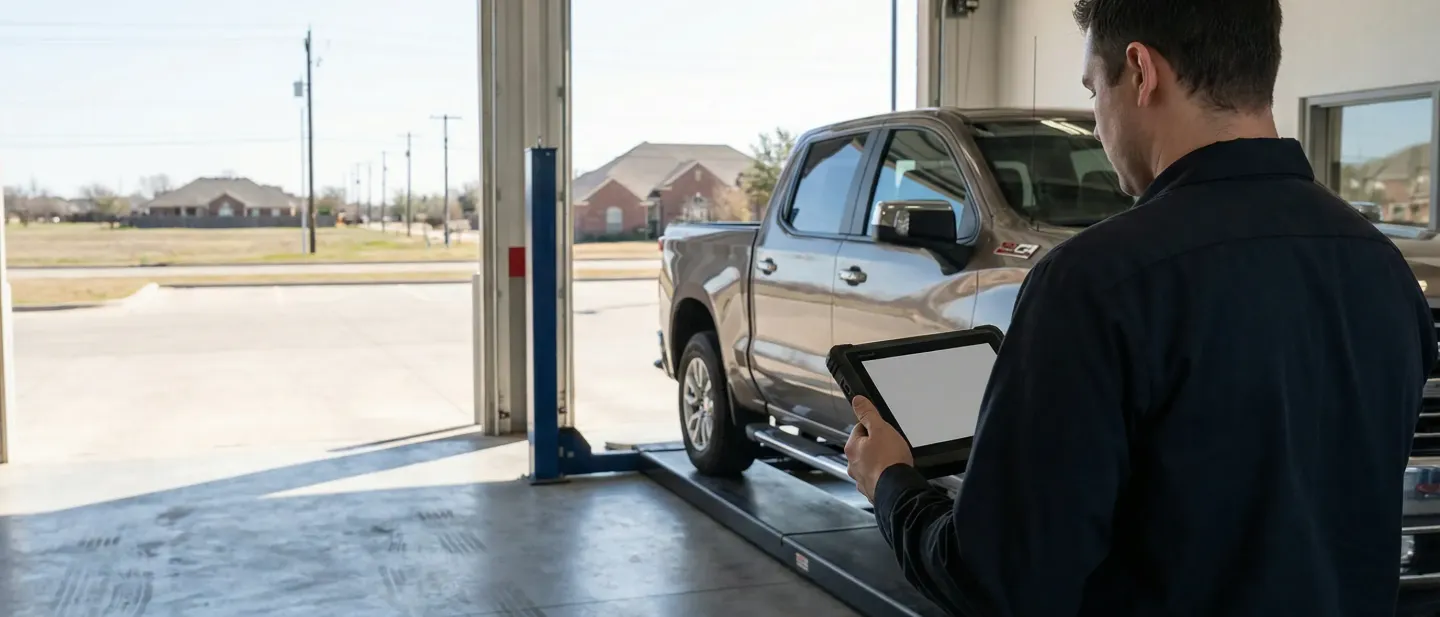
In Garland, TX, people search for automotive services about 4,370 times a month on Google; a top-of-page click costs $2.31–$8.41, and demand peaks in October.
Google Keyword Planner · Oct 2025 – Sep 2026
| Search | Monthly searches | Top-of-page CPC |
|---|---|---|
| tire shop | 1,000 | $1.43–$4.00 |
| mechanic near me | 590 | $2.23–$8.60 |
| auto repair near me | 480 | $3–$10 |
| auto repair | 390 | $2.50–$9.61 |
| oil change | 320 | $2.15–$5.23 |
| mechanic | 260 | $3–$14 |
| car ac repair | 210 | $1.70–$7.17 |
| car repair | 140 | $2.10–$5.00 |
| car battery replacement | 140 | $1.90–$9.01 |
| check engine light | 110 | $2.65–$6.60 |
US: $7.74
Google Keyword Planner · Oct 2025 – Sep 2026
Source: Google Keyword Planner (Google Ads), Google Search, English, Garland, TX, Oct 2025 – Sep 2026. Volumes are Google's monthly averages; CPC is the top-of-page bid range, weighted by search volume. How we collect these figures.
Garland's automotive repair market has the most favorable demand conditions of any service category in the city: 500,000+ registered vehicles in and around the Garland ZIPs, a 29.7-minute average commute driven almost entirely by private car, and a summer climate that destroys automotive systems with mechanical consistency every June through September. Yet independent auto shops in Garland consistently underperform in Google Ads — not because demand is insufficient, but because their campaigns are structured to fight the wrong battles against the wrong competitors.
The franchise problem is structural. Christian Brothers Automotive, Kwik Kar (multiple Garland locations), Firestone Complete Auto Care, Discount Tire, and Meineke Car Care Center all operate in Garland with corporate ad budgets, tested landing pages, and quality scores built over years of high-volume Google Ads spend. These operators dominate the broad-match "auto repair Garland TX" and "oil change near me Garland" keyword categories. An independent shop bidding into these same broad-match terms pays $2.50–$9.61/click to compete against franchises paying less per click (superior quality scores) and converting at 14–18% (tested multi-page websites with online booking). The independent shop converts at 8–10% and exits the auction as unprofitable — not because Google Ads doesn't work for auto repair, but because fighting franchise strength on franchise terms is the wrong strategy.
Oil change and tire keywords are the most searched auto service categories in Garland — and the worst ROI opportunity for independent shops. Kwik Kar owns oil change keywords in Garland with aggressive pricing campaigns ("oil change from $19.99"). Discount Tire dominates tire replacement keywords with a national brand budget. An independent shop paying $2.15–$5.23/click on "oil change Garland TX" to compete with chains that advertise sub-$20 pricing is spending real money on clicks to acquire a $25 transaction. The LTV reasoning ("they'll come back for bigger repairs") only applies if the shop has a CRM, a follow-up system, and a recall service program — most independent Garland shops do not.
The correct keyword strategy for independent Garland shops is the inverse: exclude oil change and tire categories from primary campaigns and dominate the repair specialties where franchises are weakest — transmission diagnostics, engine work, auto AC repair, and brake system repairs. These keywords still pay by the click, but they attract customers with $400–$2,500 repair needs rather than $25 oil change needs. The LTV differential between a new-customer transmission repair and a new-customer oil change is 20–40x over a 3-year relationship.
Auto AC repair is the single highest-urgency seasonal keyword category in Garland's automotive repair market. When outdoor temperatures exceed 100°F — which Garland experiences for 30+ consecutive days per year — a failed AC system is not a deferrable problem. It is an emergency. Search intent for "car AC repair Garland TX" and "auto AC recharge Garland" spikes dramatically beginning in mid-May and peaks in July. CPCs on these terms run $1.70–$7.17/click, but conversion rates hit 15–22% (pain-driven, immediate-need intent) — set against a $200–$700 average repair value. The shops that pre-stage summer AC campaigns in April rather than scrambling to launch them in June consistently win this window while late-movers compete at higher CPCs with lower quality scores.
Garland's auto repair demand is not the problem — it's the most reliable service-demand category in the city. The problem is campaign architecture that sends independent shops into franchise-dominated keyword auctions instead of the specialty repair markets where local expertise and faster service response create a genuine competitive advantage.
A high-performing Garland auto repair campaign runs on service specificity, seasonal urgency staging, and commercial fleet targeting — three lanes that national franchise campaigns are systematically unable to pursue with the local precision a Garland shop can apply.
Apply a 2.5–4 mile radius from the shop's physical location — Garland drivers with a breakdown or urgent repair need want the nearest competent option, not a 12-mile drive. Use location bid adjustments: +20% on the shop's own ZIPs, +10% on immediately adjacent ZIPs (Rowlett, Sachse), neutral on Mesquite and Richardson until conversion data justifies inclusion.
Ad scheduling: M–F 7am–6pm, Sat 7am–4pm at full bid. Reduce bids 70% outside business hours — after-hours auto repair searches don't convert to same-day appointments, and the CPC cost is wasted. Exception: emergency AC searches in summer can run limited evening hours when same-day parts and after-hours service are available.
Two overlooked demand drivers are reshaping the Garland automotive repair opportunity in 2025–2026. The first is Garland's industrial and manufacturing employer base — and the commercial fleet maintenance demand it generates. The second is the accelerating failure rate of aging vehicles in extreme heat conditions, creating an emergency repair pipeline that will grow, not stabilize, as Garland's vehicle age distribution rises.
Garland's manufacturing corridor along Garland Road, Forest Lane, and the industrial districts east of downtown Garland houses major employers including Kraft Foods, Epiroc, Arrow Electronics, and Valspar — all of whom operate commercial vehicle fleets for delivery, logistics, and facilities management. Fleet maintenance accounts generate $2,500–$8,000 per year per account in recurring service revenue. Unlike residential repair, fleet accounts are predictable, schedulable, and renew automatically when the relationship is maintained. National franchise chains (Firestone, Meineke) pursue consumer retail; B2B fleet targeting via Google Ads is structurally underserved for independent Garland shops with commercial vehicle capability.
A B2B auto repair campaign targeting "fleet vehicle maintenance Garland TX," "commercial truck repair east Dallas," and "fleet service contract Garland" generates lower lead volume than consumer campaigns — but fleet leads close at $3,000–$8,000 in annual contract value versus a one-time $500 consumer repair. The CPL tolerance for fleet leads is correspondingly higher ($150–$300 per qualified fleet lead is profitable math against a 12-month account value).
The median vehicle age in Garland's working-class and immigrant communities trends older than the DFW metro average — many households are running 2010–2016 model-year vehicles with 120,000–180,000 miles. These vehicles are in the failure-prone window for transmission, cooling system, and electrical components. Garland's extreme summer heat accelerates these failure timelines: battery performance degrades 30–50% above 95°F sustained temperature, AC compressors run at maximum load for 4–6 months straight, and radiator systems face thermal stress cycles daily.
The auto repair market in Garland is not becoming more competitive — it's becoming more segmented. The franchise chains will continue to dominate oil changes and tire sales. The independent shop that positions on specialty repair, emergency response, and commercial fleet — and runs bilingual campaigns for the 42.7% Hispanic driver population — is targeting the three highest-margin segments in the market simultaneously.
We don't build auto repair campaigns that try to outbid Firestone and Kwik Kar on oil change keywords. That is a budget-burning strategy with a known outcome. We build campaigns around the service types where independent shops have the structural advantage: specialty repair, emergency response, and fleet maintenance — categories where franchise chains either don't compete aggressively or can't match a local shop's response speed and diagnostic depth.
For Garland auto shops, our standard campaign architecture includes four separate ad groups (specialty repair, seasonal AC, commercial fleet, Spanish-language), 2.5-mile geo-targeting calibrated to the shop's actual profitable service draw distance, and a summer AC campaign pre-staged for April activation. We build negative keyword lists in the first week — oil change coupon terms, tire comparison terms, and franchise brand searches — so your budget never touches the categories where you can't compete profitably.
Management is a fixed monthly fee set by your ad spend, with the tracking set up first: see the plans and prices. We retain 98% of clients year-over-year — because when the summer AC season peaks and your phones are ringing, the relationship earns itself.
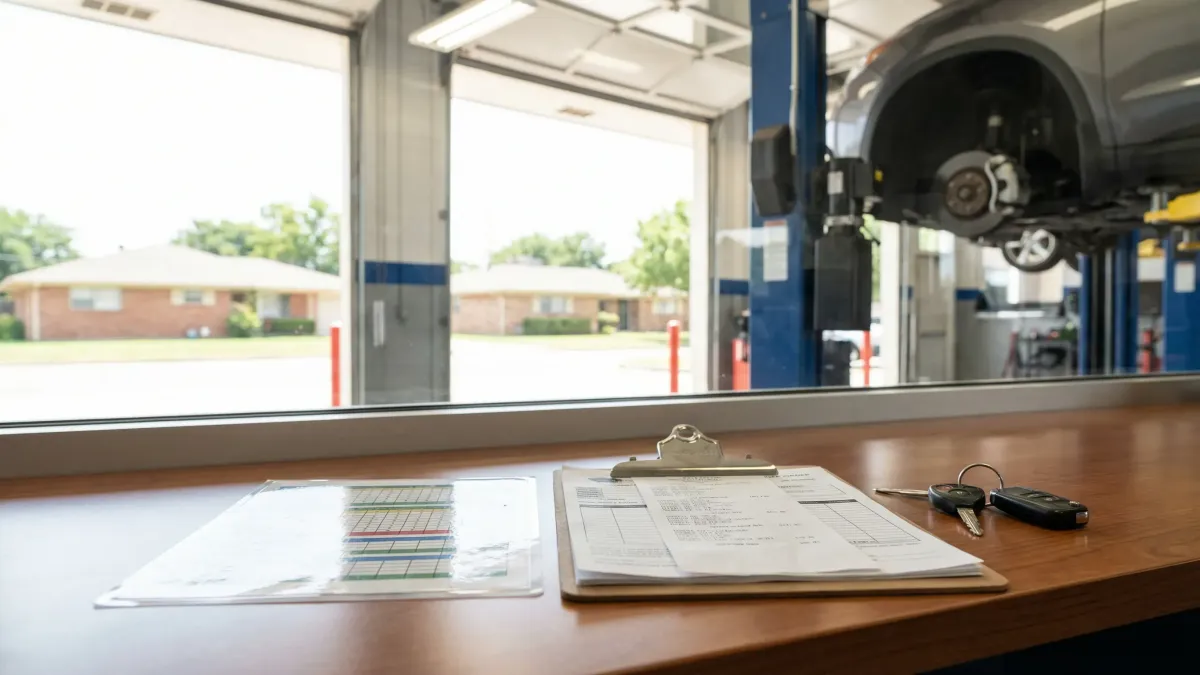
A Garland auto repair shop should budget a minimum of $1,500/month in ad spend to generate meaningful repair lead volume. At that level, with a 12% conversion rate on specialty repair terms, expect a steady flow of qualified repair inquiries each month. The critical variable is service mix: a campaign optimized for transmission and engine repair at $1,500/month generates higher-ticket leads ($400–$2,500 each) alongside general repair inquiries. A campaign diluted across oil change and tire terms at the same $1,500/month generates low-intent clicks with conversion rates of 5–7% and CPLs in the $40–$65 range — but the revenue per booked job is $25–$80, not $400–$2,500. The specialty repair architecture wins on ROI by an order of magnitude.
Summer AC campaigns justify a 30–50% temporary budget increase May through August: AC repair CPCs of $1.70–$7.17 with 15–22% conversion rates sit against repair values of $200–$700. The math at $2,000/month during AC season is judged against an average job value of $350 per booked AC job. No other automotive PPC category in Garland produces this ROI profile during the summer window.
For shops pursuing fleet accounts, expect $150–$300 CPL on commercial keywords — but a single fleet account at $4,000/year in recurring service covers 13–20 CPL events. Fleet campaigns run at steady budget year-round (fleet maintenance doesn't have a summer spike), and the pipeline fills in 60–90 days as B2B decision-makers move through their procurement cycle.
The highest-ROI keyword categories for an independent Garland auto shop are specialty repair (transmission, engine, brakes, suspension), seasonal emergency (auto AC repair and battery replacement in summer), and bilingual general repair (Spanish-language terms for Garland's Hispanic community). The specific high-performers: "transmission repair Garland TX" (8–12% CVR), "engine repair Garland TX" (7–10% CVR), "car AC repair Garland TX" ($1.70–$7.17 CPC, 15–22% CVR in summer), "brake repair Garland TX" (10–14% CVR), and "mecánico Garland TX" (minimal competition). Each of these outperforms "oil change Garland TX" ($2.15–$5.23 CPC, 5–7% CVR) once job value is factored in.
Match type discipline is essential: use exact match for high-CPC specialty terms to prevent budget bleed from adjacent searches. Phrase match on Spanish-language terms captures the full range of bilingual search variations without needing exhaustive exact-match keyword lists. broad match can work for general repair discovery terms once the campaign has 60+ days of data and a refined negative keyword list — before that, broad match on auto repair terms generates too much low-intent traffic to be budget-efficient.
Seasonal timing: load AC repair campaigns by April 15, not when the heat starts. Google's machine learning needs 2–4 weeks to optimize bidding on new campaigns — a campaign launched in June misses the first 2 weeks of peak demand with sub-optimal bids. Battery replacement keywords deserve their own October–November surge campaign (pre-winter battery failure peak); transmission and engine keywords are evergreen and should run year-round at consistent budget.
How to read this Cost per click and monthly searches are measured with Google Keyword Planner (see above). Cost per lead, conversion rate, budget and leads are estimates compiled from public benchmarks such as WordStream, not measurements.
Sources WordStream Automotive national avg $2.46 CPC; DFW premium 2–3.5x; Arlington Phase 3 ($5–$20 CPC, $45 CPL, 13% CVR) as primary DFW suburban comparable; Garland adjusted for higher franchise density
$590$990/month
1 platform · Google or MetaGoogle + Meta$790$1,290/month
1 platform · Google or MetaGoogle + Meta$1,140$1,940/month
1 platform · Google or MetaGoogle + MetaChatGPT Ads: a separate pilot, $250/month, added to a plan. See the pilot →

Matteo Braghetta founded MB Adv and runs its Google Ads accounts. He takes the first call with every new client, reads the accounts every week and writes the agency’s guides.
The other half of his job is measurement: GA4, Consent Mode and server-side tracking, so the platforms learn from real sales.
MB Adv is a Google Partner agency managing about $4.4M a year in ad spend for clients in the US, the UK and Europe.
Managed on numbers you can check.
Plans for the US