Construction PPC Washington, DC
Washington, DC's construction and remodeling market operates under conditions that make it uniquely profitable for the right contractor: a median home value of $737K+, some of the strictest historic preservation regulations in the US, and an aging housing stock where the average rowhouse is over 80 years old. Contractors who understand Capitol Hill brick, Georgetown limestone, and SHPO permit requirements don't compete for leads — they own them. <!-- stats-article-link --> <p><em>See how this city's Construction PPC costs compare nationally in our <a href="https://www.mbadv.agency/ppc-industry-statistics/construction-ppc-statistics">Construction PPC Statistics</a> report, featuring data from 40+ US cities.</em></p>
Construction PPC in DC is not a market where spending more wins. The regional contractors who dominate generic keywords — Bozzuto, Clark Construction, Grunley — run employer-brand and commercial project campaigns at budgets that dwarf what any residential remodeling SMB can match. An independent DC contractor bidding on "general contractor washington dc" at $18–$35 CPC is fighting for scraps behind competitors with $30K–$80K/month media budgets. Generic residential terms aren't much better: "kitchen remodel washington dc" at $16–$32 CPC, "home addition washington dc" at $20–$40 CPC, and "bathroom renovation dc" at $14–$28 CPC all draw heavy competition from lead aggregators (HomeAdvisor, Angi, Houzz) that buy these keywords specifically to sell leads back to contractors at $40–$100 per referral.
The Aggregator Problem
This is DC construction PPC's most insidious challenge. HomeAdvisor and Angi spend aggressively on DC construction keywords — not to provide construction services, but to capture contractor leads and resell them multiple times. A contractor who bids "kitchen remodel dc" alongside Angi is effectively competing against a business model that monetizes the same lead volume at 5–10x the scale. Angi sends the same lead to 3–5 contractors simultaneously. The resulting race-to-respond dynamic degrades close rates and trains consumers to expect multiple competing bids before committing.
The DC contractors who exit this cycle and build sustainable PPC performance do so by targeting keywords so specific that aggregators haven't bothered to bid on them. "Historic rowhouse renovation dc," "SHPO renovation contractor dc," "Capitol Hill brick restoration," and "rowhouse contractor washington dc" all have genuine, qualified search volume from DC homeowners who want a specialist — and no aggregator is farming them systematically, because they don't have a specialist to sell the lead to.
Historic Preservation Compliance as a Market Barrier
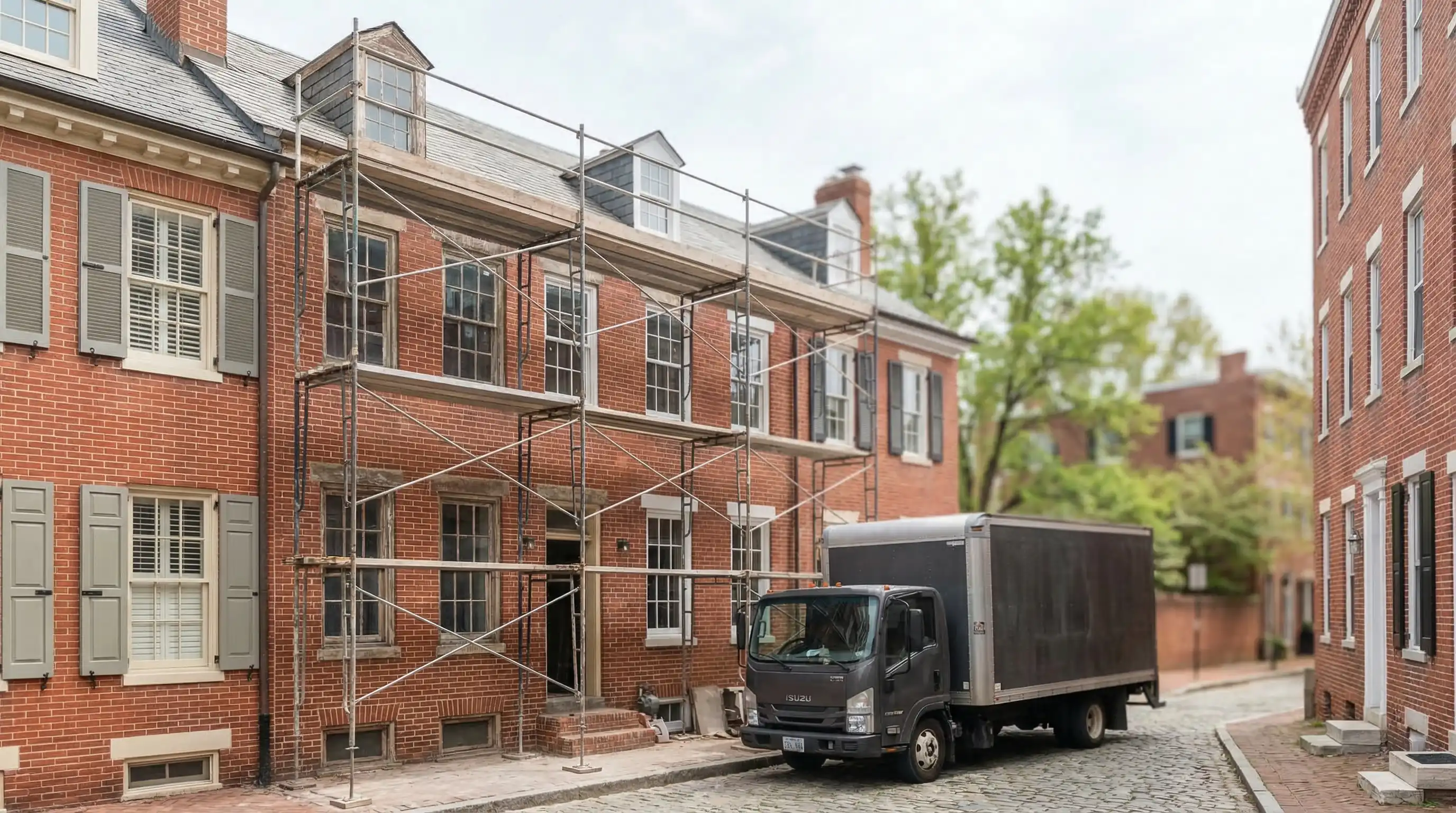
DC's historic preservation infrastructure is one of the most extensive in the US. The DC Historic Preservation Office (SHPO) governs exterior modifications in designated historic districts including Capitol Hill, Georgetown, Dupont Circle, Logan Circle, LeDroit Park, Shaw, and Columbia Heights — covering collectively thousands of residential properties. Exterior projects in these districts require SHPO review and often Certificate of Appropriateness approval before permits are issued. Projects can be delayed 4–8 weeks by SHPO review processes if the contractor doesn't understand the submission requirements.
Most DC homeowners attempting their first historic district renovation discover this compliance reality only when their permit gets flagged — after they've already hired a contractor. Contractors who educate homeowners about SHPO requirements in their ads and landing pages before the consultation begin the relationship with a trust advantage that general contractors can't match. The historic preservation expertise signal is both a competitive differentiator and a lead quality filter: homeowners who respond to "SHPO-compliant historic renovation" ads are self-qualifying as the type of project worth taking.
DC construction PPC performs best when campaigns target the city's unique property characteristics — not generic renovation keywords that could apply to any market. Three campaign tracks consistently deliver qualified leads at economically viable CPLs for DC residential and commercial contractors.
Historic Rowhouse Specialist Track
- Rowhouse-specific keywords: "historic rowhouse renovation washington dc" — $15–$30 CPC; "historic home renovation dc" — $14–$28 CPC; "rowhouse renovation contractor dc" — $10–$20 CPC; "SHPO renovation contractor dc" — $12–$25 CPC; "Capitol Hill rowhouse contractor" — $9–$18 CPC
- Landing page requirement: Before/after photos of completed DC rowhouse projects specifically — not suburban renovations. Show completed projects in Capitol Hill, Georgetown, or Dupont Circle by name. Include a line referencing SHPO compliance experience. This landing page converts SHPO-anxious homeowners at 2–3x the rate of a generic contractor landing page
- Neighborhood targeting: 20002 (Capitol Hill), 20007 (Georgetown), 20036 (Dupont Circle), 20009 (Adams Morgan/Columbia Heights) — zip codes with high historic district density and above-average home values
High-Value Residential Renovation Track
- Project-type keywords: "kitchen remodel washington dc" — $16–$32 CPC; "home addition dc" — $20–$40 CPC; "whole home renovation washington dc" — $18–$35 CPC; "rooftop deck addition dc" — $12–$25 CPC
- Investment framing: DC kitchen remodels run $45K–$150K; whole-home renovations $200K–$600K. Ad copy that references these ranges (not in a bragging way — in a "we handle DC-scale projects" framing) filters out price-sensitive searchers and attracts homeowners with the budget to hire properly
- Qualification signal: Add "free architectural consultation" or "no-obligation design assessment" rather than generic "free estimate." The consultation framing attracts $75K+ project leads; "free estimate" attracts price-shopping leads who want 5 bids for a $8,000 job
Commercial Tenant Improvement and Office Conversion Track
- Commercial keywords: "commercial tenant improvement dc" — $10–$22 CPC; "office renovation washington dc" — $12–$24 CPC; "office to residential conversion dc" — $10–$20 CPC; "embassy renovation contractor dc" — $8–$16 CPC
- Market size: DC's office vacancy rate exceeded 20% post-pandemic. The city's Push-to-Convert program incentivizes office-to-residential conversions. B2B commercial TI projects run $150K–$2M+ — one job can justify months of PPC spend
- DC Green Bank financing angle: "Qualify for DC Green Bank 0% financing on energy-efficient renovations." This hook attracts building owners considering retrofit projects who haven't started their search — creates pipeline before they start competitively bidding
Google Partner Agency
We're a certified Google Partner Agency, which means we don’t guess — we optimize withGoogle’s full toolkit and insider support.
Your campaigns get pro-level execution, backed by real expertise (not theory).

Three structural characteristics of DC's construction market create PPC opportunities that most contractors completely ignore — and each one is directly accessible through the right keyword and landing page combination.
Rooftop Deck Demand on Capitol Hill Rowhouses
Capitol Hill's Federal-style brick rowhouses are among the densest urban residential stock in the eastern US. With lot sizes typically 16–20 feet wide and backyards barely large enough for a patio table, outdoor living space is premium. The solution DC homeowners increasingly pursue: rooftop deck additions. A Capitol Hill rooftop deck runs $40,000–$90,000 fully permitted and built — and requires SHPO review, structural engineering for the original 1890–1920 construction, and a contractor who has done it before. The keyword "rooftop deck addition dc" runs at $12–$25 CPC with minimal competition because most PPC campaigns don't think at this level of specificity. But the project type is real, the demand is growing, and the homeowners who search it are already committed to the project — they're searching for the right contractor, not evaluating whether to do it.
Key insight: DC's historic rowhouse geography creates a construction demand portfolio unlike any other US city. Mini-split AC installation for ductless rowhouses, rooftop deck additions on Capitol Hill, basement finishing for English basement units (often converted to rental ADUs), and historic window replacement in SHPO districts are all specialized services with dedicated search volume and near-zero PPC competition from specialists.
English Basement ADU Conversions
Washington, DC's zoning code has allowed accessory dwelling unit (ADU) conversions since 2016. DC rowhouses with English basements — the below-grade front-entry basement units common throughout Capitol Hill and Columbia Heights — are prime ADU conversion candidates. A properly permitted English basement ADU in a $900K+ rowhouse generates $1,800–$2,800/month in rental income, making the $60,000–$100,000 conversion cost financially rational. Contractors who run "DC rowhouse basement apartment conversion" or "english basement ADU dc" campaigns capture motivated, financially committed homeowners at $8–$18 CPC. No aggregator is farming this keyword cluster. The contractor who owns it earns qualified leads from homeowners who've already done the financial math.
The Pre-Sale Renovation Segment
DC's $737K+ median home value creates a highly active pre-sale renovation market. Real estate agents regularly refer sellers to contractors for "listing prep" renovations — kitchen face-lifts ($15K–$40K), bathroom refreshes ($10K–$25K), hardwood floor refinishing, and fresh paint throughout — projects designed to improve sell price by $30K–$80K. Campaigns targeting "pre-sale renovation washington dc" or "home staging renovation dc contractor" capture this segment at $10–$22 CPC. The real estate agent referral network is a compounding return: one agent who has a great experience with a contractor refers 4–8 sellers per year, building an off-PPC lead pipeline alongside the paid campaign.
Construction PPC in DC rewards contractors who know the city's property stock — not just its search volume. The rowhouse architecture, the historic preservation requirements, the ADU zoning opportunity, and the high-value renovation economics all require campaigns built around DC specifics rather than generic home improvement templates.
At MB Adv Agency, we start construction PPC engagements with a competitive positioning audit: which project types does your crew execute best, and where is the intersection between your expertise and DC's underserved search volume? A contractor with three completed Capitol Hill SHPO projects and a rooftop deck portfolio owns a PPC positioning that no generalist can replicate — and no aggregator lead can undercut, because the homeowner came directly to you on the basis of specific expertise.
We also build landing pages that do the trust work before the consultation. For DC's high-value renovation market, the landing page is where the sale begins — before a single call or site visit. Before/after portfolios of completed DC projects, references to specific neighborhoods and project types, and SHPO compliance reassurance turn PPC traffic into consultation-ready leads rather than price-comparison inquiries.
If you're a DC contractor ready to stop competing on generic terms and start owning the niches where your expertise is irreplaceable, see our pricing options or learn about our Washington DC PPC services.
Frequently Asked Questions
What's the realistic cost-per-lead for construction PPC in Washington, DC?
CPL for DC construction PPC varies widely by project type and keyword specificity. For generic residential remodeling terms ("kitchen remodel dc," "home addition washington dc"), expect $350–$700 CPL after accounting for competition from aggregators, DSO-scale GCs, and HomeAdvisor. At those rates, the campaign only makes economic sense if your average project value exceeds $50,000 — which it does for most DC kitchen and bath remodels, but the path to profitability requires patient 60–90 day optimization cycles.
For historic rowhouse and SHPO-specific keywords — "historic home renovation dc," "rowhouse renovation contractor dc," "Capitol Hill brick restoration" — CPL typically runs $200–$450, reflecting lower competition and higher intent. These searchers have a specific problem (SHPO compliance, rowhouse structural constraints) and are looking for a specialist, not the lowest bid. Close rates on historic rowhouse leads typically run 25–40% from PPC — above the 15–25% industry average for generic remodeling leads.
For ADU and English basement conversion campaigns, expect $180–$380 CPL. These leads are motivated — they've done the rental income math before searching — and they convert to booked projects at above-average rates. A $60,000–$100,000 ADU project at $250 CPL is a 0.4% customer acquisition cost. That's excellent economics by any measure.
How should a DC contractor structure their PPC budget seasonally?
DC construction PPC has three distinct seasonal patterns that should drive budget allocation. Spring (March–May) is the highest-conversion season: DC homeowners make renovation decisions in spring, want work completed before summer heat, and contractors are booking Q3 projects. Budget should be at peak during these months — 130–150% of your annual monthly average. This is when a contractor who has been running a low-level winter "brand awareness" campaign harvests the decision-making moment that winter built.
Summer (June–August) is active construction season but a slower PPC inquiry period — DC homeowners are on vacation, congressional schedules slow down, and the summer heat discourages renovation planning conversations. Budget can be reduced to 70–80% of average. Shift to commercial TI and ADU campaigns in summer — these have less residential seasonality and commercial clients plan Q4 projects during summer.
Fall (September–November) rebounds strongly: homeowners returning from summer, pre-winter exterior project urgency (roofing, windows, exterior restoration before cold), and pre-holiday interior project planning all drive inquiry volume. Run at 120–140% of average monthly budget. Winter (December–February): maintain a reduced always-on campaign at 60–70% of average to capture the planning-phase searchers who will convert in spring. Never go dark — the winter research cycle feeds the spring booking season, and contractors who disappear from search in January lose the awareness battle for March buyers.