Moving & Storage PPC Washington, DC
Washington, DC is arguably the most structurally relocation-driven city in the United States: presidential transitions rotate 4,000–6,000 high-income households every four years, military PCS orders move 2,000–4,000 families annually from bases in the metro area, and government contractor rotation cycles keep a steady stream of professional relocations flowing in and out of the city every month. No other US city has this combination of institutional, predictable relocation demand — and the moving companies that understand how to market to each segment dominate the DC PPC landscape. <!-- stats-article-link --> <p><em>See how this city's Moving & Storage PPC costs compare nationally in our <a href="https://www.mbadv.agency/ppc-industry-statistics/moving-storage-ppc-statistics">Moving & Storage PPC Statistics</a> report, featuring data from 40+ US cities.</em></p>

Washington, DC's moving company PPC market carries some of the highest cost-per-click rates in the home services category. Local moving terms — "movers washington dc," "moving company dc" — run $22–$40 CPC. Long-distance moving terms reach $28–$60 CPC. These rates are driven by the combination of DC's affluent customer base (average move value of $3,000–$8,000 for local, $5,000–$15,000+ for long-distance), and sustained competition from national brands and well-funded regional operators.
The National Brand Competition Problem
Washington's moving market is aggressively contested by national franchise operators — Two Men and a Truck, College Hunks Hauling Junk, Mayflower, United Van Lines, and PODS — alongside strong regional competitors including Capital City Movers, Presidential Moving Services, and Suburban Solutions. These players run always-on campaigns with monthly budgets of $10,000–$40,000. They dominate generic broad-match terms and maintain high Quality Scores built on years of campaign history and brand recognition.
An SMB moving company attempting to win on "movers washington dc" against this field is competing at CPC rates that require $3,500+ per month just for meaningful volume — and even at that spend, the Quality Score disadvantage against established national advertisers inflates effective CPC by 15–25%. The moving companies achieving strong ROI in DC paid search have shifted strategy: instead of competing for generic mover terms against national brands, they've built campaigns around the specific DC demand segments where national brands have no competitive advantage.
DC's Structural Demand Complexity
What makes Washington's moving market genuinely different from any other US city is the multi-layer institutional demand structure underlying residential and commercial moves:
- Presidential transition moves: The January 2025 inauguration created the largest single-quarter residential relocation surge in DC metro history. 4,000–6,000 political appointees and senior staff rotating in and out generated demand across the full spectrum — packing, local moves within DC, long-distance moves from DC to home states, and storage for those in temporary furnished housing. The next transition (January 2029) is already on the calendar. Moving companies that aren't planning transition-period campaigns are leaving the most predictable high-volume demand spike in their market unaddressed.
- Military PCS moves: Fort Belvoir (35,000+ personnel), Joint Base Anacostia-Bolling, Marine Barracks (Capitol Hill), and Pentagon staff in Arlington generate 2,000–4,000 PCS orders per year in the metro area. Military movers require specific expertise: government rate schedules (GTC billing), PPM/DITY move calculations, and coordination with Transportation Management Offices (TMOs). Moving companies with documented military move expertise capture this segment almost exclusively — it's a qualification-barrier market.
- Government contractor rotation: Northern Virginia's GovCon hub (Tysons Corner, McLean, Reston, Bethesda) rotates tens of thousands of consultants on 1–3 year project cycles. These are professional-income households (avg $120K–$200K) making semi-predictable moves that generate $3,000–$8,000 average move values.
Each of these segments requires a different keyword strategy, different ad copy, and a different landing page. A single "movers dc" campaign cannot serve all three simultaneously — and the companies trying to do so with generic campaigns are the ones paying $35 CPC and converting at 3%. The companies who've segmented by demand type are paying $10–$20 CPC in their niche segments and converting at 5–8%.
The highest-ROI moving company PPC strategy in Washington, DC is demand segment isolation — building separate campaigns for each of DC's distinct relocation driver segments, with keyword sets and landing pages specific to each. This approach allows $3,000–$5,000/month budgets to outperform competitors spending twice as much on generic terms.
Segment-Isolated Campaign Structure
Each DC moving demand segment has its own keyword set, seasonality, and customer profile:
- Military/government mover keywords: "military movers washington dc," "DITY move dc," "PCS movers fort belvoir," "government rate movers dc" — CPC range $8–$20. These searchers have specific needs (military certification, government billing knowledge) that generic movers can't meet. Landing page must explicitly address military move types, TMO coordination, and government billing.
- Presidential transition keywords: "movers for presidential transition dc," "moving company dc inauguration," "political relocation movers washington" — CPC range $5–$15 outside peak windows; spike in competition October–March of election/transition years. Campaign should activate in October of presidential election years and run through March of inauguration year.
- Long-distance/out-migration keywords: "moving from dc to [city]" — Texas, Florida, North Carolina, Virginia are top DC out-migration destinations. "Moving from dc to austin," "moving from dc to miami" — CPC range $20–$45, but job values of $4,500–$12,000 make the CPL economics work.
- Local moving/rowhouse keywords: "local movers washington dc," "movers capitol hill dc," "rowhouse movers dc" — CPC range $18–$35. Landing page should explicitly address DC rowhouse constraints: narrow staircases, no elevators, parking restrictions in historic districts, HOA coordination.
- Storage keywords: "storage units washington dc," "moving storage dc" — CPC range $8–$20. Lower CPCs, longer conversion path, higher LTV ($150–$400/month × 12–36 months).
Seasonality Budget Allocation
DC moving demand is highly seasonal, and budget allocation should reflect it. The moving companies running flat monthly budgets are consistently under-bidding during the highest-demand windows:
- January (inauguration years): Surge period — increase budget 60–100%. Transition movers command premium pricing and still close jobs. This window occurs every four years and represents the single highest-density demand event in DC moving history.
- May–August: Peak residential moving season (school year transitions, university graduation, federal fiscal year end). Increase budget 40–60% above baseline.
- September–October: Federal fiscal year turnover, fall semester start, GovCon project cycle transitions. Maintain elevated budgets.
- November–December: Lower residential volume but political staff turnover (election results → transition planning). Pre-transition campaigns activate in October of election years.
Dynamic budget allocation across these windows — without increasing total annual spend — consistently reduces annual CPL by 15–25% compared to flat-budget approaches. The key is having each segment's campaign pre-built and ready to activate rather than scrambling to launch when the demand window opens.
Google Partner Agency
We're a certified Google Partner Agency, which means we don’t guess — we optimize withGoogle’s full toolkit and insider support.
Your campaigns get pro-level execution, backed by real expertise (not theory).

The most durable competitive insight in DC moving company PPC is also the most overlooked: DC's architectural reality creates a genuine expertise barrier that national brands cannot overcome with budget alone.
The Rowhouse Advantage
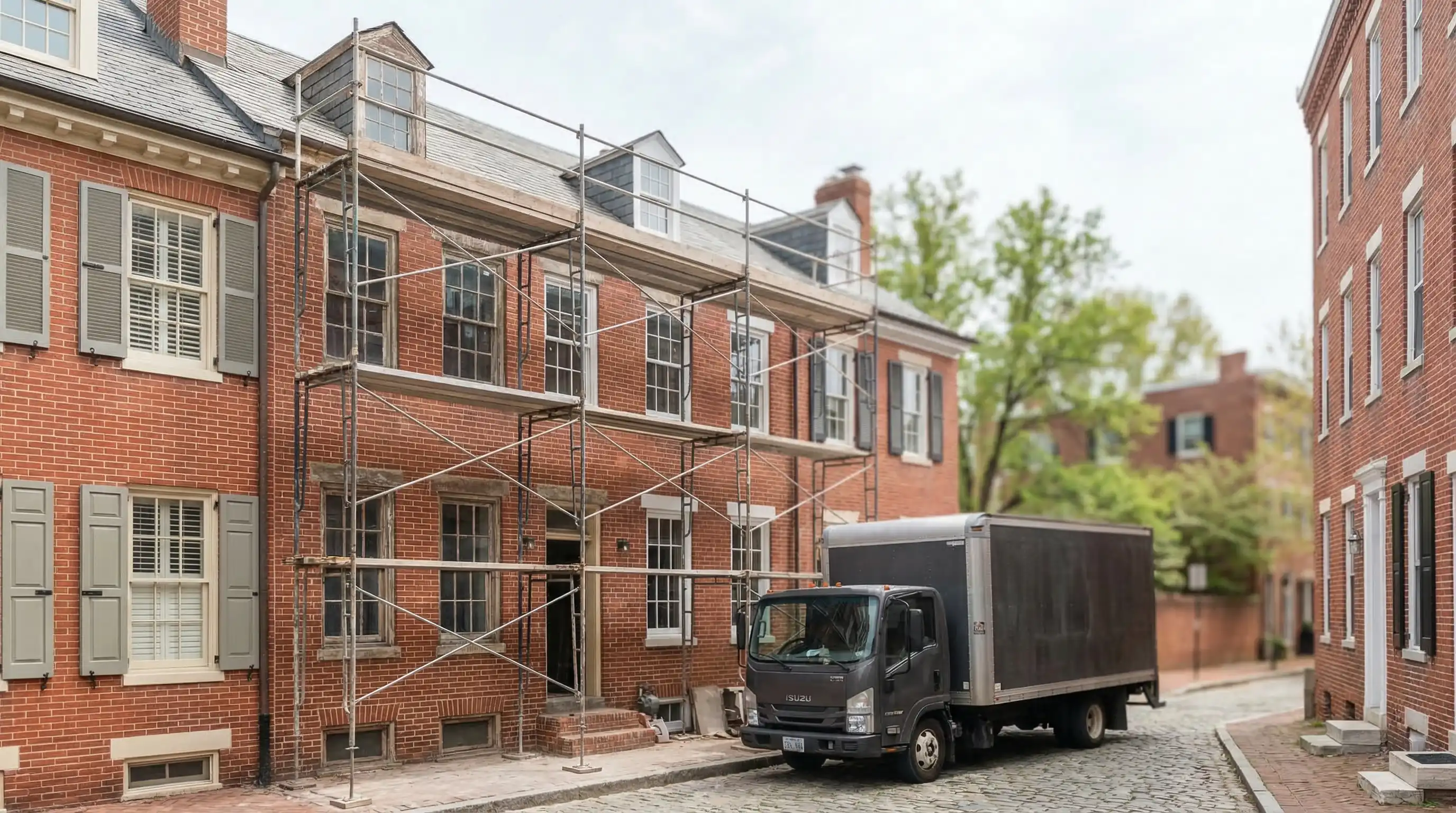
Washington, DC's iconic Federal and Victorian rowhouses present logistical challenges that suburban and Sun Belt movers have never encountered. Capitol Hill's cobblestone streets have strict parking regulations for commercial vehicles — permit requirements, weight limits, and time-of-day restrictions that a moving company unfamiliar with the district can have a truck towed on move day. Dupont Circle and Georgetown's narrow brick rowhouses have staircases with 30–36 inch clearance, original hardwood floors that scratch at the wrong angle, and shared party walls where impact damage can become a neighbor dispute. Many Adams Morgan and Columbia Heights apartment buildings have no service elevators — and no loading docks.
Moving companies that document DC-specific expertise in their ad copy and landing pages — "We've navigated 500+ Capitol Hill rowhouses. We know the parking permits, the staircase clearances, and the HOA rules." — convert at 2–3x the rate of generic "experienced movers" messaging. The specificity builds trust, disqualifies wrong-fit customers (suburban homes in Maryland, not rowhouse DC), and pre-qualifies the ideal customer before the first phone call.
Key insight: DC rowhouse moves take 15–30% longer than a comparable square footage suburban home move due to the access constraints. Moving companies that transparently quote this in their pricing — "We price DC rowhouse moves accurately, so there are no surprises on move day" — reduce post-move disputes and generate better reviews. That Google review base, when referenced in ad copy ("4.9 stars, 300+ DC rowhouse moves"), drives a measurable conversion rate increase.
Storage Demand: The Political Dwell Market
One of DC's most consistent storage demand drivers is invisible in standard market analysis: political appointees and senior government staff who arrive in DC and use temporary furnished housing (short-term corporate apartments or extended-stay hotels) while they search for permanent housing. These residents arrive with household goods they can't store at a furnished apartment — furniture, artwork, personal effects, vehicles — and need climate-controlled storage for 3–6 months while they search for a permanent home in DC's tight inventory market.
This "transition dwell" storage segment represents a high-LTV customer: $200–$400/month for 4–6 months = $800–$2,400 per customer, with a natural conversion pathway to the same moving company for the subsequent home delivery once permanent housing is secured. Storage campaigns targeting "temporary storage dc political staff" or "furnished housing storage washington dc" run at very low CPCs with almost no competition — and capture a customer who needs both storage today and a full move in 3–6 months.
Moving company PPC in Washington, DC is simultaneously one of the most competitive and most differentiated PPC markets in the home services category. The competition for generic terms is fierce — but the niche segments (military, transition, rowhouse, long-distance out-migration, storage dwell) are accessible, high-converting, and underserved by most moving company campaigns.
MB Adv Agency builds DC moving company PPC around segment isolation, seasonality-aware budget allocation, and the kind of DC-specific ad copy that turns a competitive CPC into a below-market CPL. We understand that "movers washington dc" at $35 CPC is not the same as "military movers fort belvoir dc" at $12 CPC — and that the military mover search converts at 6–8% while the generic term converts at 2–3%. Every dollar in a DC moving PPC campaign should be working against the terms where your specific expertise is a competitive moat, not a coin flip.
If you're a DC moving company running campaigns on generic terms and paying $30–$40 per click without seeing the lead volume to justify it, the answer is almost always structural — wrong keyword set, wrong match types, wrong landing page. All of these are fixable. See our PPC pricing or learn about our Washington DC services to understand what a restructured campaign looks like.

Frequently Asked Questions
What keywords should a Washington DC moving company target in Google Ads?
The most profitable DC moving company keyword strategy is a tiered approach that starts with the lowest-competition, highest-conversion niche terms and builds toward broader terms only after the niche campaigns are performing.
Tier 1 — Niche/near-zero competition (start here): Military mover terms ("military movers dc," "PCS movers dc," "DITY move washington dc") at $8–$20 CPC; storage terms ("storage units washington dc," "moving and storage dc") at $8–$20 CPC; rowhouse-specific terms ("capitol hill movers," "rowhouse movers dc") at $12–$22 CPC. These convert at 5–8% against motivated, qualified customers.
Tier 2 — Segment-specific high-intent (add after Tier 1 is profitable): Long-distance out-migration terms ("moving from dc to austin/miami/raleigh") at $20–$45 CPC but high job values ($5K–$12K); local service terms ("local movers washington dc," "movers dupont circle") at $18–$35 CPC. These require higher budgets but scale volume.
Tier 3 — Generic competitive terms (only if budget allows): "Movers washington dc," "moving company dc" — $22–$40 CPC, high volume, highest competition. Only viable with $4,000+ monthly budget dedicated to these terms and strong Quality Scores built from Tier 1 and 2 campaign history.
Negative keyword discipline matters at every tier. At $25–$40 CPC, clicks from "free movers dc," "moving trucks rental dc," "moving boxes washington dc," or competitor brand names are expensive non-conversions. A thorough negative keyword list — built before the first dollar of spend — is the single highest-ROI structural decision in any DC moving company campaign.
How does the presidential transition affect DC moving company PPC?
The presidential transition is the single largest predictable demand event in Washington DC's moving market — and most moving companies don't have a campaign plan for it. Every four years, 4,000–6,000 political appointees, senior agency staff, and political party operatives simultaneously move into and out of Washington in a 90-day window. Many are high-income ($100K–$300K+/year), are time-compressed (inauguration Day is January 20th regardless of how long it takes to find housing), and are making moves they've never made before to a city they may have never lived in.
The transition creates two distinct move types: in-migration movers (arriving appointees moving from their home state to DC — long-distance with high job values of $5K–$15K) and out-migration movers (departing administration staff moving from DC to home states, other cities, or taking positions elsewhere — same high job values). The political transition also drives the storage dwell segment described above — appointees who arrive before finding permanent housing need 3–6 months of interim storage.
The strategic campaign activation window is October of presidential election years through March of inauguration year. Target keywords like "presidential transition movers washington dc," "moving to dc for new administration," "dc to [home state] movers." These terms run at very low CPCs outside the window ($5–$12) and see modest competition increases during the window — most national moving brands aren't running transition-specific campaigns, creating a genuine competitive gap for a local DC operator. The next transition window is January 2029, making the campaign pre-build timeline October 2028.