Roofing PPC Baton Rouge, LA
Baton Rouge sits in the Gulf storm track, averages 60+ inches of rain per year, and has lived through the 2016 historic floods that caused $10 billion in damage to the metro area. For roofing companies, this isn't a market with occasional storm events — it's a market where storm preparation and response is the competitive differentiator, and where the companies that win Google Ads do so because they're ready before the storm hits, not scrambling after it. <!-- stats-article-link --> <p><em>See how this city's Roofing PPC costs compare nationally in our <a href="/resources/roofing-ppc-statistics">Roofing PPC Statistics</a> report, featuring data from 40+ US cities.</em></p>
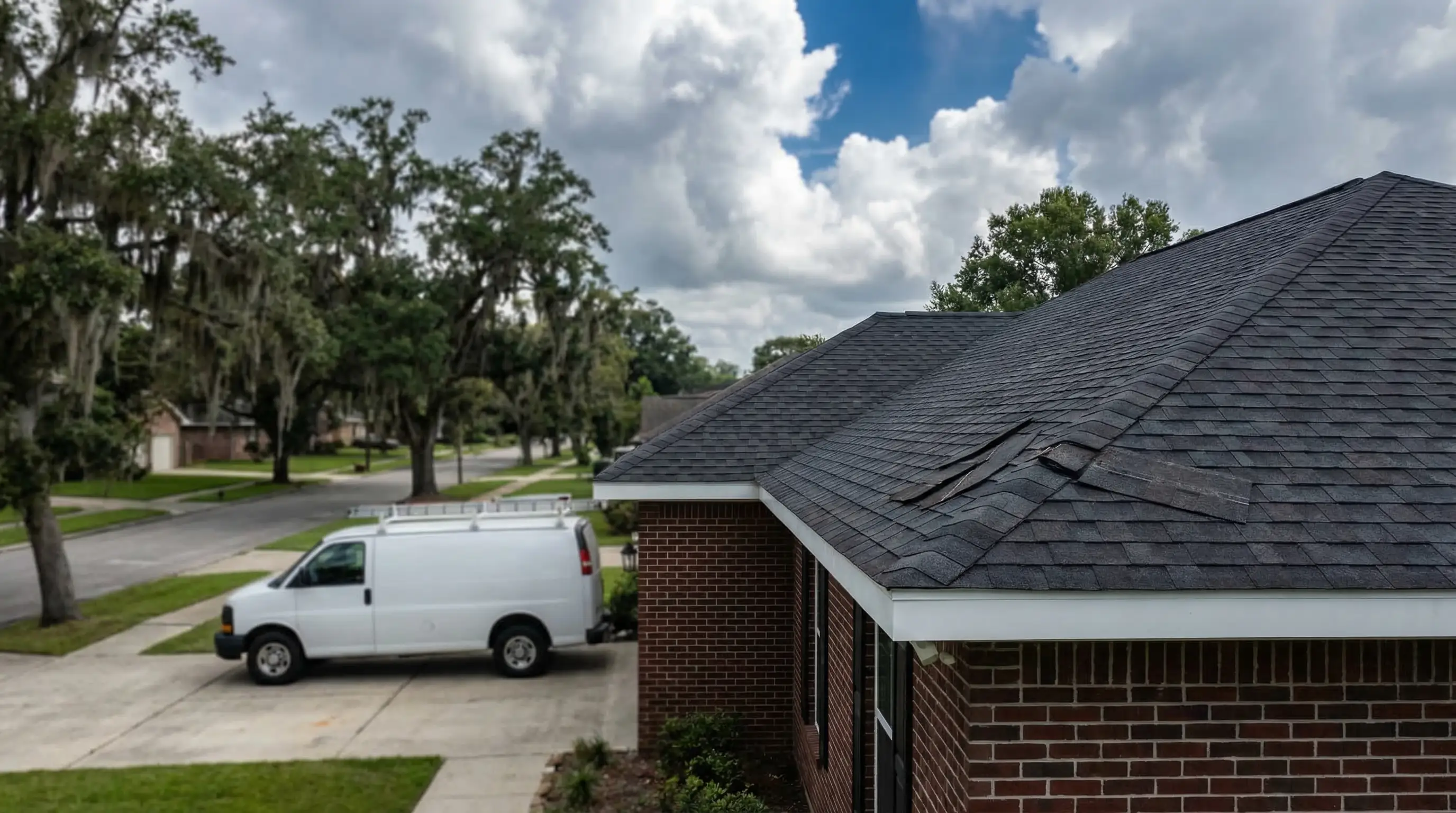
The roofing market in Baton Rouge is simultaneously one of the most demand-rich and most strategically challenging in any Gulf South city. The demand side is unambiguous: 99 providers reviewed on Expertise.com, 2,861 BBB-listed results, year-round rainfall, hurricane season spanning six months, and a housing stock that needs constant maintenance. The challenge side is equally real — and for HVAC SMBs that haven't competed in a storm-prone market before, it presents problems that straightforward PPC playbooks don't solve.
Out-of-State Storm Chasers
The defining competitive challenge in Baton Rouge roofing is the post-storm influx of out-of-state contractors. Within 48–72 hours of any significant tropical event, roofing companies from Texas, Mississippi, Georgia, and Florida arrive in Baton Rouge, spin up Google Ads campaigns targeting storm damage keywords, and compete directly for the most valuable leads in the market. They have no local reputation, no Louisiana contractor license verification visible to the consumer, and no accountability after the job — but they have the same ability to bid on Google as a company that's been in Baton Rouge for 35 years.
Red Stick Roofing (since 1983) and Garcia Roofing and Sheet Metal (since 1992) built their reputations over decades of Baton Rouge storm seasons. But in the Google Ads auction, a company that spun up last Tuesday bids alongside them. The storm window — where search volume spikes 15–30x in 48–72 hours — is where local companies either defend their market position or cede it to out-of-state competitors with nothing to lose.
The defense isn't reactive — it's structural. Local roofing companies that have pre-built storm response campaigns, with pre-written ad copy emphasizing Louisiana licensing, local references, and years in market, can activate within hours of an NHC advisory. A company that waits for the storm to pass and then builds a campaign from scratch has already missed the first and most valuable wave of post-storm searches.
Insurance Claim Complexity and Conversion
A second major challenge: most Baton Rouge roofing customers with storm damage are navigating insurance claims, not paying out of pocket. This changes the conversion dynamic fundamentally. A homeowner searching "roof repair Baton Rouge" and paying cash needs: price, availability, trust. A homeowner searching "insurance claim roof replacement Baton Rouge" needs: expertise in working with adjusters, understanding of the claims process, and confidence that the contractor won't disappear after the insurance check clears.
Insurance claim landing pages that explain the claims process — what the adjuster will look for, how supplements work, what the homeowner's rights are — convert at significantly higher rates than generic "call us for a free estimate" pages. Yet most roofing companies, including some well-established Baton Rouge firms, send insurance-intent traffic to the same homepage as their general roofing pages. That's a conversion opportunity left open.
CPCs reflect the premium: insurance claim keywords run $35–$80/click at baseline, rising to $65–$110+ during active storm periods. At those prices, a landing page that converts at 8% vs. 4% isn't a nice improvement — it's the difference between a profitable campaign and a budget drain.
The year-round baseline demand creates a third challenge: cash flow management across the storm cycle. Baton Rouge's wet season (May–November) drives the highest PPC volumes, but the real money is in post-storm replacement jobs at $7,000–$30,000 per project. Companies that deplete their Google Ads budget maintaining baseline awareness in low-storm months may not have the budget to surge when a storm event creates 10–20x the normal lead opportunity. Budget allocation across the seasonal cycle requires deliberate planning — not reactive spend increases that happen too late.
Roofing PPC strategy in Baton Rouge requires a framework that handles three distinct market states: normal operations (year-round baseline), active storm season (June–November elevated), and post-storm surge (48–168 hours following significant weather events). Each state has different budget requirements, keyword priorities, and messaging needs.
Three-State Campaign Architecture
- Baseline campaigns (year-round): "roofing company Baton Rouge LA," "roof repair Baton Rouge," "roofer near me Baton Rouge," "roof inspection Baton Rouge" — CPC range $22–$45; volume is steady; build brand recognition and capture maintenance/leak repair demand
- Storm season campaigns (June–November): "hurricane damage roof repair Baton Rouge," "storm damage roofer Baton Rouge," "wind damage roof replacement" — CPC range $35–$80; increase budget by 30–50%; activate insurance claim messaging
- Post-storm surge campaigns (activate within hours of event): "emergency roof repair Baton Rouge," "roof leak after storm Baton Rouge," "wind damage roof Baton Rouge" — CPC range $65–$110; maximum budget; require dedicated insurance claim landing pages; time-limited (72–168 hours of peak volume)
The post-storm surge campaign is the most valuable asset in a Baton Rouge roofer's PPC toolkit. It should be built in advance — campaign structure, ad copy, landing page, budget ceiling, geographic targeting all prepared — and held ready to activate via a single setting change. When an NHC advisory places Baton Rouge in a watch or warning zone, or when a significant storm system passes through, the campaign goes live immediately. This requires zero reactive creative work during the storm window — just activation.
Keyword Strategy by Intent
- Replacement intent: "roof replacement Baton Rouge," "new roof cost Baton Rouge," "re-roofing Baton Rouge" — $30–$60/click; highest LTV; require financing and materials information
- Insurance intent: "insurance claim roofing Baton Rouge," "file roof insurance claim Louisiana," "roofing company works with insurance" — $35–$80/click; highest per-project value; require adjuster-expertise messaging
- Maintenance and repair: "roof leak repair Baton Rouge," "roof patch Baton Rouge," "flat roof repair Baton Rouge" — $15–$30/click; lower LTV but steady volume; often lead to replacement discovery
- Storm-specific: "hurricane roof damage Baton Rouge," "storm damage roofer Louisiana" — $50–$95/click; seasonal but premium CPC reflects premium LTV
Ad copy for Baton Rouge roofing must address the storm chaser problem directly. "Locally Owned Since 1983 — Louisiana Licensed" in the headline outperforms generic "Top-Rated Baton Rouge Roofer" because it immediately differentiates from out-of-state operators who can't credibly make that claim. Years of service, local licensure, and named insurance carrier relationships (Allstate, State Farm, USAA) all serve as trust signals that storm chasers cannot replicate.
Call extensions and location extensions are mandatory — homeowners assessing storm damage want to reach someone immediately and confirm the company is actually in Baton Rouge. A landing page phone number that connects to a live person rather than voicemail during business hours increases conversion rates measurably in this category. Every hour a homeowner can't reach a roofer after a storm is an hour they're calling the next number on the Google results page.
Google Partner Agency
We're a certified Google Partner Agency, which means we don’t guess — we optimize withGoogle’s full toolkit and insider support.
Your campaigns get pro-level execution, backed by real expertise (not theory).

Baton Rouge roofing has a data story that most competitors aren't reading — and it creates durable advantages for the companies that understand it.
The 2016 Flood Legacy and What It Means Now
The August 2016 Louisiana floods were a defining event for Baton Rouge's construction and roofing markets. The historic 1-in-1,000-year precipitation event dropped 31 inches of rain in three days, caused over $10 billion in damage, and displaced approximately 30,000 families in the Baton Rouge metro. The roofing companies that handled this event built customer bases and reputations that persist to this day — and they did so largely through local awareness rather than digital advertising.
The market implication for 2026: there's a generation of Baton Rouge homeowners who associate roofing repair with a highly stressful, high-stakes experience. They remember which companies showed up when it mattered and which ones were nowhere to be found. PPC ad copy that acknowledges the region's storm history — not generically, but with specificity about Baton Rouge's flooding profile and the types of damage the market has experienced — resonates with this audience in a way that generic "we fix roofs" messaging doesn't.
Key insight: The 2016 flood event also reshuffled the competitive landscape significantly. Several established roofing companies expanded rapidly to handle the surge, then contracted when demand normalized — and some left the market entirely. The current competitive field of 19 top-ranked Baton Rouge providers (Expertise.com) has significant new entrants since 2016. For companies with pre-2016 history in the market, that tenure is an asset in PPC advertising — it's a trust signal that recent entrants can't manufacture.
Metal Roofing Demand Growth
Metal roofing is the fastest-growing residential roofing segment in storm-prone Gulf South markets, and Baton Rouge is no exception. Homeowners who've replaced asphalt shingles twice in ten years due to storm damage are increasingly choosing metal alternatives that carry 40–50 year lifespans and better wind resistance ratings. Metal roof installations in Baton Rouge run $12,000–$25,000 — significantly higher ticket than asphalt replacement — and the segment is growing at an above-average rate.
Metal roofing keywords are substantially less competitive than general roofing terms. "Metal roof Baton Rouge," "standing seam metal roofing Louisiana," "metal roof cost Baton Rouge" run $15–$35/click — well below the $50–$95 range for storm emergency keywords — while converting to projects with 2–3x the average revenue. Companies offering metal roofing that aren't running separate campaigns for this segment are leaving a high-LTV, lower-competition opportunity on the table.
The commercial and light industrial segment adds another dimension. Baton Rouge's Port-adjacent industrial zone and chemical corridor have extensive flat and low-slope commercial roofing needs — membrane systems, built-up roofing, and modified bitumen installations with maintenance contracts. Commercial roofing keywords run lower CPCs than residential storm terms, and the project sizes ($20,000–$200,000+ for commercial) make every converted commercial lead worth substantially more than residential replacement. Any residential roofer with commercial capability should run separate commercial campaigns targeting the industrial corridor specifically.
Parish-specific campaigns outperform metro-wide targeting in Baton Rouge. East Baton Rouge, Ascension (Prairieville), Livingston (Denham Springs), and West Baton Rouge Parishes all have distinct housing stock characteristics and homeowner demographics. Campaigns with parish-specific ad copy and landing pages ("roofing company serving Ascension Parish" vs. "East Baton Rouge roofer") consistently outperform generic metro-wide campaigns on Quality Score and conversion rate.
Baton Rouge roofing PPC is not a set-it-and-forget-it category. A campaign that performs adequately in a dry February is the wrong configuration for a post-hurricane surge in September — the keywords, budgets, landing pages, and messaging all need to shift with the weather. That kind of active campaign management is exactly what most roofing companies' in-house administrators can't provide and most generalist digital agencies don't understand.
MB Adv Agency has built storm-response PPC infrastructure for Gulf South and storm-prone markets. We've seen what happens when roofing companies without pre-built surge campaigns try to react after the storm — they spend more per lead, capture fewer jobs, and watch out-of-state competitors earn the revenue that should belong to local businesses. The solution is structural, not reactive: build the storm campaign in advance, know exactly what activates it, and deploy it while competitors are still pulling together ad copy.
For Baton Rouge roofers, that means a baseline year-round campaign that maintains brand presence at efficient CPCs, a hurricane season overlay that increases spend and activates insurance claim messaging, and a surge campaign ready to deploy within hours of an NHC advisory. The difference between a company that executes all three and one that runs a single flat campaign is measurable in leads per storm event — and in annual revenue. See our pricing page for options that match your operational scale, and review our roofing PPC Dallas guide for parallel methodology in another storm-prone market.
Frequently Asked Questions
How does roofing PPC change during hurricane season in Baton Rouge?
Hurricane season (June–November) changes roofing PPC in Baton Rouge in three specific ways — budget, keywords, and messaging — and companies that don't adjust all three underperform the market.
Budget: Baseline roofing campaigns run on $1,800–$3,500/month for a small residential operation. During active hurricane season, with regular tropical weather systems generating elevated search volume, budgets should increase by 30–50% — to $2,500–$5,000/month. Post-storm surge campaigns require a separate, pre-capped budget of $5,000–$12,000 ready to deploy over 72–168 hours after a significant event. Companies that don't pre-allocate this budget frequently run out of money during the exact window when leads are most valuable.
Keywords: Hurricane season shifts the keyword priority mix. Baseline keywords ("roofing company Baton Rouge," "roof repair") remain active, but storm-specific terms ("hurricane damage roof Baton Rouge," "wind damage roofer Louisiana," "insurance claim roof replacement") should see bid increases of 40–60% during active weather windows. These terms run $50–$95/click during surge periods — expensive, but converting to $10,000–$30,000 insurance claim projects at 8–12% CVR, the ROI is clear.
Messaging: Post-storm ad copy should lead with speed and credibility — "Available Now," "Louisiana Licensed," "We Handle Insurance Claims" — not price or generic quality claims. Homeowners assessing storm damage are in a high-anxiety state. They need confidence the contractor will be there quickly, do the job correctly, and navigate their insurance company. That's the message that converts in the 72-hour post-storm window. Generic "trusted roofers" copy doesn't achieve it.
Should Baton Rouge roofing companies run PPC year-round or only during storm season?
Year-round. Full stop. The argument for pausing in the off-season is understandable — storm season is where the money is — but it's wrong for three reasons specific to the Baton Rouge market.
First: there's no true off-season for roofing in Baton Rouge. The city receives 60+ inches of rainfall annually, distributed throughout the year. Leak repairs, maintenance inspections, and flashing repairs happen in February just as in August. Baseline PPC running year-round captures this steady demand at CPCs of $22–$45/click — far below the $65–$110/click storm-window rates — and at a time when competition from seasonal surge advertisers is minimal.
Second: Quality Score compounds with continuity. Google's Quality Score algorithm rewards campaigns that maintain consistent performance over time. A campaign that pauses for three months and reactivates in June starts at a Quality Score disadvantage against companies that ran continuously. Lower Quality Score means higher CPCs for the same keywords — meaning the company that ran year-round gets cheaper clicks during the most competitive storm-season period than the one that just reactivated.
Third: winter is brand-building season for spring decision-makers. Baton Rouge homeowners who notice aging shingles in November frequently wait until spring to schedule replacement. A company that maintains PPC visibility in the November–February window stays top of mind for those spring jobs — while the roofing company that paused ads in September is invisible when the homeowner starts actively researching in February. Year-round spending of $1,200–$1,800/month in the off-season generates spring pipeline that pays back 5–10x during the May–June replacement surge.