HVAC PPC Baton Rouge, LA
Baton Rouge HVAC companies face a market where air conditioning isn't seasonal — it's existential. With heat indices regularly exceeding 105°F and A/C running 10 to 11 months a year, emergency search volume is relentless, and the companies that dominate Google Ads capture the highest-intent calls before competitors even know the phone should be ringing. <!-- stats-article-link --> <p><em>See how this city's Hvac PPC costs compare nationally in our <a href="/resources/hvac-ppc-statistics">Hvac PPC Statistics</a> report, featuring data from 40+ US cities.</em></p>
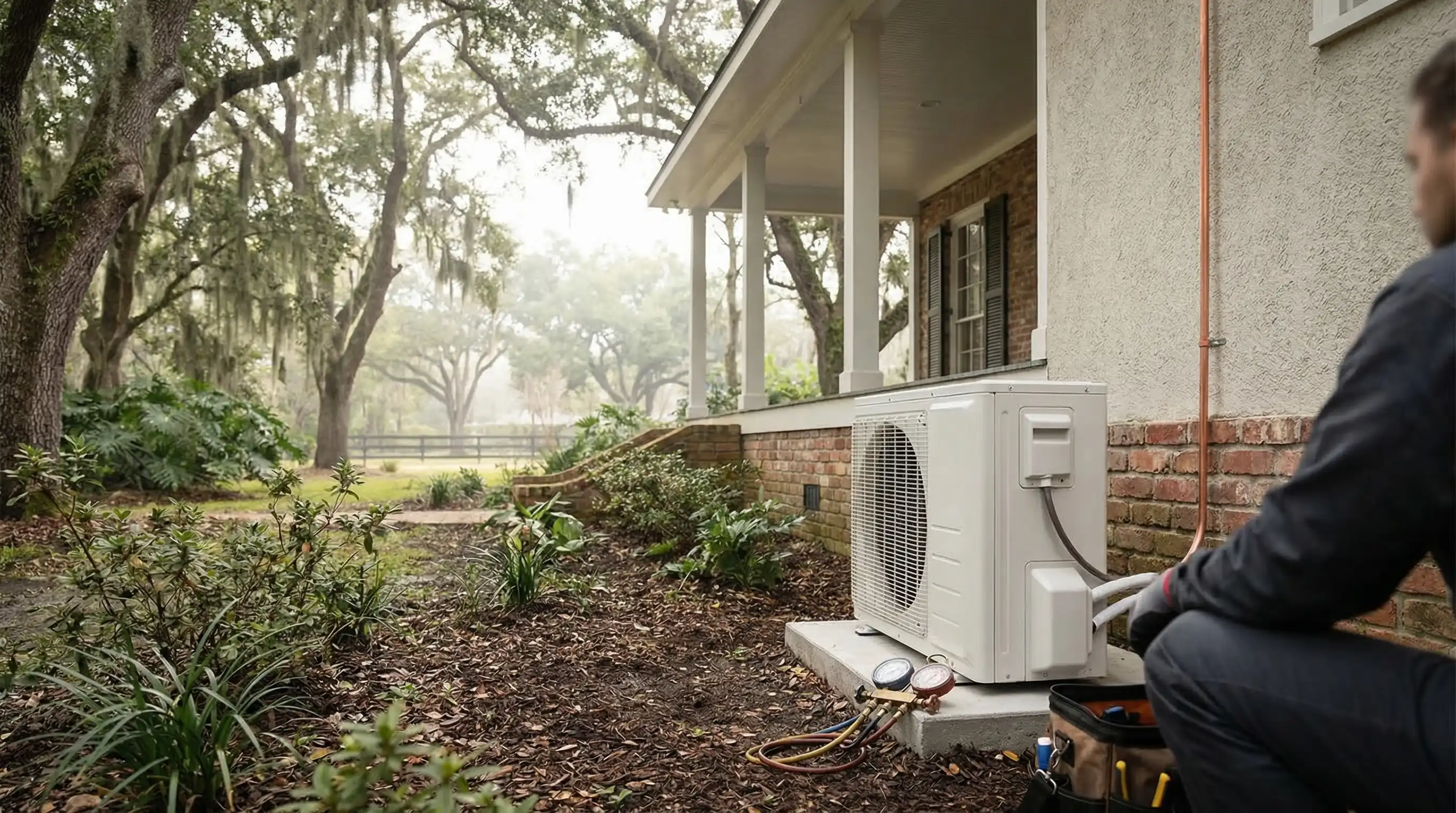
Running HVAC Google Ads in Baton Rouge isn't the same as running them in a four-season market. This is a subtropical city where summer starts in May and doesn't relent until October — and where the question isn't whether someone will search for A/C repair today, but which company they'll find first. The challenges are real, specific to this climate, and punishing for SMBs that approach PPC without a local-first strategy.
The Franchise Dominance Problem
The first challenge is competitive pressure from national operators. One Hour Heating & Air Conditioning has run continuous paid search in Baton Rouge since before most local HVAC companies had a website. ARS/Rescue Rooter maintains a standing presence on high-intent emergency keywords. These franchises allocate fixed monthly budgets — they don't run out of money at 2pm on the hottest day of the year. Local SMBs frequently do.
When a small HVAC company sets a flat daily budget without campaign scheduling, it burns through its spend by early afternoon on peak days — leaving the evening hours, when most homeowners get home and discover their A/C is broken, entirely uncontested. The franchise operators are still bidding. The local company isn't. That's not a creativity problem — it's a campaign structure problem.
Emergency Intent Requires Emergency Infrastructure
Baton Rouge HVAC searches are disproportionately emergency-driven. Estimated CPCs for emergency keywords — "AC repair Baton Rouge same day," "emergency AC repair Baton Rouge" — run $40–$70/click during peak periods. At that price, a campaign that sends clicks to a generic homepage with no call tracking wastes $400–$700 before a single qualified lead is confirmed.
The second challenge, therefore, is attribution infrastructure. Most HVAC SMBs in this market can't tell you whether a call came from Google Ads, a yard sign, or a referral. Without call tracking, there's no way to know which keywords drive actual service calls vs. which ones drive window-shoppers checking prices at midnight. Campaigns without attribution data can't be optimized — they just spend.
Baton Rouge's year-round A/C usage creates another structural trap: the maintenance vs. emergency split. Emergency repair searches convert at 10–14% because the intent is binary — the A/C is broken right now. Maintenance plan searches convert at half that rate. Campaigns that lump these two audiences into the same ad group dilute Quality Score, raise CPCs, and send the wrong message to both groups. A homeowner calling about a broken unit at 95°F wants "we'll be there in 2 hours." A homeowner browsing maintenance contracts wants "we'll save you money over time." Serving them the same ad is a guaranteed underperformer.
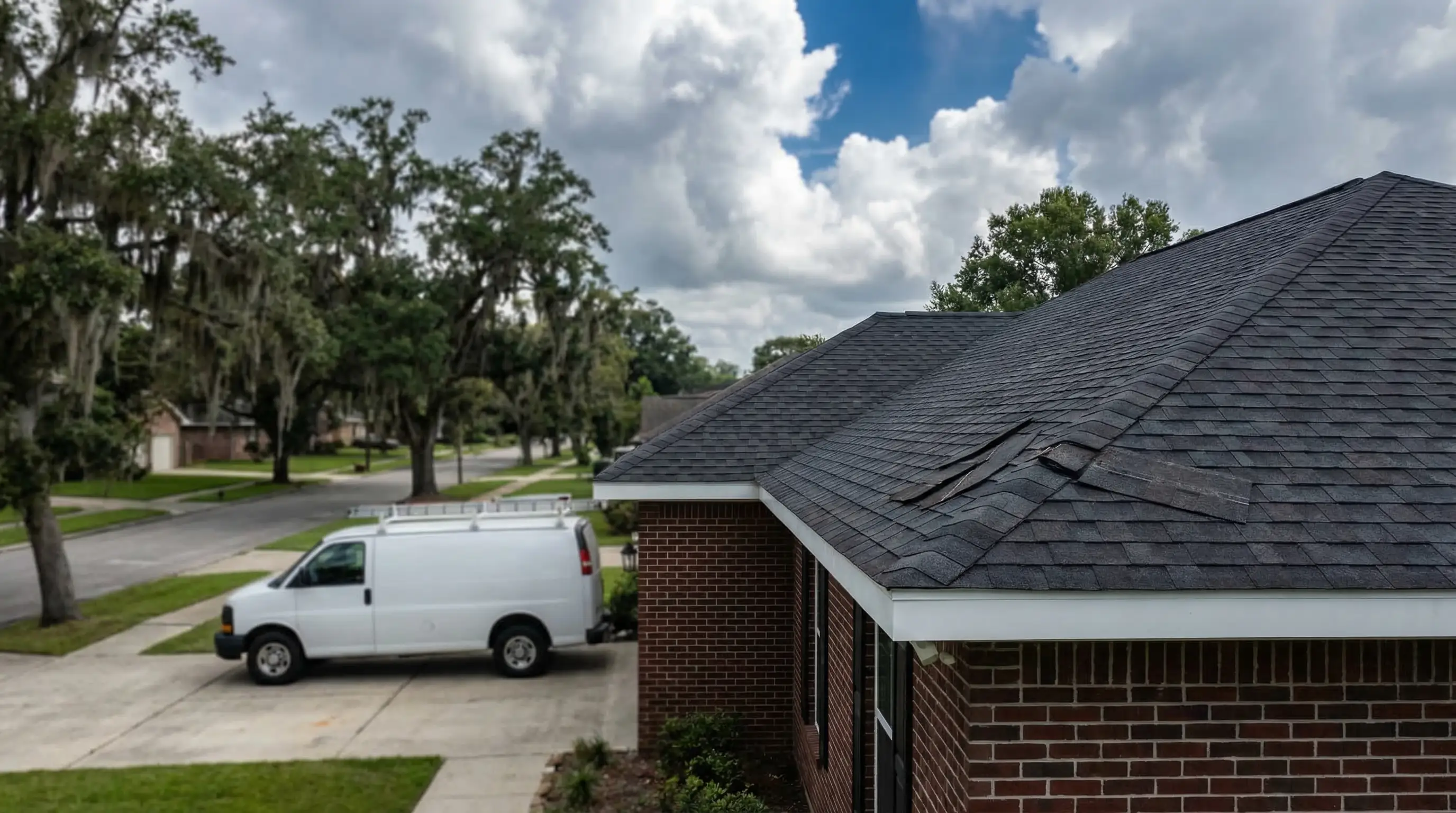
A third challenge specific to Baton Rouge: tropical storm and hurricane events. Outdoor condenser units are vulnerable to wind-driven debris and flooding. After a significant storm — even one that makes landfall 150 miles away — search volume for A/C repair and equipment replacement spikes sharply. Companies without pre-built storm-response campaigns miss a window that can represent 20–30% of a month's revenue compressed into 72 hours.
The competitive reality in this market is that HVAC PPC isn't optional for growth. With 69+ providers competing for the same emergency searches, organic ranking alone isn't sufficient during peak demand. The SMBs winning market share are the ones running structured, climate-aware paid campaigns — not running generic ads that happen to mention Baton Rouge in the headline.
HVAC PPC in Baton Rouge rewards companies that build campaigns around the climate — not around generic industry templates. The market's specific demand patterns (year-round A/C, emergency urgency, storm events) create clear opportunities for SMBs that segment properly and bid with context.
Campaign Structure: Emergency vs. Maintenance vs. Replacement
The first strategic decision is segmentation. Three distinct audience behaviors require three distinct campaign types:
- Emergency repair campaigns: "AC repair Baton Rouge," "AC not working Baton Rouge," "emergency AC repair Baton Rouge" — CPC range $25–$70; highest intent; require call extensions + same-day messaging
- Maintenance plan campaigns: "HVAC tune-up Baton Rouge," "AC maintenance Baton Rouge," "air conditioning service contract" — CPC range $10–$22; lower intent; require value-focused copy and email capture
- System replacement campaigns: "new AC unit Baton Rouge," "HVAC installation Baton Rouge," "central air system cost Baton Rouge" — CPC range $18–$40; high LTV intent; require financing messaging and brand credibility signals
Running all three in a single campaign guarantees average performance across the board. Segmenting them allows budget allocation by priority (emergency gets 60% of budget in summer) and messaging precision (replacement campaigns can mention financing; emergency campaigns never should).
Bid Scheduling for a 100°F Market
Budget scheduling is the highest-leverage tactic available to Baton Rouge HVAC advertisers. Heat-driven searches peak between 11am and 8pm on weekdays — when homeowners are at work and return to find a broken system. Campaigns should suppress early-morning bids (lower intent, lower volume) and concentrate spend during high-temperature afternoon and evening windows.
During summer months, a 30–50% bid increase modifier during peak hours (noon–7pm) on days when the forecast exceeds 95°F outperforms flat bidding by a significant margin. Most HVAC SMBs don't implement weather-triggered bid adjustments. That's a competitive gap that any well-structured campaign can exploit.
- Cooling emergency keywords: "AC repair Baton Rouge same day" — $40–$70/click; concentrate budget here June–September
- Brand + service area: "HVAC company Baton Rouge LA," "air conditioning repair Baton Rouge" — $18–$35/click; maintain year-round
- Long-tail high-intent: "central air not cooling Baton Rouge," "AC blowing warm air Baton Rouge" — $15–$28/click; lower competition, high conversion intent
- Storm response: "wind damage AC unit Baton Rouge," "AC unit flooded Baton Rouge" — $20–$45/click; seasonal surge campaigns triggered by NHC advisories
Geographic targeting within the Baton Rouge DMA matters. Concentrate bids in the core residential zones — Mid City, South Baton Rouge, Zachary, Denham Springs, Prairieville — where homeownership rates and median incomes support HVAC replacement jobs. Bid adjustments for zip codes with higher home values increase average job size without increasing cost per click.
For landing pages: emergency campaigns should go to a page with a phone number above the fold, a headline confirming same-day service, and a trust signal (years in business, NATE certification, BBB rating). The form should be one field: phone number. Every additional field reduces conversion rate on a page where the visitor is already in distress.
Remarketing to past website visitors with maintenance plan offers in the weeks after a service call is one of the highest-ROI tactics available — it captures customers at the peak of their trust in the brand, when they've just experienced a successful repair. Maintenance plan customers generate $800–$1,400 in recurring revenue over four years from a single remarketing conversion.
Google Partner Agency
We're a certified Google Partner Agency, which means we don’t guess — we optimize withGoogle’s full toolkit and insider support.
Your campaigns get pro-level execution, backed by real expertise (not theory).

The data that most HVAC advertisers miss in Baton Rouge is the seasonal asymmetry of this market. Unlike Dallas or Atlanta, where heating and cooling create a roughly balanced demand curve, Baton Rouge is structurally lopsided toward cooling — and the implications for PPC strategy are significant.
Year-Round A/C Is a Competitive Advantage in Disguise
Most HVAC markets have a clear off-season. In Baton Rouge, there isn't one. Air conditioning runs from approximately March through November — that's nine months of baseline A/C demand, before accounting for emergency calls in December and January when the system runs intermittently. This means HVAC companies in Baton Rouge don't face the cash flow crunch that hammers HVAC SMBs in four-season markets during winter months.
For PPC, this creates a year-round opportunity that most companies underinvest in. The instinct is to surge in summer and pause in winter. The reality is that winter in Baton Rouge — rare freeze events excepted — is still A/C maintenance season. Tune-up and system inspection keywords run $10–$22/click in November and December versus $40–$70/click for emergency keywords in July. The off-peak period is the most cost-efficient time to build brand recognition and capture maintenance contract customers who will convert to high-LTV repair and replacement jobs the following summer.
The Storm Damage Opportunity
Baton Rouge's location in the Gulf storm track creates a recurring demand event that has no equivalent in inland markets. When a tropical system passes within 200 miles, condenser unit damage (wind-thrown debris, flooding) generates a search surge that can push monthly leads up by 40–80% in a single week. Outdoor unit replacement ranges from $2,800–$6,500 for residential equipment — among the highest single-ticket HVAC jobs.
The companies that capture storm demand are not the ones who react after the storm hits — they're the ones who have pre-built campaigns ready to activate. A storm-response campaign with pre-written ad copy, a dedicated landing page, and a pre-set budget increase modifier can be live within two hours of a National Hurricane Center advisory. Without that infrastructure, the first 48 hours of peak search demand — when urgency is highest and comparison shopping is lowest — go entirely to competitors who happen to be running generic campaigns.
Key insight: Baton Rouge homeowners searching after a storm event have lower price sensitivity than baseline callers. They want the problem solved, not the best quote. This means ad copy emphasizing speed and reliability outperforms price-focused messaging in storm windows — the opposite of what works for routine maintenance campaigns.
The demographic profile of Baton Rouge's homeowner market adds another layer. With a 47.8% homeownership rate — well below the national average — the homeowner base is somewhat smaller than in peer cities. But the homeowners who do own property in Baton Rouge skew toward higher income and longer tenure, which correlates with higher willingness to replace aging systems rather than repair them. The average HVAC replacement LTV in this market — $6,000–$14,000 — makes every homeowner lead worth substantially more than the CPL suggests.
One underexploited segment: the commercial and light-industrial tier. Baton Rouge's petrochemical corridor and Port-adjacent light industrial facilities require commercial HVAC service year-round. These are higher-ticket contracts with predictable maintenance schedules. Commercial HVAC keywords are less competitive than residential emergency terms — and the lead-to-contract value ratio is significantly higher for any HVAC company positioned to serve them.
HVAC PPC in Baton Rouge requires more than running ads with the city's name in the headline. It requires understanding that this is a Gulf South market where the air conditioner is as essential as running water — and where the companies that win on Google Ads are the ones who match that urgency with campaign infrastructure built for it.
MB Adv Agency manages PPC for home services companies across Southern markets where heat-driven emergency demand defines the competitive landscape. We've built storm response campaigns for Gulf Coast clients, managed summer surge budgets without running out of money at 2pm, and built attribution systems that finally answer the question every HVAC owner asks: "Which ads are actually bringing in calls?"
For Baton Rouge HVAC companies, that means structured campaigns for emergency, maintenance, and replacement — not a single campaign trying to serve three different audiences. It means bid scheduling tuned to peak-heat hours. It means call tracking that ties every inbound call to the keyword that generated it. And it means a storm-response capability that turns the next tropical system into a growth event rather than a scramble.
The ROI math is straightforward: at $65–$180/lead and an average job value of $400–$14,000, a well-run campaign pays for itself on the first signed replacement job. See how we approach HVAC PPC in Houston — a similar Gulf South market — and explore our pricing tiers to find the right fit for your operation.
Frequently Asked Questions
How much should a Baton Rouge HVAC company spend on Google Ads?
The right budget depends on your service mix and growth goals — but the Baton Rouge market has a clear floor. At $18–$70/click for high-intent HVAC keywords, a $500/month budget won't generate meaningful call volume. It will generate enough clicks to confirm the ads are running and not enough to draw conclusions about performance.
For a small residential HVAC operation targeting emergency repair and maintenance calls, $1,500–$3,000/month is the operational minimum — enough to maintain consistent presence on core keywords without running out of budget before the hottest part of the day. At this level, you can expect 12–25 qualified leads per month, depending on campaign quality and seasonal timing.
For a mid-size company with both residential and commercial accounts, or one that wants to run system replacement campaigns alongside emergency repair, $3,500–$6,500/month is a more appropriate range. This allows separate campaign budgets for each intent type rather than a single pool that runs out when emergency calls spike.
The most important budgeting principle: increase spend before summer, not after it starts. Companies that scale their budgets in April — when CPCs are lower and competition is thinner — establish Quality Score advantages that persist into the peak summer period when bids spike. Waiting until July to increase budget means paying 30–50% more per click than companies that got there first. A summer surge of 30–50% above your baseline budget (May–September) is the standard approach for Gulf South HVAC markets.
Why do HVAC Google Ads fail in Baton Rouge?
Most HVAC PPC campaigns in Baton Rouge fail for one of three reasons — and all three are structural, not creative.
First: wrong campaign architecture. Lumping emergency repair, maintenance, and replacement into a single campaign is the most common mistake. Each audience has different intent signals, different search behavior, and different conversion triggers. An emergency caller needs confirmation you'll arrive today. A replacement shopper needs financing information and a trust signal. A maintenance prospect needs a value argument about long-term savings. One campaign can't serve all three without diluting every message.
Second: flat daily budgets without scheduling. A $100/day budget that runs uniformly from midnight to midnight in Baton Rouge wastes significant spend on low-intent early-morning searches, then exhausts the budget before the 5pm heat-of-day emergency rush. Campaign scheduling — suppressing bids from 1–7am and concentrating budget between noon and 8pm during summer months — routinely improves lead volume by 20–35% on the same budget.
Third: no attribution. Without call tracking, there's no feedback loop. You can't tell whether "emergency AC repair Baton Rouge" is driving calls or just clicks. You can't see that your Tuesday afternoon ads convert at 3x the rate of Monday morning ads. You can't justify the budget to the owner of the company, because the data doesn't exist. Call tracking is not optional infrastructure in a market where CPCs run $40–$70 — it's the minimum requirement for knowing whether the campaign is working.
Fix those three structural problems, and Baton Rouge HVAC PPC is a straightforward performance play. The market has genuine demand, year-round urgency, and competitive gaps that local SMBs can exploit with disciplined campaign management.