Roofing PPC Kansas City, KS
Kansas City, KS averages 4–6 significant hail events per year, and Wyandotte County's 1950s–1970s housing stock means a large share of roofs are at or past their 25-year lifespan — already primed for replacement before the next storm season arrives. The challenge for local roofing contractors isn't generating demand; it's capturing it before the out-of-state storm-chasing firms flood Google Ads within hours of every major weather event. <!-- stats-article-link --> <p><em>See how this city's Roofing PPC costs compare nationally in our <a href="/resources/roofing-ppc-statistics">Roofing PPC Statistics</a> report, featuring data from 40+ US cities.</em></p>
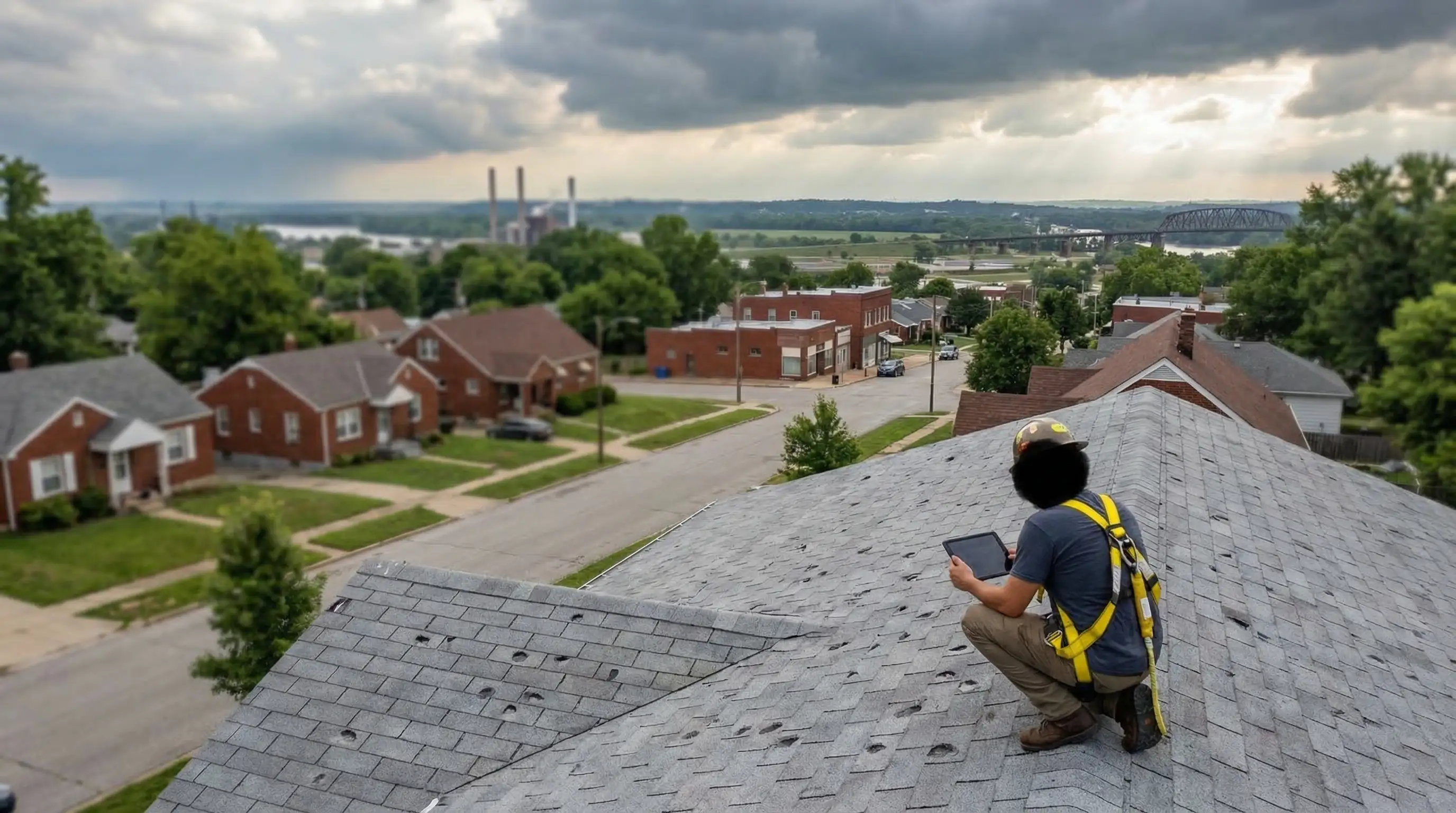
Roofing PPC in Kansas City, KS operates in two distinct modes: steady-state (between storms) and storm-surge (immediately after a significant hail or wind event). Most roofing operators focus exclusively on one or the other. The campaigns that dominate this market are built to handle both — with different structures, different ad copy, and different bidding logic for each mode.
Storm Chasers Define Your Competitive Reality
Within 24–48 hours of any significant Wyandotte County hail event, out-of-state roofing firms — many operating across dozens of storm-active markets simultaneously — activate pre-built Google Ads campaigns targeting "hail damage roof Kansas City" and related terms. They have budgets built for surge spending, ad copy pre-written for storm aftermath, and no operational costs in the market beyond their Google Ads spend. CPCs for post-storm roofing keywords spike from $20–$35 to $40–$60+ within the first 24 hours.
Local KCK roofing contractors competing in this environment face a structural disadvantage: they're bidding against firms with no fixed costs who can sustain elevated CPCs indefinitely. The only winning strategies are: (1) establish market presence before the storm so brand familiarity reduces the need to win every click in the surge, (2) shift campaign emphasis from pure storm-damage keywords to insurance-assistance and local-trust keywords that storm chasers rarely use effectively, and (3) maintain a storm-surge budget reserve that activates automatically when severe weather hits Wyandotte County.
The Insurance Claim Complexity
In storm-active roofing markets like KCK, 60–70% of roofing jobs are insurance-funded. This fundamentally changes the customer's decision process. They're not price-shopping between contractors — they're selecting which contractor will guide them through the insurance claim process most competently. Search intent for "storm damage roof Kansas City Kansas" includes an implicit second question: "Can this company help me with my insurance adjuster?"
Roofing contractors who acknowledge this in their ad copy and landing pages — "We work directly with your insurance company" — see measurably higher CVR than contractors whose ads focus purely on material quality or installation speed. The conversion event for insurance-funded roofing is not a purchase decision; it's a trust decision about who will advocate for the homeowner through a bureaucratic process most homeowners have never navigated before.
This extends to keywords. "Roofing contractor Wyandotte County" and "hail damage insurance claim Kansas City" are structurally different searches — the second one requires insurance-savvy ad copy, and most local roofing PPC campaigns serve generic copy to both. Segmenting these into separate ad groups with tailored messaging consistently improves conversion rates on the insurance-intent segment.
Older Housing Stock Creates Steady-State Demand
Beyond storm cycles, KCK's 1950s–1970s housing stock creates genuine replacement demand that exists independent of weather events. Roofs installed in the late 1990s and early 2000s on these homes are now 20–25 years old — at or past their functional lifespan for standard asphalt shingles. The 60.9% homeownership rate means this aging cohort of roofs sits on owner-occupied homes where the replacement decision falls on the homeowner, not a property management company.
Steady-state roofing campaigns — "Is your roof 20+ years old?" — run at lower CPCs than storm-damage terms and reach homeowners who are in a proactive decision mode rather than a crisis mode. These leads often convert at higher average ticket values because the homeowner isn't under insurance company time pressure and can choose premium materials without the constraint of insurance reimbursement schedules.
Effective KCK roofing PPC requires two parallel campaign tracks that operate simultaneously — one built for the steady-state market, one ready to surge on storm events — plus a trust differentiation layer that separates local contractors from out-of-state competitors.
Storm Response Campaign Architecture
Pre-configure storm-response campaigns before storm season starts (before April). The campaign should be paused in normal conditions and structured to activate within hours of a severe weather event in Wyandotte County:
- Hail damage keywords: "hail damage roof Kansas City KS," "hail damage roof repair Wyandotte County," "roof damage after storm Kansas City" — estimated CPC $30–$60 (storm surge), $20–$35 (steady-state)
- Insurance claim keywords: "roofing company insurance claim Kansas City," "hail damage insurance roof Kansas City Kansas" — estimated CPC $25–$45
- Emergency inspection keywords: "free roof inspection Kansas City KS," "roof damage inspection Wyandotte County" — estimated CPC $18–$30
Storm response ad copy must reference the specific event: "Hail hit Wyandotte County? Get your free inspection today. We handle insurance claims directly." Generic "storm damage roofing" copy underperforms hyper-local event-specific copy by a measurable margin.
Steady-State and Replacement Campaigns
Between storm events, roofing campaigns shift to replacement intent and proactive inspection keywords:
- Roof replacement keywords: "roof replacement Kansas City KS," "new roof estimate Kansas City Kansas," "roofing contractor KCK" — estimated CPC $20–$35
- Aging roof keywords: "roof inspection Kansas City KS," "how long does a roof last," "roof replacement cost Wyandotte County" — estimated CPC $15–$25
- Financing keywords: "roof replacement financing Kansas City," "new roof no money down KCK" — estimated CPC $14–$22
Trust Differentiation Layer
The single most effective copy element separating local KCK contractors from out-of-state storm chasers is a combination of proximity + longevity signals: "Wyandotte County's roofing contractor since [year]. Licensed, local, here after the storm clears." Storm-chasing firms cannot use language about being rooted in the community because they aren't — and KCK homeowners know it. Insurance adjusters also respond better to established local contractors with verifiable Kansas licensing. This is an asymmetric competitive advantage that money alone cannot replicate.
Landing page structure for KCK roofing campaigns should mirror the trust-first messaging. The page headline leads with the city and service ("Kansas City KS Roofing — Licensed, Insured, Local"), followed immediately by social proof (Google reviews count, years in business, number of Wyandotte County roofs completed). The contact form should be visible above the fold on mobile — in a storm-response context, mobile traffic represents 70–80% of all roofing searches and every additional scroll reduces conversion probability. A click-to-call button pinned to the bottom of the mobile screen eliminates that friction entirely.
Google Partner Agency
We're a certified Google Partner Agency, which means we don’t guess — we optimize withGoogle’s full toolkit and insider support.
Your campaigns get pro-level execution, backed by real expertise (not theory).

KCK's roofing market has two structural features that most advertisers miss — and that create exploitable PPC opportunities for operators who understand the local market dynamics.
The Post-Storm Search Window
Post-storm roofing search volume in KC metro follows a predictable pattern: volume spikes within 2–6 hours of a significant hail event, peaks at 24–72 hours, then declines steadily over 2–3 weeks as demand is absorbed. The first 72 hours represent approximately 60% of the total post-storm search opportunity. Out-of-state storm chasers who activate campaigns in this window win a large share of insurance-funded jobs before local operators even realize the demand spike is happening.
The counter-strategy is automation: Google Ads scripts that monitor Wyandotte County weather alerts and trigger bid increases automatically, the moment a severe weather warning is issued. This is not a complex technical implementation — it's a pre-configured script that checks a weather API endpoint and adjusts campaign bids based on storm intensity. Operators with this infrastructure beat competitors to the surge; operators without it always react 12–24 hours late.
Key insight: The June 2024 severe hail event across KC metro — producing 1.5–2 inch hail in Wyandotte County — generated a documented search spike for roofing terms. Local contractors who were already running campaigns captured leads at pre-surge CPCs for the first few hours before the auction became fully competitive. That early-window advantage is worth building campaign infrastructure to protect.
Ice Storms: The Underutilized Winter Angle
Most KCK roofing PPC focuses on spring/summer hail. February and March — KCK's ice storm season — receive significantly less roofing ad spend despite generating real roof damage. Ice dams, icicle weight stress, and standing water on flat-pitch sections of older homes create structural damage that homeowners often don't notice until spring. Ice storm roofing keywords run at 30–50% lower CPCs than peak spring hail terms, with conversion rates that are lower in volume but comparable in intent.
An operator running "ice dam roof damage Kansas City," "roof inspection after ice storm KCK," and "flat roof winter damage Wyandotte County" in February and March faces minimal competition and builds a lead pipeline at lower cost — leads that convert to spring replacement jobs when the snow melts and the damage becomes fully visible. This is a budget-efficient off-season strategy that most roofing PPC accounts leave entirely unaddressed.
The Kansas City, KS roofing market punishes generic PPC. Storm chasers flood the post-storm auction with generic "hail damage roofing" copy every year. The local contractors who survive and grow are the ones with campaign infrastructure built specifically for Wyandotte County's weather patterns — pre-configured storm response, insurance claim messaging, and local trust signals that out-of-state firms cannot replicate.
MB Adv Agency builds roofing PPC campaigns on Kansas City market data, not national templates. We know when Wyandotte County's storm season peaks, which zip codes have the highest concentrations of aging roofs, and how to write insurance-savvy ad copy that converts homeowners who are navigating a claim for the first time. Our campaigns are structured to win both the steady-state replacement market and the post-storm surge market — not one or the other.
If you're a KCK roofing contractor running campaigns that don't have a storm-surge activation structure, you're ceding the most valuable 72 hours of demand in every weather cycle to competitors. See our approach at MB Adv PPC lead generation, or explore our transparent pricing tiers for home services businesses.
Frequently Asked Questions
How do roofing PPC campaigns handle the insurance claim process in Kansas City, KS?
Insurance-funded roofing jobs represent 60–70% of KCK's roofing revenue cycle, so campaigns that don't address the insurance claim process are missing the majority of the market's actual conversion pathway. Effective insurance-aware PPC operates on three levels.
First, ad copy must signal insurance competency: "We handle your insurance claim from inspection to final sign-off" converts homeowners in claim-mode better than generic quality or price messaging. The homeowner's primary anxiety isn't which shingles to use — it's whether they'll navigate the adjuster process correctly and avoid a low-ball settlement. Ads that address this directly are more relevant and earn better Quality Scores, which means lower CPCs alongside higher CVR.
Second, landing pages for insurance-intent searches should include a specific section on the claims process: what the contractor does at inspection, how they document damage for adjusters, what happens if the adjuster undervalues the claim. This content answers the homeowner's implicit secondary question and removes the friction that causes people to exit and search for a competitor.
Third, keyword segmentation matters: "hail damage roof Kansas City" and "roofing company insurance claim help" are different intent signals. The second is further down the funnel — the homeowner already knows they have damage and is specifically looking for insurance claim expertise. Campaigns that put both keywords in the same ad group serve generic copy to a high-intent search. Separate ad groups, separate ad copy, measurably better results on the insurance-intent segment.
What's a realistic roofing PPC budget for a Kansas City, KS contractor?
Base budget for a KCK roofing contractor runs $2,000/month in steady-state periods — enough to maintain presence on replacement and inspection keywords year-round and capture organic demand between storm events. Expected leads at this budget: 12–25 per month at estimated $70–$160 CPL, with higher conversion rates in spring when homeowners are actively evaluating roofs post-winter.
The critical addition is a storm surge budget: a pre-allocated reserve of $1,000–$2,000 per storm event that activates when severe weather hits Wyandotte County. Without this reserve, you either stay at base budget while auction prices spike (losing impression share exactly when intent is highest), or you take funds from your steady-state campaign to compete in the surge (creating gaps in your base coverage). The surge reserve is a separate budget line, not a reallocation from base spend.
Seasonal budget distribution for KCK roofing: heaviest in April–July (storm season + summer replacement demand), moderate in August–September, lighter in October–January (though ice storm campaigns in February are worth $500–$800/month), with March representing the pre-season ramp-up period. Total annual ad spend for a well-covered KCK roofing account typically runs $30,000–$60,000 — concentrated in the storm-active half of the year, with off-season efficiency work filling the calendar gap.
At the high end ($4,000–$6,000/month baseline), full KC metro coverage including KCK and the Missouri side becomes viable, with comprehensive storm response infrastructure and bilingual campaigns for KCK's Spanish-speaking homeowner segment. The bilingual angle on roofing — "inspección de techo gratis, Kansas City Kansas" — runs at significantly lower CPCs with minimal competition and converts at rates comparable to English campaigns in the right neighborhoods.