Roofing PPC New York, NY
New York City has approximately 1.05 million buildings across all five boroughs — and an estimated 70–75% of them use flat or low-slope roofing systems. Every national roofing PPC playbook is written for suburban asphalt shingles. NYC's brownstones, co-ops, and pre-war flat roofs require a fundamentally different campaign strategy, and the roofing companies that recognize this gap are generating leads at a fraction of the cost their competition pays. <!-- stats-article-link --> <p><em>See how this city's Roofing PPC costs compare nationally in our <a href="/resources/roofing-ppc-statistics">Roofing PPC Statistics</a> report, featuring data from 40+ US cities.</em></p>
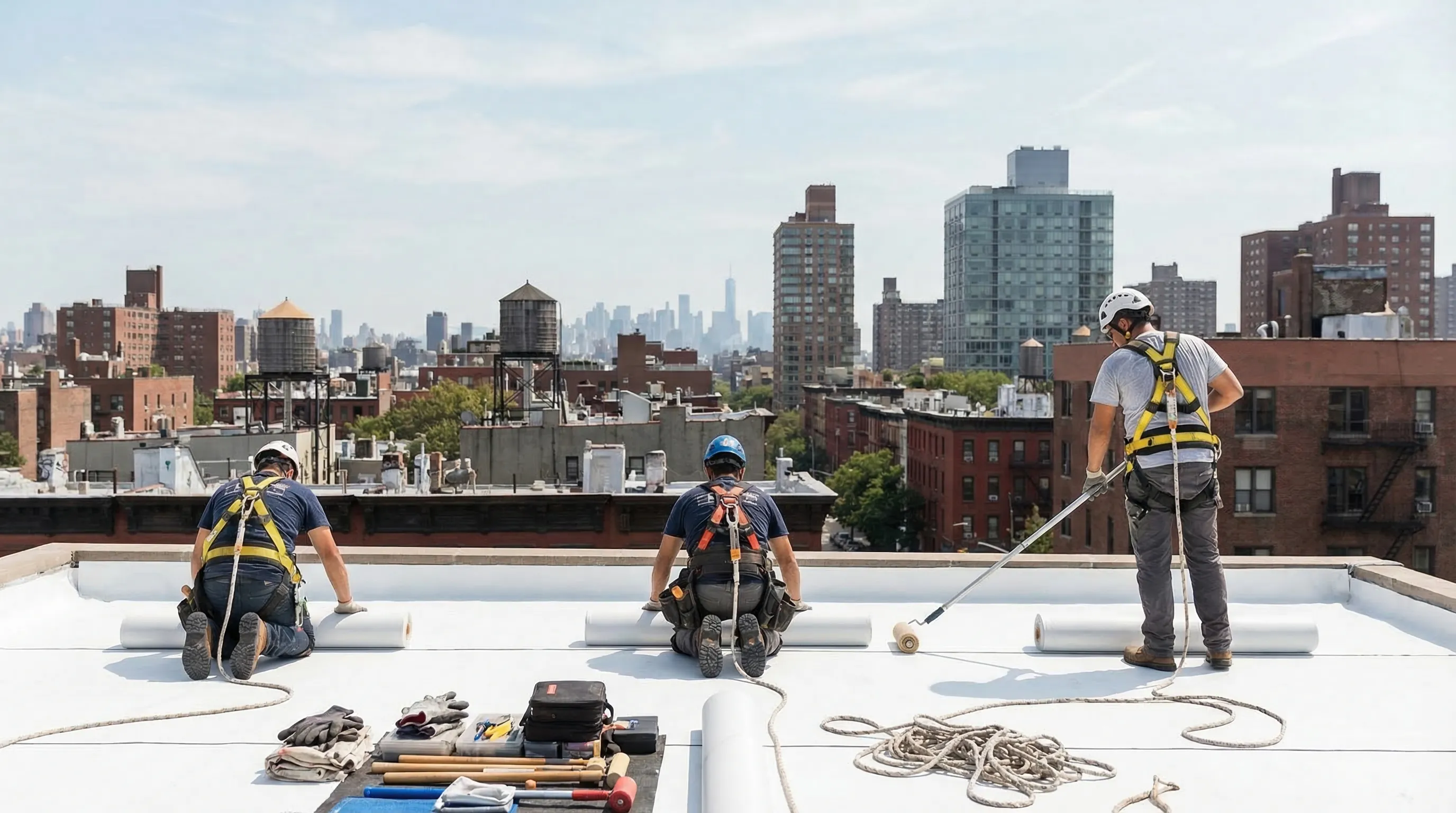
The structural challenge of NYC roofing PPC is unlike anything in the national market: NYC is a city of flat roofs, and nearly every established PPC template, every keyword list, and every ad creative that national agencies deploy was built for the Sun Belt — where asphalt shingles dominate, storm damage is the primary demand driver, and "roof replacement near me" is the baseline query. A roofing contractor in Staten Island, Brooklyn, or the Bronx who blindly applies this playbook wastes 30–40% of their budget on intent signals that don't map to their actual service.
The Aggregator Lead-Sharing Problem
Angi (formerly Angi/HomeAdvisor), Thumbtack, and Modernize — three platforms running significant PPC themselves — aggregate leads for NYC roofing contractors by competing on the exact terms contractors need: "roof repair near me," "flat roof contractor NYC," "emergency roof repair New York." When a homeowner clicks an Angi ad and submits a lead form, that lead is sold to three to five competing contractors simultaneously. The contractor pays the platform for a shared lead, not an exclusive one. A roofing company paying $150 per Angi lead is paying more per exclusive job opportunity than a company generating PPC leads directly — because the Angi lead is shared and the PPC lead is exclusive.
The math is straightforward: at a $4,000/month Google Ads budget with a 10% CVR and $35 average CPC, a contractor generates approximately 115 clicks and 11–12 leads per month at a CPL of $130–$150. Those leads are exclusive — when the homeowner submits a form on the contractor's landing page, no competitor gets that contact information. The same $4,000 on Angi might buy 26 shared leads — but each of those leads is simultaneously calling 3–5 other contractors, making them functionally worth a fraction of the exclusive PPC lead in terms of conversion potential.
NYC's Flat Roof Knowledge Gap
NYC's flat roof market creates a quality problem for contractors running generic HVAC/roofing campaigns: the searcher using "roof repair Brooklyn" expects a company that knows what a TPO membrane, EPDM rubber roof, or modified bitumen system is — not a contractor quoting for 3-tab asphalt shingles. Ad copy that says "roof repair near me" attracts all searchers; ad copy that says "flat roof membrane repair Brooklyn — TPO and EPDM specialists" attracts the specific searchers who have a flat roof problem and immediately signals expertise. Specificity in NYC roofing PPC is not just better messaging — it is a Quality Score signal. Google's algorithm recognizes search intent alignment; "flat roof repair Brooklyn" matched to a landing page about flat roof repair in Brooklyn scores higher than the same search matched to a generic "roof repair" homepage.
NYC's permit complexity adds another layer of lead quality filtering. Most NYC roofing jobs on commercial and multi-family buildings require NYC DOB permits. Landlords, property managers, and co-op boards are experienced buyers who will ask about permit experience on the first call. Ad copy that mentions DOB licensing and permit experience pre-qualifies leads — filtering out homeowners who don't understand the process and flagging the contractor's expertise for the commercial buyers who need it. NYC DOB permit credential in PPC copy lifts qualified lead rate by 20–35% compared to permit-silent ads targeting the same keywords.
Emergency demand management is where NYC roofing PPC gets its most challenging. Nor'easters — 3–7 significant events per year, October through March — generate post-storm search surges that are predictable in season but unpredictable in timing. A contractor whose campaign is not pre-positioned for the surge (adequate budget, bid adjustments, emergency-specific ad copy) is watching competitors capture post-storm demand while their own budget cap limits are hit in the first 3 hours of peak search activity. Emergency roofing is the highest-CVR moment in the entire demand cycle — and the moment that most average campaigns are least prepared for.
NYC roofing PPC strategy must segment by two fundamentally different market tracks from the campaign's first day: the flat roof urban core track (Manhattan, Brooklyn, Bronx, Queens — brownstones, co-ops, row houses, commercial buildings) and the pitched roof suburban track (Staten Island, outer Queens, outer Brooklyn — asphalt shingle homeowners). These two tracks have different CPCs, different landing page needs, different decision timelines, and different customer profiles. Running them in a single campaign is the single biggest structural mistake NYC roofers make.
Campaign Architecture by Service Track
- Flat roof repair (emergency): "flat roof leak NYC," "flat roof repair [borough]," "EPDM roof leak repair" — $30–$65 CPC; 10–15% CVR; same-day to 72-hour decision; highest revenue-per-lead
- Flat roof replacement (planned): "flat roof replacement Brooklyn," "TPO roofing NYC," "EPDM roof installation Manhattan" — $25–$55 CPC; 5–9% CVR; 2–6 week decision cycle; $8,000–$22,000 average job value
- Residential pitched roof (Staten Island): "roof replacement Staten Island," "shingle roof repair Staten Island" — $20–$45 CPC; 7–12% CVR; seasonal storm correlation; mirrors national suburban roofing economics
- Commercial / property management: "commercial roofing NYC," "roofing contractor property managers," "building roof maintenance contract" — $20–$50 CPC; B2B buyer; longer decision, higher LTV; separate landing page essential
- Green roof / Local Law 92/94 compliance: "green roof installation NYC," "Local Law 92 compliance roofing," "sustainable roofing NYC" — $15–$35 CPC; near-zero competition today; growing mandatory compliance market
- Spanish-language roofing: "reparación techo plano NYC," "empresa techos Bronx" — $10–$20 CPC; minimal competition; Bronx and Queens property owners
Storm surge activation is the most time-sensitive campaign optimization in NYC roofing. The optimal playbook: when weather forecasts show a Nor'easter or tropical storm system 48–72 hours out, increase campaign budgets by 150–200%, activate emergency-specific ad copy ("Emergency Roof Repair — Storm Response NYC — Same Day"), and set bid modifiers to maximize impression share on emergency terms. By the time the storm hits and search volume spikes, Quality Scores are warming and the contractor's ads are already at full position. Waiting until the storm is over to respond means paying higher CPCs for weaker position against competitors who pre-positioned — which is exactly the scenario most NYC roofers experience every October.
Local Law 92/94 compliance campaigns are the two-year early-mover opportunity in NYC roofing. The law requires new buildings and those undergoing major roof alterations to install green roofs or solar panels. As the regulation tightens and enforcement increases, building owners across NYC will face mandatory compliance decisions. Today, "green roof installation NYC" and "Local Law 92/94 roofing compliance" are nearly uncontested PPC terms — a contractor who builds campaign and landing page infrastructure now owns the category before competition arrives. The contractors who act in 2025–2026 will have Quality Score advantages and brand recognition that late entrants cannot easily overcome.
Google Partner Agency
We're a certified Google Partner Agency, which means we don’t guess — we optimize withGoogle’s full toolkit and insider support.
Your campaigns get pro-level execution, backed by real expertise (not theory).

NYC's approximately 1.05 million buildings across the five boroughs represent the largest urban building stock in the United States — and approximately 70–75% of them carry flat or low-slope roofs. The flat roof replacement cycle is a persistent, structural demand driver unlike seasonal storm damage: flat membrane systems (TPO, EPDM, modified bitumen) have a 10–20 year lifespan, and NYC's dense, aging building stock generates annual flat roof replacement volume that is essentially weather-independent. Even in a mild winter with no major Nor'easters, flat roof replacement demand stays elevated because end-of-life roofs are constantly cycling through the replacement pipeline.
The Landlord and Property Manager Buyer
NYC's residential building ownership structure creates a B2B buyer segment that most roofing contractors target with B2C campaigns — a fundamental mismatch. In NYC, a substantial portion of "residential" roofing customers are not individual homeowners but landlords managing 2–20 unit buildings. A landlord with three row houses in Bushwick is making roofing decisions based on project ROI, tenant disruption minimization, DOB compliance, and multi-building contractor relationships — not the same emotional calculus as a Staten Island homeowner replacing a storm-damaged roof.
B2B-targeted roofing campaigns — "roofing contractor for property managers," "multi-building roof maintenance contracts NYC," "NYC landlord roofing services" — reach this audience at CPCs of $20–$40 per click with significantly lower competition than generic roofing terms. The conversion rate is lower (property managers take longer to decide), but the average job value is higher and the repeat business potential — a property manager with 10 buildings is a $100,000+ annual relationship — is vastly better than one-time homeowner jobs. NYC building superintendents manage HVAC and roofing vendor decisions for the city's multi-unit stock, and they are reachable through business-targeted keyword campaigns that no residential roofing PPC playbook acknowledges.
The Local Law 92/94 compliance market deserves quantitative framing: the law covers new buildings and those undergoing "significant roof alterations." NYC processes approximately 75,000–90,000 new building and alteration permits annually (NYC DOB data). Even a small fraction of those projects triggering Local Law 92/94 compliance review represents thousands of mandatory green roof installation decisions per year — a market that currently has almost no dedicated PPC competition. A contractor certified and positioned for this work who builds a green roof landing page and runs a targeted Local Law 92/94 campaign owns a niche with high barriers to entry (specialized materials, installation expertise) and minimal cost-per-click competition.
NYC roofing demand peaks and their PPC implications, by season:
- Spring (March–May): Highest planned replacement volume; co-op boards approve projects before summer; prime campaign launch window for flat roof replacement
- Summer (June–August): Heat blister membrane failures; construction season peak; flat roof installation in full swing; $3,000/month baseline should scale to $5,000+
- Fall Nor'easter season (September–November): Storm surge demand begins; pre-positioning campaigns by September 1 is mandatory; combined storm + planned replacement volume
- Winter (December–February): Post-storm emergency patches; flat roof failures from freeze-thaw; January is second-highest emergency demand month
Key insight: The ROI math on NYC flat roof PPC is stark. At $4,000/month with 35 leads per month and a 15% close rate, a contractor signs 5 jobs. If 3 are flat roof membrane replacements at $14,000 average and 2 are repairs at $2,000 average, that's $46,000 in job revenue from $4,000 in ad spend — an 11.5:1 return. One commercial flat roof at $40,000 flips the ratio further. The economics of NYC's high-ticket flat roof market make roofing one of the most favorable PPC verticals in the city.
NYC roofing PPC works when campaigns are built for NYC's buildings — not for the suburbs where national roofing PPC templates originate. Flat roof membrane terminology, DOB permit experience signaling, borough-specific geo-targeting, and storm surge pre-positioning are the four structural elements that separate NYC roofing campaigns that generate $8,000–$22,000 flat roof replacement leads from campaigns generating tire-kicker traffic.
MB Adv Agency builds roofing campaigns calibrated for NYC's market: flat roof specialty keywords, permit credential ad copy, landlord and property manager targeting tracks, Local Law 92/94 early-mover positioning, and storm surge bid-modification protocols timed to weather forecast data. Our lead generation service tracks to booked jobs — not just form fills. ROI math: 5 flat roof replacement jobs per month at $14,000 average from a $4,000 ad budget = $70,000 in revenue per month.
For roofing contractors ready to own their borough: review our management tiers or explore our full NYC PPC service page. NYC's flat roof replacement market operates year-round — unlike Sun Belt storm-dependent roofing — which means every month is a revenue opportunity for a properly structured campaign.
Frequently Asked Questions
How does NYC flat roof PPC differ from standard roofing Google Ads?
The difference begins at the keyword level. Standard national roofing PPC is optimized for asphalt shingle queries: "roof replacement near me," "shingle roof repair," "roofing contractor." These terms have almost no relevance in NYC's urban core, where the building stock is 70–75% flat or low-slope. NYC-specific flat roof terms — "flat roof repair Brooklyn," "TPO membrane NYC," "EPDM roof replacement Manhattan," "modified bitumen contractor Queens" — represent entirely different keyword categories that national agencies don't build because they don't appear in national keyword research tools at meaningful volume.
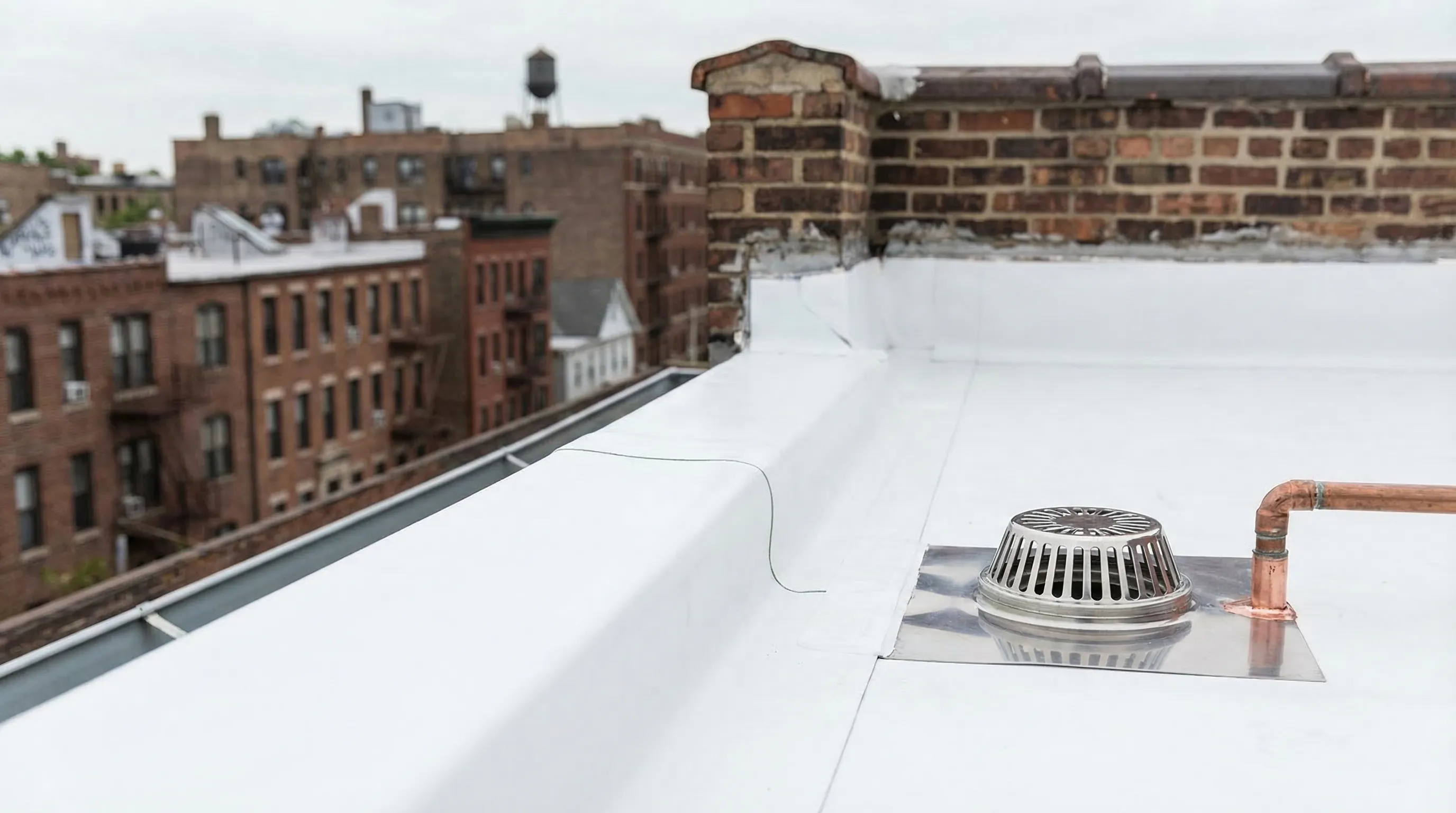
Landing page architecture is the second major divergence. National roofing landing pages show photos of suburban homes, asphalt shingles, and peaked rooflines — imagery that creates a cognitive mismatch for an NYC property owner looking at their brownstone's flat tar and gravel roof. NYC flat roof PPC requires landing pages showing NYC building types: brownstone rooftop work, EPDM membrane installation, TPO seam detail, water tower and skyline background. The visual match between the searcher's actual building and the landing page's imagery is a conversion multiplier that most agencies underestimate.
Emergency campaign activation is also structurally different. NYC's Nor'easter cycle creates predictable storm surge demand that NYC roofing campaigns must be pre-built to capture. National roofing agencies manage reactive budgets — increasing spend after demand spikes. NYC-specific strategy requires proactive storm pre-positioning: budget increases and bid adjustments should go live when weather forecasts show storms 48–72 hours out. By the time a storm hits NYC and search volume spikes 300–500% for emergency roof repair, the contractor whose campaign was pre-positioned captures leads at Quality Score–weighted CPCs; the contractor who reacts on storm day pays inflated rates for lower ad positions.
What budget should a NYC roofing contractor start with, and how long before leads come in?
Starter budget for a borough-focused NYC roofing campaign: $3,000–$5,000/month. At $3,500/month targeting flat roof repair and replacement in one or two boroughs (Brooklyn and Manhattan, or Queens and Bronx), a contractor should expect 20–40 clicks per day, 15–30 qualified leads per month, and a CPL of $90–$180 depending on whether those leads are emergency (lower CPL, higher CVR) or planned replacement (higher CPL, larger job value).
Timeline expectation: Google Ads campaigns take 30–45 days to fully optimize. Quality Scores build over the first month as Google learns which clicks convert on your landing page. Months 1–2 are the learning phase: expect CPLs 20–40% higher than steady-state and lead volume 30–50% below the campaign's mature output. By month 3, a properly structured campaign has established Quality Score baselines, the bidding algorithm has conversion data to optimize against, and CPLs stabilize at their target range. Most contractors abandon campaigns in month 2, before the optimization curve flattens — which is the single most common cause of roofing PPC failure in NYC.
Seasonal timing amplifies these numbers significantly. A campaign launching in March (spring surge season for planned flat roof replacements) or in September (pre-Nor'easter season) is entering the market at peak demand with an established Quality Score. A campaign launching in January (mid-winter, weather unpredictable) or December (construction season ending) spends its learning phase in the lowest-demand period of the year. If budget allows, launch 6–8 weeks before your expected peak season — let the campaign learn during moderate demand and capture full volume when demand spikes. At $14,000 average flat roof replacement job value, a single signed job in month one covers the entire month's ad spend with margin to spare.