Roofing PPC Seattle, WA
Seattle's 37+ inches of annual rainfall, 150+ cloudy days, and moss-colonizing humidity don't just keep roofing contractors busy — they create a demand structure found nowhere else in the United States. The market has 400–500 licensed contractors in King County, CPCs that regularly hit $55–$70 for replacement keywords, and a "pre-winter rush" seasonality pattern (September–October) that generates some of the highest-value leads of the year. The contractors who dominate this market aren't running generic roofing ads — they're running Seattle-specific campaigns built around moss, storm damage, and the Pacific Northwest replacement cycle. <!-- stats-article-link --> <p><em>See how this city's Roofing PPC costs compare nationally in our <a href="/resources/roofing-ppc-statistics">Roofing PPC Statistics</a> report, featuring data from 40+ US cities.</em></p>
Roofing is the most competitive Google Ads vertical in Seattle. "Roof replacement Seattle" and "roofing contractor Seattle" regularly hit $55–$70 CPC at peak competition — higher than most U.S. markets — and the field is deep: an estimated 80–100 active PPC advertisers among King County's 400–500 licensed contractors means this is a market where keyword strategy, not just budget, determines who wins.
Why Seattle Roofing Campaigns Fail
The most common failure mode is launching a campaign structured for a Sun Belt market: broad replacement keywords, summer budget peak, no moss-specific messaging, no insurance claim angle. This setup wastes budget on the wrong intent at the wrong time and misses Seattle's most defensible keyword categories entirely.
The competitive landscape starts at the top with WA Roofing Professionals and Axis Roof & Gutter — established regional SMBs with significant digital presence. Emerald City Roofing and Findley Roofing both run strong localized campaigns. The national franchise layer adds Bone Dry Roofing with national PPC infrastructure. Against this field, a new campaign with broad match keywords and a generic "free estimate" CTA has almost no chance of a profitable CPL without careful keyword architecture.
The second structural challenge is campaign breadth. Seattle roofing customers search across an unusually wide range of intent types:
- Storm damage intent — "emergency roof repair Seattle," "storm damage roof Seattle" — seasonal spikes after windstorms (2–4 per year), high urgency, same-day decision. CPCs: $35–$55.
- Moss removal/prevention intent — "moss removal roof Seattle," "roof moss treatment Seattle" — a Seattle-specific, year-round category with no equivalent in dry-climate markets. CPCs: $18–$32. Often entry-point jobs that lead to replacement conversations.
- Full replacement intent — "roof replacement Seattle," "new roof cost Seattle" — highest value, highest CPC, 3–8 week decision cycle. Requires substantive landing pages with project galleries and financing options.
- Gutter intent — "gutter installation Seattle," "gutter replacement King County" — closely adjacent to roofing; many contractors offer both. Lower CPCs ($12–$22), lower ticket, but a natural upsell path.
The Seasonality Complexity
Unlike most U.S. markets, Seattle roofing has no dead season — it just has different dominant intents at different times. Campaigns that run flat monthly budgets without seasonal intent shifts are structurally misaligned with how Seattle homeowners actually search. The pre-winter rush (September–October) when homeowners want new roofs before the rain season starts is a Seattle-specific pattern that most national campaign templates don't account for. Bidding flat through September costs contractors leads at the moment conversion intent peaks.
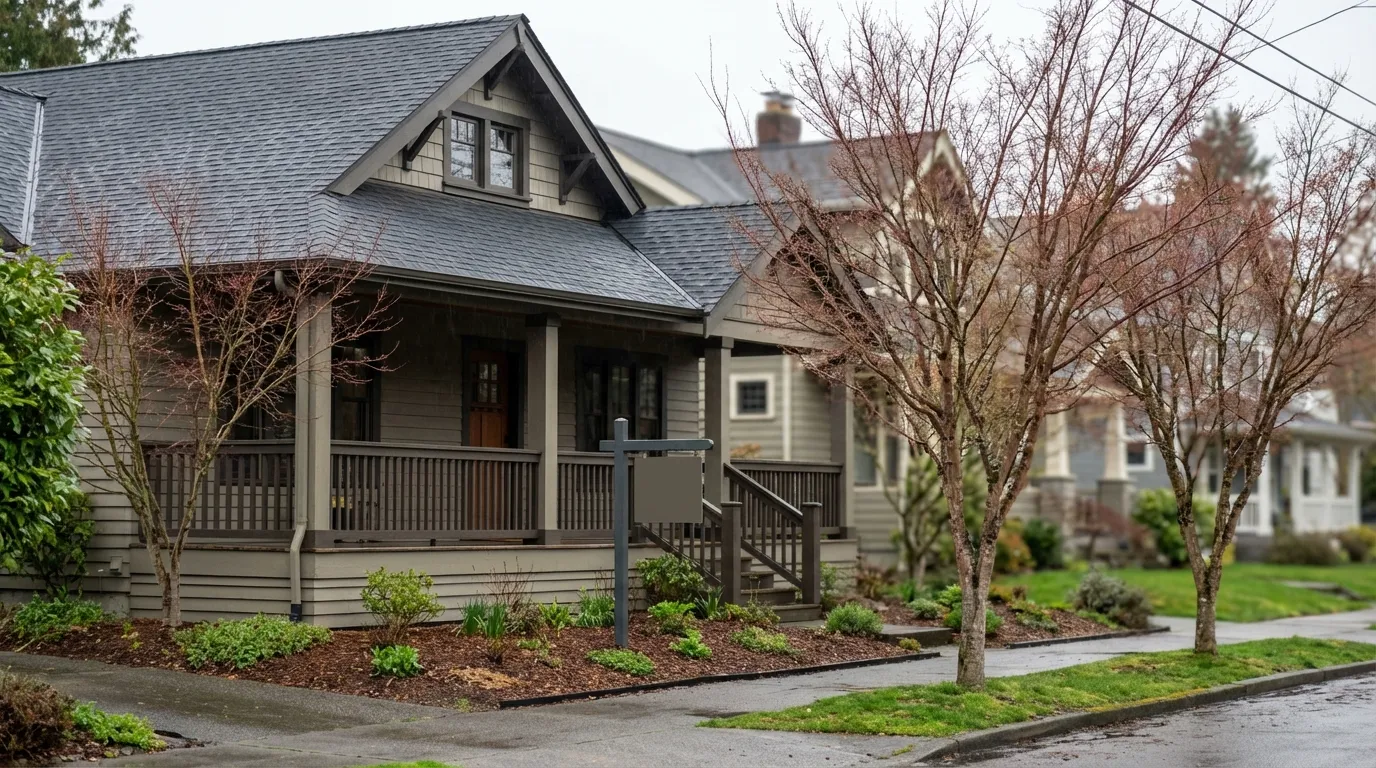
There's also a photography problem. Seattle roofing customers are highly visual — they want to see before/after moss removal photos, local project galleries showing Northwest-style craftsman homes, and evidence that the contractor understands Pacific Northwest construction. Generic stock photo landing pages for roofing in Seattle convert at roughly half the rate of locally-photographed project galleries. This is a landing page problem, not an ads problem, but it kills campaign performance just as effectively.
The Seattle roofing PPC account that wins is built around four campaigns aligned with the four core intent types — and it leads with moss, not replacement. Here's the structure and logic.
Campaign Architecture: From Entry-Point to High-Value
- Campaign 1 — Emergency / Storm Damage: Call-only ads, 24/7 scheduling during storm season (Nov–Apr), "Emergency Tarping Available" and "Insurance Claim Help" headlines. Keywords: "emergency roof repair Seattle," "storm damage roofer Seattle," "roof leak repair emergency." Expected CPC: $35–$55. This campaign should run at elevated budget October–April and scale back in peak summer install months when emergency intent is lower.
- Campaign 2 — Moss Treatment (Entry-Point): Seattle's most defensible keyword category. Lower CPCs ($18–$32), lower barrier to entry as a first sale, and a natural lead into a re-roofing conversation 18–36 months later. Keywords: "moss removal roof Seattle," "roof moss treatment King County," "algae removal shingles Seattle." Landing page must show before/after local photos — this audience is highly visual. Headline formula: "Seattle Roof Moss Treatment — Before the Rains Hit."
- Campaign 3 — Full Replacement: Highest bids, highest value. Responsive search ads with headlines addressing financing, timeline, and the Seattle-specific replacement cycle (shorter lifespan due to rain/humidity). Keywords: "roof replacement Seattle," "new roof Seattle cost," "roofing contractor Seattle WA," "Eastside roofing contractor." Expected CPC: $45–$65. Landing page must include project gallery, customer reviews, and financing CTA.
- Campaign 4 — Gutters (Upsell/Entry): Lower bids, volume play, natural pairing with moss and replacement campaigns. Keywords: "gutter installation Seattle," "gutter replacement King County," "leaf guard gutter Seattle." Expected CPC: $12–$22. Use this campaign to keep crews scheduled during low-replacement periods.
Geo-Targeting and Insurance Claim Angles
Neighborhood targeting materially reduces CPC in this market. "West Seattle roofer," "Bellevue roofing contractor," "Northgate roofing company" — these sub-city terms have 30–50% lower CPCs than city-wide terms with equivalent lead quality. Set up a location-specific ad group within Campaign 3 with neighborhood-level keywords and corresponding landing pages. The specificity signals local expertise and improves Quality Score.
The insurance claim angle is underused by most Seattle roofing SMBs. After each winter windstorm event (typically November–February), a significant percentage of Seattle homeowners file insurance claims for shingle and flashing damage. Adding RSA headlines like "Storm Damage? We Handle Insurance Claims" and "Free Storm Damage Inspection + Claim Assistance" captures post-storm intent at CPCs significantly below the generic replacement keywords — because fewer competitors are bidding on this specific language.
Bidding strategy: Start with Maximize Clicks and CPC caps during the first 4 weeks to gather conversion data. Move to Target CPA bidding after 30+ conversions. Set call tracking as the primary conversion action — 50%+ of roofing leads come via phone. For storm damage campaigns specifically, increase bids by 40–60% in the 48 hours following a named storm event. This is when search volume spikes and first-mover advantage is measurable.
Google Partner Agency
We're a certified Google Partner Agency, which means we don’t guess — we optimize withGoogle’s full toolkit and insider support.
Your campaigns get pro-level execution, backed by real expertise (not theory).

Seattle's composite shingles fail 5–8 years faster than in dry climates — a 30-year rated shingle in Dallas or Phoenix realistically lasts 18–22 years on a Seattle roof. This isn't a contractor talking point; it's material science. The persistent humidity, moss load, and thermal cycling from Pacific Northwest winters accelerate granule loss and shingle degradation at a measurable rate. This single fact has significant implications for PPC timing and messaging.
The Replacement Cycle Is Shorter — and It's Starting Now
Seattle's housing stock peaked in construction volume during the 1970s–1990s. A home built in 1985 with its original or first-replacement roof is already past its useful life in the Pacific Northwest climate. A significant percentage of Seattle's 340,000+ single-family homes have roofs that are overdue for replacement by Pacific Northwest standards — and the homeowners who replaced roofs in the early 2010s are now in the 12–15 year range, approaching the replacement window under maritime conditions.
This means the replacement volume isn't cyclical in the way hurricane damage creates short replacement waves in coastal markets — it's structural and ongoing. A well-positioned roofing contractor with strong PPC infrastructure in 2025–2026 is entering a multi-year replacement wave that will sustain lead volume regardless of weather events.
The Moss Entry-Point Model: A Seattle-Specific Funnel
The most counterintuitive insight in Seattle roofing PPC: moss treatment campaigns generate replacement leads. Here's the funnel: a homeowner searches for moss removal (lower urgency, lower CPC), books a $500–$800 treatment job, gets an honest condition assessment from the contractor, and receives a replacement proposal when the roof is found to be in terminal condition. This happens at an estimated conversion rate of 25–40% for treatment jobs on roofs 15+ years old in Seattle's climate.
The math: a moss treatment lead costs $80–$150 to acquire via PPC. The treatment job earns $500–$800. Of every 3–4 treatment customers, one converts to a $14,000–$30,000 replacement. The effective CPL for the replacement lead (when attributed back through the treatment funnel) is $240–$600 — which is competitive with direct replacement lead acquisition costs, with the additional benefit of an established relationship and trust built through the service interaction. This is a uniquely Seattle funnel model with no equivalent in dry-climate roofing markets.
Key insight: Roofing CPLs in Seattle of $180–$380 look expensive in isolation. Against average replacement tickets of $14,000–$32,000, they represent a 37–177x return on ad spend. The contractors losing money on roofing PPC in Seattle aren't paying too much per lead — they're closing too few of the leads they receive, usually due to slow response time (>2 hours), insufficient social proof, or no financing option presented at the quote stage.
Roofing PPC in Seattle requires knowing the market at a granular level: which storm months drive the emergency campaign, when to push moss treatment as a lead magnet, how to structure the pre-winter September–October budget spike, and which neighborhoods convert best for replacement leads. Generic campaigns don't survive long against Washington Energy Services and Axis Roof & Gutter's established accounts.
MB Adv Agency builds roofing campaigns around Seattle's actual demand calendar — not a national template. We set up the four-campaign structure from day one, configure call tracking with storm-season bid adjustments, and write landing page copy built around the moss, rain, and Pacific Northwest replacement cycle that resonates with Seattle homeowners in a way that "free estimate" CTAs simply don't.
Our clients at the $4,000–$6,000/month investment level in Seattle's roofing market generate 15–30 qualified leads per month with CPLs in the $180–$320 range — and they convert those leads at higher rates because the campaign messaging pre-qualifies intent before the phone rings. See our pricing page for plan details, or review our Google Ads management approach before booking a free campaign audit.
Frequently Asked Questions
When is the best time to launch a roofing PPC campaign in Seattle?
The optimal launch window for Seattle roofing PPC is August 15 – September 1. Here's the reasoning: the pre-winter rush (September–October) is Seattle's highest-intent, highest-value lead window for full replacement. Homeowners who want a new roof before the November rains start their search in September. A campaign launched in August has 4 weeks to gather conversion data, optimize Quality Scores, and enter Smart Bidding mode — so by September 1, the algorithm is working with seasoned signals instead of cold-starting during peak demand.
The second-best launch window is February–March, timed to catch the spring inspection season (April–June) when homeowners who survived another winter assess storm damage and decide whether moss treatment or full replacement is next. Campaigns launched in March hit peak spring demand with 4–6 weeks of optimization behind them.
Avoid launching cold in July–August for the replacement campaign — summer is peak install season but CPCs are at their annual high and the Smart Bidding algorithm is learning against your most expensive traffic. The exception is the moss treatment and gutter campaigns, which can be launched at any time since those CPCs are lower and competition is less intense. If your business is seasonal and you can only run ads part of the year, run them September–November and March–June — these two windows together cover both the pre-winter and spring replacement surges that drive the majority of high-value Seattle roofing revenue.
What budget does a Seattle roofing contractor need to compete on Google Ads?
The honest minimum to compete in Seattle roofing PPC is $4,000/month — and $5,000–$6,000/month is the level that generates consistent, scalable lead volume. Here's why the floor is higher than national averages: replacement keywords in this market run $45–$65 CPC, storm damage terms run $35–$55, and at a 5% campaign CVR, you need roughly 500–700 clicks per month to generate 25–35 leads. At $35–$55 average CPC across the account, that's $17,500–$38,500 in gross click cost for a 25–35 lead volume — so the math only works with strategic keyword exclusions, tight geo-targeting, and Quality Score optimization that reduces your effective CPC below market average.
The good news: the high CPCs are matched by high ticket values. A single full replacement job at $18,000–$25,000 covers 4–6 months of ad spend. At a 15–20% close rate on qualified leads (realistic with fast follow-up and strong reviews), a $5,000/month budget generates 2–4 replacement jobs per month — $36,000–$100,000 in monthly revenue attributable to PPC. That's a 7–20x ROAS before accounting for repeat customers, referrals, or maintenance contract upsells. The moss treatment campaigns add a lower-cost lead volume on top of replacement traffic and create the cross-sell funnel described earlier. Budget the replacement campaign at $3,500/month as the core, with $500–$1,500/month across moss treatment, emergency, and gutter campaigns.