Google Ads AI Max now adds branded searches control for better brand and non-brand campaign management
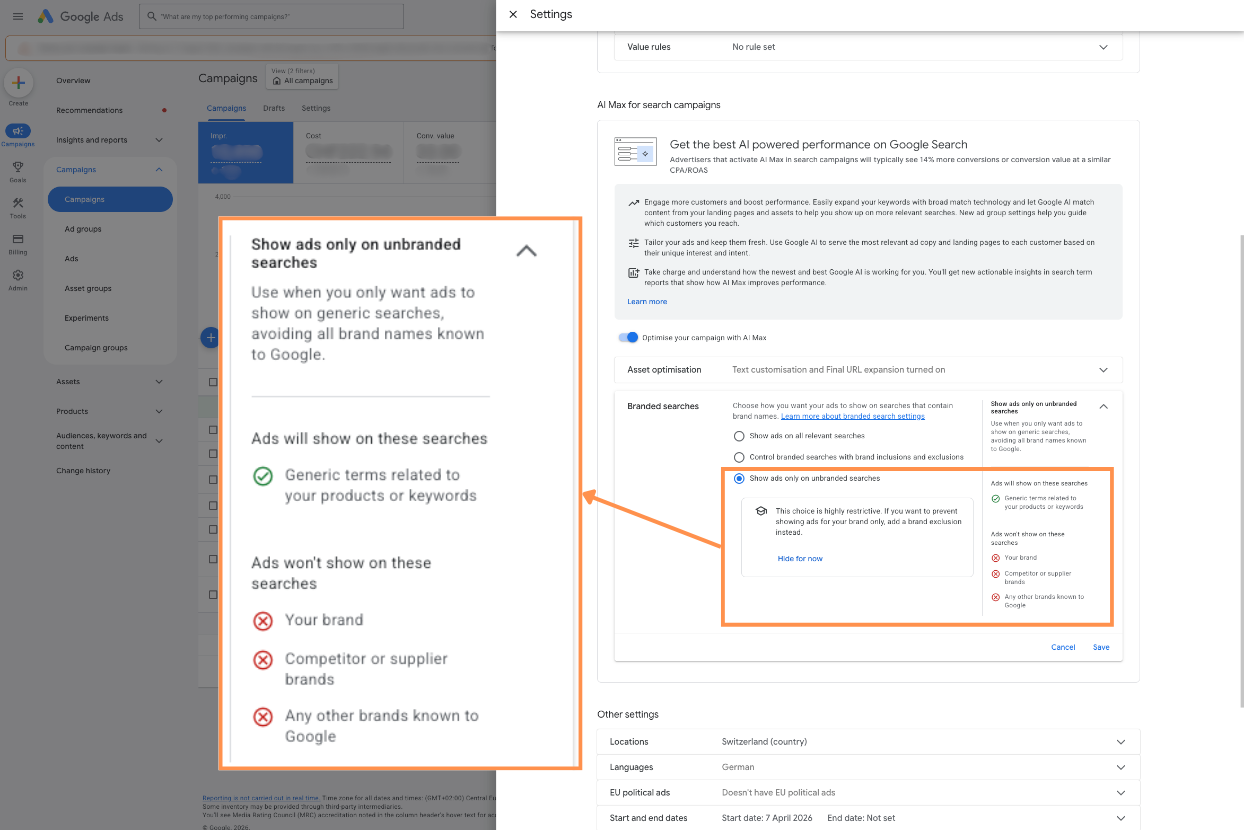
Google Ads has added a useful layer of control to AI Max campaigns: a native Branded Searches setting that determines how the campaign handles brand queries. On the surface, this looks like a small interface update. In practice, it addresses one of the more persistent operational concerns around automation in paid search: where branded demand should live, and how much freedom AI-driven campaigns should have to capture it.
For advertisers already managing separate brand and non-brand search strategies, this matters immediately. One of the recurring tensions with automated campaign types is that they often perform best when given broad access to inventory, but that same openness can blur the line between incremental demand generation and demand capture. The new branded search control in AI Max is essentially Google acknowledging that this boundary still matters.
A more useful kind of control
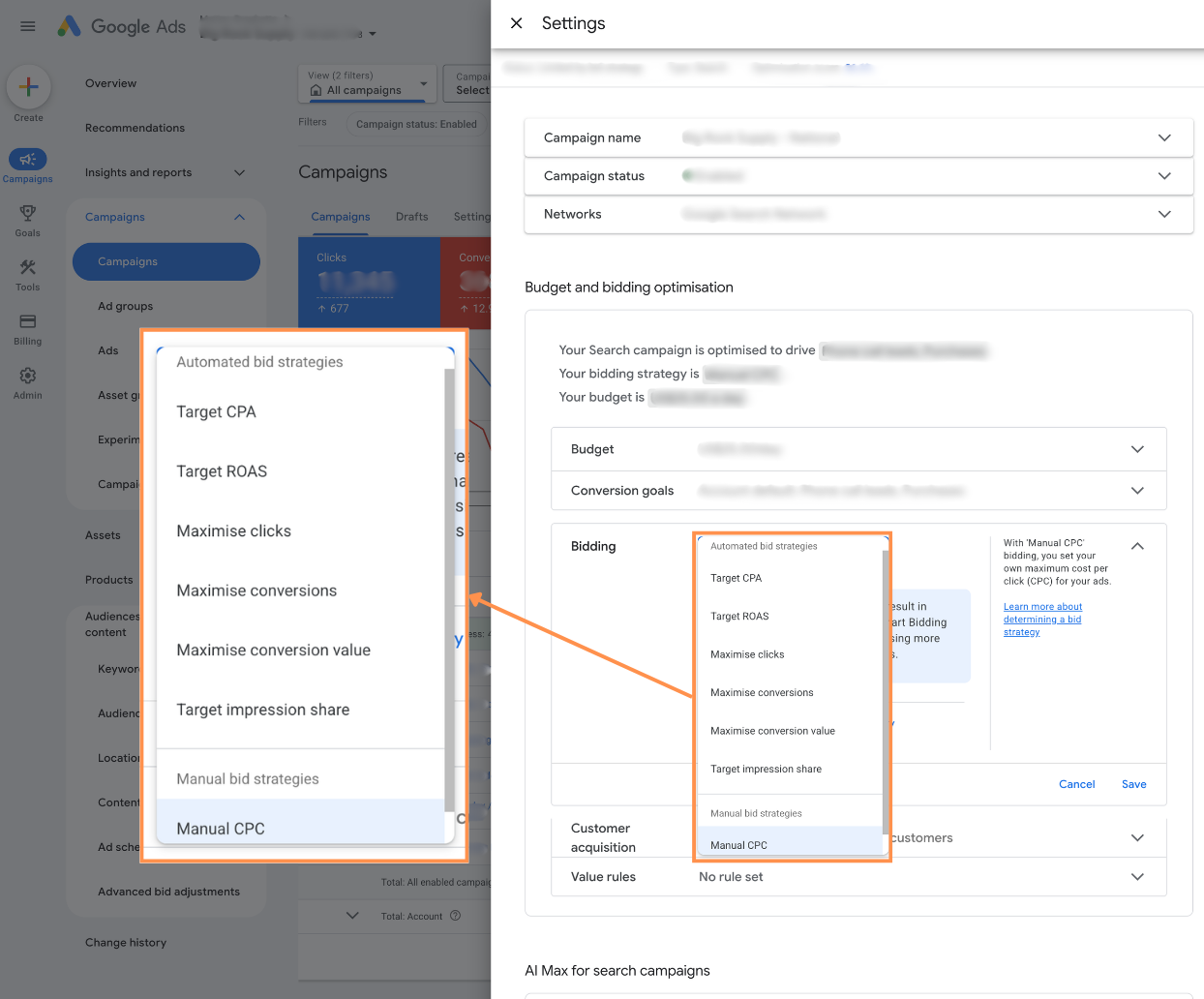
The new setting allows advertisers to choose between three approaches. AI Max can serve on all relevant searches, it can use brand inclusions and exclusions, or it can be limited to unbranded searches only.
That range is important because not every account is structured the same way. Some advertisers want AI Max to operate with minimal constraints and optimize across both branded and non-branded intent. Others need stricter query allocation because they already have mature branded Search campaigns with their own budgets, bidding logic, and reporting expectations.
The most strategically significant option is the ability to show ads only on unbranded searches. That gives advertisers a cleaner way to position AI Max as a prospecting or expansion layer rather than a campaign type that absorbs easy branded conversions and muddies performance analysis.
This is especially relevant in accounts where brand traffic is already highly efficient. If a dedicated brand campaign is doing its job, there is usually little strategic upside in allowing another automated campaign to compete for the same demand unless there is a deliberate reason to consolidate.
Why this matters beyond campaign settings
In many Google Ads accounts, branded traffic plays a very different role from non-branded traffic. Brand queries are typically lower funnel, cheaper to convert, and heavily influenced by existing awareness, organic presence, and offline activity. Non-brand queries, by contrast, are where advertisers often look for growth, discovery, and incremental reach.
When those two traffic types are blended inside a heavily automated campaign, performance interpretation becomes harder. Conversion rates can look stronger than they really are from a prospecting perspective. CPC trends can become less meaningful. Attribution can over-credit automation for demand that would likely have converted anyway.
That is why this new AI Max branded searches control is more than a convenience feature. It improves the ability to preserve campaign intent.
If AI Max is meant to find new relevant demand, the unbranded-only setting creates a much clearer operating environment. If it is meant to act more broadly across all search behavior, including brand, advertisers can still allow that. The difference is that the choice is now explicit rather than loosely managed through workarounds.
The cannibalization issue is real
One of the biggest practical concerns with automated Google Ads campaign types is cannibalization. Not always in the dramatic sense of “stealing” conversions, but in the quieter sense of redistributing credit, budget, and query coverage across campaigns in ways that make account performance harder to read.
For advertisers with dedicated branded Search campaigns, AI Max overlap can create several issues at once. It can inflate AI Max efficiency by pulling in branded searches. It can reduce visibility into whether non-brand expansion is actually working. And it can complicate budget decisions, because spend may shift toward lower-resistance branded demand instead of higher-value prospecting opportunities.
The new branded search setting helps reduce that ambiguity. It does not eliminate the need for careful monitoring, but it gives advertisers a native mechanism to define campaign boundaries more precisely.
That precision matters even more in larger accounts where multiple campaign types coexist and query routing has downstream effects on reporting, forecasting, and stakeholder confidence.
The most operationally useful option for mature accounts
For accounts already running dedicated branded campaigns, the unbranded-only setting is likely to be the most practical choice.
Not because branded traffic is unimportant, but because it is usually better managed in its own environment. Branded campaigns often have specific impression share goals, tighter CPC expectations, and a distinct strategic purpose: protecting and capturing existing demand efficiently. AI Max, on the other hand, is better positioned as an exploratory or expansion-focused system.
Separating those roles creates cleaner analysis. It becomes easier to understand whether AI Max is genuinely generating incremental value through unbranded search terms, broader matching, and machine-led query discovery. It also makes budget allocation more rational. Brand budgets can be defended based on capture efficiency, while AI Max budgets can be evaluated on growth potential and marginal return.
In other words, this setting helps restore a campaign architecture that many advanced advertisers already prefer.
There are still trade-offs
That said, tighter control is not automatically better in every case. Some advertisers may find that allowing AI Max to run across all relevant searches improves total conversion volume or simplifies account management. In smaller accounts, or in accounts without a clearly separated brand strategy, strict exclusions may create unnecessary fragmentation.
There is also a measurement trade-off. Once branded and unbranded traffic are more cleanly separated, some campaigns may appear to “decline” simply because they are no longer benefiting from blended branded demand. That is not a performance problem; it is a reporting correction. But it can still require explanation internally.
The same applies to CPCs and conversion rates. An AI Max campaign restricted to unbranded searches may show weaker efficiency metrics than one allowed to absorb branded traffic. That does not mean the campaign is worse. It may simply mean the campaign is finally being judged on the right basis.
What advertisers should watch after making the change
After updating the branded searches control, the key task is not just checking whether the setting saved correctly. It is validating how search term behavior, CPCs, conversion mix, and attribution patterns change over time.
The main question is whether query routing now aligns with the account’s intended campaign structure. If brand campaigns retain branded demand more consistently and AI Max shifts toward unbranded discovery, that is usually a positive development. But it is worth watching for edge cases, especially where brand variants, competitor terms, or loosely branded category searches may behave differently than expected.
This is one of those Google Ads updates that seems minor until you consider how much campaign analysis depends on traffic classification. Giving advertisers a native branded search control inside AI Max brings welcome clarity to an area where automation has often felt too opaque. For teams trying to separate brand capture from AI-driven prospecting, that clarity is not cosmetic. It is structural.

As a Google Ads expert, I bring proven expertise in optimizing advertising campaigns to maximize ROI.
I specialize in sharing advanced strategies and targeted tips to refine Google Ads campaign management.
Committed to staying ahead of the latest trends and algorithms, I ensure that my clients receive cutting-edge solutions.
My passion for digital marketing and my ability to interpret data for strategic insights enable me to offer high-level consulting that aims to exceed expectations.
Google Partner Agency
We're a certified Google Partner Agency, which means we don’t guess — we optimize withGoogle’s full toolkit and insider support.
Your campaigns get pro-level execution, backed by real expertise (not theory).

4.9 out of 5 from 670+ reviews on Fiverr.
That’s not luck, that’s performance.
Highly recommend Matteo to set up your server side tracking. He has a deep understanding of e-commerce tracking and will go above and beyond to make sure everything is set up correctly and working 100%. If you are scaling your store this set up is non-negotiable in my opinion and there isn't many people who have this much knowledge or put the effort in to get it right. Thanks again!
avorodesign.com
I can only recommend Matteo! He was very patient, professional and very knowledgeable about GA4, Consent Mode v2, and GDPR compliance. Communication was clear, and the setup was done professionally and efficiently. Highly recommend him for anyone needing reliable tracking implementation.
www.natureiki.life
Matteo shines in the realm of online professionals. His work is not only deep in data but also complemented by his proactive communication and cooperation, setting a new standard for freelancers. If you want someone who truly exceeds expectations, look no further. Highly recommended!

www.omanbeverlysmyth.com
Exceptional Service Beyond Expectations - Outstanding Service Impeccable depth, flawless delivery, and exceptional language fluency—this service exceeded all expectations. Highly recommended. Matteo truly ROCKS!!!
ium-paris.com
Top-notch, always highly value working with Matteo. An absolute Google Ads Genius. This is approximately the 8th time I have hired him and he's helped us get 6-7 ROAS. We are excited in continuing to improve our lead flow. Hire this guy if you need Google Ads help. Thanks Matteo!
www.dleeventgroup.com
I finally found the guy who can setup server side tracking and all the ecosystem properly. I definitely recommend Matteo. He is very responsive, kind and wants to dig into things. He configured GA4, Meta, Google Ads, Outbrain and google consent v2 with Cookiebot. Thanks Matteo.
inomega.fr
MB Adv delivered exceptional work with outstanding professionalism and lots of patience, taking time to see effects of changes made and not just do the work and submit it. The proactive communication and video summaries of the work completed made working with Matteo a pleasure, as he consistently went above and beyond. Highly recommended for web analytics projects! We are already working on another project.
www.withnellsensors.co.uk
Working with Matteo on my Google Ads was a game-changer. He's not just a strategist, he's a true partner. He understood my goals and tailored a campaign that perfectly reached my target audience. I'm grateful for his expertise and dedication.
dccargo.com
Click-driven mind
with plastic-brick obsession.
We build Google Ads campaigns with the same mindset we use to build tiny brick worlds: strategy, patience, and zero tolerance for wasted pieces.
Data is our blueprint. Growth is the only acceptable outcome.