Google Ads Promotion Mode (Beta): a smarter way to manage temporary target ROAS changes for Smart Bidding
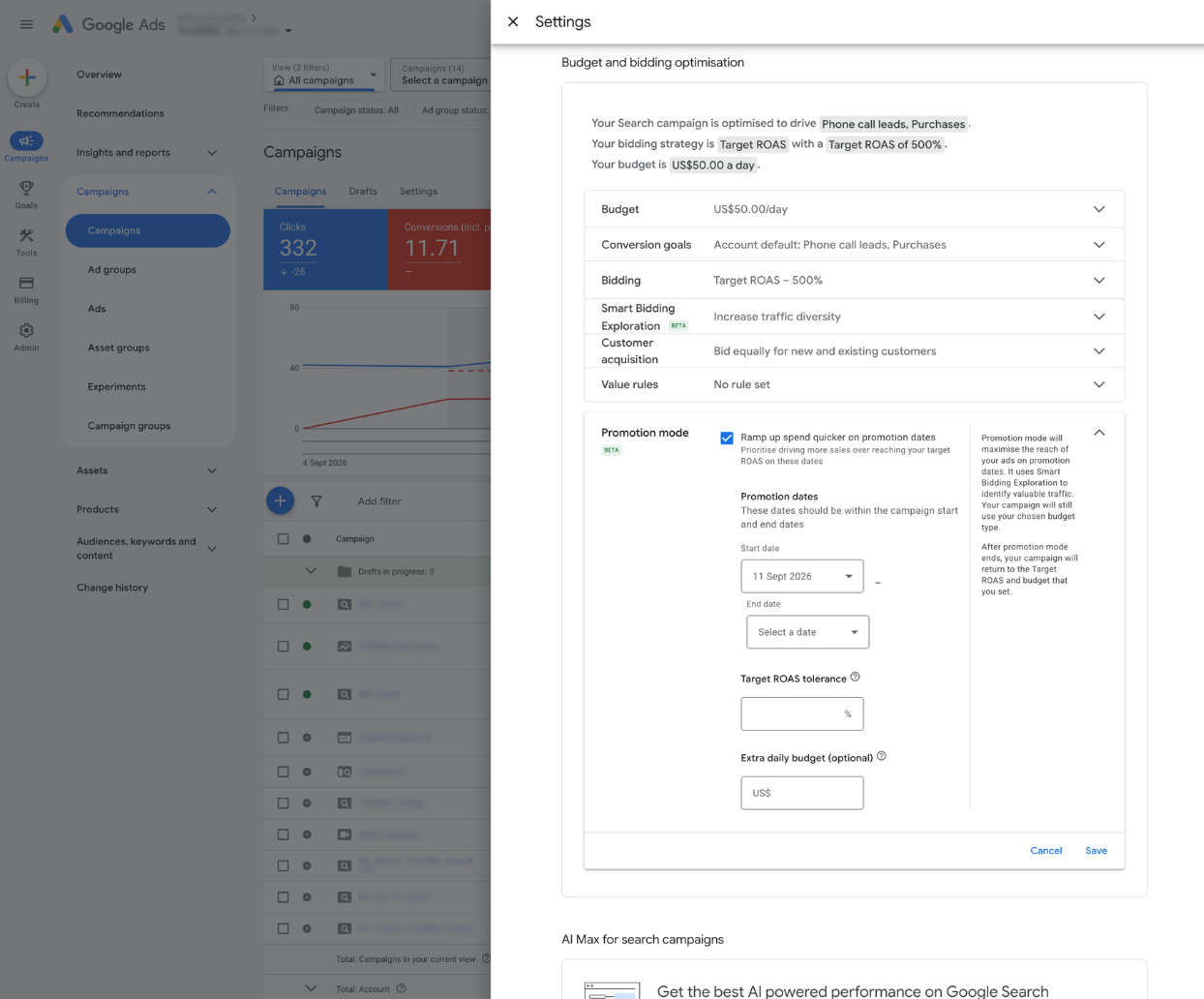
Google Ads has introduced a new Promotion mode in beta for eligible Search and Performance Max campaigns. At first glance, it may look like another budgeting feature. In practice, its more interesting purpose is to give Smart Bidding a temporary, defined permission to pursue additional conversion value at a lower return on ad spend.
That distinction matters for advertisers managing flash sales, product launches, holiday events, or short promotional periods. Historically, scaling a tROAS campaign often meant manually lowering the ROAS target, increasing budgets, and then making sure every change was reversed once the event ended. Promotion mode appears designed to make that process more structured.
Google’s interface describes three core inputs: a promotion start and end date, a level of ROAS tolerance, and, optionally, an additional daily budget for the promotional period.
The important control is not the budget, it is ROAS tolerance
Adding budget to a Google Ads campaign does not automatically create more volume. A campaign using Target ROAS may still be constrained by its bidding goal: if Smart Bidding cannot find auctions that meet the expected return threshold, it may not spend the extra budget.
Promotion mode addresses that constraint more directly. The ROAS tolerance setting lets advertisers signal that, for a limited window, they are willing to accept a lower return in exchange for reaching more available demand.
Google does not publicly document every underlying bidding decision or auction-level mechanism behind this beta. Still, the practical implication is clear: a campaign that would normally remain selective under its standard ROAS target may be able to compete more broadly during the promotion window.
This is why separating budget flexibility from ROAS flexibility is useful. They solve different problems:
- Additional budget provides room to spend more.
- ROAS tolerance gives Smart Bidding more room to pursue incremental volume.
- A date range puts an automatic boundary around the temporary change.
For teams that regularly manage promotional activity, the scheduled end date may be as valuable as the bid flexibility itself. Temporary target changes are easy to make and surprisingly easy to leave in place after an event, particularly when promotions end over a weekend or when responsibility is shared across teams.
Promotion mode is not simply a replacement for Seasonality Adjustments
The closest existing Google Ads feature is Seasonality Adjustments, but the intent is different.
Seasonality Adjustments are used to inform Smart Bidding that an advertiser expects a short-term change in conversion rate. In other words, the advertiser is helping Google forecast a change in how likely users are to convert during a specific period.
Promotion mode, by contrast, is framed around an advertiser’s willingness to make a temporary ROAS trade-off.
That difference is strategically significant. A retailer may expect conversion rate to increase during a sale because discounting makes more visitors likely to buy. That is a conversion-rate forecasting question. The same retailer may also decide it is willing to accept a lower ROAS to capture more total revenue or acquire more customers during the event. That is an efficiency-threshold decision.
Those two decisions can occur at the same time, but they are not identical.
Google’s public information does not fully clarify how Promotion mode interacts with Seasonality Adjustments when both are available and applied to overlapping periods. It also does not clearly establish whether advertisers should treat the tools as complementary in all cases. Until Google provides more detail, advertisers should avoid assuming that stacking them will necessarily produce a better outcome.
Where Promotion mode may be most useful
The beta is most relevant when demand is real, time-bound, and commercially valuable enough to justify a planned efficiency trade-off.
Examples may include a short-term retail sale, a limited product release, a promotional event supported by email and social activity, or a major shopping period where the business has deliberately decided to prioritize revenue volume, customer acquisition, or inventory movement over its usual ROAS threshold.
It is less compelling when the main issue is weak demand, an uncompetitive offer, poor conversion tracking, or a campaign that is already limited by creative, feed, landing-page, or inventory problems. Relaxing ROAS constraints cannot solve those underlying issues. It can only change how aggressively Smart Bidding competes for the demand that exists.
There is also an important measurement consideration. A lower ROAS during a promotional period is not automatically a sign that the promotion underperformed. If the commercial objective was incremental revenue, margin contribution, new-customer growth, or stock clearance, the right evaluation framework may be broader than the campaign’s headline ROAS.
A useful evolution, with beta-stage questions still open
Google officially positions Promotion mode as a beta feature, and availability is not universal. Search and Performance Max are the stated campaign types where it may appear, but Google does not publicly specify a complete rollout schedule, geographic availability, account eligibility criteria, or every limitation attached to the beta.
That uncertainty matters. Advertisers should not build a promotional operating process around the feature until they can confirm access and understand how it behaves in their own accounts.
Even so, the product direction is sensible. Google Ads has long offered tools to influence Smart Bidding around exceptional events, but Promotion mode introduces a cleaner distinction between predicting a conversion-rate change and consciously accepting a temporary ROAS compromise.
For mature Google Ads programs, that is more than a convenience feature. It is a potentially more disciplined way to make promotional trade-offs explicit, time-limited, and easier to govern.

As a Google Ads expert, I bring proven expertise in optimizing advertising campaigns to maximize ROI.
I specialize in sharing advanced strategies and targeted tips to refine Google Ads campaign management.
Committed to staying ahead of the latest trends and algorithms, I ensure that my clients receive cutting-edge solutions.
My passion for digital marketing and my ability to interpret data for strategic insights enable me to offer high-level consulting that aims to exceed expectations.
Google Partner Agency
We're a certified Google Partner Agency, which means we don’t guess — we optimize withGoogle’s full toolkit and insider support.
Your campaigns get pro-level execution, backed by real expertise (not theory).

4.9 out of 5 from 670+ reviews on Fiverr.
That’s not luck, that’s performance.
Highly recommend Matteo to set up your server side tracking. He has a deep understanding of e-commerce tracking and will go above and beyond to make sure everything is set up correctly and working 100%. If you are scaling your store this set up is non-negotiable in my opinion and there isn't many people who have this much knowledge or put the effort in to get it right. Thanks again!

avorodesign.com
I can only recommend Matteo! He was very patient, professional and very knowledgeable about GA4, Consent Mode v2, and GDPR compliance. Communication was clear, and the setup was done professionally and efficiently. Highly recommend him for anyone needing reliable tracking implementation.

www.natureiki.life
Matteo shines in the realm of online professionals. His work is not only deep in data but also complemented by his proactive communication and cooperation, setting a new standard for freelancers. If you want someone who truly exceeds expectations, look no further. Highly recommended!

www.omanbeverlysmyth.com
Exceptional Service Beyond Expectations - Outstanding Service Impeccable depth, flawless delivery, and exceptional language fluency—this service exceeded all expectations. Highly recommended. Matteo truly ROCKS!!!

ium-paris.com
Top-notch, always highly value working with Matteo. An absolute Google Ads Genius. This is approximately the 8th time I have hired him and he's helped us get 6-7 ROAS. We are excited in continuing to improve our lead flow. Hire this guy if you need Google Ads help. Thanks Matteo!

www.dleeventgroup.com
I finally found the guy who can setup server side tracking and all the ecosystem properly. I definitely recommend Matteo. He is very responsive, kind and wants to dig into things. He configured GA4, Meta, Google Ads, Outbrain and google consent v2 with Cookiebot. Thanks Matteo.

inomega.fr
MB Adv delivered exceptional work with outstanding professionalism and lots of patience, taking time to see effects of changes made and not just do the work and submit it. The proactive communication and video summaries of the work completed made working with Matteo a pleasure, as he consistently went above and beyond. Highly recommended for web analytics projects! We are already working on another project.

www.withnellsensors.co.uk
Working with Matteo on my Google Ads was a game-changer. He's not just a strategist, he's a true partner. He understood my goals and tailored a campaign that perfectly reached my target audience. I'm grateful for his expertise and dedication.

dccargo.com
Click-driven mind
with plastic-brick obsession.
We build Google Ads campaigns with the same mindset we use to build tiny brick worlds: strategy, patience, and zero tolerance for wasted pieces.
Data is our blueprint. Growth is the only acceptable outcome.